This fact was one of the primary reasons for the Climate Leaders’ Summit: Women Kicking it on Climate, which was hosted on 16 and 17 May by Catherine McKenna, Canada’s Minister of Environment and Climate Change.
“I am privileged to work with so many fearless women who are climate leaders,” said McKenna on why she organized the summit. “We know women and girls are particularly at risk when it comes to climate change, and yet women are also at the forefront of bold climate leadership around the world. Together, women are turning ideas into solutions.”
The event brought together female climate leaders from around the world, with representatives from the public, private, academic and civil society sectors. The group focused on topics such as improving collaboration to find solutions to climate change, female empowerment and ensuring that women are represented in global conversations surrounding the environment.
As scientists have begun to understand the effects of climate change, it has become apparent that women are at greater risk, especially in the developing world. In many countries women are responsible for securing food, water and energy for cooking, heating and sustaining their families. This means that they depend on natural resources for their livelihoods, which are threatened by drought, uncertain rainfall and deforestation – all things that are exacerbated by climate change.
For this reason, one of the primary topics of the summit was the importance of sustainable development and clean growth. Especially important is giving women the tools they need to earn a better living and live themselves, and their families out of poverty.
While many issues were discussed, the main theme of the summit was the importance of women’s leadership, especially in combating climate change. Women in leadership roles were essential in creating the Paris Agreement, which includes a soon-to-be implemented Gender Action Plan that will ensure greater female participation in climate negotiations. But the greatest takeaway from the discussions was the importance of advocating for equal gender representation in leadership roles, whether it be in politics, business, or at the local level.
At the end of the summit the general feeling among the women involved was one of inspiration and empowerment. Tina Birmpili, the head of the United Nations Ozone Secretariat, was one of the women who participated. At the end of the experience she felt especially motivated to continue pushing for change.
“We need more women, not only in policymaking and environmental science but also in engineering and technological innovation,” said Birmpili. “Let the disproportionate effect climate change has on women, and the deeper understanding they consequently acquire day by day, be the driving force to catapult them to all positions they deserve to have in the fight against climate change.”
Gov. Phil Murphy has pledged an all-renewable energy future for New Jersey by 2050. He is to be commended.
But, that goal won’t be achieved by doling out $300 million annually to PSEG and Exelon to bail out the Salem/Hope Creek nukes in Salem County as proposed by a bill overwhelmingly approved by the Democratic-controlled New Jersey Legislature. Those millions would come from ordinary citizens paying their electric bill.
That’s money that could otherwise be used to implement a clean energy future that would pull the state’s energy needs away from climate-changing fossil fuels and nuclear energy, which generates thousands of pounds of lethal, highly radioactive waste — the exact same mix of poisons found in atomic bombs.
I’m adding my voice to the chorus of outrage that has risen against this preposterous ratepayer-funded bailout. We know what this is about. It’s a shell game to guarantee an unfair 18-percent annual return to investors on the backs of ratepayers. And it’s New Jersey money that the companies could use to prop up their out-of-state nukes.
PSE&G has reportedly agreed to pay a $39 million settlement to grid operators for allegedly violating bidding rules. Shall we go into Exelon’s Oyster Creek history of tritium leaks, airborne radiological releases that at times were beyond federal limits, safety issues related to metal fatigue, and destruction of Barnegat Bay?
These companies should not be rewarded with hard-earned New Jersey dollars.
I’m in agreement with the many arguments from a broad coalition of groups against the bailout, but I’d like to go further and bring health concerns to the forefront.
I’ve been involved in issues related to reducing reliance on nuclear power since the late 1980s. I have a long association with the Radiation and Public Health Project (RPHP), a nonprofit research group that tracks cancer rates around nuclear plants. I have also immersed myself in studying the effects of exposure to continuous low-level radiation, the type of which is emitted from nuclear plants.
An RPHP analysis of Centers for Disease Control data shows that before Salem/Hope Creek began operating, the cancer death rate in Salem County was slightly below the state average. As late as the mid-1980s, the county rate was 5 percent below the state. But since then, local rates have risen, and in the past decade, Salem county’s cancer death rate was 20 percent above the state — the highest rate of the 21 New Jersey counties. While this area of the state has other significant environmental hazards and a federal Superfund site, the cumulative effects from routinely released toxic radiation must be evaluated as a potential cause.
If Gov. Murphy still leans toward signing the Legislature’s hair-brained bill that would award annual corporate welfare checks to the behemoths of PSE&G and Exelon, then he, at least, should do a conditional veto. That veto should not only include the conditions suggested by the environmental community and other coalition members, but also go a step further.
Any bailout for the Salem/Hope Creek nuke plants must include an ironclad commitment for an early closure date, and a full decommissioning by plant workers once operations cease. This is fair and just; it places the public health and safety of citizens first, while securing long-term, well-paying employment for the workers who have the institutional intelligence to carry out the task of dismantling the reactor, and securing the highly radioactive waste that will remain deadly for tens of thousands of years.
New Jersey neglected over the past eight years to implement a strong clean-energy agenda, and is now having to choose its poison — fossil fuels or nukes — until renewables are firmly established as base load.
That’s a bitter pill that should not be made more difficult to swallow with money flowing out of ratepayer pockets and into corporate wallets.
Minot Air Force Base loses explosives on North Dakota road –The security forces of the 91st Missile Wing are responsible for protecting the intercontinental ballistic missile silos that Minot Air Force Base operates across the Great Plains. | 15 May 2018 | The Air Force is offering $5,000 for leads on the whereabouts of a box of explosive grenade rounds that its personnel accidentally dropped [!?!] on a road in North Dakota while traveling between two intercontinental ballistic missile silos — the facilities scattered across the U.S. heartland that stand ready to launch nuclear warheads at a moment’s notice. Airmen from the 91st Missile Wing Security Forces team were traveling on gravel roads May 1 in North Dakota when the back hatch of their vehicle opened and a container filled with the explosive ammunition fell out, according to a statement from Minot Air Force Base. On May 11, the Air Force sent more than 100 airmen to walk the entire six-mile route where the grenades were probably lost, according to a statement from the local Mountrail County sheriff. But two weeks after it was lost, the box of explosives still hasn’t been found.
More secrecy at SCE&G? Utility won’t give up V.C. Summer records, state agency says, The State, BY SAMMY FRETWELL, sfretwell@thestate.com, May 17, 2018
A state agency says SCE&G is refusing to give up records that could be used to justify rolling back monthly power bills the utility charges customers for the failed V.C. Summer nuclear construction project.
The state Office of Regulatory Staff says it needs the records to better understand what went wrong with the failed effort to build two reactors in Fairfield County, northwest of Columbia.
According to Regulatory Staff, the information being withheld by SCE&G includes:
▪ Summaries of auditors’ reports.
▪ A 2016 estimate of the cost to complete the nuclear construction project.
▪ Records given to the FBI and other law enforcement agencies, investigating possible criminal fraud in the construction project.
▪ Meeting notes about the Bechtel report, a study that outlined massive problems with the project at least two years before SCE&G publicly revealed them.
“Many responses do not appear to comply in good faith’’ with laws requiring SCE&G to give up records, Regulatory Staff lawyer Jenny R. Pittman wrote in a May 9 letter obtained Thursday by The State.
Regulatory Staff is seeking the documents as part of its legal effort to roll back the $27-a-month charge that SCE&G continues to charge its residential customers for the bungled nuclear plant. The state Public Service Commission is expected to hold hearings on that issue late this year as well as Dominion Energy’s proposed buyout of SCE&G’s parent, SCANA.
………SCE&G’s refusal to release records to Regulatory Staff is the latest skirmish in a growing battle over documents that regulators and lawyers say they need to review. Attorneys for Friends of the Earth and the Sierra Club, which have cases before the PSC seeking to roll back SCE&G’s rates, also have been rebuffed by the utility in their requests for records.
Bob Guild, a lawyer for the two environmental groups, said Thursday that SCE&G’s reluctance to work with the Office of Regulatory Staff isn’t surprising. The utility doesn’t want regulators, or the public, to see potentially damning information, he said……..http://www.thestate.com/news/local/article211324814.html
Serbia to Probe Health Impact of NATO Depleted Uranium Balkan Insight 18 May 18 The Serbian parliament will establish a commission to examine the alleged effects on public health of NATO’s use of depleted uranium ammunition during the 1999 bombing of Yugoslavia. Serbian MPs are expected to vote on Friday to establish a parliamentary commission to determine whether NATO’s use of depleted uranium ammunition in 1999 has increased the number of cancer sufferers – despite scepticism from medical experts……..
Parliament speaker Maja Gojkovic said that she believes the commission will be able to prove the link between the use of depleted uranium ammunition and cases of cancer.
Economic growth could prompt greater greenhouse gas emissions than previously forecast, study says, Independent UK Harry Cockburn , 18 May 18
Scientists may have to recalibrate their projections of what a “worst case” climate change scenario is, as new studies take into account greater global economic growth than previously forecast.
Climate scientists forecasting how the earth’s climate will change over time examine trends in greenhouse gas emissions, which are largely dependent on how the global economy behaves. As countries get richer, the amount they consume goes up, and so too do greenhouse gas emissions.
Scientists use four scenarios called representative concentration pathways (RCPs) that attempt to depict possible futures for our planet.
The standard worst case scenario, RCP 8.5, assumes rapid and unrestricted economic growth which will see rampant burning of fossil fuels. In addition, it also assumes no further action will be taken to limit warming than the policies countries are already pursuing.
However, scientists at the University of Illinois say there is a one-in-three chance that by the end of the century emissions will have exceeded those estimated in the RCP 8.5 scenario.
“Our estimates indicate that, due to higher than assumed economic growth rates, there is a greater than 35 per cent probability that year 2100 emissions concentrations will exceed those given by RCP8.5,” Peter Christensen told the New Scientist.
According to reports from NASA GISS, the world just experienced its third hottest April on record. Topping out at 0.86 degrees Celsius above NASA’s 20th Century baseline, April of 2018 edged out 2010 as third in the record books despite the ongoing natural variability based cooling influence of La Nina. (Analysis of present global temperature […]
The French stress test for nuclear power, Ft.com 18 May 18
Years late and billions over budget the first European Pressurised Reactor is set to become operational. Its success is critical for France Andrew Ward in London and David Keohane in Paris MAY 17, 2018 “….. fuel loading at Taishan — one of the last steps before it starts producing electricity — carries wider significance beyond China. Taishan, operated by China General Nuclear Power Corp, the state-owned energy company, is on course to become, within months, the first plant in the world to operate a European Pressurised Reactor — the Franco-German technology plagued by delays and cost overruns since it was designed in the 1990s. “The Taishan 1 fuel loading is a very important milestone,” says Xavier Ursat, head of new nuclear projects for EDF, the French state-backed utility which owns 30 per cent of the project. “It will bring a new image to the EPR.”
Few technologies are in greater need of a makeover. When work started on the first EPR as a joint venture of Areva of France and Siemens of Germany at Olkiluoto, Finland, 13 years ago, it was supposed to herald a new era of growth for atomic power. Instead, as construction timetables slipped and German support melted away, the EPR has become a symbol of the nuclear industry’s struggle to remain competitive. EDF, the main surviving corporate champion behind the EPR, is hoping that completion of Taishan will mark a turning point in efforts to convince sceptical investors, policymakers and potential buyers that the reactor can still be a success. At stake is the future of the wider French nuclear sector, which is relying on the EPR for long-term growth, at a time when the country’s dependence on atomic power is being questioned by President Emmanuel Macron ’s administration.
Taishan is the furthest advanced of four EPR projects around the world and, at a mere five years late, the least delayed. Olkiluoto is due to come into service next year, a decade late and nearly three times over budget at €8.5bn. It is a similar story at EDF’s flagship Flamanville plant in France, which is seven years late and €7bn over budget. A further project involving two EPRs at Hinkley Point, south-west England, is not due for completion until the end of 2025, eight years after EDF once predicted it would be finished. These setbacks have plunged France’s nuclear industry into financial turmoil. Areva, battered by its losses at Olkiluoto, was last year folded into EDF in a state-brokered deal that amounted to a bailout of the sector. A €4bn capital raising by EDF last year improved its balance sheet but the company still had €33bn of net debt at the end of 2017, only a little less than its current market capitalisation.
No country has more invested in nuclear power than France, which generates 70 per cent of its electricity from the splitting of atoms. The EPR was designed to renew the country’s nuclear fleet as many of its existing 58 reactors approach the end of their operational lives, while also generating valuable export orders. But construction delays have been seized on by those — including some inside the Macron government — who want a decisive shift in French energy policy away from nuclear and towards renewable power. A policy “road map” is due by the end of the year setting out how fast France should pursue a government target to cut nuclear’s share of domestic electricity production to 50 per cent. Similar debates are under way in many countries where nuclear power is generated, as critics argue that its high costs, safety risks and radioactive waste can no longer be justified when the costs of wind and solar power are falling rapidly. ……….
While the EPR was designed to be almost bomb and meltdown-proof, construction flaws have painted a less robust picture. France’s nuclear regulator, the Autorité de Sûreté Nucléaire, ruled last year that anomalies in the steel used at Flamanville meant the reactor’s lid, or vessel head, would need replacing — at significant expense — after just six years of operation. Separate defects have since emerged in the welding of steel pipes at the French plant. EDF is due to reveal within weeks whether it can still meet its latest timetable to be fully operational by November 2019. While the start-up of Taishan will be a welcome fillip, Flamanville remains the bigger test for EDF because of its 100 per cent ownership and because approval from the ASN — seen as a gold standard in nuclear regulation — bestows credibility on the technology internationally. ………
Setbacks at Flamanville have cast a shadow over the early stages of construction at Hinkley Point, where two EPRs are being built with an aim to meet 7 per cent of UK electricity demand. EDF insists that experience accumulated at Flamanville and Taishan will make Hinkley a smoother process. Avoiding delays in the UK will be crucial if EDF is to persuade international buyers — and its own shareholders, not least the French government — that the EPR’s teething problems are over. ………https://www.ft.com/content/7c68a702-57cb-11e8-bdb7-f6677d2e1ce8
Is there enough space for all the wind turbines and solar panels to provide all our energy needs? What happens when the sun doesn’t shine and the wind doesn’t blow? Won’t renewables destabilise the grid and cause blackouts?
In a review paper last year in the high-ranking journal Renewable and Sustainable Energy Reviews, Master of Science Benjamin Heard (at left) and colleagues presented their case against 100% renewable electricity systems. They doubted the feasibility of many of the recent scenarios for high shares of renewable energy, questioning everything from whether renewables-based systems can survive extreme weather events with low sun and low wind, to the ability to keep the grid stable with so much variable generation.
Now scientists have hit back with their response to the points raised by Heard and colleagues.The researchers from the Karlsruhe Institute of Technology, the South African Council for Scientific and Industrial Research, Lappeenranta University of Technology, Delft University of Technology and Aalborg University have analysed hundreds of studies from across the scientific literature to answer each of the apparent issues. They demonstrate that there are no roadblocks on the way to a 100% renewable future.
“While several of the issues raised by the Heard paper are important, you have to realise that there are technical solutions to all the points they raised, using today’s technology,” says the lead author of the response, Dr. Tom Brown of the Karlsruhe Institute of Technology.
“Furthermore, these solutions are absolutely affordable, especially given the sinking costs of wind and solar power,” says Professor Christian Breyer of Lappeenranta University of Technology, who co-authored the response.
Brown cites the worst-case solution of hydrogen or synthetic gas produced with renewable electricity for times when imports, hydroelectricity, batteries, and other storage fail to bridge the gap during low wind and solar periods during the winter. For maintaining stability there is a series of technical solutions, from rotating grid stabilisers to newer electronics-based solutions. The scientists have collected examples of best practice by grid operators from across the world, from Denmark to Tasmania.
The response by the scientists has now appeared in the same journal as the original article by Heard and colleagues.
“There are some persistent myths that 100% renewable systems are not possible,” says Professor Brian Vad Mathiesen of Aalborg University, who is a co-author of the response.
“Our contribution deals with these myths one-by-one, using all the latest research. Now let’s get back to the business of modelling low-cost scenarios to eliminate fossil fuels from our energy system, so we can tackle the climate and health challenges they pose.”
For more information, please contact:
Tom Brown, Young Investigator Group Leader, Karlsruhe Institute of Technology | tom.brown@kit.edu
Kornelis Blok, Professor, Delft University of Technology | k.blok@tudelft.nl
Christian Breyer, Professor, Lappeenranta University of Technology | christian.breyer@lut.fi
Brian Vad Mathiesen, Professor, Aalborg University | bvm@plan.aau.dk
Today, advocates of thorium typically point to a variety of advantages over uranium. These include fail-safe reactor operation, because most thorium reactor designs are incapable of an explosion or meltdown, as was seen at Chernobyl or Fukushima. Another is resistance to weapons proliferation, because thorium reactors create byproducts that make the fuel unsuitable for use in nuclear weapons.Other advantages include greater abundance of natural reserves of thorium, less radioactive waste and higher utilisation of fuel in thorium reactors. Thorium is often cast as “good nuclear”, while uranium gets to carry the can as “bad nuclear”.
Not so different
While compelling at first glance, the details reveal a somewhat more murky picture. The molten salt architecture which gives certain thorium reactors high intrinsic safety equally applies to proposed fourth-generation designs using uranium. It is also true that nuclear physics technicalities make thorium much less attractive for weapons production, but it is by no means impossible; the USA and USSR each tested a thorium-based atomic bomb in 1955.
Other perceived advantages similarly diminish under scrutiny. There is plenty of uranium ore in the world and hence the fourfold abundance advantage of thorium is a moot point. Producing less long-lived radioactive waste is certainly beneficial, but the vexed question remains of how to deal with it.
Stating that thorium is more efficiently consumed is the most mischievous of the claimed benefits. Fast-breeder uranium reactors have much the same fuel efficiency as thorium reactors. However, they weren’t economic as the price of uranium turned out to rather low.
High start-up costs: Huge investments are needed for thorium nuclear power reactor, as it requires significant amount of testing, analysis and licensing work. Also, there is uncertainty over returns on the investments in these reactors. For utilities, this factor can weigh on the decisions to go ahead with plans to deploy the reactors. The reactors also involve high fuel fabrication and reprocessing costs.
High melting point of thorium oxide: As melting point of thorium oxide is much higher compared to that of uranium oxide, high temperatures are needed to make high density ThO2 and ThO2–based mixed oxide fuels. The fuel in nuclear fission reactors is usually based on the metal oxide.
The nuclear power plant near Richland shut down unexpectedly at 6:51 a.m. Friday.
The Columbia Generating Station’s main power transformers automatically disconnected from the grid, and the plant then automatically shut down, said John Dobken, spokesman for Energy Northwest… There is no risk to the public. …http://www.tri-cityherald.com/news/local/hanford/article211425994.html
Eskom continues with front-end nuclear preparation May 17 2018 Carin Smith
Cape Town – Eskom is continuing with front-end planning for a nuclear build programme, Loyiso Tyabashe, senior manager of nuclear new build at Eskom, said at African Utility Week on Thursday.
During a discussion on nuclear energy, Professor Anton Eberhard of the University of Cape Town asked Tyabashe why Eskom was still focusing on nuclear development when it did not seem to be on President Cyril Ramaphosa’s radar.
North Korean leader Kim Jong Un provides guidance on a nuclear weapons program in this undated photo released by North Korea’s Korean Central News Agency (KCNA) in Pyongyang September 3, 2017. KCNA via REUTERS
When North Korea suddenly threw a historic summit with the United States into question on Wednesday, it cited – five times – the fate of another country and another leader, half a world away, as an example of why no one should trust American efforts to disarm another nation.
The country was Libya, and the leader was Muammar Gaddafi, who made a bad bet that he could swap his nascent nuclear program for economic integration with the USA.
That deal, executed by the Bush administration nearly 15 years ago, is a footnote to American histories of that era. But it has always loomed large for the North Koreans.
The planned June 12 meeting between US President Donald Trump and North Korean leader Kim Jong-un has been regarded by disarmament advocates as an opportunity to end decades of animosity between North Korea and the US.
But in the mind of Trump’s new national security adviser, John Bolton, who was an architect of the Libya deal, that is the model of how things should play out as the two leaders meet: Complete nuclear disarmament in return for the promise of economic integration. Bolton said as much last weekend.
In issuing its threat to back out of the summit meeting, the North referred to Bolton’s comments, calling them a “Libya mode of nuclear abandonment”.
So why is the Libya model suddenly becoming a sticking point in the meeting between Trump and Kim?
What happened in Libya
In 2003, Gaddafi saw the US invasion of Iraq and the toppling of Saddam Hussein, and may well have concluded he was next. In a lengthy, secret set of negotiations with Britain and the US, he agreed to voluntarily hand over the equipment he had purchased from Abdul Qadeer Khan, a leader of the Pakistani nuclear program. North Korea and Iran had also been customers of Khan, who was later placed under house arrest after his activities were exposed.
The Libya material was flown out of the country, much of it placed at a US weapons laboratory in Oak Ridge, Tennessee. When president George W. Bush announced the deal, he made a clear reference to North Korea and Iran when he said “I hope other leaders will find an example” in Libya’s action.
What happened less than a decade later might be at the heart of what Kim appears to fear.
The US and its European allies began a military action against Libya in 2011 to prevent Gaddafi’s threatened massacre of civilians. US president Barack Obama acceded to arguments from secretary of state Hillary Clinton to join the European-led action.
But no one in the Situation Room debated what message the decision to turn on Gaddafi might send to other countries the US was trying to persuade to relinquish their weapons, according to interviews conducted later with more than half a dozen people engaged in the discussion.
North Korea’s fear of meeting the same fate as Libya – or maybe more specifically its leader meeting the same fate as Gaddafi – has appeared to factor into North Korea’s thinking about its own weapons program for years.
In 2011, after the US and allies launched airstrikes in Libya, North Korea’s foreign minister said the denuclearisation of the North African nation had been an “an invasion tactic to disarm the country”.
After Gaddafi was killed, the narrative in North Korea became clear: Had he not surrendered his nuclear program, North Korean officials said, he might still be alive.
In 2016, shortly after North Korea conducted a nuclear test, its state-run news outlet, the Korean Central News Agency, made direct reference to Libya and Iraq. “History proves that powerful nuclear deterrence serves as the strongest treasured sword for frustrating outsiders’ aggression,” the agency said.
“The Saddam Hussein regime in Iraq and the Gaddafi regime in Libya could not escape the fate of destruction after being deprived of their foundations for nuclear development and giving up nuclear programs of their own accord,” it said.
But North Korea was also clear to draw a line between itself and the two nations. Its statement on Wednesday said it was off base to suggest that the “dignified state” of North Korea could share the same destiny as Libya or Iraq, which “collapsed due to yielding the whole of their countries to big powers”.
“The world knows too well that our country is neither Libya nor Iraq, which have met miserable fates,” the statement said. The North made explicit reference to a homegrown achievement that Gaddafi never neared: It had already become a nuclear-armed country.
Unlike North Korea, Libya was not actually a nuclear weapons state. During inspections in 2003, the Americans discovered Libya had centrifuges that could be used to produce highly enriched uranium – fuel for a bomb.
“It is absolutely absurd to dare compare the DPRK, a nuclear weapon state, to Libya, which had been at the initial state of nuclear development,” the North Korean statement said, using the initials for the country’s official name, the Democratic People’s Republic of Korea.
North Korea has tested six nuclear weapons, and US intelligence agencies believe it has 20 to 60 more, as well as intercontinental ballistic missiles capable of striking the United States.
What is the White House saying about the Libya model?
North Korea’s statement Wednesday also made direct reference to Bolton.
In his first televised interviews after becoming national security adviser last month, Bolton told Face the Nation on CBS and Fox News Sunday that Libya’s denuclearisation was what he envisioned when moving ahead with North Korea talks.
“We have very much in mind the Libya model from 2003, 2004,” he said on Fox. “There are obviously differences. The Libyan program was much smaller, but that was basically the agreement that we made.”
When a reporter asked Sarah Huckabee Sanders, the White House press secretary, specifically about the Libya model and if the administration’s approach to North Korea would be the same, she backed away from Bolton’s comparison.
“I haven’t seen that as part of any discussions, so I am not aware that that’s a model that we are using,” Sanders said Wednesday. “There is not a cookie cutter on how this works.” New York Times
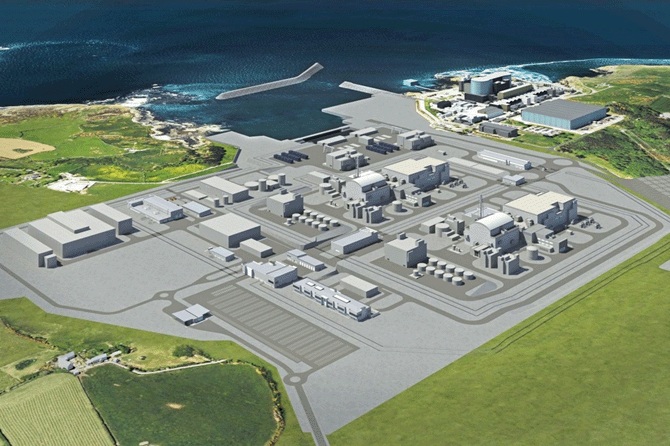
British government offers $18 billion to Hitachi’s UK nuclear project: Kyodo, Reuters Staff TOKYO (Reuters) 17 May 18 – The British government has offered 2 trillion yen ($18 billion)in financial support to a unit of Japan’s Hitachi Ltd (6501.T) to build nuclear reactors in Wales, Kyodo News reported on Thursday.
…….. The British government is offering support in loans and other ways to Hitachi unit Horizon Nuclear Power to cover a large proportion of the cost of its Wylfa Newydd project in Wales, Kyodo reported, citing a source close to the matter.
…….. Hitachi could decide as early as this week whether to go ahead, Kyodo said. It said the government’s offer was aimed at easing concerns about rising cost expectations, which have increased to 3 trillion yen.
A Hitachi spokesman declined to comment when contacted by Reuters.
The Kyodo report cited unidentified observers questioning whether the government would be able to carry out the offer, due to parliamentary opposition.
The British government played down a Japanese media report last week which said it would guarantee loans for the construction of the two reactors in Wales.
Britain is seeking new ways to fund nuclear projects after drawing criticism over a deal awarded to France’s EDF (EDF.PA) to build the UK’s first nuclear plant for 20 years, which could cost 30 billion pounds ($40 billion).







 nuclear-news