The Fort St. Vrain spent nuclear fuel store – just another example of America’s stranded radioactive waste dumps

 , FRED PEARCE,
“…….. About 30 miles northeast of Rocky Flats, out on the prairie near the small town of Platteville, is the Fort St. Vrain spent-fuel store. It resembles nothing so much as an outsize grain store, but since the 1990s it has been holding 1,400 spent fuel rods, laced with plutonium and encased in blocks of graphite. The spent fuel was left behind when the neighboring nuclear power plant shut. The plan had been to send it to another temporary store at the Idaho National Laboratory, but the governor of Idaho banned the shipment. The Fort St. Vrain facility is designed to withstand earthquakes, tornado winds of up to 360 miles per hour, and flooding six feet deep. Also time. It will be several decades at least before the federal government finds the fuel a final resting place.
The country is littered with such caches of spent fuel stuck in limbo. According to the Government Accountability Office (GAO), 80,000 metric tons of spent fuel, the most dangerous of all nuclear wastes, is stored at 80 sites in 35 states. The sites include stores at past and present power plants such as Maine Yankee, and stand-alone federal sites such as Fort St. Vrain. As the GAO puts it: “After spending decades and billions of dollars … the future prospects for permanent disposal remain unclear.” Nobody wants to give the stuff a forever home.
Nuclear waste is conventionally categorized as high-, intermediate-, or low-level. Low-level waste includes everything from discarded protective clothing to plant equipment and lab waste. It can usually be treated like any other hazardous waste, which in practice usually means burial in drums in landfills or concrete-lined trenches.
Intermediate waste contains radioactive materials with isotopes that decay with half-lives long enough to require long-term incarceration. It includes many reactor components, as well as chemical sludges and liquids from processing radioactive materials, which can often be solidified in concrete blocks. Once solid, intermediate waste can be buried safely in shallow graves, though anything containing plutonium will have to be disposed of deep underground because of the very long half-life.
Much of America’s intermediate-level waste will end up at the country’s largest deep-burial site for such radioactive material. The U.S. military’s Waste Isolation Pilot Plant in salt beds near Carlsbad, New Mexico, could eventually take 6.2 million cubic feet of waste. But it has had problems that have slowed progress and raised questions about its viability.
A chemical explosion in 2014 sprayed the tunnels dug into the salt beds with a white, radioactive foam. When a ventilation filter failed, some of the plutonium reached the surface, where at least 17 surface workers were contaminated. The military shut the tunnels for three years to clean up. While WIPP is today back in business, full operations cannot resume until a new ventilation system is in place, probably in 2021. The eventual cost of the accident, including keeping the dump open longer to catch up with the waste backlog, has been put at $2 billion.
High-level waste is the nastiest stuff. It includes all spent fuel and a range of highly radioactive waste liquids produced when spent fuel is reprocessed, a chemical treatment that extracts the plutonium. Most of America’s high-level waste liquids—and around 30 percent of the world’s total—are in tanks at Hanford.
High-level waste is either very radioactive and will stay so for a long time, or it generates heat and so requires keeping cool. Usually both. It accounts for more than 95 percent of all the radioactivity in America’s nuclear waste, and needs to be kept out of harm’s way for thousands of years.
There is general agreement that the only way to keep high-level waste safe is by turning the liquids into solids and then burying it all deep underground, somewhere where neither water nor seismic activity is likely to bring the radioactivity to the surface, and where nobody is likely to stumble on it unexpectedly. There is disagreement, however, about whether this buried waste should be kept retrievable in case future technologies could make it safer sooner, or whether accessibility simply places a burden of guardianship on future generations.
Before it can be buried, most high-level waste needs to be stored for up to a century while it cools. Unfortunately, this has encouraged countries to put off making plans. None of the world’s high-level waste currently has any permanent resting place. The planet is instead peppered with interim stores. America is no better. Its 90,000 metric tons of high-level waste—set to rise to as much as 140,000 tonnes by the time the last power plant closes—is mostly sitting in ponds at dozens of power stations or lockups like Fort St. Vrain………..https://www.theatlantic.com/science/archive/2018/05/the-60-year-downfall-of-nuclear-power-in-the-us-has-left-a-huge-mess/560945/
Britain’s “nuclear renaissance” in the balance as Hitachi ponders Wylfa nuclear project
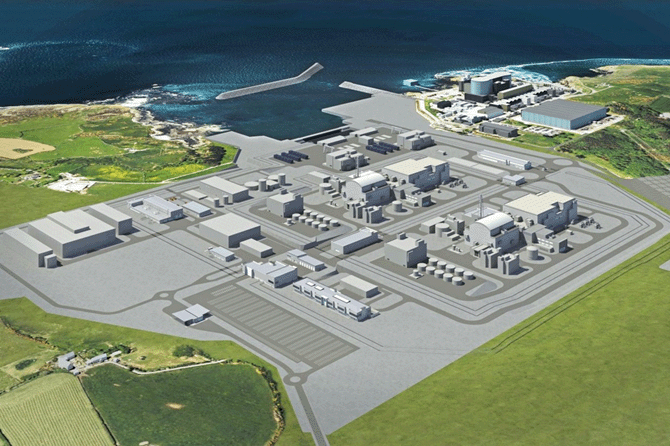
 Times 27th May 2018 , The fate of a £15bn-plus nuclear power station is set to be decided this
week — and with it the future of Britain’s atomic renaissance.
The Japanese industrial giant Hitachi is due to decide Monday whether to
proceed with Wylfa. Hitachi’s decision has huge implications for
industrial collaboration between Britain and Japan and the country’s
nuclear power industry.
The project hinges on winning financial support
from Westminster. This weekend, ministers are expected to set out their
offer to Hitachi in a letter ahead of the crucial meeting. The proposal is
expected to include UK taxpayers taking a direct stake in the plant,
alongside Hitachi and the Japanese state, as well as guaranteeing loans. In
return, Westminster wants Hitachi to substantially undercut on price the
£20bn Hinkley Point plant in Somerset, which is being built by EDF.
TheFrench company struck a deal with the government for a guaranteed payment
of £92.50 per megawatt hour for 35 years. Ministers are expected to make
an announcement once they return from this week’s parliamentary recess.
They will herald it as an example of the type of post-Brexit trade deal
Britain can expect.
https://www.thetimes.co.uk/edition/business/deadline-day-for-japans-hitachi-over-wales-15bn-horizon-nuclear-plant-mdxhnj9x8
Hitachi board of management wavers over costs of Wylfa nuclear power plan
FT 27th May 2018 , The board of Japanese industrial giant Hitachi is “very finely
balanced” over the future of a £15bn nuclear power station it is
developing in Wales, as it prepares to meet on Monday in Tokyo for a
critical vote on the project.
On the agenda is the key issue of whether the
scheme should proceed under a proposed “tripartite” shareholding
structure, which would see the UK and Japanese governments take equity
stakes alongside Hitachi. Wylfa is seen as crucial for the future of
Britain’s energy security and also important for UK-Japan trade relations
as Brexit approaches.
An outline agreement setting out the principles of
the arrangement is understood to have been reached between the UK
government and Horizon, the Hitachi subsidiary company developing Wylfa. It
covers the initial two reactors to be built at the site, though there could
eventually be more.
People close to Hitachi said that, less than 24 hours
before the board meeting, it was difficult to predict which way the board
would lean. Just over two-thirds of the board’s members are outside
directors — an unusually high ratio for a Japanese company. While the
vote on the shareholding structure will mark a “critical milestone” for
Horizon, the ultimate fate of the project awaits another key decision,
according to people familiar with the project.
Full cost estimates for the
development will not be completed until the end of 2018, and the formal
agreement to invest in construction of the plant itself is not expected
until next year. That decision will hinge on whether Hitachi is satisfied
on a range of financial considerations, including capital cost and return
on investment. Another key factor is the strike price — the guaranteed
level at which the plant sells electricity — which is still subject to
discussion. The UK government is expected to back a price some £15 per
megawatt hour lower than the £92.50/MWh negotiated for the Hinkley Point C
nuclear plant that is under development by EDF.
https://www.ft.com/content/f4f6ec74-61b7-11e8-90c2-9563a0613e56
President Trump’s Washington swamp – the nuclear lobby/politics revolving door
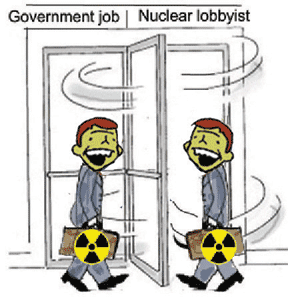 New swamp: Ex-Perry adviser lobbies for energy firm bailout AP, By MATTHEW DALY and RICHARD LARDNER, 29 May 18, WASHINGTON — At a West Virginia rally on tax cuts, President Donald Trump veered off on a subject that likely puzzled most of his audience.
“Nine of your people just came up to me outside. ’Could you talk about 202?’” he said. “We’ll be looking at that 202. You know what a 202 is? We’re trying.”
One person who undoubtedly knew what Trump was talking about last month was Jeff Miller, an energy lobbyist with whom the president had dined the night before. Miller had been hired by FirstEnergy Solutions, a bankrupt power company that relies on coal and nuclear energy to produce electricity. His assignment: push the Trump administration to use a so-called 202 order — named for a provision of the Federal Power Act — to secure a bailout worth billions of dollars.
Although Trump didn’t agree to the plan — he still hasn’t — for Miller, a president’s public declaration of interest amounted to a job well done.
How a single lobbyist helped carry a long-shot idea from obscurity to the presidential stage is a twisty journey through the new swamp of Trump’s Washington. Rather than clearing out the lobbyists and campaign donors that spend big money to sway politicians, Trump and his advisers paved the way for a new cast of powerbrokers who have quickly embraced familiar ways to wield influence.
Miller is among them. A well-connected GOP fundraiser, he has served as an adviser to California Gov. Arnold Schwarzenegger and Texas Gov. Rick Perry, also a close friend. He ran Perry’s unsuccessful presidential campaign in 2016. And when Trump tapped Perry to lead the Energy Department, Miller shepherded his friend through confirmation, sitting behind him, next to the nominee’s wife, at the Senate hearing.
When Perry came to Washington, Miller did, too. He launched his firm, Miller Strategies, early last year and began lobbying his friend and other Washington officials.
Besides Perry, Miller is close to other Trump-era power players. He is among House Majority Leader Kevin McCarthy’s best friends, their relationship dating back decades to Miller’s days in California. In more recent years, Miller developed a friendship with Vice President Mike Pence adviser Marty Obst.
“He’s very influential in Washington, a leading fundraiser,” Obst said of Miller.
Now, after 14 months in business, the 43-year-old Miller has collected more than $3.2 million from a roster of clients that includes several of the nation’s largest energy companies, among them Southern Co., a nuclear power plant operator headquartered in Atlanta, and Texas-based Valero Energy, according to federal filings.
Miller also has continued to raise money for GOP politicians. He contributed nearly $37,000 of his own over the past year to Republicans, including Sen. Ted Cruz of Texas and Greg Pence of Indiana, who’s seeking the congressional seat once held by his younger brother, the vice president, according to federal campaign records.
He is an active supporter of America First Action, a pro-Trump super PAC that raised $4.7 million in the first three months of 2018.
…….. Miller registered as a lobbyist in Washington in February 2017, just after Trump took office. He was hired by FirstEnergy in July 2017. Lobbying disclosure records show he was paid to target the highest levels of American government: the White House — including the offices of Trump and Pence — and Perry’s Energy Department. Miller has earned $330,000 from FirstEnergy since last year, making him one of the company’s highest-paid outside lobbyists……..https://apnews.com/e620b6cb527d41ebbb1c27974d771822
Nevada fights back – resentment against becoming America’s nuclear waste dump
Federal Nuclear Dumping in Nevada Stirs Statewide Resentment,
For decades, the federal government has treated Nevada as a radioactive waste dumping ground, now the state is fighting back U.S. News by Michael Green May 29, 2018
NEVADANS CAN BE FORGIVEN FOR THINKING THEY ARE IN AN ENDLESS LOOP OF “THE WALKING DEAD” TV SERIES. Their least-favorite zombie federal project refuses to die.
In 2010, Congress had abandoned plans to turn Yucca Mountain, about 100 miles northwest of Las Vegas, into the nation’s only federal dump for nuclear waste so radioactive it requires permanent isolation. And the House recently voted by a wide margin to resume these efforts.
Nevada’s U.S. Sens. Dean Heller, a Republican, and Catherine Cortez Masto, a Democrat, have made their determination to block the latest Yucca proposal clear since the Trump administration first proposed resurrecting the project in early 2017.
While teaching and writing about the state’s history for more than 30 years, I have followed the Yucca Mountain fight from the beginning — as well as how Nevadans’ views have evolved on all things nuclear. The project could well go forward, but I believe that it probably won’t as long as there are political benefits to stopping it.
The roots of statewide resentment
TWO-THIRDS OF NEVADANS OPPOSE THIS PLAN, according to a 2017 poll. The state’s experience with federal actions, including nuclear weapons and waste, may help explain the proposed repository’s long-standing unpopularity……. https://www.usnews.com/news/best-states/articles/2018-05-29/commentary-federal-nuclear-dumping-in-nevada-stirs-statewide-resentment
Germany is ready to support Iran in restoring its economy as long as Iran adheres to the Joint Comprehensive Plan of Action (JCPOA)
Germany to assist Iran in restoring economy while Tehran adheres to JCPOA https://en.mehrnews.com/news/134429/Germany-to-assist-Iran-in-restoring-economy-while-Tehran-adheresTEHRAN, May 29 (MNA) – Germany is ready to support Iran in restoring its economy and also, to continue bilateral trades, as long as Iran adheres to the Joint Comprehensive Plan of Action (JCPOA), said German Foreign Minister Heiko Maas.
“We will continue to make efforts to fulfill Iran’s hopes for economic recovery and good trade relations as long as Iran is ready and able to prove that it adheres to its obligations under the nuclear deal,” Maas said at the Global Solutions Summit held in Berlin, sputnik reported on Tuesday.
In a meeting with US Secretary of State Mike Pompeo, Maas has mentioned that US and Germany are pursuing “two entirely separate paths” regarding Iran’s issue.
US president Donald Trump withdraw from JCPOA on May 8 and reintroduced sanctions against Iran. This is while other signatory states of the deal including Russia, China and European countries don’t support US decision and have repeatedly highlighted their commitment to the agreement and guarding Iran’s interests.
Julian Assange was smeared without proof. USA refused to hear his account of Wikileaks and ‘Russiagate’
 US has no interest in hearing what Julian Assange can freely say about Russiagate – Max Blumenthal https://www.rt.com/news/428010-assange-russiagate-testimony-blumenthal/
Assange, who is currently incommunicado in the Ecuadorean embassy in London, reportedly offered – through an intermediary – to talk to US investigators about the release of DNC documents by WikiLeaks during the 2016 US election campaign.
US intelligence claims that WikiLeaks acted on behalf of Russia as part of a campaign to prop up the candidacy of Donald Trump and undermine that of Hillary Clinton. The offer was flatly rejected by Representative Adam Schiff, the ranking Democrat on the House Intelligence Committee, who said Assange would only be interviewed if he is in US custody.
“The US has no intention of interviewing Julian Assange except under duress, possibly after a long period of solitary confinement, the kind that Chelsea Manning endured,” journalist Max Blumenthal told RT, referring to the whistleblower, whose leak to WikiLeaks of classified US material exposing abuses in Iraq lead to her nearly seven-year confinement. Schiff is “the de facto grand inquisitor of the Russiagate investigation”, he said, so he presumably speaks for the entire US intelligence community.
No WikiLeaks people were publicly accused of having a hand in the supposed hacking of the DNC computer network and that the narrative of the hacking itself is on a very shaky foundation, Blumenthal remarked.
“They don’t want to interrupt their narrative with what could be facts very similar to the case of the hacking of the Democratic National Committee. The DNC has never handed over its servers to any US intelligence or law enforcement agency and has likely destroyed those servers,” he said. “It seems like the US does not want to know what’s in them just as the US only wants to know what Assange has to say only after he has been sufficiently held and intimidated.”
Blumenthal says Assange is rightfully afraid of leaving the Ecuador embassy because of his claim that he would then be grabbed by the UK law enforcement and extradited to the US under a classified indictment – the existence of which neither Washington nor London will confirm. If put in US custody, he is likely to become the first person prosecuted in America for what is essentially a journalist revealing classified information, he added.Read more
‘The smelly kid in class’: Former Met officer taunts Julian Assange’s mother on Twitter
“You have the whole beltway press corps howling about [US President Donald] Trump being mean to them and criticizing them. But almost no one in Washington in the press corps will stand up and defend Julian Assange as a fellow journalist,” he said. “This is a case that sets a precedent for the rest of the media in how other journalists would be treated if they reveal classified information. And it seems like there is little concern about it in the journalistic community in the West.”
The lack of support is because the US intelligence community smeared WikiLeaks and Assange personally, calling them a non-governmental intelligence agency and a Russian agent respectively, Blumenthal said, adding that the smear campaign didn’t bother to provide any proof.
“This narrative is almost impossible to challenge. It is simply the CIA’s narrative accepted hook, line and sinker by the New York Times, the Washington Post and all of the major cable media news networks,” he explained.
Assange was given political asylum under the leftist Ecuadorean President Rafael Correa. His successor, Lenín Moreno, has put the country on the path of rapprochement with the US. Moreno is apparently under pressure from Washington to have Assange kicked out of the embassy, which would essentially require him to violate the Ecuadorean law banning extradition of its citizens to foreign nations, Blumenthal said.
“Julian Assange is an Ecuadorean citizen. The Ecuadorean president Lenín Moreno has acceded to US wishes on so many points and said that Julian Assange is a problem he inherited,” he said. “It’s really up to [Moreno] to decide between the pressure that he is receiving from the US, which has just signed a joint military agreement with his country, and the rule of law, the Ecuadorean constitution, which forbids him from handing over an Ecuadorean citizen like Assange to the United States or the UK.”
Albuquerque city councilors oppose shipping radioactive waste through city
Council opposed to shipping radioactive waste through city Albuquerque Journal By Steve Knight / Journal Staff Writer May 28th, 2018 Albuquerque city councilors voted 4-3 – with one abstention – to approve a memorial opposing transportation of high-level radioactive waste by railway through the city for temporary consolidated storage in southeastern New Mexico……..
UK is not correctly testing Hinkley Point dumped mud for radioactivity
Barry GEM 28th May 2018 ,Richard Bramhall. Referring to The GEM’s recent article on the dumping of
mud from Hinkley Point in the Bristol Channel, campaigners oppose the
dumping not because of ‘passion’ but because of science.
EDF’s references to bananas, radon and cosmic rays are unscientific. Potassium 40
(in the bananas), radon and cosmic rays are evenly distributed in body
tissue and the radiation effects are well understood.
The radioactive particles which EdF refuses to look for in the mud are quite different. The
UN has published data showing enormous amounts of particulates from Hinkley
Point. These are microscopic fragments of uranium oxide and probably
plutonium which are small enough to inhale. From the lung they can travel
anywhere in the body — to the lymph nodes, for example. Such particles
emit very short-range radiations all the time, continually hitting the
cells within a few microns. To treat this as an average all-body dose is
like thinking you can safely keep your baby warm by tucking a soldering
iron into her babygro. The Government laboratory that tested mud samples
did not use techniques capable of detecting uranium or plutonium. This is
why campaigners demand thorough testing.
http://www.barry-today.co.uk/article.cfm?id=119988&headline=%E2%80%98Hinkley%20Point%20mud%20needs%20more%20testing%E2%80%99%20%E2%80%93%20a%20GEM%20reader%27s%20letter§ionIs=news&searchyear=2018
1 This Month



Tell the Ukrainian Government to Drop Prosecution of Peace Activist Yurii Sheliazhenko

Petition to revoke the licensing of the Near Surface Nuclear Disposal Facility (NSDF) at Chalk River. https://www.ourcommons.ca/petitions/en/Petition/Details?Petition=e-7247


of the week – STOP SMALL MODULAR REACTORS IN CANADA
To see nuclear-related stories in greater depth and intensity – go to https://nuclearinformation.wordpress.com
-
Archives
- March 2026 (212)
- February 2026 (268)
- January 2026 (308)
- December 2025 (358)
- November 2025 (359)
- October 2025 (376)
- September 2025 (258)
- August 2025 (319)
- July 2025 (230)
- June 2025 (348)
- May 2025 (261)
- April 2025 (305)
-
Categories
- 1
- 1 NUCLEAR ISSUES
- business and costs
- climate change
- culture and arts
- ENERGY
- environment
- health
- history
- indigenous issues
- Legal
- marketing of nuclear
- media
- opposition to nuclear
- PERSONAL STORIES
- politics
- politics international
- Religion and ethics
- safety
- secrets,lies and civil liberties
- spinbuster
- technology
- Uranium
- wastes
- weapons and war
- Women
- 2 WORLD
- ACTION
- AFRICA
- Atrocities
- AUSTRALIA
- Christina's notes
- Christina's themes
- culture and arts
- Events
- Fuk 2022
- Fuk 2023
- Fukushima 2017
- Fukushima 2018
- fukushima 2019
- Fukushima 2020
- Fukushima 2021
- general
- global warming
- Humour (God we need it)
- Nuclear
- RARE EARTHS
- Reference
- resources – print
- Resources -audiovicual
- Weekly Newsletter
- World
- World Nuclear
- YouTube
-
RSS
Entries RSS
Comments RSS
 nuclear-news