The coal and nuclear industries criticize subsidies for solar and wind power based on their belief that the subsidies distort the market.
However, a closer look shows the coal, natural gas, oil and nuclear sectors enjoy substantial subsidies, and federal outlays for solar investments are decreasing as the price of solar declines. Wind costs have also dropped significantly over the last decade.
All sources of energy receive subsidies. The question is why continue to throw money at the dying coal and nuclear power industries, whose costs continue to rise despite subsidies.
Meanwhile, the solar and wind industries saw significant growth only in the last decade. It stands to reason that these sectors would receive taxpayer support – they generate well-paying jobs and reduce pollution.
These technologies also continuously become more efficient, while their prices steadily decline. In fact, according to Lazard, unsubsidized utility-scale wind and solar farms are now cheaper than new coal power plants and are competitive with natural gas power plants.
This month, solar developer John Weaver provided an analysis of a recent Energy Information Administration report, which described 2016 federal direct spending, research and development, and tax expenditures on energy technologies.
Solar power is subsidized by the federal government with the 30 percent investment tax credit, or ITC, Weaver explained. Both large and small solar arrays qualify. The credit is based on the costs of a solar project. He notes that the outlays for this credit have dropped by half since 2013.
“This speaks specifically to the falling price of solar power as the tax credit is directly based on project costs, and not system sizes,” Weaver said.
According to EIA, just over $1 billion in subsidies leveraged up to $30 billion in investment. Weaver suggests a higher number for subsidies, but, anyway you look at it, the solar ITC in 2016 leveraged much more investment than it cost.
But Congress is still dumping money into these technologies. According to EIA, the total combined tax expenditures for coal and nuclear power for years 2010, 2013 and 2016 were well over $4 billion combined. This doesn’t include the pay-as-you-go subsidy dumped on ratepayers at the state level to essentially force construction of these financially risky projects.
In addition, fossil fuels receive significant subsidies for development, extraction, investment and processing. A collaborative effort by Friends of the Earth, Taxpayers for Common Sense and the R Street Institute, known as the Green Scissors campaign, tracks federal tax expenditures for the energy sector. An analysis by the group concluded that fossil fuels received nearly $11 billion in subsidies in 2016.
The only reason nuclear power became a viable option in the first place was because Congress passed the Price Anderson Act in 1957 to shift the bulk of the costs of a major nuclear accident onto the public. These costs could come close to $1 trillion, according to CNN.
By contrast, subsidizing wind and solar investment has yielded very positive results. Any complaints from the fossil fuel and nuclear industries about those subsidies are hypocritical at best.
Germany To Compensate RWE & Vattenfall Over Nuclear Phase-Out, Clean Technica, 25 May 18 The German Government has passed a bill that gives the country the legal right to proceed with its phase-out of nuclear power but will open the door to companies like Vattenfall and RWE to receive compensation for their investment into nuclear power plants.
Following the 2011 Fukushima nuclear disaster in Japan, Germany made the unprecedented decision to close down all its nuclear power plants — the oldest eight power plants were closed immediately, while the remaining nine are scheduled to be turned off by 2022.
“A decision has been taken to shut down eight plants before the end of this year and they definitely won’t be reactivated. And the remaining nine will be shut down by the end of the decade,” Juergen Becker, deputy environment minister at the time, told Reuters. “Japan has shown that even if there is a minuscule occurrence, the residual risk is too high to justify the continuation of nuclear power (…) It is better to go for other energy services in a civilized country.”
In response, German utility RWE and Swedish power company Vattenfall sued the German government, arguing that they were due financial compensation for investing in a technology that, at the time, the German government was supporting, and that in suddenly reversing direction, the companies would suffer significant financial losses.
In December of 2016, the German Federal Constitutional Court confirmed that the government’s decision to phase-out nuclear power was “essentially constitutional.” This week, the German Federal Government approved a bill which implemented the findings of the Court, giving the country the right to proceed with its phase-out but also allowing utilities to seek “adequate financial compensation for so-called frustrated investments they made in nuclear power plants between 28 October 2010 and 16 March 2011.”
San Francisco’s Hunters Point Radiation Problems Worsen https://yubanet.com/california/san-franciscos-hunters-point-radiation-problems-worsen/By Public Employees for Environmental Responsibility Washington, DC, May 25, 2018— The U.S. Navy has found “data manipulation and/or falsification” afflicting years of radiation surveys on the buildings at San Francisco’s Hunters Point shipyard, invalidating its contractor’s claims the buildings are safe for “unrestricted release,” according to a Navy report posted by Public Employees for Environmental Responsibility (PEER). This finding compounds the growing scandal over fraudulent soil samples by the contractor Tetra Tech and pushes the costs and schedule for the nearly 30-year cleanup of this Superfund site deeper into limbo.
The Navy’s March 2018 “Building Radiation Data Initial Evaluation Report” confirms data manipulation allegations by former Tetra Tech employees. It reexamines Tetra Tech radiation surveys submitted from 2008 through 2016 for 28 buildings on six parcels covering most of the 500-acre site and concludes that “the surveys have been falsified and cannot be used.” Among other flaws, the report points to –
Improper radiation scan speeds “in nearly all survey units” thus rendering its recorded data useless. Moving the scan too rapidly above its design rate prevents accurate detection of radiation levels;
Evidence of “duplicated data strings” for more than half the buildings, meaning that the exact same printout appears to have been cut and pasted for use on multiple structures; and
The potential for even more data shortcomings: “This report cannot verify that additional portions of the database have not been manipulated.”
“Contrary to the old saying, the figures apparently do lie at Hunters Point,” stated PEER Executive Director Jeff Ruch, who revealed last month that the U.S. Environmental Protection Agency determined nearly all the Tetra Tech soil samples on a large portion of the site were “neither reliable nor defensible.” “Now we know there was falsification not just of soil contamination measures, but also of the buildings.”
Buildings inappropriately declared clean can be leased out for reuse or torn down and their debris shipped to disposal or recycling sites not designed or licensed for radioactive waste.
Significantly, the report did not review any building in Parcel A, the 75-acre portion of the site already turned over to the city and redeveloped, claiming there were “no data” available to reevaluate. This gap does little to dispel growing concern about the true level of contamination on the small portion of the site already declared clean.
While the Navy is responsible for decontaminating the site, EPA is supposed to make sure the work is complete and correct. Neither agency, however, has indicated what steps will be taken to right this reeling remediation. Much of the key information, such as this latest Navy report, is not made publicly available.
“Instead of moving forward, the Hunters Point cleanup is careening in reverse,” added Ruch, noting that every charge the Tetra Tech whistleblowers have made is being verified, one after another. “To get to the bottom of this mess, perhaps the Tetra Tech whistleblowers should be put in charge.”
BBC 23rd May 2018 Plans to move mud from alongside the Hinkley Point nuclear site in Somerset
to a dumping ground off Cardiff Bay have been debated by AMs. It comes
after a petition to the assembly against the plans attracted over 7,000
signatures. Other online petitions gathered tens of thousands of
signatures. The assembly petitions committee took evidence on the issue and
published a summary of the evidence it had heard and requested the debate
in the Senedd.
As part of plans to build the new Hinkley Point C nuclear
power station in Somerset – 300,000 tonnes needs to be dredged from the
seabed nearby. The developers are set to move it within weeks to a disposal
site off Cardiff Bay. Both developers EDF and Natural Resources Wales
insist tests have shown the sediment poses no risk but campaigners claim it
could be contaminated by discharges from the old Hinkley Point A and B and
argue the mud has not been adequately tested.
Plaid Cymru’s Simon Thomas said the issue illustrated that “we have so little control of our natural
resources, that we have to accept the spoil of a nuclear power station in
Hinkley Point”. He said that as a matter of principle it is was the Welsh
parliament that should decide what happens in Welsh waters.
The company behind Hinkley Point C – EDF – said the mud has been tested independently
to internationally accepted standards and shown to pose no risk to human
health or the environment. It has refused a Petitions Committee request to
pay for further sampling – arguing claims the mud is toxic are alarmist and
wrong, and that any sampling would yield the same results and would not
remove the petitioner’s objection about the testing process. Energy
Secretary Lesley Griffiths said Natural Resources Wales was satisfied there
was no risk from the dredged material to people, the environment, or the
wildlife that lives there. However, she said she has asked NRW to review
the way it communicated its decisions over this licence.
Independent AM Neil McEvoy, who met the demonstrators, dismissed the suggestion the mud
had been tested properly and described the situation as a “dereliction of
duty”. He said: “We have a Welsh Government allowing Wales to be dumped on
and the mud hasn’t been tested… The top soil was tested – [but] you’ve
got five samples only under five centimetres for 300,000 tonnes of mud.”
Anti-nuclear campaigner Tim Deere Jones, who submitted the petition, is
unhappy with the level of testing undertaken. He said: “What kind of
radioactivity is in the mud, how much of it is in the mud, if you dump it
into the Cardiff grounds which is a dispersal site – where will it disperse
to?”
Richard Bramhall is from the Low Level Radiation Campaign, chairman of
the Welsh Anti Nuclear Alliance and a former member of the government
advisory committee advising on the radiation effects of internal emitters. “The idea that the average radioactivity in the mud is at a low level is of no comfort at all to the people of south Wales,” he said. “The particles will blow ashore and once they’re in your lungs that’s not a low dose.” http://www.bbc.co.uk/news/uk-wales-44223979
Scottish Government 24th May 2018 Scotland will become one of the first countries to achieve a 100% reduction
in carbon emissions, Climate Change Secretary Roseanna Cunningham has said.
The new Climate Change Bill will immediately set a target of a 90%
reduction by 2050, which the UK Committee on Climate Change (UK CCC) states
is currently “at the limit of feasibility.”
The draft Bill sets out that the Scottish Government intends to go further still and achieve a 100%
reduction in emissions, known as ‘net-zero’, as soon as possible.
Ministers will be legally required to keep the net-zero target date under
review by seeking expert advice on the issue every five years. The target
date will become legally-binding, subject to the consent of the Scottish
Parliament, as soon as there is sufficient evidence to demonstrate the date
is credible and achievable.
As well as increasing long term ambition, the
new Bill also includes the most ambitious interim targets in the world, as
well as stretching annual targets for every year between now and 2050. This
means action will need to increase immediately, across every sector of the
Scottish economy. It will also require action by individuals, communities
and businesses – as well as government. https://news.gov.scot/news/commitment-to-net-zero-greenhouse-gas-emissions
NASA looks to send a small nuclear reactor to the moon and MarsSanDiego Union-Tribune, 23 May 18 ………. some aren’t exactly over the moon with the prospect of nuclear power in space.
Among other incidents, the group points to a Russian nuclear-powered satellite that crashed into the Indian Ocean in 1982 and chunks of another that fell into a remote area of the Northwest Territories of Canada in 1978.
Gagnon also worries about launch accidents, contamination and whether projects like Kilopower may “serve as a Trojan horse” that could lead to using nuclear to power weapon systems in space.
“It’s not the kind of thing we can play games with,” Gagnon said. “One thing we know is technology is not invincible — the Titantic, the Challenger, Fukushima, there are a whole host of examples in the modern age. And when you start mixing nuclear power into the equation, it’s a very dangerous thing.”
SCE&G misled lawmakers about critical nuclear report, state agency says, Greenville News, Sammy Fretwell and Avery G. Wilks, The Stat May 24, 2018
SCE&G executives misled S.C. legislators about why a report was commissioned to investigate troubles at the failing V.C. Summer nuclear expansion project, state regulators say.
In sworn testimony to lawmakers last fall, Kevin Marsh, then chief executive of SCE&G and its parent company SCANA, told legislators the Bechtel Corp. was hired to complete a study on problems at the ill-fated project to help prepare for a possible lawsuit against Westinghouse, the project’s lead contractor.
Because the report — kept secret until after the V.C. Summer project collapsed — was part of an anticipated lawsuit, it could remain confidential from regulators, legislators and the public, utility officials told legislators last fall.
However, in filings late Wednesday with the S.C. Public Service Commission, regulators at the state Office of Regulatory Staff said the Bechtel report was put together to assess what was going wrong with the construction of two new nuclear reactors northwest of Columbia, not to support a lawsuit………..
Documents released Wednesday by Regulatory Staff indicate the Bechtel report was kept confidential at the insistence of Westinghouse. Westinghouse wanted protection from legal liability at another nuclear construction project that it was in charge of, the Plant Vogtle nuclear expansion effort in Georgia, records show.
………Last fall, McMaster obtained the final Bechtel report from state-owned Santee Cooper and released it to the public.
Philippines mulls nuclear revival, SBS News, 23 May 18 Phillipines holds the only nuclear power plant in Southeast Asia, and some in the power hungry country are looking at reviving the mothballed facility.
…….Opposition to reviving Manila’s nuclear ambitions remains strong, with advocates citing a reliance on imported uranium, high waste and decommissioning costs, as well as safety concerns.Geologist Kelvin Rodolfo has repeatedly warned against the activation of the Bataan plant, saying it sits on an active earthquake fault that runs through a volcano, currently dormant.
Donald Trump cancels North Korea nuclear summit, In letter to Kim Jong-un, Trump says talks are ‘inappropriate … based on the open hostility displayed in your recent statement’, Guardian, Julian Borger in Washington and Benjamin Haas in Seoul, 25 May 2018
Donald Trump has cancelled his planned summit with the North Korean leader, Kim Jong-un, blaming his decision on a threatening statement from the Pyongyang regime, and warning that the US military is “ready if necessary”.
n a formal letter to Kim released by the White House, Trump said he had been “very much looking forward” to meeting the North Korean leader.
But he wrote: “Sadly, based on the tremendous anger and open hostility displayed in your most recent statement, I feel it is inappropriate, at this time, to have this long-planned meeting.”
Trump declared that the meeting would not take place “for the good of both parties, but to the detriment of the world”.
In remarks to the press after the letter was released, Trump said it was still possible the summit could go ahead, albeit at a later date, but warned Pyongyang that the US and its allies would respond if it carried out “foolish or reckless acts”.
Asked if cancellation of the summit increased the risk of war, he replied: “We’ll see what happens.”
Meanwhile, the president said his campaign of “maximum pressure” would continue, involving the “strongest sanctions ever imposed”. However, in the wake of Trump’s withdrawal from this summit, soon after abrogating a nuclear deal with Iran that had global support, there are now serious doubts over his ability to galvanise international support for increased sanctions, or even enforce the existing sanctions regime.
Trump’s letter to Kim mixed regretful and conciliatory passages with a reminder of the size of the US nuclear arsenal.
“You talk about your nuclear capabilities, but ours are so massive that I pray to God they will never have to be used,” Trump wrote.
The cancellation came two days after a visit to the White House by the South Korean president, Moon Jae-in, who had sounded hopeful about a historic summit that he portrayed as vital to peace on the Korean peninsula.
Moon held an emergency meeting with top officials just before midnight local time on Thursday night. His office appeared surprised by the announcement, with spokesman Kim Eui-kyeom saying: “We are trying to figure out what President Trump’s intention is and the exact meaning of it.”
Pyongyang also appeared to be taken entirely by surprise.
North Korea claims it has demolished its nuclear testing site North Korea has carried out what it said is the demolition of its nuclear test site, setting off a series of explosions over several hours in the presence of foreign journalists. ABC News, 25 May 18
Key points:
Closing of North Korea’s nuclear test site was announced by Kim Jong-un before planned summit with US President Donald Trump
North Korea brought in a small group of foreign journalists to witness the event
Demolition comes after North Korea labelled US Vice President Mike Pence a “political dummy”
The explosions at the nuclear test site deep in the mountains of the North’s sparsely populated north-east were centred on three tunnels at the underground site and a number of buildings in the surrounding area.
North Korea had completely dismantled its Punggye-ri nuclear test ground “to ensure the transparency of discontinuance of nuclear test,” state news agency KCNA said.
The dismantling of the nuclear test ground “completely closed the tunnel entrances,” it said, adding that two tunnels there had been ready for use in “powerful underground nuclear tests”.
There was no leakage of radioactive material or adverse impact on the surrounding environment from the dismantling, the agency added.
The Pentagon is speeding up US weapons deliveries to allied militaries such as Saudi Arabia, Romania, Japan, and South Korea through new “pilot authorities that change how it can design and execute contracts” according to news reports.
Defense One, quoted Ellen Lord, US defense undersecretary for acquisition and sustainment, as saying, Wednesday “we have a whole variety of specific programs where we are focused on applying these authorities: Patriot Missiles for Romania; Global Hawk for Japan, THAAD [high-altitude air defense missiles] for Saudi Arabia, and TOW [vehicle-launched missiles] for multiple foreign military sales partners.”
These new authorities will allow the Pentagon to shave “years” off the time it takes to deliver weapons to friendly militaries, Lord said at the annual SOFIC event here.
The report added that Saudi Arabia is a frequent target of missile strikes by Houthi rebels. Regional authorities routinely fret about Iran’s growing missile capabilities.
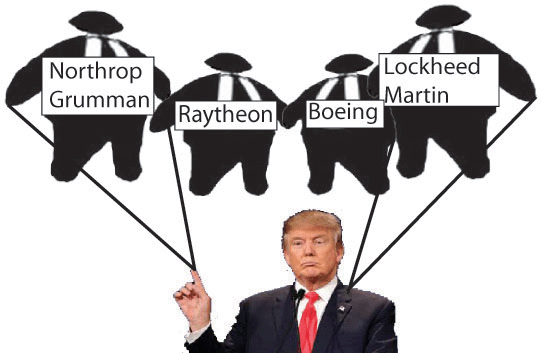
The Trump administration, working to increase exports of US-made weapons, has started the process to execute the sale 120,000 precision-guided munitions to allies Saudi Arabia and the United Arab Emirates.
Reuters said Tuesday that the White House asked the US Congress to review the deal.
Last year, the Trump administration approved the sale of about $7 billion of the precision-guided weapons to Saudi Arabia.
Raytheon Co is the largest maker of the PGMs in the United States.
Administration and congressional sources confirmed that the informal 40-day review period to sell the munitions to the two countries was under way.
Loujain is a well-known campaigner for women’s right to drive in the ultra-conservative kingdom. Late last week, we learned that she had been arrested from her home. She was one of at least six prominent women’s rights activists detained by the Saudi Arabian authorities.
Loujain has been arrested several times in recent years for campaigning for women’s right to drive and the abolition of the male guardianship system. Now, she is the victim of a state-orchestrated smear campaign, designed to undermine the important campaigning that she and other human rights activists have been undertaking.
Along with the other human rights activists, Loujain has been detained and accused of crimes including “suspicious contact with foreign entities” and undermining the “security and stability” of the country. She was branded a ‘traitor’ to the country by state-aligned media. These arrests come one month before Saudi Arabian authorities will lift the ban on women driving in the kingdom. It is a cruel irony that the very women who championed the right to drive campaign may not be able to benefit from their activism – instead, they may be behind bars instead of behind the wheel.
These accusations are nothing more than ludicrous lies, intended to silence strong feminist voices speaking up for women’s rights.
The following morning, it only got worse. A vile and unprecedented smear campaign took over the front pages of Saudi newspapers and spread across social media platforms. Local newspapers like Okaz and Al-Jazirah were filled with aggressive front-page headlines, photos and countless opinion articles, calling the activists spies. On Twitter, one graphic was widely shared, revealing the faces and names of these activists with the word “traitor” stamped across their photos.
We fear that they, like many other peaceful activists and human rights defenders, will be tried and sentenced to lengthy prison terms for their activism. This continued criminalization of peaceful activism and human rights work is repulsive. It’s been a week since their arrests, and we still don’t know where the activists are, if they have been presented with clear legal charges, or have had access to a lawyer of their choosing.
In recent weeks, Saudi Arabia’s Crown Prince Mohammad bin Salman has travelled the world on a PR blitz, shaking hands with fellow leaders while promising positive change in the kingdom. MbS (as he’s known) claims women’s rights will be respected as part of his reforms. These arrests show those promises to be a lie.
How can the Crown Prince tell the world that he is an advocate for women’s rights while locking up activists who have called for the reforms he claims credit for? How can he claim to support women’s empowerment when the brave activists who have sacrificed their freedom for the rights and freedoms of Saudi Arabian women in the country won’t be able to drive next month?
For government leaders around the world who have been taken in by MbS’ talk of reform, we have a simple message: as long as human rights activists are deemed a threat to state security, and as long as the rights to freedom of expression, association, and assembly are equated with terrorism, Saudi reform is not meaningful.
It is clear that underneath all the PR hype and spin, Crown Prince Mohammad bin Salman doesn’t care about women’s rights and real human rights reforms. Saudi Arabian authorities cannot continue to publicly state they are dedicated to reform, while treating women’s rights campaigners in this cruel way. It’s time to end the systematic discrimination against women and the repression of the human rights community in Saudi Arabia.
Samah Hadid is Amnesty International’s Middle East Director of Campaigns
Saudi Arabia has widened its crackdown on women’s rights activists, bringing the number of arrests up to 11 people, according to human rights groups.
Since the sweep began on May 15, the detained activists, most of whom are women, have been branded “traitors” by pro-government news outlets and social media accounts, according to Human Rights Watch. Over the weekend, several state-linked newspapers published the names and photographs of those detained in what rights groups dubbed a “smear campaign“.
Those arrested reportedly include prominent women’s rights defenders who have long advocated for ending the ban on women driving, among them, Loujain al-Hathloul, Aziza al-Yousef and Eman al-Nafjan, along with Mohammed al-Rabea, an activist, and Ibrahim al-Modaimeegh, a human rights lawyer. They may face charges for “suspicious contact with foreign parties” and undermining “stability,” according to the Presidency for State Security, an office which reports to the king.
Since the kingdom is expected to soon lift its prohibition on women driving, rights groups said the motivation behind the escalating arrests remains unclear.
King Salman bin Abdulaziz Al Saud and his son, Crown Prince Mohammed bin Salman, drew international plaudits last year when they announced the ban on female drivers would end on June 24.
But now international outrage over the arrests threatens to derail the crown prince’s image as liberalizer.
“The crown prince, who has styled himself as a reformer with Western allies and investors, should be thanking the activists for their contributions to the Saudi women’s rights movement,” Sarah Leah Whitson, HRW’s Middle East director said in a statement. “Instead, the Saudi authorities appear to be punishing these women’s rights champions for promoting a goal bin Salman alleges to support — ending discrimination against women.”
A collaborative research team from China has published a new analysis that shows the Earth’s climate would increase by 4 °C, compared to pre-industrial levels, before the end of 21st century.
To understand the severity of this, consider the Paris Agreement (https://unfccc.int/process/the-paris-agreement/what-is-the-paris-agreement) of the United Nations. It’s a global effort to prevent an increase of 2°C. Nearly every country on the planet–the United States is the only country to withdraw–has agreed to work to prevent the catastrophic effects of two degrees of warming.
“A great many record-breaking heat events, heavy floods, and extreme droughts would occur if global warming crosses the 4 °C level, with respect to the preindustrial period,” said Dabang Jiang, a senior researcher at the Institute of Atmospheric Physics of the Chinese Academy of Sciences. “The temperature increase would cause severe threats to ecosystems, human systems, and associated societies and economies.”
In the analysis, Jiang and his team used the parameters of scenario in which there was no mitigation of rising greenhouse gas emissions. They compared 39 coordinated climate model experiments from the fifth phase of the Coupled Model Intercomparison Project (https://www.wcrp-climate.org/wgcm-cmip), which develops and reviews climate models to ensure the most accurate climate simulations possible.
They found that most of the models projected an increase of 4°C as early as 2064 and as late as 2095 in the 21st century, with 2084 appearing as the median year.
This increase translates to more annual and seasonal warming over land than over the ocean, with significant warming in the Arctic. The variability of temperature throughout one year would be lower in the tropics and higher in polar regions, while precipitation would most likely increase in the Arctic and in the Pacific. These are the same effects that would occur under 1.5°C or 2°C increases, but more severe.
“Such comparisons between the three levels of global warming imply that global and regional climate will undergo greater changes if higher levels of global warming are crossed in the 21st century,” wrote Jiang.
The researchers continue to investigate the changes associated with 4°C of global warming in extreme climates.
“Our ultimate goal is to provide a comprehensive picture of the mean and extreme climate changes associated with higher levels of global warming based on state-of-the art climate models, which is of high interest to the decision-makers and the public,” said Jiang.
Researchers from the Chinese Academy of Sciences Center for Excellence in Tibetan Plateau Earth Sciences, the Collaborative Innovation Center on Forecast and Evaluation of Meteorological Disasters at the Nanjing University of Information Science & Technology, the Joint Laboratory for Climate and Environmental Change at Chengdu University of Information Technology, and the University of Chinese Academy of Sciences contributed to this study.
This work was supported by the National Basic Research Program of China and the National Natural Science Foundation of China.











 nuclear-news