Call to White House to oppose Saudi Arabia’s threat to acquire nuclear weapons
 White House Should State Opposition to Saudi Threat to Acquire Nuclear Weapons http://www.ipsnews.net/2018/05/white-house-state-opposition-saudi-threat-acquire-nuclear-weapons/
America expands is nuclear arsenal as it demands that Iran and North Korea have no nuclear weapons
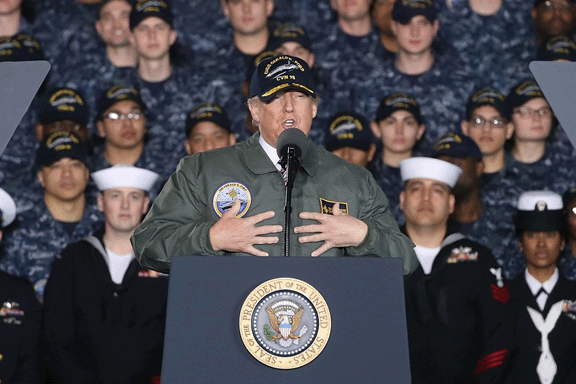 As U.S. Demands Nuclear Disarmament, It Moves to Expand Its Own Arsenal, NYT. By David E. Sanger and William J. Broad, May 14, 2018
WASHINGTON — For the White House, these have been dramatic days for nuclear disarmament: First President Trump exited the Iran deal, demanding that Tehran sign a new agreement that forever cuts off its path to making a bomb, then the administration announced a first-ever meeting with the leader of North Korea about ridding his nation of nuclear weapons.
But for the American arsenal, the initiatives are all going in the opposite direction, with a series of little-noticed announcements to spend billions of dollars building the factories needed to rejuvenate and expand America’s nuclear capacity.
The contrast has been striking. On Thursday evening, hours after Mr. Trump announced that his meeting with Kim Jong-un, the North Korean leader, would take place on June 12 in Singapore, the Pentagon and the Energy Department announced plans to begin building critical components for next-generation nuclear weapons at the Savannah River Site in South Carolina.
The idea is to repurpose a half-built, problem-ridden complex that was originally intended to turn old nuclear weapons into reactor fuel to light American cities. Now the facility will be used to revitalize America’s aging nuclear weapons, and to create the capacity to make many hundreds more.
…… While it is possible that the American buildup is part of a negotiating strategy, offering Mr. Trump something he can trade away before it gets started, the White House has made clear, in both statements and strategy, that it envisions the reduction of nuclear weapons as a one-way street.
….. President Barack Obama argued that the United States could not urge other countries to give up nuclear programs while expanding its own. But many of his own aides later said they wished he had done far more to reduce America’s arsenal, arguing that it could safely drop below the number the Russians deployed.
Now Mr. Trump is heading in the other direction. The United States has dramatically stepped up the effort to overhaul the existing arsenal and prepare for the day when it might once again be enlarged. Unless the New Start Treaty is renewed for five years, any limits on the American and Russian arsenals will expire in February 2021, just days after Mr. Trump would enter his second term.
In the meantime, the American government is doing all it can to make clear it is preparing for an era of nuclear buildup.
…….. Los Alamos is to make 30 pits per year, and the South Carolina plant 50. That setup, the Energy and Defense Departments said, will improve “the resiliency, flexibility and redundancy of our nuclear security enterprise by not relying on a single production site.” But it also signals a return to production of new weapons, even as Mr. Trump is withdrawing from the 2015 deal with Iran in part because of “sunset provisions” that he says will eventually allow Tehran to do the same.
The federal rationale for making up to 80 pits a year is hidden in layers of secrecy but turns on stated fears that the plutonium fuel at the heart of American weapons will deteriorate with age, eventually rendering them useless.
Whether that fear is justified is a matter of debate. In 2006, a federal nuclear panel found that the plutonium pits aged far better than expected, with most able to work reliably for a century or more.
That judgment led critics to contend that the federal government was seeking a new generation of nuclear pits for reasons not of national security but of saber-rattling.
“No new pits are needed for any warhead,” Greg Mello, the executive director of the Los Alamos Study Group, a private organization in Albuquerque that monitors the nation’s nuclear complex and opposes expansion, said recently. “There are thousands of pits stockpiled for possible reuse.”
The Pentagon’s Nuclear Posture Review, published in February, called for the new capability to produce plutonium pits. It also called on Congress to approve the new low-yield nuclear weapons.
Last week, the full House Armed Services Committee endorsed the Nuclear Posture Review, but with Democrats overwhelmingly voting against it.
“We have to have a credible deterrence, but I think the Nuclear Posture Review goes way beyond credible nuclear deterrence,” said Representative Adam Smith of Washington, the top Democrat on the committee, warning that “we could stumble into a nuclear war.” https://www.nytimes.com/2018/05/14/world/trump-nuclear-savannah-river.html
Beware John Bolton, serial killer of nuclear agreements. He is shooting us all in the foot.
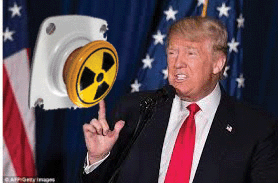 The Path of Broke Nuclear Agreements, Yahoo News, Tom Z. Collina, Catherine Killough, Philip Yun The National Interest•May 20, 2018 Unlike North Korea today, Iran does not possess a single nuclear weapon. By trashing the Iran deal, President Trump risks turning Iran into North Korea.
The Path of Broke Nuclear Agreements
President Donald Trump, at the urging of National Security Advisor John Bolton, has withdrawn from the Iran nuclear agreement, putting the future of the deal in jeopardy. Trump did this despite the fact that Iran is in compliance with the deal, that the deal has served to shrink Iran’s nuclear program and keep it away from a bomb, and that it has prevented another costly war in the Middle East.
Just how bad will things get with Iran now that Trump has acted? Hard to say, but we can see the writing on the wall: Tehran could restart its nuclear program and edge closer to building a bomb. This would lead to increased calls from the right to—once again—stop Iran from acquiring nuclear capability, by military force if necessary. Trump is already indicating that things are heading in that direction. Just one day after breaking out of the Iran deal, Trump warned of “very severe consequences” if Iran resumes its nuclear program.
To fully understand the risks of the Trump administration abandoning the Iran deal, one need only recall what happened in North Korea after Bolton, then in the Bush administration as an under secretary of state, did his part to kill another landmark nuclear deal—the Agreed Framework.
In 1994, the North Korean regime threatened to go nuclear for the first time. To prove the point, Pyongyang expelled all international inspectors and made preparations to extract weapons-grade plutonium from its Yongbyon research reactor. The risks of a conventional conflict—even then— were high because the Clinton Administration was seriously considering military intervention in case diplomacy failed. An unprecedented meeting between former president Jimmy Carter and North Korean leader Kim Il-sung eventually led to the first U.S.-North Korea nuclear deal, the Agreed Framework.
Though only four pages long, the Agreed Framework served a similar purpose to the 159-page Iran agreement: to prevent a state from developing nuclear weapons. And, though neither agreement was perfect, the Agreed Framework—like the Iran deal thus far—proved successful, preventing the North from producing dozens more nuclear weapons worth of fissile material. For nearly a decade, the North readmitted international inspectors, stopped producing plutonium and shelved plans to build two large reactors.
……. Instead of working to improve the Agreed Framework by adding additional, stronger measures to what already existed, the Bush administration chose to back out of the agreement in 2002. Since that time, North Korea has consistently shocked the world with the speed, sophistication, and fulfillment of its nuclear ambitions.
……. Now, it is difficult to conceive of North Korea relinquishing a nuclear arsenal it has worked for two decades to achieve. But in 1994, long before North Korea tested its first bomb, the North did not have nuclear weapons to give up. Since then, the chance of convincing North Korea to give up its nuclear program has become less likely and more costly.
That history begs the question: What would North Korea look like today had we kept the Agreed Framework and built on it, rather than throwing it away?
Unlike North Korea today, Iran does not possess a single nuclear weapon, only the theoretical capability to one day produce them. By trashing the Iran deal, President Trump risks turning Iran into North Korea.
John Bolton was a central player in withdrawing U.S. support from the North Korea deal in 2002 and from the Iran deal now. History has shown that abandoning the North Korea deal made the problem worse, not better. Similarly, we can expect that the Iran crisis will now get worse, not better, as Tehran resumes its nuclear program and Trump responds with military threats.
Beware John Bolton, serial killer of nuclear agreements. He is shooting us all in the foot.
Philip Yun is Executive Director of Ploughshares Fund, a San Francisco-based peace and security foundation. He was a member of a government working group that managed U.S. policy and negotiations with North Korea under President Clinton and was part of the U.S. delegation that traveled to North Korea with Secretary of State Madeleine Albright in 2000.
Tom Collina is the Director of Policy at Ploughshares Fund. He has over 25 years of Washington, DC experience in nuclear weapons, missile defense and nonproliferation issues.
Catherine Killough is the Roger L. Hale Fellow at Ploughshares Fund, focusing on North Korea’s nuclear and missile development, inter-Korean relations, the US alliance system in East Asia, and the transnational politics of Asia.
Image: Unlike North Korea today, Iran does not possess a single nuclear weapon. By trashing the Iran deal, President Trump risks turning Iran into North Korea. https://www.yahoo.com/news/path-broke-nuclear-agreements-235800375.html
Hitachi’s build of Wylfa nuclear power station delayed – may never happen
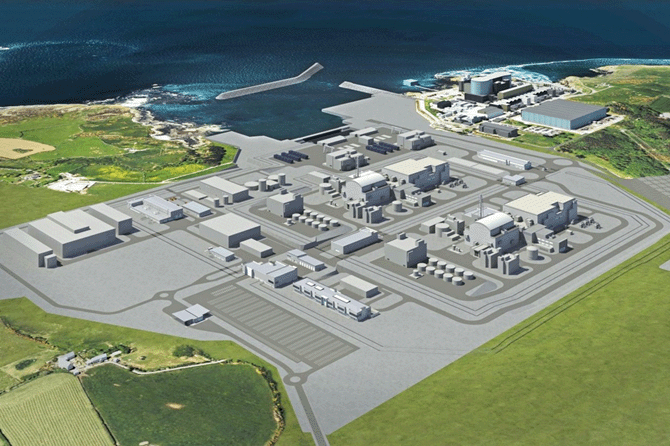
Asahi Shimbun 20th May 2018 [Machine Translation] Hitachi announced plans to delay the goal of starting
nuclear power plans planned in the UK for about two years to 2027. The collection of funds necessary for the project is difficult, and reconsideration of sharing has started between companies that undertake design and construction.
The continuation of the project itself is increasingly uncertain.
In the plan, two nuclear reactors will be built on Anglesey island in the UK. The goal of starting operation has been
announced as “early 20’s”.However, according to officials, the Hitachi side recently proposed a new goal “April 27” to companies and others involved in the plan. It is planned to decide whether to start construction in 2019,
but it seems to be assuming a case where this time is delayed.
https://www.asahi.com/articles/ASL5M4HZ3L5MULFA001.html
European Union remains committed to the Iran nuclear agreement, reassures Iran

 Europe reassures Iran of commitment to nuclear deal without U.S, Alissa de Carbonnel 19 May 18 TEHRAN (Reuters) – The European Union’s energy chief sought to reassure Iran on Saturday that the bloc remained committed to salvaging a nuclear deal with Tehran despite U.S. President Donald Trump’s decision to exit the accord and reimpose sanctions.
Miguel Arias Canete delivered the message on a visit to Tehran and also said the 28-nation EU, once the biggest importer of Iranian oil, hoped to strengthen trade with Iran.
“We have sent a message to our Iranian friends that as long as they are sticking to the (nuclear) agreement the Europeans will… fulfill their commitment. And they said the same thing on the other side,” Arias Canete, European Commissioner for energy and climate, told reporters after talks with Iran’s nuclear chief Ali Akbar Salehi.
Salehi said it would be disastrous if EU efforts fail to preserve the 2015 deal, in which Tehran agreed to curb its nuclear work in return for the lifting of most Western sanctions. “The ball is in their (EU leaders) court,” Salehi said. “We hope their efforts materialize.”
Since Trump’s announcement of the U.S. exit on May 8, EU leaders have pledged to try to keep Iran’s oil trade and investment flowing but admitted that will not be easy to do so.
Britain, France and Germany back the deal as the best way of stopping Tehran getting nuclear weapons but have called on Iran to limit its regional influence and curb the missile program……..https://www.reuters.com/article/us-iran-nuclear-eu/europe-reassures-iran-of-commitment-to-nuclear-deal-without-us-idUSKCN1IK063
Walter Pincus warns U.S. Congress to be sceptical of Pentagon’s call to fund a new nuclear weapon
 The Pentagon is seeking money for a new nuclear weapon. Congress should be skeptical. https://www.washingtonpost.com/opinions/the-pentagon-is-seeking-money-for-a-new-nuclear-weapon-congress-should-be-skeptical/2018/05/18/d13fe766-59e4-11e8-8836-a4a123c359ab_story.html?utm_term=.e44ec44d91b4 By Walter Pincus May 18 Walter Pincus is a former Washington Post reporter and columnist covering national security issues.
Top Pentagon officials are telling some pretty tall tales in seeking congressional support for a new, low-yield, nuclear warhead to put on a long-range, submarine-launched ballistic missile.
Gen. John E. Hyten, commander of U.S. Strategic Command, gave the most unusual rationale when he testified on March 20 before the Senate Armed Services Committee.
The stated purpose of this new weapon is to deter the Russians from using any of their low-yield nuclear weapons — something Russian President Vladimir Putin has often threatened to do if he ever found himself being overwhelmed by NATO conventional forces, presumably in Western Europe.
The United States and its NATO allies already have about 200 low-yield nuclear bombs deployed in Europe. But Hyten and Pentagon officials say an additional weapon is needed to deter Putin’s first use of his tactical nukes, because the aircraft that would deliver our bombs, stealthy as they may be, might not be able to get through Russian defenses.
That’s where the new submarine-launched weapon would come in.
In Hyten’s presentation, should the Russians initiate the use of tactical nukes on the battlefield, the United States would launch one or two low-yield weapons from submarines, not toward the battlefield, where allies might be threatened, but toward targets in Russia.
Here’s the most interesting part: How are the Russians going to know the warheads on those incoming missiles are low-yield, and not — like most nuclear warheads delivered by our submarine-launched ballistic missiles — 10 times more powerful than the bombs used to strike Hiroshima and Nagasaki?
Hyten’s initial response to that question was to tell the senators that from launch to detonation some 30 minutes would elapse.
He then explained: “If somebody does detect that launch, they would see a single missile or maybe two missiles coming. They will realize it is not an existential threat to their country and, therefore, they do not have to respond with an existential threat.” By “existential threat” Hyten essentially meant a full-scale first strike by hundreds of U.S. warheads, designed to knock out Russia’s ability to respond and perhaps survive as a nation.
In short, Hyten suggested that Putin — or his successor — would wait 30 minutes for the incoming one or two U.S. missiles to hit Russian targets before deciding whether to launch a major nuclear response back at the United States.
Why does Hyten suggest that?
His answer was surprising: “That is what I would recommend if I saw that coming against the United States.”
Has any prior STRATCOM commander, or any other U.S. senior government official, announced publicly the United States would ride out any nuclear attack before responding?
Hyten went on to explain, “If we do have to respond, we want to respond in kind and not further escalate the conflict out of control.”
He described the new warhead as a “deterrence weapon first, and then a response weapon . . . to keep the conflict from escalating worse. It actually makes it harder for an adversary to use [a nuclear] weapon in the first place and if it does use it, it allows you to respond appropriately.”
Hyten added, “The key is a rational actor. A rational actor is the basis of all deterrent policy.”
Defense Secretary Jim Mattis made a simpler claim for developing the new warhead in testimony on May 9 before the Senate Appropriations defense subcommittee. He described the scenario Hyten used: Russia, facing defeat in a conventional battle, “would escalate to a low-yield nuclear weapon knowing that our choice would be . . . to either respond with a high-yield [nuclear weapon] or surrender — in other words, frankly suicide or surrender, because a nuclear exchange between Russia and the United States would be a disaster for this planet.”
Suicide or surrender are hardly the only choices, and Mattis should know better.
That same day, May 9, Rep. Adam Smith (Wash.), ranking Democrat on the Armed Services Committee, offered the more traditional understanding of how to deter the Russian low-yield nuclear weapon threat. It came during markup of the fiscal 2019 defense authorization bill.
Smith said, “We don’t create this notion that we can just exchange nuclear weapons and as long as they are small it will be okay. It won’t be okay.” Instead, he suggested, the response to the Russians should be, “We have over 4,000 nuclear weapons, and if you launch one, we will launch ours back at you. And we are not going to sit there and be concerned to make sure that ours isn’t bigger than yours when you started this.”
The Washington state congressman added, “If we send that message, that is a very sufficient deterrent.”
The full House Armed Services Committee ended up authorizing $65 million for development of the new low-yield, sub-launched missile and sent the measure on for an eventual vote by the full House. Meanwhile, the Senate Armed Services Committee has scheduled taking up the measure the week of May 21 where it may face more opposition than it did in the House committee. It should.
Desperate nuclear lobby goes bananas over bananas
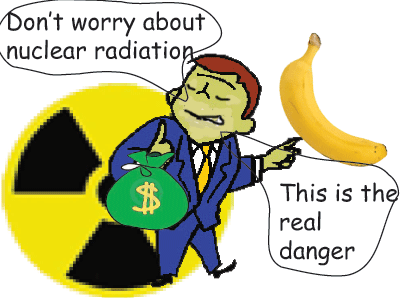
The pro-nuclear lobby goes bananas https://beyondnuclearinternational.org/2018/05/20/the-pro-nuclear-lobby-goes-bananas/
Japanese government’s inflexibility in keeping its nuclear power goals, despite the global transition to renewables

 Gov’t energy plan inflexibility on nuclear, renewables reveals lack of vision (Mainichi Japan) The government has unveiled its revised basic energy plan, though its core elements concerning the ratio of Japan’s electricity needs to be supplied by nuclear power and renewables by fiscal 2030 has not changed from the plan adopted three years ago.
In that three years, conditions surrounding energy production have changed drastically both inside and outside Japan, so it is very difficult to understand why the government has chosen to simply maintain course.
The energy plan calls for 20-22 percent of Japan’s energy mix to be made up of nuclear power in 2030, with renewables accounting for 22-24 percent — just as the 2015 version did. However, while Japan has been marking time, other advanced nations have been moving fast to expand solar and other renewable power generation. The reason is simple: measures to combat global warming simply cannot wait.
…….Renewable energy already makes up about 15 percent of Japan’s electricity production. The big utilities have also been expanding their renewable generation base as electricity market liberalization has spurred competition. Keeping the 2030 renewables target as-is could discourage this trend.
We must also question the continuing role projected for nuclear power. Around 30 reactors would be required to fill 20-22 percent of Japan’s energy needs as laid out in the plan, but only eight are now back in operation following the shutdowns after the triple-meltdown at the Fukushima No. 1 nuclear plant.
Serious questions are being raised over the economic viability of nuclear plants, as is shown by the fact that Kansai Electric Power Co. decided last year to decommission two of its larger reactors. Even experts are shaking their heads in doubt at the energy plan’s targets for nuclear power generation……..https://mainichi.jp/english/articles/20180519/p2a/00m/0na/016000c
Missouri legal case – claim that cancer caused by Manhattan Project

 Woman claims Manhattan Project caused her cancer https://stlrecord.com/stories/511423482-woman-claims-manhattan-project-caused-her-cancer, by Amanda Thomas | May 20, 2018, ST. LOUIS – A Florissant woman has filed a lawsuit against a biopharmaceutical company and chemical-producing corporation for alleged negligence related to the disposal of “hazardous, toxic, and radioactive materials” near residential neighborhoods in St. Louis County.
UK’s contentious new arrangement for nuclear safeguards, following exit from Euratom
 David Lowry’s Blog 17th May 2018 , Brexit correspondent missed the main issue arising from the UK nuclear
regulator’s report leaked to Sky News. On July 13 last year, the UK
Government position paper on “Nuclear materials and safeguards issues,”
included the key proposal that the UK will: “take responsibility for
meeting the UK’s safeguards obligations, as agree with IAEA
(International Atomic Energy Agency).”
Currently “ safeguards” are applied in the UK under a ‘voluntary ‘trilateral treaty between the UK,
Euratom and the IAEA. It comprises 36 pages in total, opening with the key
element in the treaty stating in A r t i c l e 1(a) “The United Kingdom
shall accept the application of safeguards, in accordance with the terms of
this Agreement, on all source or special fissionable material in facilities
or parts thereof within the United Kingdom, subject to exclusions for
national security reasons only (my emphasis)
The exclusion opt out is explained at Article 14 which reads in part: “If the United Kingdom
intends to make any withdrawals of nuclear material from the scope of this
Agreement for national security reasons …. it shall give the Community
(ie Euratom) and the Agency (IAEA) advance notice of such withdrawal…”
The ONR has been given unprecedented responsibility for policing a
diplomatically contentious new arrangement, which will increase suspicion
among member states of the 1968 nuclear nonproliferation treaty ( for which
the UK , as a co-drafter of the treaty text, is one of three depositary
states) – which ministers pray-in-aid whenever they discuss the rationale
for a UK nuclear safeguards system. However, ministers routinely
cherry-pick those parts of the NPT that suite their purposes: but the NPT
is an integrated diplomatic agreement, with its articles all relevant and
related.
Cherry-picking is both diplomatically unwise, as it normalises
abrogation for other signatory nations, and undermines the very treaty for
which the UK is supposed to act as a protective depositary state!
http://drdavidlowry.blogspot.co.uk/2018/05/uk-nuclear-safeguardsare-dangerously.html
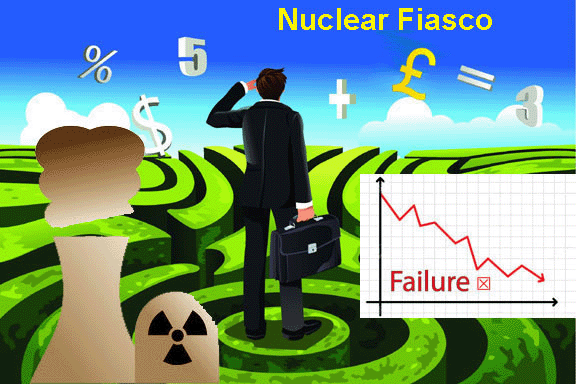
Hitachi’s nuclear export transfers risks to both Japanese and British people while companies get profits
 Urgent Joint Statement: Hitachi’s nuclear export transfers risks to both Japanese and British people while companies get profits http://www.foejapan.org/en/energy/doc/180502.html
Hitachi’s Chairman Nakanishi is reportedly going to visit British Prime Minister Teresa May on 3rd May to ask the U.K. government to take a direct stake in Wylfa Newydd nuclear power project in Anglesey, Wales. The report says Hitachi is going to ask not only for direct investment but also an assurance for a power purchase agreement(1). Hitachi’s struggle just shows the risks of the nuclear power project is simply huge.
In February, Mr. Nakanishi already expressed the view that the project would not happen without government commitment and stated “Both UK and Japanese governments understand that the project would not go on without the commitment by the governments”(2). To reduce the risk of the project, the project is said to be insured by Nippon Export and Investment Insurance(NEXI), 100 percent Japanese government owned export credit agency(3).
In addition to huge construction cost, nuclear projects are associated with various risks such as accidents, increased cost for tougher regulations, opposition from local people, radioactive waste management and so on. Risks are too huge to manage. Thus, it is clear that companies should decide to retreat from the project. While transferring risks of the project to people, it is unacceptable that the companies and banks take profits.
Electricity generated from Hinkley Point C nuclear power, which is currently under construction in UK will be purchased at £92.5/MWh, which is approximately twice as expensive as the average market price. National Audit Office of UK warned that this would increase ratepayers burden (4). If UK government gives an assurance for expensive price of electricity to Hitachi, the project will put more burden not only Japanese taxpayers with huge risks, but also British ratepayers with huge costs. For whose sake is this project?
The project site for Wylfa Newydd is surrounded by pristine nature. Colonies of protected bird such as Arctic terns was discovered near the site(5). The National Welsh Coastal Path borders the land bought by Hitachi which is in an area of Otstanding Natural Beauty. The project would put a heavy burden on the social and economic infrastructure on the island rather than benefitting the local economy(6) .
“Don’t pour good money in to the bottomless black hole of nuclear power. This is an old fashioned, dirty, dangerous and extortionately expensive technology. The Fukushima triple explosions and meltdowns has and will continue to cost the people of Japan greatly. There is no end in sight for this continuing tragedy, which means that no new nuclear reactors are going to be built in Japan. It is unacceptable that Japan wish to export this deadly technology to another state in order to keep Japan in the nuclear club.”
TEPCO’s Fukushima Daiichi nuclear accident is not over. Globally the cost of renewable energy decreases dramatically and energy efficiency is also improved. Exporting nuclear power is against that trend. This is morally and economically the wrong direction. Moreover, pouring public money to a handful of private companies without consulting the public or having discussion at a parliament is unacceptable.
Japanese government and companies should seek and promote nuclear phase out and sustainable and democratic energy systems based on thorough reflection on the lessons learned from the nuclear accident. We strongly oppose Hitachi’s Wylfa Newydd project. No money from Japanese and British taxpayers should be used to save this totally outdated and dangerously wasteful project.
1. “Hitachi seeks assurance from UK’s May on shared stake in nuclear project” Nikkei Asia Review, 29th April 2018.
2. ”Committements by both UK and Japanese government necessary fro Hitachi’s nuclear project, says next chair of Keidanren” (In Japanese) Reuters, 13th Feb 2018.
3.“Japanese and UK government to support Hitachi’s nuclear project, loss may result in public financial burden (in Japanese)” Asahi Shimbun, 11th Jan 2018.
4. “Hinkley Point C” National Audit Office, 23th June 2017
5.“Plans for Welsh nuclear power plant delayed by concerns over seabirds” Guardian, 9th Apr 2018.
6.“Wylfa Newydd: Nuclear plant ‘increases homelessness risk’” BBC, 27th Mar 2018.
Contact:
Friends of the Earth Japan
fukakusa@foejapan.org
+81-3-6909-5983
Ayumi Fukakusa
People Against Wylfa B
pawbcymru@gmail.com
Dylan Morgan
Saudi Arabia angst over the geopolitics of nuclear deals
The cloak that hides the dagger – nuclear deals and geopolitics, Daily Maverick , Saliem Fakir • 18 May 2018The nature of nuclear plants make them very prone to sovereign compromise if national governments can no longer pay their debt bills.
Nuclear deals should not be seen as pure commercial arrangements but sometimes an apparatus of geo-politics, especially in state-to-state relations. They are always more than what you can see from the surface. Perhaps, what is true about nuclear may be true about other technologies and large-scale infrastructure or resource extraction deals.
The question arises as to whether South Africa is not long overdue in having a foreign investment review process for private or state foreign firms in matters that of national security and where investments could pose a sovereign risk to the national economy
Large-scale infrastructure projects concentrate capital (usually debt), technical expertise and long-term supply and maintenance arrangements with foreign firms. Unpaid debt can be converted into odious obligations by a foreign power.
There has been some focus on Russia’s nuclear interests, via Rosatom, in South Africa’s bid to secure a nuclear fleet – with somewhat dubious reasons under Jacob Zuma’s presidency.
While, the Russians got the lion’s share of attention the courts in fact ruled, in the case brought by Earthlife Africa (ELA) and the South African Faith Communities Environment Institute (SAFCEI), against all agreements signed by the South Africa government forcing a retreat from early agreements signed with the US, South Korea, China and Russia.
The courts sent the government back to the drawing board with parliament to debate and vet these agreements in future.
This is all now a moot point given that nuclear power is unlikely to be pursued as part of South Africa’s energy mix under President Cyril Ramaphosa. This being said some future insights can be gained on the nexus between large infrastructure programmes and their relation with geo-politics and geo-economics.
This is a topic less of a focus here and hardly debated nor appreciated given how much of the world is now in the throes of multi-polarity and geopolitical rivalry. In this world – state-to-state relations will gain ascendency even if market mechanisms are used. When it comes economic rebooting even ‘non-interfering’ states in liberalised market economies are willing to do the bidding of their flagship firms. Foreign relations easily mesh with geo-economic interests.
This is because liberal economists see the utopia of markets and not the world as it is, and the world as it is, is being slowly shaped by great power rivalries, in a range of geographies vital to sustaining such power.
On the geographical point consider Djibouti: its strategic location at a crucial choke-point and Sea Lane of Communication (SLOC), through which vital shipping passes between Europe and Asia, is home to multiple military bases of rival powers. Djibouti’s economy is highly dependent on revenue from these military bases and its entire economic logic is shaped by security concerns in the Gulf of Aden and Bab-al-Mandeb – the narrowest point going through the Red Sea given the situation of conflict in Somalia and Yemen.
………The irony is that the hand of geopolitics is everywhere to be seen but little examined here on our shores both in theory and as its existence manifests within the sinews of each deal that involves state-to-state relations or even seemingly independent market pursuits by flagship multinationals who are also proud carriers of their national flag.
……….The nature of nuclear plants make them very prone to sovereign compromise if national governments can no longer pay their debt bills.
If one is beholden to a long continuity of dependence (given the long life-span of nuclear plants) for expertise and debt obligations then autonomy will have to soften and give way to compromise and concessions in other arenas of the economy if these obligations cannot be met. A quick scan of the history of sovereign debt and foreign relations will easily make clear the poignancy of the narrative presented above.
…….A geopolitical story is unfolding as Saudi Arabia is seeking to build nuclear plants putting the US in a Catch-22.
The US has to give permission to the Saudi requests for it to go ahead with a nuclear power programme as US companies are also keen to bid and be freed up to supply the necessary technology and materials to the Saudis through the behest of the NSG. Otherwise the Saudis will turn to others.
Naturally, the US is concerned about nuclear arms race in the Middle East in the light of the now collapsing nuclear deal with Iran under the Joint Comprehensive Plan of Action (JCPOA) given that the US has withdrawn from it. Other fronts where national interests confront foreign control over strategic assets are the interest of China Nuclear Gen’s bid to buy a stake in Britain’s NuGen in Moorside. The British desperately want foreign investment but also do not want to have their economy held at ransom to Chinese nuclear plant operators if Britain is still part of the western alliance. China’s bid has not been short of anxious Brits concerned about national security.
The litany of examples need not be given further detail here as the point has been made.
The question of geopolitics and sovereign geo-economic interests will become more the norm than not in the future. A foreign investment review process is long overdue in the light of the fact that South Africa nearly saw itself caught up in a foreign power’s geopolitical games: even when hidden under the cover of commerce there is the fear that behind the silky cloak there is possibly also a dagger. DM https://www.dailymaverick.co.za/opinionista/2018-05-18-the-cloak-that-hides-the-dagger-nuclear-deals-and-geopolitics/#.WwHjPDSFPGg
Uncertainty about China’s nuclear power future
“……….Uncertainties for Nuclear Power, Carnegie Endowment, Mark Hibbs, 14 MAY 18
China’s nuclear power wager might not indefinitely pay high dividends. Until now, the state has boosted the nuclear power industry with incentives that, in the future, may come under pressure. The electric power system is subject to reform in the direction of more transparent oversight and pricing that might disadvantage nuclear investments. President Xi Jinping supports state control of strategic economic sectors, but he also advocates market reforms that have helped lead Western nuclear power industries into crises.
The nuclear sector must withstand what Xi calls “new normal” conditions: a gradual slowing down of China’s economy, characterized by diminishing returns on capital goods investments and translating into rising debt and overcapacity. Nuclear investments may be affected by demographics, changes in electricity load profile, and technology innovations including emergence of a countrywide grid system able to wheel bulk power anywhere.
There is also political risk. Public support for nuclear power in China is volatile and may be low. Concerns since the Fukushima Daiichi accident in Japan have prompted Beijing not to proceed with long-established plans to build most of China’s future nuclear plants on inland sites. Should this policy continue into the 2020s, prospects for China’s nuclear construction sector will decline; indefinitely continuing nuclear construction at eastern coastal sites (where nearly all of China’s nuclear power is generated) may encounter resistance on economic, capacity, and political grounds.
Under Xi, China’s globalization continues but the state is assuming ever-greater liability. Political decisionmaking and corporate culture may not support an indefinite increase in the risk presented by more nuclear power investments. Some quasi-official projections before Fukushima that China by 2050 might have 400 or more nuclear power plants have been cut in half. Beijing’s risk calculus may reflect that China’s population would blame the Communist Party and the state for a severe nuclear accident. In a country with a patchy track record for industrial safety, said one Chinese planning expert in 2016, “The more reactors we have, the greater our liability.”
…….. If China merely replicates others’ collective past experience, it will reinforce the view that fast reactors and their fuel cycles are too risky, complex, and expensive to generate large amounts of electricity.
- If China merely replicates others’ collective past experience, it will reinforce the view that fast reactors and their fuel cycles are too risky, complex, and expensive to generate large amounts of electricity.
- ……. ……..Whether China succeeds or fails, the global repercussions will be significant. …..https://carnegieendowment.org/2018/05/14/future-of-nuclear-power-in-china-pub-76311
Mox plutonium reprocessing plant has been a huge waste of U.S. taxpayers’ money
Another SC nuclear boondoggle could soon meet its end. This time it’s $7B in taxpayer money wasted, Post and Courier By Andrew Brown abrown@postandcourier.com , – May 20, 2018
1 This Month

of the week – Shut Down Drone Warfare!


Tell the Ukrainian Government to Drop Prosecution of Peace Activist Yurii Sheliazhenko

Petition to revoke the licensing of the Near Surface Nuclear Disposal Facility (NSDF) at Chalk River. https://www.ourcommons.ca/petitions/en/Petition/Details?Petition=e-7247
To see nuclear-related stories in greater depth and intensity – go to https://nuclearinformation.wordpress.com
-
Archives
- March 2026 (244)
- February 2026 (268)
- January 2026 (308)
- December 2025 (358)
- November 2025 (359)
- October 2025 (376)
- September 2025 (257)
- August 2025 (319)
- July 2025 (230)
- June 2025 (348)
- May 2025 (261)
- April 2025 (305)
-
Categories
- 1
- 1 NUCLEAR ISSUES
- business and costs
- climate change
- culture and arts
- ENERGY
- environment
- health
- history
- indigenous issues
- Legal
- marketing of nuclear
- media
- opposition to nuclear
- PERSONAL STORIES
- politics
- politics international
- Religion and ethics
- safety
- secrets,lies and civil liberties
- spinbuster
- technology
- Uranium
- wastes
- weapons and war
- Women
- 2 WORLD
- ACTION
- AFRICA
- Atrocities
- AUSTRALIA
- Christina's notes
- Christina's themes
- culture and arts
- Events
- Fuk 2022
- Fuk 2023
- Fukushima 2017
- Fukushima 2018
- fukushima 2019
- Fukushima 2020
- Fukushima 2021
- general
- global warming
- Humour (God we need it)
- Nuclear
- RARE EARTHS
- Reference
- resources – print
- Resources -audiovicual
- Weekly Newsletter
- World
- World Nuclear
- YouTube
-
RSS
Entries RSS
Comments RSS
 nuclear-news