France’s “revolving door” between nuclear power managers and politicians: big conflict of interest!
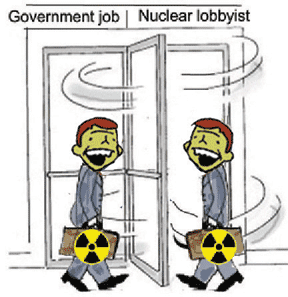 Liberation 2nd May 2018 , The practice of ” revolving doors” consisting of going back and forth
between public and private, without worrying too much about conflicts of
interest, is not the prerogative of the French elite and concerns all
sectors of the world. activity in Europe.
But according to a report to be published Wednesday by the group of Greens in the European Parliament, it
is particularly developed in France in the fossil and nuclear energy
industries. What explain a certain lack of voluntarism in terms of
ecological transition. This 82-page document entitled “Revolving Doors and
the Fossil Fuel Industry” , which Libération has procured, reviews the
“warm relations” that have developed in the main countries of the Union
between policy makers and large companies energy through these famous
revolving doors.
http://www.liberation.fr/france/2018/05/02/energie-les-portes-du-pouvoir-ouvertes-a-tous-les-vents-du-lobbying_1646907
A containment failure: How American nuclear regulators undercut power plant safety from the beginning
 Bulletin of Atomic Scientists 4th May 2018 , In 1965, the US Atomic Energy Commission made a fateful decision to license
nuclear power plants that, top safety experts believed, had containment structures that were inadequate to contain dangerous releases of
radioactivity in the case of core-melting accidents.
It was a critical turning point in reactor safety. The AEC’s downgrading of the containment’s role opened the door to smaller, cheaper, “dynamic”
containments, which offered significantly less protection in case of a fuel melt accident. Buyers of nearly four dozen large US power reactors opted
for the most vulnerable of such containments, of which 30 remain in
operation.
Because of their inadequate containments, they should all be retired. All but one have exceeded their original 40-year license
durations. New plants shouldn’t be licensed unless they include containments that actually do what they were originally supposed to do –
contain all radioactive material, even in a worst-case melt-down of a nuclear reactor core.
Climate Change Turns Coastal Property Into a Junk Bond
Climate Change Turns Coastal Property Into a Junk Bond, The returns can be great, unless the investment winds up under water. Bloomberg, By Noah Smith, May 3, 2018 “……… Even in the worst-case scenario, sea level rise will be moderate by 2050 — perhaps 1 or 2 feet along most U.S. east coast locations. And there’s a good chance it will be much less.
A rise of that magnitude doesn’t sound like a lot. But it would inundate a number of low-lying coastal areas. The National Oceanic and Atmospheric Administration’s sea level rise viewer app lets you play around with the data and look at maps. Even a moderately bad climate-change scenario could swamp some pieces of coastal real estate within a few decades.
But sea level rise isn’t a gradual, steady thing. The ocean is not a still bowl of water, but a roiling mass tossed around by winds and tides. Long before coastal areas are permanently underwater, they’ll experience increased risk of catastrophic flooding. Hurricane Harvey, which last year flooded much of the city of Houston and became the second most expensive natural disaster in U.S. history (behind another wind-induced coastal flood, 2005’s Hurricane Katrina), is probably a harbinger of more frequent storm-driven disasters.
So for the next few decades, climate change probably won’t send coastal real estate prices crashing, but it does create a tail risk for buyers. Increased probability of coastal flooding makes waterfront real estate a bit like a junk bond — something that will probably go up in value, but has a small to moderate chance of going to zero. Junk bonds generally don’t have a value of zero, but the risk of devastation definitely does depress their selling price.
Recent research confirms that the climate threat is already showing up in prices. Economists Asaf Bernstein, Matthew Gustafson and Ryan Lewis have a recent paper showing that houses exposed to sea-level rise of between 0 and 6 feet have been selling at a 7 percent discount relative to houses a similar distance from the beach that aren’t exposed. The time period they look at is 2007-2016 — before the damage from Harvey. They also confirm that the discount is higher in locations where people report more worry about climate change.
Another recent study, by environmental researchers Jesse Keenan Thomas Hill and Anurag Gumber, shows something similar. Focusing on Miami-Dade County, they show that higher-elevation locations have risen in price faster than similar locations at low elevations. That’s consistent with the theory that wealthy buyers pay a premium to escape flooding risk. High-elevation areas could also have other benefits, of course, such as increased safety from crime — but with crime down dramatically in Miami, this is a less convincing explanation of the increased elevation premium.
In fact, the price differences these economists find may be understating people’s worries about climate change, because of flood insurance. The U.S. government insures many coastal properties against floods, mostly in Texas and Florida. The National Flood Insurance Program charges below-market premiums to many of the riskiest houses, effectively subsidizing owners of the properties most vulnerable to coastal flooding.
So evidence shows that landlords, homeowners and real estate investors are now taking climate change seriously. Polls still find a big partisan gap in concern about climate change, with 67 percent of Republicans claiming that they worry only a little or not at all. But in financial markets, the reality of the phenomenon is starting to be felt. Noah Smith at nsmith150@bloomberg.net https://www.bloomberg.com/view/articles/2018-05-03/flood-risk-makes-coastal-real-estate-look-like-a-junk-bond
Climate Change Ignores all Borders as Rain Bombs Fall on Kauai and the Middle East Alike

The weaponization of weather language has long been a topic of some controversy in the meteorological press. Peace-loving people the world over rightly try to communicate in a manner that discourages violent conflict. And the term ‘rain bomb’ has taken quite a lot of flak from those with thus-stated good intentions.
However, whether or not the language itself bristles with perceived warlike phrases, the weather itself is steadily being weaponized against everyone and everything living on the face of planet Earth by the greenhouse gasses fossil fuel related industries and technologies continue pumping into the air.

(Bruce Haffner snapped this photo of an extreme heavy rainfall event over Phoenix, AZ during 2016. Climate change has been increasing the intensity of the most severe storms. So we see historic an unusually strong events more and more frequently.)
So I’ll add this brief appeal before going into another climate change related extreme…
View original post 858 more words
May 3 Energy News

Opinion:
¶ “Concrete is a disaster for our planet: can the building industry break its addiction?” • There are myriad proposed solutions to the problems posed by concrete, such as changing the way we make concrete, creating sustainable alternatives, or doing away with it altogether. But we use so much of it that it is hard even to imagine life without it. [CNN]
 High-rise buildings (CNN image)
¶ “Is Offshore Wind About To Hit Cost-Competitiveness In New York And New England?” • Offshore wind may seem pricey, but it is actually extremely valuable. Analysis from the Lawrence Berkeley National Laboratory shows that the market value of electricity generated by offshore wind will soon exceed its cost in the Northeast. [Forbes]
¶ “Are public objections to wind farms overblown?” • Renewable energy researchers wanted to see how much local opposition there is to existing wind farms across…
View original post 765 more words
Proposed UK Coal Mine: Proximity to Sellafield Nuclear Site and Earthquakes – Letter — Mining Awareness +

Originally posted on Keep Cumbrian Coal in the Hole: Excellent letter in last weeks Westmorland Gazette in reply to previous letter dismissing concerns about the coal mine plan. Anita’s letter points out the close proximity of the proposed coal mine to Sellafield and the inconvenient truth that coal mining causes earthquakes. Anita who wrote the…
1 This Month


Tell the Ukrainian Government to Drop Prosecution of Peace Activist Yurii Sheliazhenko

Petition to revoke the licensing of the Near Surface Nuclear Disposal Facility (NSDF) at Chalk River. https://www.ourcommons.ca/petitions/en/Petition/Details?Petition=e-7247


of the week – STOP SMALL MODULAR REACTORS IN CANADA
To see nuclear-related stories in greater depth and intensity – go to https://nuclearinformation.wordpress.com
-
Archives
- March 2026 (204)
- February 2026 (268)
- January 2026 (308)
- December 2025 (358)
- November 2025 (359)
- October 2025 (376)
- September 2025 (258)
- August 2025 (319)
- July 2025 (230)
- June 2025 (348)
- May 2025 (261)
- April 2025 (305)
-
Categories
- 1
- 1 NUCLEAR ISSUES
- business and costs
- climate change
- culture and arts
- ENERGY
- environment
- health
- history
- indigenous issues
- Legal
- marketing of nuclear
- media
- opposition to nuclear
- PERSONAL STORIES
- politics
- politics international
- Religion and ethics
- safety
- secrets,lies and civil liberties
- spinbuster
- technology
- Uranium
- wastes
- weapons and war
- Women
- 2 WORLD
- ACTION
- AFRICA
- Atrocities
- AUSTRALIA
- Christina's notes
- Christina's themes
- culture and arts
- Events
- Fuk 2022
- Fuk 2023
- Fukushima 2017
- Fukushima 2018
- fukushima 2019
- Fukushima 2020
- Fukushima 2021
- general
- global warming
- Humour (God we need it)
- Nuclear
- RARE EARTHS
- Reference
- resources – print
- Resources -audiovicual
- Weekly Newsletter
- World
- World Nuclear
- YouTube
-
RSS
Entries RSS
Comments RSS
 nuclear-news