The UN’s climate change body releases its first annual report

 http://www.climateactionprogramme.org/news/the-uns-climate-change-body-releases-its-first-annual-report, 1 May 18 The UN’s official climate secretariat has launched its first annual report into its work in combatting climate change.
The body is instrumental in delivering the commitments of the Paris Agreement and Kyoto Protocol to reduce carbon emissions and prevent the rise in global temperatures.
“Climate Change is the single biggest threat to life, security and prosperity on Earth,” said executive secretary Patricia Espinosa.
“This annual report shows how UN Climate Change is doing everything it can to support, encourage and build on the global response to climate change,” she added.
The report covers what UN Climate Change sees as its key achievements over the past year including its official conference, COP23, in Bonn. The 30,000 people who attended helped ensure action on climate change was maintained, including the importance of commitments before 2020.
The conference also saw financial commitments of almost $1 billion made by member states on partners. Norway led a coalition pledging $400 million to support sustainable agriculture and forest management. Germany, the UK, and others also pledged $153 million to fight deforestation in the Amazon rainforest.
The launch of the Talanoa Dialogues have been a central part of UN Climate Change’s work in 2017. This Fiji-led idea is designed to be a ‘global conversation’ to involve as many people in climate action as possible. The Dialogues aim to inform and inspire member states as they work on their climate commitments. UN Climate Change’s first-ever Gender Action Plan was also launched to increase the participation of women in the response to climate change.
The report also looks to the challenges throughout 2018, including the official adoption of the Paris Agreement’s work programme and procedures in December.
“Throughout 2018 and beyond, let us do all in our power, together, to accelerate action,” said Ms. Espinosa. “Only by doing so can we succeed in protecting our planet from climate change and securing a low-carbon, sustainable future.”
In addition, the report also details the agency’s total funding, with its running costs now reaching $98 million, covering its rolling programmes and activities. $29 million is set aside as part its core budget. Staff costs for its 400 employees are now at $1.5 million.
UK: Many cops guarding nuclear weapons found to be unfit
Daily Record 30th April 2018 , Dozens of elite gun cops tasked with protecting Britain’s nuclear weapons
at Faslane and other military sites are too unfit to carry firearms, it
emerged yesterday. A shocking report into the Ministry of Defence Police
reveals “concern” at the growing number who have been sidelined. The
crisis has emerged after tougher fitness tests equal to those taken by
other armed officers were introduced. Some MoD police – whose jobs include
guarding the nuclear submarine fleet at Faslane, SAS headquarters in
Hereford and GCHQ’s Cheltenham base – have failed the new tests. Others
have simply refused to take part, the Mail on Sunday reported.
https://www.dailyrecord.co.uk/news/scottish-news/gun-cops-faslane-too-unfit-12451711
Rare eye cancer cases reported (not a mention of proximity to nuclear station)
Doctors are stumped after at least 36 people from SAME Alabama college are diagnosed with rare eye cancer that affects only six in every million
- Researchers are investigating the cause of ocular melanoma in two communities
- Eighteen people in Huntersville, North Carolina have been diagnosed
- A troubling and rising number of people affiliated with Auburn University in Alabama have been diagnosed as well
- The rare disease affects only six out of every one million people
- One woman started an Auburn ocular melanoma Facebook page where 36 people reached out saying they too have been diagnosed
- The university has launched its own investigation
A rare eye cancer has struck 18 people in North Carolina and reportedly 36 more in Alabama, leaving doctors stumped as they search for a cause.
Only six out of every one million people are diagnosed with ocular melanoma each year.
Four friends with the rare cancer who attended Auburn University together believe an investigation into their alma mater may find the cause.
In January, 18 patients within a 15-mile radius were diagnosed with the cancer in Huntersville, North Carolina.
The four friends with ocular melanoma, have learned of 36 other Auburn University grads or workers who have the cancer as well, according to CBS………
Although the situation in Auburn has not been dubbed a cluster, the group of patients with the cancer in Huntersville has been defined as a cancer cluster.
In Huntersville not only have 18 people have been affected, but four have died within a 15-mile radius due to the illness.
Oddly the cancer, although more typically found in men in their 60s, has affected majority women in their 30s or younger in the community.
Investigators studying the Huntersville cluster with accounts dating back to 2014, published a report earlier this month that said no cause of the cluster has been found.
The study investigated air, water and land related issues but it yielded no findings towards a cause.
‘It’s just hard to believe that there’s not a common thread here. I just keep thinking they need to do more,’ Mecklenburg County Commissioner Pat Cotham said to WCNC. http://www.dailymail.co.uk/news/article-5675573/Rare-eye-cancer-strikes-communities-North-Carolina-Alabama.html#ixzz5EDN7ZUDA
Hitachi seeks talks to slash shareholding in UK nuclear business, seeks direct government funding
Nikkei Asian Review 29th April 2018 , Chairman to ask British premier May to take direct stake in Horizon power unit.
Hitachi will ask the U.K. government to take a direct stake in the company
that is to build and operate a nuclear power plant in Wales which is now
100% owned by the Japanese industrial company.
Hitachi expects the U.K. government will invite private British companies to participate and hopes
to reduce its own stake to less than 50%. Hitachi has recently concluded
that the risk of proceeding with the Anglesey project, at an estimated cost
of more than 3 trillion yen ($27.5 billion), is too great to manage on its
own as a private company.
It plans to withdraw from the project if restructuring negotiations fall through. Such a move would have significant
repercussions for nuclear power policy for both Britain and Japan. In
response to Hitachi’s concerns, the British government earlier this month
proposed that U.K. interests and Japanese public and private interests join
with Hitachi to move Anglesey forward. The three sets of shareholders would
each put 300 billion yen into the project, giving each a one-third stake.
According to sources, the company and the Japanese government see it as too
risky for Japanese interests to retain a majority shareholding and hope
that British interests will acquire a controlling stake.
https://asia.nikkei.com/Business/Companies/Hitachi-seeks-talks-to-slash-shareholding-in-UK-nuclear-business
Legal discussions over failed nuclear plants – will result in tougher regulations
 Tougher utility regulations advance, as attorneys argue over failed S.C. nuclear project https://www.postandcourier.com/business/tougher-utility-regulations-advance-as-attorneys-argue-over-failed-s/article_872a5b7c-4d5d-11e8-8743-b78c8b42b82a.html, By Andrew Brown abrown@postandcourier.com
Academy apologizes for Taoist blessings at nuclear project
http://www.globaltimes.cn/content/1100320.shtml
The Beijing-based academy apologized for not restraining the behavior of its partner, claiming the ritual was “against the spirit of science” in a statement released on its official Sina Weibo account on Monday.
He Zhanjun and Cao Yuxiang, employees at the academy’s Shanghai institute of applied physics, were suspended on Monday after the institute found they were present at the ritual but did nothing to stop it.
The Thorium Molten Salt Reactor Nuclear Energy System is a project developed by the academy and the Gansu government at a total cost of 22 billion yuan ($3.48 billion).
Seven officials from Minqin county, Gansu Province are also being investigated by a local discipline watchdog after pictures of the ritual went viral.
The photos showed a Taoist monk holding religious items and reciting incantations as a lamb was slaughtered and yellow papers with Taoist spells were burned in front of him.
The heated debate, whether for or against, was valuable in attracting public attention to projects involving large amounts of public money, noted Zhao Chu, a Shanghai-based columnist and military affairs specialist.
“At a time when knowledge and sciences are advocated, we should also reserve some respect for historical and cultural heritage as well as local and religious customs,” Zhao wrote in an article posted on news site qq.com on Tuesday.
1 This Month
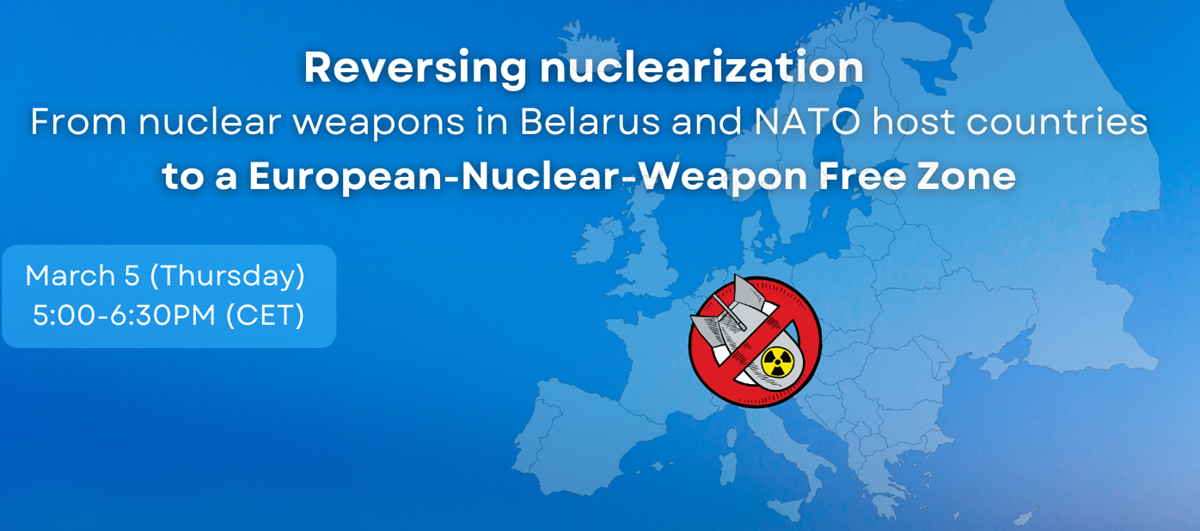
5 March -Online – Reversing nuclearization:
From nuclear weapons in Belarus and NATO host countries to a European-Nuclear-Weapon Free Zone
11am-12:30pm Eastern Time USA / 5pm-6:30pm CET

of the week – Advocating for a
nuclear free beach – https://www.samuellawrencefoundation.org/
The Samuel Lawrence Foundation advocates for a Nuclear Waste Free Beach at San Onofre, join us and take action!

10 March A LIVE WEBINAR THE REAL EFFECTS OF NUCLEAR POWER
What the Industry Isn’t Telling Us
1:00 PM Mountain, 2 pm Central, 3 pm Eastern. Live on the Keepers of the Water Facebook page

18 March Webinar @ 1 PM EST: An Assessment of SMR Projects: The Case of Canada
register for the zoom:
https://us02web.zoom.us/webinar/register/WN_o8BIIOUvQ2ONJR1nta65DQ#/registration

of the week – STOP SMALL MODULAR REACTORS IN CANADA
To see nuclear-related stories in greater depth and intensity – go to https://nuclearinformation.wordpress.com
-
Archives
- March 2026 (37)
- February 2026 (268)
- January 2026 (308)
- December 2025 (358)
- November 2025 (359)
- October 2025 (376)
- September 2025 (258)
- August 2025 (319)
- July 2025 (230)
- June 2025 (348)
- May 2025 (261)
- April 2025 (305)
-
Categories
- 1
- 1 NUCLEAR ISSUES
- business and costs
- climate change
- culture and arts
- ENERGY
- environment
- health
- history
- indigenous issues
- Legal
- marketing of nuclear
- media
- opposition to nuclear
- PERSONAL STORIES
- politics
- politics international
- Religion and ethics
- safety
- secrets,lies and civil liberties
- spinbuster
- technology
- Uranium
- wastes
- weapons and war
- Women
- 2 WORLD
- ACTION
- AFRICA
- Atrocities
- AUSTRALIA
- Christina's notes
- Christina's themes
- culture and arts
- Events
- Fuk 2022
- Fuk 2023
- Fukushima 2017
- Fukushima 2018
- fukushima 2019
- Fukushima 2020
- Fukushima 2021
- general
- global warming
- Humour (God we need it)
- Nuclear
- RARE EARTHS
- Reference
- resources – print
- Resources -audiovicual
- Weekly Newsletter
- World
- World Nuclear
- YouTube
-
RSS
Entries RSS
Comments RSS
 nuclear-news