Guardian 25th April 2018 ,Hundreds of thousands of people will be forced from their homes on
low-lying islands in the next few decades by sea-level rises and the contamination of fresh drinking water sources, scientists have warned.
A study by researchers at the US Geological Survey (USGS), the Deltares Institute in the Netherlands and Hawaii University has found that many small islands in the Pacific and Indian Oceans will be uninhabitable for humans by the middle of this century. That is much earlier than previously thought.
Experts say the findings underline the looming climate change driven migration crisis that is predicted to see hundreds of millions of people forced from their homes in the coming years. More than half a
million people around the world live on atoll islands, often extraordinary and beautiful structures based on coral reefs. Their closeness to sea level makes them particularly vulnerable to climate change. https://www.theguardian.com/environment/2018/apr/25/climate-change-to-drive-migration-from-island-homes-sooner-than-thought
Russian Arctic glacier loss doubles as temps warm https://www.eurekalert.org/pub_releases/2018-04/cu-rag042518.php, CORNELL UNIVERSITY , 25 Apr 18, ITHACA, N.Y.– Ice mass loss in the Russian Arctic has nearly doubled over the last decade according to Cornell University research published in the journal Remote Sensing of Environment.
The research focused on Franz Josef Land, a glaciated Russian archipelago in the Kara and Barents seas – among the northernmost and most remote parcels of land on Earth.
“Glaciers there are shrinking by area and by height. We are seeing an increase in the recent speed of ice loss, when compared to the long-term ice-loss rate,” said lead researcher Whyjay Zheng, a Cornell University doctoral student in geophysics. “We are finding out that the ice is changing more rapidly than we previously thought,” said Zheng. “The temperature is changing in the Arctic faster than anywhere else in the world.”
From 1953 to 2010, the average rate of ice surface loss was 18 centimeters per year. From 2011 to 2015, the ice surface decrease was 32 centimeters per year, which is a water loss of 4.43 gigatons annually, said Zheng. For perspective, that much water would raise the level of Cayuga Lake — the longest of New York state’s Finger Lakes, at 38 miles — by 85 feet and inundate the cities of Ithaca and Seneca Falls.
he Arctic has been warming in recent decades, but glaciers across the region are responding in different ways. “Previous studies have shown that the glaciers in northern Canada seem to be shrinking at a faster rate than the ones in some parts of northern Russia,” said senior author Matt Pritchard, Cornell professor of geophysics.
“Our work takes a closer look at the Russian glaciers to understand why they might be responding to a warming Arctic differently than glaciers in other parts of the Arctic. Why glaciers in Franz Josef Land have been shrinking more rapidly between 2011 and 2015 than in previous decades is possibly related to ocean temperature changes,” said Pritchard.
###
Support for Zheng’s research was provided by an Overseas Ph.D. Scholarship funded by the Ministry of Education, Taiwan.
Cornell University has television, ISDN and dedicated Skype/Google+ Hangout studios available for media interviews.
Bulletin of Atomic Scientists 24th April 2018 , During the Cold War, the United States and the Soviet Union manufactured
enormous quantities of plutonium for use in nuclear weapons. When that era
ended, the United States and the newly formed Russian Federation began to
reduce their nuclear arsenals. Both nations possessed large stockpiles of
plutonium—a problem that posed both a sustained threat to the environment
and a risk of future nuclear weapons proliferation.
In 2000, the United States and Russia pledged to dispose of their excess plutonium in order to
mitigate the security concerns, safety risks, and storage costs. They
signed the Plutonium Management and Disposition Agreement, which requires
each country to dispose of at least 34 metric tons of weapons plutonium.
Unfortunately, the agreement failed to solve the excess plutonium problem. Eighteen years later, the United States has been unable to develop a
successful strategy to safely, affordably, and permanently dispose of
plutonium from dismantled nuclear weapons, despite a high degree of
industrial capability and technical expertise. Why has the United States
been unable to either implement its obligations under the disposition
agreement or execute its own policy? And how can the Plutonium Disposition
Program finally become effective? https://thebulletin.org/what-went-wrong-us-plutonium-disposition11733
https://www.eurekalert.org/pub_releases/2018-04/ugs-ml042318.php, US GEOLOGICAL SURVEY
Sea-level rise and wave-driven flooding will negatively impact freshwater resources on many low-lying atoll islands in such a way that many could be uninhabitable in just a few decades. According to a new study published in Science Advances, scientists found that such flooding not only will impact terrestrial infrastructure and habitats, but, more importantly, it will also make the limited freshwater resources non-potable and, therefore, directly threaten the sustainability of human populations.
Most of the world’s atolls are in the Pacific and Indian oceans. The scientists focused on Roi-Namur Island on Kwajalein Atoll in the Republic of the Marshall Islands for their site study from November 2013 to May 2015. The Republic of the Marshall Islands has more than 1,100 low-lying islands on 29 atolls, is home for numerous island nations and hundreds of thousands of people.
Scientists from the U.S. Geological Survey, Deltares, National Oceanic and Atmospheric Administration, and the University of Hawai?i at Mānoa used a variety of climate-change scenarios to project the impact of sea-level rise and wave-driven flooding on atoll infrastructure and freshwater availability. The approach and findings in this study can serve as a proxy for atolls around the world, most of which have a similar morphology and structure, including, on average, even lower land elevations.
“The tipping point when potable groundwater on the majority of atoll islands will be unavailable is projected to be reached no later than the middle of the 21st century,” said Curt Storlazzi, USGS geologist and lead author of the new report.
Sea levels are rising, with the highest rates in the tropics, where thousands of low-lying coral atoll islands are located. Previous studies on the resilience of these islands to sea-level rise projected they will experience minimal inundation impacts until at least the end of the 21st century. However, those previous studies did not take into account the additional hazard of wave-driven overwash (storm waters and waves that wash up and over the low-lying island) nor its impact on freshwater availability.
“Such information is key to assess multiple hazards and prioritize efforts to reduce risk and increase the resiliency of atoll islands’ communities around the globe,” said Storlazzi.
These findings have relevance not only to populated atoll islands in the Marshall Islands, but also to those in the Caroline Islands, Cook Islands, Gilbert Islands, Line Islands, Society Islands, Spratly Islands, Maldives, Seychelles, and Northwestern Hawaiian Islands.
Thus, the study scientists project that, based on current global greenhouse gas emission rates, the interactions between sea-level rise and wave dynamics over coral reefs will lead to an annual wave-driven overwash of most atoll islands by the mid-21st century. Such annual flooding would result in the islands becoming uninhabitable due to frequent damage to infrastructure and the inability of their freshwater resources to recover between overwash events.
The primary source of freshwater for populated atoll islands is rain that soaks into the ground and remains there as a layer of fresh groundwater that floats on top of denser saltwater. As atoll islands come to be overwashed annually, on average, in the next few decades (assuming current greenhouse gas emission rates), flooding impacts to infrastructure and the loss of freshwater resources would make human habitation difficult in most locations beginning between the 2030s to 2060s, requiring the relocation of island inhabitants or significant financial investments in new infrastructure.
“The overwash events generally result in salty ocean water seeping into the ground and contaminating the freshwater aquifer. Rainfall later in the year is not enough to flush out the saltwater and refresh the island’s water supply before the next year’s storms arrive repeating the overwash events,” explained Stephen Gingerich, USGS hydrologist and co-author of the new report.
The full report, “Most Atolls will be uninhabitable by the mid-21st century due to sea-level rise exacerbating wave-driven flooding,” in Science Advances is available online.
No more drilling. Af, CARLY CASSELLA, 13 APR 2018 Prime Minister Jacinda Ardern is doing everything in her power to wean New Zealand off fossil fuels.
This week, the New Zealand government announced it will no longer grant any new offshore oil exploration permits. The 22 permits that have already been issued are set to expire in 2030.
The new Prime Minister, who took office last year, says this is all part of her aggressive, long-term plan to move towards a carbon-neutral future.
What’s behind the push against Iran nuclear deal?
Iran being ‘demonised’ for opposing western powers and their allies attempting to dominate the Middle East, experts say. Aljazeera, by Ali Younes, 27 Apr 18
A sustained effort by the administration of US President Donald Trump and its allies at home and in the Middle East to cancel, or at least renegotiate, the Iran nuclear deal appears to have succeeded in bringing one major European country, France, to its side.
French President Emmanuel Macron said during a visit to the United States this week that he hoped to “work on a new deal with Iran” following “frank discussions” with Trump.
The US president is a fierce critic of the landmark 2015 pact, signed between Tehran and the US, France, Russia, Germany, China, the UK and the European Union.
Iranian President Hassan Rouhani swiftly countered, saying: “You [Trump], along with the leader of some European country, are deciding for an agreement reached among seven parties. Who allowed you to do that?”
Iran experts argue, however, that the real issue is not Tehran’s nuclear programme, that even if it were taken out of the picture, “Iran would still be demonised and made evil” by its regional adversaries – similar to what has been happening, they argue, since the 1979 revolution.
“The root causes of Israeli and Western animosity towards Iran has to do with its opposition to Western hegemony in the region and its support and sympathy with the Palestinian people,” said Mohammad Marandy, professor at the University of Tehran.
“Iran’s key foreign policy objectives since the 1979 revolution were its moral stance against the South African apartheid and its solidarity with the Palestinian people.”
A push against Iran
The push against Iran in Washington acquired more ammunition when Trump recently appointed John Bolton as his national security adviser.
Bolton, a former US ambassador to the UN during the presidency of George W Bush, has been a vocal opponent of the 2015 deal, which was signed by the administration of President Barack Obama.
In a 2015 opinion piece at the New York Times, Bolton floated the idea of a US or Israeli bombing of Iran’s nuclear reactors.
……The deal, formally known as the Joint Comprehensive Plan of Action (JCPOA), eased sanctions on Iran in return for it agreeing that it would not develop nuclear weapons.
Fatemeh Aman, a Washington-based Iran analyst, said if Tehran “decided to make between one to three nuclear bombs, it could have made them within two, three months based on the amount of highly enriched uranium they had before they signed the agreement with the US and its allies.
“But once they signed the agreement and shipped their highly enriched uranium to Russia, Iran is now much further away from producing a nuclear bomb,” she added.
“This has put Iran nuclear programme back to 10-15 years.”
The International Atomic Energy Agency has repeatedly certified Iran’s compliance with the 2015 agreement, while the country is also a member of the Non-Proliferation Treaty (NPT) and a signatory of the Additional Protocols, which stipulate strict safeguard measures against nuclear proliferation, Aman noted…….. https://www.aljazeera.com/news/2018/04/fixation-iranian-nuclear-threat-180426085605834.html
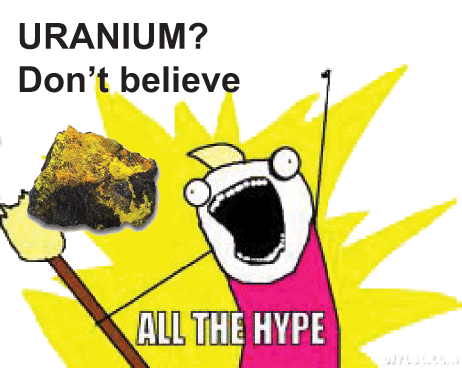
Uranium industry slumps, nuclear power dead in the water, Chain Reaction magazine, Dr Jim Green, April 2018
Very few mines could operate at a profit at current prices. Some mines are profitable because earlier contracts stipulated higher prices, while many mines are operating at a loss. Many companies have been loathe to close operating mines, or to put them into care-and-maintenance, even if the only other option is operating at a loss. They have been playing chicken, hoping that other companies and mines will fold first and that the resultant loss of production will drive up prices. “We have to recognise that we over-produce, and we are responsible for this fall in the price,” said Areva executive Jacques Peythieu in April 2017.
Current prices would need to more than double to encourage new mines ‒ a long-term contract price of about US$70–$80 is typically cited as being required to encourage the development of new mines.
The patterns outlined above were repeated in 2017. It was another miserable year for the uranium industry. A great year for those of us living in uranium producing countries who don’t want to see new mines open and who look forward to the closure of existing mines. And a great year for the nuclear power industry ‒ in the narrow sense that the plentiful availability of cheap uranium allows the industry to focus on other problems.
Cut-backs announced
The patterns that have prevailed over the past five years or so might be changed by decisions taken by Cameco and Kazatomprom (Kazakhstan) in late 2017 to significantly reduce production. Canada closed McArthur River in Canada in January and plans to keep it closed for around 10 months ‒ it had been producing more uranium than any other mine in the world. Kazakhstan has been producing almost 40% of world supply in recent years and plans to reduce production by 20% from 2018‒2020.
Previous cut-backs in Canada and Kazakhstan have had little or no effect, and so far the late-2017 announcements have had no effect. But the cut-backs are significant and their impact might yet be felt.
A late-2017 report by Cantor Fitzgerald equity research argued that the decisions by Cameco and Kazatomprom could result in a “step change” for uranium prices. But Warwick Grigor from Far East Capital was downbeat about Cameco’s announcement. “I don’t see this as a turnaround for the uranium price; at best they will stay where they are, but it doesn’t signal a boom in price,” he said in November 2017.
BHP marketing vice-president Vicky Binns said in December 2017 that uranium markets would remain oversupplied for close to a decade, with downward pressure remaining on uranium prices despite Cameco’s production cuts. She said that demand for uranium could outstrip supply by the late 2020s but that could change if developed nations close their nuclear reactors earlier than expected, or if renewables take a larger than expected market share.
Equally downbeat comments have been made by other industry insiders and analysts in recent years. Former Paladin Energy chief executive John Borshoff said in 2013 that the uranium industry “is definitely in crisis” and “is showing all the symptoms of a mid-term paralysis”. Former World Nuclear Association executive Steve Kidd in May 2014 predicted “a long period of relatively low prices”. Nick Carter from Ux Consulting said in April 2016 that he did not see a supply deficit in the market until “the late 2020s”.
Perhaps a uranium price increase is on the way but it will do little to salvage Australia’s uranium industry. Apart from BHP’s Olympic Dam mine in SA, the only other operating uranium mine in Australia is Beverley Four Mile in SA. At Ranger in the NT, mining has ceased, stockpiles of ore are being processed, and ERA is planning a $500 million project to decommission and rehabilitate the mine site.
And with the cost of a single power reactor climbing to as much as $20 billion, proposals to introduce nuclear power to Australia seem more and more quixotic and are now largely limited to the far right ‒ in particular, Australians Conservatives’ luminary Senator Cory Bernardi and the Minerals Council of Australia.
Even Dr Ziggy Switkowski ‒ who used to be nuclear power’s head cheerleader in Australia and was appointed to lead the Howard government’s review of nuclear power ‒ recently said that “the window for gigawatt-scale nuclear has closed”. He said nuclear power is no longer cheaper than renewables and the levelised cost of electricity is rapidly diverging in favour of renewables. https://www.foe.org.au/uranium_industry_slumps
Jim Green is the national nuclear campaigner with Friends of the Earth Australia and editor of the Nuclear Monitor newsletter produced by the World Information Service on Energy and the Nuclear Information & Resource Service.
Published in Chain Reaction #132, April 2018. National magazine of Friends of the Earth Australia. www.foe.org.au/chain_reaction_132
IN 1961, AS JOHN F. Kennedy was inaugurated, Cold War tensions were running high, and the military had planes armed with nuclear weapons in the air constantly. These planes were supposed to be ready to respond to a nuclear attack at any moment. If the planes were already in the air, the thinking went, they would survive a nuclear bomb hitting the United States.
But one of the closest calls came when an America B-52 bomber dropped two nuclear bombs on North Carolina.
In January, a jet carrying two 12-foot-long Mark 39 hydrogen bombs met up with a refueling plane, whose pilot noticed a problem. Fuel was leaking from the plane’s right wing. The wing was failing and the plane needed to make an emergency landing, soon. But before it could, its wing broke off, followed by part of the tail. The plane crash-landed, killing three of its crew. (Five other men made it safely out.)
In the plane’s flailing descent, the bomb bays opened, and the two bombs it was carrying fell to the ground.
As it fell, one bomb deployed its parachute: a bad sign, as it meant the bomb was acting as if it had been deployed deliberately. It started flying through the seven-step sequence that would end in detonation. The last step involved a simple safety switch. When a military crew found the bomb, it was nose-up in the dirt, with its parachute caught in the tree, still whole. As the Orange County Register writes, that last switch was still turned to SAFE.
The second bomb had disappeared into a tobacco field. Only “a small dent in the earth,” the Register reports, revealed its location.
It took a week for a crew to dig out the bomb; soon they had to start pumping water out of the site. Though the bomb had not exploded, it had broken up on impact, and the clean-up crew had to search the muddy ground for its parts. When they found that key switch, it had been turned to ARM. To this day, it’s unclear why the bomb did not go off.
The crew didn’t find every part of the bomb, though. The secondary core, made of uranium, never turned up. Today, the site where the bomb fell is safe enough to farm—but the military has made sure, using an easement, that no one will dig or erect a building on that site.
In Moscow, the liquidators of the nuclear accident at the Chernobyl NPP gathered together to commemorate the anniversary of the disaster.
The meeting took place in a small museum, which has been collecting archive photos and documents of those events for 10 years now. Employees of the Belarusian embassy in Moscow donated photos from the last expedition to the exclusion zone as a gift to the museum.
Over 600,000 people participated in the liquidation of the consequences of the accident. As a result of the accident, a radioactive cloud spread radioactive materials over most of Europe. The most affected territories are those of Ukraine, Belarus, and Russia.
‘We’re here today to guarantee further security for Ukrainians and all Europeans to turn their attention to important projects, which we will gradually implement day by day – along with our partners. We plan to put the new safe confinement into service in December’, the president said.
The head of the state added that the mounting works on the object are almost over.
As it was reported earlier, the construction works began in Chornobyl exclusion zone in Nobvemner 2017; the nuclear waste repository will be built in the restricted area of Kyiv region. According to UNN news agency, the opening ceremony took place on November 9; Ukrainian company Energoatom will be the one supervising the construction process.
According to the Minister of Energy and Coal Production Ihor Nasalyk, by building its own nuclear waste repository, Ukraine will be able to refuse the service offered by Russia, which costs Kyiv more than 7 million dollars annually.
The Windsor-Essex County Health Unit and the Town of Amherstburg will be starting Potassium Iodide pill distribution in the primary zone near the nuclear generating station.
Residents in the zone, 16.1 km from Enrico Fermi 2 Nuclear Generating Station (Fermi 2), will begin getting the pills on May 7.
KI pills block the thyroid from absorbing radioactive iodine which may be released during a nuclear incident.
In the very unlikely event of a nuclear emergency, KI pills would help to prevent the long term development of thyroid cancer.
Residents that live within the primary zone and on Boblo Island will be receiving letters this week with details inviting them to pick up free KI pills for their home and ask any questions they may have.
The health unit says if you do not receive a letter inviting you to pick up KI pills, your home does not fall within the primary zone.
Residents living within the secondary zone will have an opportunity to receive pills for their home in the near future.
KI pills are only to be taken if instructed by the Chief Medical Officer of Health for Ontario. They should be stored in a safe, dry, and accessible place along with your 72-hour emergency kit.
Health unit officials say the risk has not changed at Fermi 2, however what has changed is the regulatory framework for Canadian nuclear installations.
The Canadian Nuclear Safety Commission (CNSC) has mandated that all residents within the primary zone of a nuclear installation have KI pills available in their homes.
While Fermi 2 is not regulated by the CNSC, health unit and town officials want the residents living within the primary zone of Fermi 2 to be as prepared as all other Canadian residents.
For more information on KI pills and KI distribution, please visit www.wechu.org/KI or call 519-258-2146 ext.
Kent Online 23rd April 2018 , Romney Marsh could become the country’s first nuclear waste site.
Folkestone & Hythe District Council (FHDC) has asked the Government for
more information on its Geological Disposal Facility (GDF). The proposal,
to build a radioactive waste site the size of 22 Wembley Stadiums up to
1,000m underground in the UK, is currently out to consultation with
councils. http://www.kentonline.co.uk/romney-marsh/news/kent-to-house-nuclear-waste-site-181715/
Kilkenny People 23rd April 2018, Kilkenny County Council’s ‘concern’ over Hinkley Point nuclear power
expansion. Local councillors last week agreed to write a ‘statement of
concern’ regarding the expansion of the nuclear power plant at Hinkley
Point in Somerset, England.
Cllr Malcolm Noonan and Tomas Breathnach raised
the matter at the monthly meeting of Kilkenny County Council. Cllr Noonan
noted that Tuesday was the cut-off for submissions, in what he described as
a ‘very limited’ consultation process.
LA Times 23rd April 2018,As crews demolished a shuttered nuclear weapons plant during 2017 in
central Washington, specks of plutonium were swept up in high gusts and
blown miles across a desert plateau above the Columbia River.
The releases at the Department of Energy cleanup site spewed unknown amounts of
plutonium dust into the environment, coated private automobiles with the
toxic heavy metal and dispensed lifetime internal radioactive doses to 42
workers.
The contamination events went on for nearly 12 months, getting
progressively worse before the project was halted in mid-December. Now,
state health and environmental regulators, Department of Energy officials
and federal safety investigators are trying to figure out what went wrong
and who is responsible. http://www.oregonlive.com/pacific-northwest-news/index.ssf/2018/04/why_was_plutonium_dust_left_to.html
Toronto Star 23rd April 2018 ,Canada mishandling nuclear waste plans, Indigenous, environmental groups
warn. First Nations leaders say they have not been properly consulted about
the prospect of a nuclear waste disposal site being established northwest
of Ottawa near a prominent nuclear research centre.
Environmental groupsalso say the controversy over the site near Chalk River, Ont., illustrates
the fact that the federal government lacks suitable policies to regulate
the handling of nuclear waste. Glen Hare, deputy grand chief of the
Anishinabek Nation, says his people were not consulted about the proposed
dump site, which is located less than a kilometre away from the Ottawa
River. https://www.thestar.com/news/canada/2018/04/23/canada-mishandling-nuclear-waste-plans-indigenous-environmental-groups-warn.html






 nuclear-news