Ostap Semerak called for international help to stop a potential “radiation catastrophe” as the United States also expressed concern over the mine and a key water facility in eastern Ukraine that has temporarily shut down after five workers were shot.
Soviet specialists conducted the underground explosion to free trapped gas at the YunKom mine in Yenakieve, 55km northeast of what is now the militant stronghold of Donetsk, and pumps have kept the blast zone relatively dry ever since.
Separatist officials insist that pumping and special monitoring are no longer necessary, however, citing local and Russian experts who say radioactivity levels in the mine are normal, and that flooding it would pose no threat of contamination to the Donbas region’s water table.
“What the militants are playing at is nothing other than terrorism and political blackmail,” Mr Semerak told members of the European Parliament in Strasbourg.
“Our joint task with international partners is to prevent a second Chernobyl in Donbas,” he said, referring to the atomic power station north of Kiev that exploded in April 1986, showering much of northern Europe with radiation
Drinking water
Earlier this week US state department spokeswoman Heather Nauert wrote on Twitter: “Plans by Russian proxies to flood the abandoned YunKom coal mine… could threaten drinking water of thousands of Ukrainians in Russia-controlled eastern Ukraine. We urge Russia and its proxy authorities to act responsibly.”
Four years of fighting in Donbas have killed more than 10,300 people, displaced 1.6 million and ravaged an industrial region of mines, metal works and chemical plants, creating the potential for a long legacy of environmental problems.
“Any present destabilisation of the mine via flooding could release up to 500 cubic metres of radiation-contaminated mine waters into the ground water table,” the OSCE said.
The conflict frequently disrupts water supplies through Soviet-built canals and pipes that criss-cross the front line, and which workers take considerable risks to maintain and repair after damage by shelling.
Under fire
The Donetsk water filtration plant, which sits right on the frontline, shut down again on Wednesday after five employees were wounded when their bus came under fire the previous day.
Hundreds of thousands of people in government and militia-held territory receive water from the plant, which is often struck by shells despite the presence there of chlorine and other hazardous chemicals.
“The chlorine is being washed out so it doesn’t stay in the pipes. They are halting the pumping station,” said Alexander Yevdokimov, acting head of the Donbas Water company. “It doesn’t mean we have shut it down forever, but we simply need security guarantees for our employees.”
Ms Nauert said the US urged “all forces to withdraw from positions around the Donetsk filtration station and other critical civilian infrastructure”.
The Department of Energy (DOE) has called for 42 actions to correct safety deficits that led to a series of radioactive releases during demolition of the now-closed plutonium processing facility at the former Hanford nuclear weapons production site in Washington state.
The actions include better application of coatings and use of other technologies to control spread of radioactive contamination, broader radiation boundaries, improve air dispersion measurement and modeling, greater involvement of employees as demolition moves ahead, and better training of and communication with site workers to solicit their input.
Following the releases, site remediation halted last December. Several hundred workers were tested for radiation exposure. Test results showed that several dozen workers had inhaled or ingested detectable radiation but at levels acceptable to the department.
The shutdown only affects demolition of the plutonium facility, but that is a significant part of the $2 billion a year Hanford cleanup. Hanford, in turn, is the largest component in what is the world’s more expensive remediation program. During World War II and the Cold War, the Hanford site was one of more than 100 U.S. plants that made nuclear weapons components. All the plant sites are undergoing some level of remediation.
The radiation exposure incidents at Hanford occurred last year and DOE’s analysis of what happened was released publicly in March. Additionally, DOE recently announced an additional internal but independent review of the plutonium demolition project. That analysis will be “ongoing,” according to DOE’s Office of Enterprise Assessments, which will conduct the review. An official with the office would not predict when oversight will end.
The demolition and remediation will not restart until the Washington State Department of Ecology and the U.S. Environmental Protection Agency, which regulate Hanford cleanup activities, are satisfied the operation is safe, according to DOE and Washington state officials.
The plutonium finishing facility turned plutonium nitrate solutions into solid, hockey-puck-sized plutonium “buttons” that could be shipped to other facilities. It once was a complex of some 90 building and was shut down in the 1980s. Cleanup began in 1989; demolition began in 2016.
Last June and again in December, demolition activities contaminated workers and vehicles at the site. Small levels of radiation were found away from the plutonium facility but still within the Hanford site. No detectable amounts were found in workers’ homes, DOE says.
In the March report, DOE says 281 workers requested bioassays and were tested following the December release. The results found two doses less than 1 millirem, eight doses between 1 to 10 mrem, and one dose between 10 to 20 mrem. DOE sets the acceptable level at 100 mrem/year for nonradiological workers and members of the public and 500 mrem/year for radiological workers.
Following the June release, some 300 workers requested testing and bioassays found elevated radiation exposure for 31 workers, DOE says.
BBC forced to deny reporting outbreak of nuclear war after fake news clip goes viral Telegraph UK, Will Horner
The BBC was last night forced to distance itself from a fake news clip reporting the outbreak of nuclear war after a video purporting to show hostilities between Russia and Nato was widely circulated online.
The three-minute clip, which appears to be set in the BBC News studio and uses the BBC logo, features a British presenter claiming armed conflict has broken out in the Baltic after a Russian aircraft was shot down.
It features footage of Russian naval ships launching cruise missiles, nuclear mushroom clouds, and shows the Queen being evacuated from Buckingham Palace.
“This video clip claiming to be a BBC news report about NATO and Russia has been circulating widely… We’d like to make absolutely clear that it’s a fake and does not come from the BBC,” the corporation said on Twitter.
The clip is a shortened version of an hour-long video that has been uploaded to YouTube several times since 2016 with the disclaimer that it is a “fictional dramatization.”
It began widely circulating on social media, particularly WhatsApp, after it was edited and re-uploaded to YouTube on Monday without that disclaimer.
The video also features a new ending purporting to be a “nuclear attack warning” with the logos of the Ministry of Defence and the Home Office.
The presenter of the video told The Daily Telegraph he was employed by Benchmarking Assessment Group, an Irish talent headhunting company, to shoot the video that would be used as a “psychometric test” to see how “their clients react in a disaster scenario”.
“From the original YouTube posting it says very clearly that it is fictional. You’d have to be an idiot to believe it anyway, it doesn’t even look like a genuine BBC news report. It was never meant to,” said Mark Ryes, a British voice actor……..
Nuclear Ban 17th April 2018, In advance of the Non-Proliferation Treaty Preparatory Committee which
meets in Geneva from April 23rd over 30 UK civil society organisations have
co-signed a letter to Boris Johnson, challenging the government to take its
disarmament responsibilities seriously and in particular to participate in
the UN Treaty on the Prohibition of Nuclear Weapons (TPNW). http://www.nuclearban.scot/challenge-to-uk-to-participate-in-nuke-ban-treaty/
The State 18th April 2018 ,Four decades after radiation leaked from a landfill for nuclear waste near
Barnwell, unsafe levels of radioactive pollution continue to contaminate
groundwater near the site, as well as a creek that flows toward the
Savannah River. Now, after 13 years of legal battles between the landfill’s
operator and environmentalists, the S.C. Supreme Court is considering
whether to force changes that would make the site less likely to leak
radioactive contaminants, landfill critics say. http://www.thestate.com/latest-news/article209093444.html
Interview A conversation with Helen Caldicott From the forthcoming issue (May 2018)Taylor and Francis online, 17 Apr 18
“…………Helen Caldicott:
Yeah, though I think the election was about racism and the fact that CNN and Foxput Trump on for free for hours and hours and hours, because it sold a lot of Viagra and hemorrhoid cream. And they acknowledged that. They said he’s good for business.
There was one occasion when CNN and Fox were looking at an empty stage for about half an hour waiting for him to appear, and there’s Bernie Sanders with an audience of tens of thousands and they never paid any attention to that. Now that’s evil. The networks put Trump in. Not the Russians, whose role was minor in comparison – bad as it was.
Why don’t people write about that? It’s so obvious.
Dan Drollette:
Do you have any suggestions about what could be done …
Helen Caldicott:
Well the media should not be used just to sell stuff. In fact, it’s gotten so bad that the media itself has become a product, and no longer a public service. And the person who’s led this approach is Rupert Murdoch, of News Corporation [parent company of Fox News]. I keep wishing that he would shuffle off this mortal coil, but his mother lived to 101.
Dan Drollette:
Speaking of the media, Ira Helfand said that he feels that there is a strong prejudice in the media towards the idea that nuclear weapons are here to stay. In his words, there is a “dogma among some elements of the press” that even talking about eliminating nuclear weapons is unrealistic. And he said it’s a perception he’s always fighting. Do you think that that’s true?
Helen Caldicott:
I do. And more than that, I think that there’s an attitude that my nuclear stockpile has to be bigger than yours; I even wrote a book called Missile Envy, a la Freud. And
the generals in the Pentagon hated it, but they all had a copy on their book shelf.
And it really is very sexual: They talk about missile erectors, soft lay downs, deep penetration, hard lines and soft lines. And they talk about this like this in front of women, with no sense of embarrassment at all. The missiles are penile surrogates.
Some of the jokes in the movie Dr. Strangelove were not much of an exaggeration. After Dan Ellsberg saw it, he said it was like a documentary. It wasn’t fiction.
It would be hilarious except it’s scary as hell.
Dan Drollette:
Speaking of movies, you were 19 years old when you saw On the Beach. Considering that this is International Women’s month, do you have any suggestions you’d like to make to any 19-year-old women out there?
Helen Caldicott:
Yes, they should watch my film, If You Love This Planet(https://www.youtube.com/watch?v=7FjgBBQFmGs). It is 30 minutes long, it was made by the Canadian Film Board, and it won an Oscar for short documentary. But it says everything that anyone needs to know. The haircuts are different because it was made about 30 years ago, but that film cracks people’s psychic numbing.
Dan Drollette:
So you want them to watch films like that, and become more aware of what the issues are?
Helen Caldicott:
If they want to survive they have to know what the story is. And then they have to use their democracy. They have to vote, and they have to run for Congress. And one thing that heartens me is that very many women at the moment are running for Congress. Because in 1978, I started what’s called the Women’s Party for Survival. Because I noticed that although 52 percent of us are women and we have the nurturing hormones, and we have no power. The organization has changed names a few times, but it encourages and helps women run for Congress. And it’s quite powerful.
Dan Drollette:
Okay. Just a couple more questions. What do you think are the prospects for the future? Do you think there’s a lot more nuclear saber-rattling lately? Are things getting worse?
Helen Caldicott:
Yes. And I don’t think … I’d never say this in public, but I don’t think we’re going to make it, Dan.
Dan Drollette:
Seriously?
Helen Caldicott:
My prognosis is grim.
Dan Drollette:
Seriously? I would like to put you on the record for this, if that’s okay.
Helen Caldicott:
(pause) Yeah, okay. That’s my prognosis as a physician, and as someone who really knows about the subject inside-out and back-to-front.
Dan Drollette:
I just want to repeat that. Your prognosis is that we’re not going to make it?
Helen Caldicott:
Yep.
Dan Drollette:
Wow.
Helen Caldicott:
Well, certainly from global warming, but I’m now talking about nuclear holocaust. And I don’t … In fact if you look at the record and the number of mistakes that have been made and errors, I actually don’t know how or why we are still here. Looking at it as a physician, collating all the data, etcetera, I don’t actually understand how we are still here.
Dan Drollette:
You’re thinking of all those mistakes? Flights of geese that were mistaken as incoming flights of B-52 bombers? The accidental dropping of bombs off Palomares in Spain and other places? The belligerent tweets and whatnot by people like Trump? That’s the kind of thing that you’re thinking about?
Helen Caldicott:
Yes. And there are so many other examples. I’ve put some of them in one of my books, The New Nuclear Danger: George Bush’s Military Industrial Complex. For example, in 1995, America launched a weather satellite from Norway. They had informed the Kremlin that this was going to happen but the Kremlin lost the data, because the Russians are pretty hopeless when you deal with them. So often they have interviewed me and then the camera didn’t work, so they had to do it again.
So, the Kremlin lost the data, they saw this missile go up, and they thought: “America’s launched a weapon from a Trident just off the coast.” And for the first time ever, the [Russian nuclear] football was opened.
Yeltsin was in charge – a hardened alcoholic – and he had three generals over his shoulder, he had three minutes to decide whether or not to launch, and the generals were advising him to launch. And at the last minute, about three seconds before it was going to hit, it veered off in another direction and they closed the football.
Now that is not the only situation. There have been many such situations, but they don’t really get reported. But this is what’s going on a lot. How is it that we’re still here? They only have seconds to decide.
Dan Drollette:
Is it a sudden burst of rationality at the last minute? Luck?
Helen Caldicott:
Luck. It’s pure, pure luck. Especially when you consider that America won’t rule out a first-strike policy: the idea that you can decapitate Moscow and take out all their nuclear missiles, so what the Russians saw on their radar was in line with an American attack.
And the Russians don’t want to lose a nuclear war, because they’ve got the same mentality. So they’ve got a system called the “Dead Hand” – essentially a system based in a deep underground bunker in the Ural Mountains that allows them to launch a missile that tells their other missiles to launch before the American missiles can land. In other words, it was an automatic system that would allow the Russians to strike back with nuclear weapons even if the Kremlin leadership was decapitated. One of the Russian who oversaw and designed the installation of the system later revealed it to the Western press.
Dan Drollette:
It sounds a lot like the plot-line of the imaginary “Doomsday Machine” in Dr. Strangelove.
Helen Caldicott:
Yeah, but this is for real. Let me send you information about it; I’ve got it somewhere here on my bookshelf. The author came to Australia, and he was such a lovely man. And I took him out to my daughter’s and he stayed there, and he just fell in love with Australia and the surfing beaches and the lifestyle.
[Editor’s note: Nearly a decade after the Dead Hand system was installed, Russian military specialist Col. Valery Yarynich shared details with Bruce Blair of the Brookings Institution; with Blair’s help, Yarynich published a book about it in 2003, titled C3: Nuclear Command, Control, Cooperation. When Yarynich was asked by a reporter why he chose to speak so openly and candidly to the West, Yarynich informed him that “it was utter stupidity to keep the Dead Hand secret; such a retaliatory system was useful as a deterrent only if your adversary knew about it.” (https://www.washingtonpost.com/opinions/valery-varynich-the-man-who-told-of-the-soviets-doomsday-machine/2012/12/20/147f3644-4613-11e2-8061-253bccfc7532_story.html)]
Dan Drollette:
Okay, sounds good. Before we sign off, I do have to ask you: Do you ever get discouraged? And if so, how do you deal with it?
Helen Caldicott:
Well, I’m going to be 80 this year. And I was going to write one more book, called Why Men Kill and Why Women Let Them. But I think I won’t write it.
I actually personally have been a bit depressed, and I think it’s because when I look at the world and what is happening, it’s very, very, very grim. Trump is dismembering the infrastructure of America. There are terrible things happening around the world, and I just think we’re out of control.
Previously, I’d always felt that I should educate people and take action, and that I must practice global preventive medicine.
When I wrote If You Love This Planet back in 1991 – a book about global warming, toxic pollution, deforestation, overpopulation, the whole thing – I had a sort of notion that everyone would read it and they would stop global warming and everything. But, of course they didn’t… You have to get the majority of people to understand where things are, so that they can use their democracy to change things. But if you’ve got an uneducated population on everything, then our society really is sleepwalking on its way to Armageddon.
Though I do take heart from what happened in the ‘80s. Within five years, 80 percent of Americans were opposed to the notion of nuclear war. Now that was the second American revolution. It was peaceful, sagacious, and it was a revolution of thinking, it was really amazing. And it laid the groundwork for some amazing things; the movement helped lead Reagan meeting with Gorbachev. Two mere mortals met over a weekend, and they almost agreed to abolish nuclear weapons. So it’s not impossible.
Dan Drollette:
So hopefully we can get a reprise of the ‘80s kind of thing?
Helen Caldicott:
Well, hopefully you’ve got leaders who will lead, and who are inspirational, and who can corral this technical jargon down to lay language so that ordinary people can understand that their lives and the lives of their children are in great danger.
Dan Drollette:
Were there any last comments that you wanted to make before I sign off?
Helen Caldicott:
If you want me to be really frank, I sometimes feel that my life has been a failure. That we almost did get to a point to eliminate nuclear weapons, but it hasn’t happened. So, I want on my tombstone the words: “She tried.”
And while getting the number of nuclear weapons down from 70,000 to 15,000 is good, we have to go farther. And we can’t settle for half-measures, like getting the number down to 1,000 nuclear weapons – even 1,000 bombs dropping on 100 cities would cause nuclear winter and the end of our life on Earth. So, we need to get our data straight. One thousand bombs on 100 cities equals annihilation. Counting the numbers is just silly. It’s like saying: “How many metastases of a melanoma do you need before you die” sort of thing.
Dan Drollette:
We have to remove all of them?
Helen Caldicott:
If you have only one, you know it will metastasize again. The whole idea of keeping any sort of stockpile is just crazy. The whole thinking is so masculine – a “mine’s bigger than yours” sort of thing. It goes right back to that, still. And that’s why 52 percent of the population, which are women, will have to step into their power and stop being so pathetic. Stop being wimps.
So often, I’ll give a talk in America and people will crowd around, and a man will make a suggestion, and I’ll say, “You know that’s a great suggestion, you should run for Congress” and he’ll say “Yeah.” But when a similar situation happens with a woman, she literally takes two steps backwards and says “Who, me?”
And that’s the problem. We’ve got to be like a lioness, and protect her cubs. We’ve got to tap into that ferocity and that nurturing instinct.
https://www.ucsusa.org/sites/default/files/legacy/assets/documents/nuclear_power/thorium-reactors-statement.pdf Some people advocate the use of thorium to fuel nuclear power plants. Thorium could be used in a variety of different types of reactors, including conventional light-water reactors, which are the type used in the United States. However, thorium cannot be used by itself to sustain a nuclear chain reaction: it must be used together with a fissile material such as enriched uranium, uranium-233, or plutonium.
Nuclear reactors fueled with thorium and uranium do not provide any clear overall advantages over reactors fueled with uranium alone. All types of nuclear fuels, whether uranium- or thorium-based, generate large amounts of heat during reactor operation, and failing to effectively remove that heat will lead to serious safety problems, as was seen at Fukushima. The U.S. Department of Energy has concluded after a review that “the choice between uranium-based fuel and thorium-based fuel is seen basically as one of preference, with no fundamental difference in addressing the nuclear power issues [of waste management, proliferation risk, safety, security, economics, and sustainability].”1 However, the report also notes that “Since no infrastructure currently exists in the U.S. for thorium-based fuels, and the processing of thorium-based fuels is at a lower level of technical maturity when compared to processing of uranium-based fuels, costs and RD&D [research, development and deployment] requirements for using thorium are anticipated to be higher.”
Some people believe that liquid fluoride thorium reactors, which would use a high-temperature liquid fuel made of molten salt, would be significantly safer than current-generation reactors. However, such reactors have major flaws. There are serious safety issues associated with the retention of fission products in the fuel, and it is not clear these problems can be effectively resolved. Such reactors also present proliferation and nuclear terrorism risks because they involve the continuous separation, or “reprocessing,” of the fuel to remove fission products and to efficiently produce U-233, which is a nuclear weapon-usable material. Moreover, disposal of the used fuel has turned out to be a major challenge. Stabilization and disposal of the remains of the very small “Molten Salt Reactor Experiment” that operated at Oak Ridge National Laboratory in the 1960s has turned into the most technically challenging cleanup problem that Oak Ridge has faced, and the site has still not been cleaned up.
Astrobiology Magazine, By Amanda Doyle – Apr 19, 2018
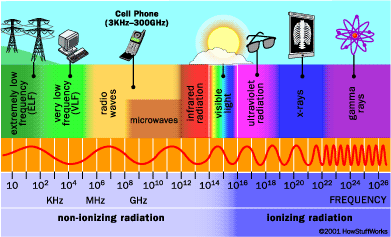
Low-mass stars are currently the most promising targets when searching for potentially habitable planets, but new research has revealed that some of these stars produce significant amounts of ultraviolet (UV) radiation throughout their lifetimes. Such radiation could hinder the development of life on any orbiting planets.
M-dwarfs are stars that are cooler and less massive than stars like our Sun, and are the most common type of star in the Galaxy, meaning that it is vital that we better understand them and the influence they have on their planets.
Detecting terrestrial planets in the habitable zone – the region where liquid water can exist on a planet’s surface – when they pass in front of, or transit, Sun-like stars is difficult. This is partly because we only see a small dip in the light as the planet crosses the star, and also partly because their orbits are long enough that we have to wait several years to observe multiple transits. However, because M-dwarfs are smaller and cooler, the planets in their habitable zone are much closer to their star, resulting in larger and more frequent drops in light, making them easier to detect.
This makes M-dwarfs ideal candidates when searching for potentially habitable planets, which has led to habitable zone terrestrial planets being discovered around M-dwarfs including Proxima Centauri, TRAPPIST-1and Ross 128.
Ultraviolet levels over time
A paperby astrophysicists Adam Schneider and Evgenya Shkolnik from Arizona State University, recently published in The Astronomical Journal,has revealed that the hottest and most massive M-dwarfs, referred to as ‘early type’, emit different amounts of UV radiation over their lifetime compared to the less massive and cooler ‘mid-’ and ‘late-type’ M-dwarfs. The paper used observations from NASA’s Galaxy Evolution Explorer (GALEX) spacecraft to study several populations of M-dwarfs in ultraviolet light.
M-dwarfs are known to emit higher levels of potentially harmful UV radiation than stars like our Sun. UV radiation can erode planetary atmospheres and have a detrimental effect on biology. It can also affect the abundances of molecules in planetary atmospheres, including carbon dioxide, oxygen and ozone……….
What is US nuclear policy, exactly? Bulletin of the Atomic Scientists, Adam Mount, Abigail Stowe-Thurston 19 Apr 18,The US Nuclear Posture Reviews (NPR) are the nation’s primary statements of nuclear weapons policy, and each has been debated closely. However, the 2018 NPR is unusual in that it has been subject not only to debate about the rectitude of its policies, but also about what those policies actually are. Even as press accountsclaimthat the review provides for significant, even alarming changes to USpolicy, four notable experts, writing in Real Clear Defense, recently assured us that thedocument is “clearly in the mainstream of U.S. nuclear policy.” These widely divergent accounts are not merely a function of incomplete information or expertise, but also due to the fact that statements by the NPR authors and other senior defense officials reveal inconsistencies on several subjects—including the circumstances in which the US would consider using nuclear weapons, the capability of existing forces, and the necessity and mission of two proposed nuclear options.
………there remain serious questions about the administration’s commitment to basic tenets of US nuclear weapons policy. For example, does the administration accept mutual vulnerability with Russia? Does it understand strategic stability as a product of a strategic relationship—one the United States could threaten with its actions—or simply as the ability to deter adversaries? If the United States seeks superiority over other nuclear powers, as the president has suggested, it could influence the answers to those questions and could potentially represent a revolutionary shift in US nuclear policy.A survey of the statements of senior officials and associated authors of the NPR reveal significant inconsistencies on central elements of US policy—including on the definition of non-nuclear strategic attacks, the capability of existing forces, and the necessity and mission of the newly proposed systems……….
The question of whether the United States would respond to a major cyberattack with nuclear weapons has been the subject of considerable concern and debate. In January, days after the draft NPR was leaked, the New York Times cited three anonymous current and former senior government officials confirming that a large cyberattack against the United States could elicit a nuclear response.
The leaked draft of the review stated, “…the President will have an expanding range of limited and graduated options to credibly deter Russian nuclear and non-nuclear strategic attacks, which could now include attacks against U.S. [Nuclear Command, Control, and Communications], in space and cyber space.” Following significant public concern, this sentence was revised and the clause “in space and cyber space” stricken from the final versionof the NPR released in February. Nevertheless, the fact that it was included in the leaked draft indicates that the authors initially intended the category of “non-nuclear strategic attacks” to include a scenario in which the United States would retaliate against a major cyberattack.
Though the published document does not explicitly include cyberattacks as an example of “extreme circumstances,” it does not explicitly exclude the possibility of a nuclear response to a cyberattack……….. https://thebulletin.org/what-us-nuclear-policy-exactly11709
Firefighters Warn NSW Is “Not Out Of The Woods” On Third Day Of Bushfires, Pedestrian. 16 Apr 18 More than 250 firefighters continue to battle bushfires in NSW’s southwest, which has spread more than 2,400 hectares since Saturday afternoon.
The blaze, which is believed to have originated in the vicinity of Casula, was fanned further by strong winds on Sunday.
More than 500 firefighters from the Rural Fire Service, Fire & Rescue NSW and the Australian Defence Force attempted to contain the blaze over the weekend with help from volunteers and 11 water-bombing helicopters.
The fire tore trough Holsworthy military range, and while approaching suburban areas, has been staved off. Several residents report fighting off embers with hoses and water buckets.
The fire was downgraded from “emergency level” to “watch and act” on 5.30pm Sunday, then again downgraded to “advice” around 2am Monday.
While lower wind conditions are expected to help with containing the fire, RFS Deputy Commissioner Rob Rogers warned that the high temperatures remain an issue.
“Still quite a difficult day ahead (on Monday),” Rogers told the Nine Network. “I think we’ve got a long way to go before we’re out of the woods.”
There’s also a risk that winds could also pick up to 35km/h later today.
The RFS is currently advising residents in Pleasure Point, Sandy Point, Alfords Point, Barden Ridge [ie; Lucas Heights] , Voyager Point, Illawong, Menai & Bangor to “remain vigilant throughout the day and keep themselves up to date by checking the NSW RFS website“……..https://www.pedestrian.tv/news/firefighters-warning-nsw-bushfires/
AUSTRALIA is struggling to contain a growing bushfire that is racing towards a nuclear reactor, amid fears that the blaze could expand beyond their control. By OLI SMITH Apr 16, 2018
Apocalyptic blaze surrounding nuclear reactor sets off emergency
More than 500 Australia firefighters are struggling to tackle a massive bushfire, with several residents urged to seek shelters as evacuation is now “too late”.
Scenes of the blaze, which started yesterday, have been described as “apocalyptic” after the fire ripped through nearly 2,500 hectares of land close to the suburbs of Sydney.
Firefighters failed to stop the out-of-control blaze from burning through a major military base – and a nuclear reactor is the next at-risk location.
The New South Wales Rural Fire Service (RFS) said it was concerned that flying embers could spark even more blazes……
The unseasonably hot Autumn in south-eastern Australia has been blamed for worsening the bushfire after record temperatures for April.
Shane Fitzsimmons, of the RFS, warned that strong 60km per hour winds are expected to push towards residential homes.
He said that the country’s largest army barracks at Holsworthy, where stockpiles of fuel, ammunition and explosive materials are kept, had been hit by the fire.
The township will be stuck with 753 metric tons of nuclear waste because the U.S. has no plan for its disposal. Oyster Creek’s used nuclear fuel now goes to the plant’s spent fuel pool, a specially designed area where the fuel cools for five years. After that, it’s moved to dry cask storage in metal canisters safely contained within a massive concrete structure.
Gary Quinn, Lacey’s former mayor and a current committeeman, said the town never anticipated having to deal with the spent fuel, which stays radioactive for hundreds of thousands of years.
With nuke plant shutting down, N.J. community inherits 1.7M pounds of waste WHYY By Catalina Jaramillo April 16, 2018
As nuclear power plants around the country continue to shut down — 20 reactors are already on their way out, and several more are expected to follow — questions remain about what to do with the nuclear waste they leave behind.
The U.S. Department of Energy made the commitment to remove and dispose spent nuclear fuel from reactors starting in 1998, but a federal plan to store that waste at Yucca Mountain in Nevada never came to fruition. And there are no plans in place for a permanent spent fuel repository.
Meanwhile, communities hosting nuclear plants — including Lacey Township, New Jersey — face an uncertain future. Exelon’s Oyster Creek nuclear generating station, the oldest operating in the country, will retire in October. The plant, which sits alongside Barnegat Bay, in Ocean County, has served as the town’s main economic driver for 50 years. Residents are anxious about what will happen next.
“Is it going to bring the town down? As far as empty houses, … lost business and things like that,” asked Richard Rom, community president of Pheasant Run, a senior complex with more than 400 residents. “I’m concerned.” ……..
Lacey is not only losing the economic benefits of hosting the nuclear plant. The township will be stuck with 753 metric tons of nuclear waste because the U.S. has no plan for its disposal. Oyster Creek’s used nuclear fuel now goes to the plant’s spent fuel pool, a specially designed area where the fuel cools for five years. After that, it’s moved to dry cask storage in metal canisters safely contained within a massive concrete structure.
Gary Quinn, Lacey’s former mayor and a current committeeman, said the town never anticipated having to deal with the spent fuel, which stays radioactive for hundreds of thousands of years.
“When it was first built, it was never agreed upon that it would become a spent fuel storage facility — which … at this point in time appears to be what we’re facing,” Quinn said.
………Last year, bills authorizing federal funds to compensate Lacey and other communities for storing the nuclear waste were introduced in the U.S. House and Senate. The Stranded Act of 2017 establishes that — because the federal government failed to keep the waste — the communities hosting nuclear plants are “interim nuclear waste storage sites” and should be paid what the Nuclear Waste Policy Act of 1982 set as a rate for states operating waste sites: $15 per kilogram of spent nuclear fuel.In the case of Oyster Creek, which by the end of 2018 will have approximately 1.66 million pounds of nuclear waste, that would work out to $11.2 million a year for Lacey Township. That’s exactly what the town could be losing in energy tax receipts.
But the bills, which have been referred to committees, have gained no traction……..
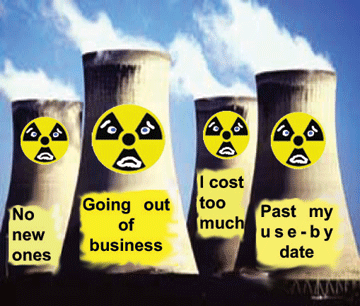
Exelon Official: No New Nuclear Plants To Be Built in the U.S. Because of the plants’ size and security needs, the costs become prohibitive.U.S. News By Alexa Lardieri, Staff WriterApril 16, 2018,
A SENIOR OFFICIAL WITH America’s largest nuclear plant operating company is predicting a dim future for nuclear power in the U.S.
William Von Hoene, senior vice president and chief strategy officer at Exelon, said last week that he doesn’t foresee any new nuclear plants being built in the United States due to their high operating costs.
“The fact is – and I don’t want my message to be misconstrued in this part – I don’t think we’re building any more nuclear plants in the United States. I don’t think it’s ever going to happen,” S&P Global quoted Van Hoene as saying at the annual U.S. Energy Association’s meeting in Washington, D.C. “I’m not arguing for the construction of new nuclear plants. They are too expensive to construct, relative to the world in which we now live.”………
“I think it’s very unlikely that absent some extraordinary change in environment or technology, that any nuclear plants beyond the Vogtle plant will be built in my lifetime, by any company,” S&P Global quoted Van Hoene as saying, referring to a plant currently under construction in Georgia.
World War 3 IMMINENT! Scared ex-Soviet general warns NUCLEAR war is INEVITABLE
A SCARED former Russian army general issued a harrowing warning that a nuclear war is “inevitable” and it is an “illusion” if leaders feel they can control a military conflict between the US and Russia. Express UKBy THOMAS HUNT, Apr 17, 2018 Former Russian general: Use of nuclear weapons is inevitable
Evgeny Buzhinskiy, a retired Lieutenant-General, claimed the Cold War was rather comfortable in comparison to the current conflict and the West should be prepared because Vladimir Putin “will not accept defeat” if World War 3 started.
Speaking to Channel 4 News, he said: “I think it’s worse than the Cold War, which we have been waging for 40 years after the Second World War.
“In the Cold War time I was in the armed forces and I was quite comfortable I’d say.
“There were definite duels and definite red lines – everybody knew what to do.There were no threats, no sanctions, no isolation, no cornering, no nothing.
“There was just ideological confrontation, but people on both sides knew how far they could go.”
The military veteran was then asked by the presenter whether rising tensions could lead to a third world war.
The General responded: “Of course. I repeat, you cannot control military confrontation between Russia and the United States.
Of course Russia cannot wage a war against the United States. For years, economically it cannot.
“In the general purpose forces, we are a bit lagging behind the United States.
“And of course, Russia will no accept any kind of defeat.
“So the involvement of nuclear weapons is inevitable.”
When asked if he is just trying to scare viewers, Mr Buzhinskiy said he was scared for the possible repercussions. He added: “I am scared myself because I have children and I have grandchildren so I am scared for their fate.”
France’s nuclear plans under pressure, Petroleum Economist, 17 Apr 18
Flaws found at a flagship reactor could curb EDF’s technology export ambitions
Piping weld issues reported at Électricité de France’s Flamanville nuclear reactor project last week threaten to delay similar reactor builds across Finland and the UK, eroding confidence in the technology’s future role in western Europe’s energy mix.
State-owned EDF admitted on 10 April that inspectors had found “quality deviations” on 150 welds in a system used to transport steam to turbines at the Flamanville European Pressurized Reactor (EPR), a third generation pressurised water reactor in northwestern France.
Those inspections were prompted by an initial finding in February that 38 of 66 weldings on a secondary cooling circuit were not in line with standards, which were passed on at the time to France’s Nuclear Safety Authority (ASN).
Because the ASN has already demanded that a study be completed into the initial problems by the second half of 2018, it’s likely the new discovery will exacerbate problems with the long-delayed plant’s timetable and costs—it is seven years behind schedule and €7bn ($8.6bn) over budget.
The impact of the substandard weldings will also likely be felt further afield, particularly on timings for other long-delayed EPRs that the firm is currently building: Hinkley Point C in the UK, and Olkiluoto 3 in Finland.
Construction of the first EPR in Olkiluoto started in 2005 and was initially set to be completed by 2009, but in October 2017, the project was again delayed to May 2019, when it is intended to become western Europe’s first new nuclear power station for 15 years. Meanwhile, construction is slated to start on the 3.2-gigawatt Hinkley Point C plant in Somerset, southwest England, in 2019. The plant was first proposed in 2008 and is expected to take at least a decade to bring online, at a cost of £20.3bn ($28bn).
“Repeated construction delays further undermine the credibility of nuclear power as a viable option for electricity generation in the context of urgency to combat climate change”, Mycle Schneider, lead author of the World Nuclear Industry Status Report, told Petroleum Economist. “Nuclear power turns out to be not only increasingly expensive, but far too slow to compete with other options.”
Fukushima in focus
Despite the delays, the need to ensure strict standards in a post-Fukushima environment was underlined by an incident last December at China’s Taishan1 reactor, which was constructed by China General Nuclear Power Corporation (GCN) with EDF. Taishan1’s deaerator, which removes oxygen and other gases from boiler feedwater circuits, cracked during performance testing due to defective welding.
Safety issues have loomed over nuclear power’s future in western Europe since the Fukushima accident in Japan in March 2011, when a 9.0-magnitude offshore earthquake triggered a 46-foot tsunami that hit the plant, leading to the leakage of radioactive materials and shutdown of the plant. ……..
On 31 March, the Belgian government confirmed that its future energy strategy included a plan to shut down all nuclear power plants by 2025, and Germany, Spain and Switzerland have also made plans to phase out nuclear power by the 2020s. Even President Emmanuel Macron’s French election campaign included a promise to cut nuclear power generation from 72% to 50%.
“In a strict commercial sense, nuclear power is a tough proposition in western Europe. Unlike emerging economies and regions, demand is flat in the continent,” said Jane Nakano, a senior energy analyst at the Center for Strategic and International Studies. “In mature markets it is tough to make a business case for massive projects that require huge upfront investment.” …….http://www.petroleum-economist.com/articles/low-carbon-energy/nuclear/2018/frances-nuclear-plans-under-pressure




 nuclear-news