ULTRAVIOLET RADIATION FROM LOW-MASS STARS COULD RENDER PLANETS UNINHABITABLE
 Astrobiology Magazine, By Amanda Doyle – Apr 19, 2018
Low-mass stars are currently the most promising targets when searching for potentially habitable planets, but new research has revealed that some of these stars produce significant amounts of ultraviolet (UV) radiation throughout their lifetimes. Such radiation could hinder the development of life on any orbiting planets.
M-dwarfs are stars that are cooler and less massive than stars like our Sun, and are the most common type of star in the Galaxy, meaning that it is vital that we better understand them and the influence they have on their planets.
Detecting terrestrial planets in the habitable zone – the region where liquid water can exist on a planet’s surface – when they pass in front of, or transit, Sun-like stars is difficult. This is partly because we only see a small dip in the light as the planet crosses the star, and also partly because their orbits are long enough that we have to wait several years to observe multiple transits. However, because M-dwarfs are smaller and cooler, the planets in their habitable zone are much closer to their star, resulting in larger and more frequent drops in light, making them easier to detect.
This makes M-dwarfs ideal candidates when searching for potentially habitable planets, which has led to habitable zone terrestrial planets being discovered around M-dwarfs including Proxima Centauri, TRAPPIST-1and Ross 128.
Ultraviolet levels over time
A paper by astrophysicists Adam Schneider and Evgenya Shkolnik from Arizona State University, recently published in The Astronomical Journal,has revealed that the hottest and most massive M-dwarfs, referred to as ‘early type’, emit different amounts of UV radiation over their lifetime compared to the less massive and cooler ‘mid-’ and ‘late-type’ M-dwarfs. The paper used observations from NASA’s Galaxy Evolution Explorer (GALEX) spacecraft to study several populations of M-dwarfs in ultraviolet light.
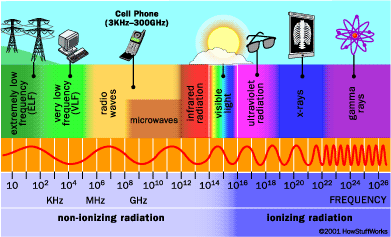
M-dwarfs are known to emit higher levels of potentially harmful UV radiation than stars like our Sun. UV radiation can erode planetary atmospheres and have a detrimental effect on biology. It can also affect the abundances of molecules in planetary atmospheres, including carbon dioxide, oxygen and ozone……….
Harmful to life
The results suggest that lower-mass M-dwarfs have persistent UV radiation, which could rule out the possibility of life on any orbiting planets, including those around TRAPPIST-1 and Proxima Centauri………https://www.astrobio.net/alien-life/ultraviolet-radiation-from-low-mass-stars-could-render-planets-uninhabitable/
No comments yet.
1 This Month

of the week – Shut Down Drone Warfare!


Tell the Ukrainian Government to Drop Prosecution of Peace Activist Yurii Sheliazhenko

Petition to revoke the licensing of the Near Surface Nuclear Disposal Facility (NSDF) at Chalk River. https://www.ourcommons.ca/petitions/en/Petition/Details?Petition=e-7247
To see nuclear-related stories in greater depth and intensity – go to https://nuclearinformation.wordpress.com
-
Archives
- April 2026 (79)
- March 2026 (251)
- February 2026 (268)
- January 2026 (308)
- December 2025 (358)
- November 2025 (359)
- October 2025 (376)
- September 2025 (257)
- August 2025 (319)
- July 2025 (230)
- June 2025 (348)
- May 2025 (261)
-
Categories
- 1
- 1 NUCLEAR ISSUES
- business and costs
- climate change
- culture and arts
- ENERGY
- environment
- health
- history
- indigenous issues
- Legal
- marketing of nuclear
- media
- opposition to nuclear
- PERSONAL STORIES
- politics
- politics international
- Religion and ethics
- safety
- secrets,lies and civil liberties
- spinbuster
- technology
- Uranium
- wastes
- weapons and war
- Women
- 2 WORLD
- ACTION
- AFRICA
- Atrocities
- AUSTRALIA
- Christina's notes
- Christina's themes
- culture and arts
- Events
- Fuk 2022
- Fuk 2023
- Fukushima 2017
- Fukushima 2018
- fukushima 2019
- Fukushima 2020
- Fukushima 2021
- general
- global warming
- Humour (God we need it)
- Nuclear
- RARE EARTHS
- Reference
- resources – print
- Resources -audiovicual
- Weekly Newsletter
- World
- World Nuclear
- YouTube
-
RSS
Entries RSS
Comments RSS
 nuclear-news
Leave a comment