Decommissioning of Japan’s nuclear stations: is it really worth the cost – to reactivate any of them?
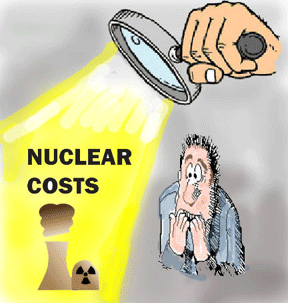
 Japan Times 1st April 2018, The recent decision by Shikoku Electric Power Co. to decommission the aging
No. 2 reactor at its Ikata nuclear facility in Ehime Prefecture serves as
yet another reminder that tightened safety regulations and market
conditions in the aftermath of the 2011 Fukushima crisis are imposing a
heavy financial burden on power companies that run nuclear power plants.
Whether or not they push for reactivating the reactors idled in the wake of
the 2011 accident, both the government and the power industry are urged to
reassess the economics of nuclear power to determine whether they are still
worth the cost.
The Ikata reactor is the ninth at six nuclear power plants
across Japan to be decommissioned after the 2011 disaster, not including
the six at Tokyo Electric Power Co.’s Fukushima No. 1 plant, which was
crippled by the meltdowns at three of its six reactors in March 2011 after
the plant was flooded by giant tsunami in the Great East Japan Earthquake.
All of the reactors were aging and nearing the 40-year limit on their
operation, and the power companies were faced with the question of whether
to decommission the reactors or apply to the Nuclear Regulation Authority
for approval of a one-time extension of their operation for another 20
years — which would have entailed costly additional investments to bump
up their safety under the post-Fukushima rules. https://www.japantimes.co.jp/opinion/2018/04/01/editorials/reassess-economics-nuclear-power/
Cancer Stats Skyrocket Around Nuclear Reactors: Epidemiologist Joseph Mangano.
Nuclear Hotseat 4th April 2018
Drastic action on fossil fuels is needed, as the Poles melt – with unpredictable consequences
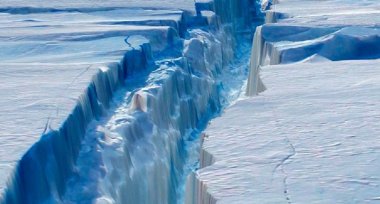 Both the north pole and the south pole are situated in the middle of huge ice deserts which are melting around the edges under the influence of human activity. The difference that matters between them is that the ice of the Arctic floats: if it melted nothing much would happen to aggregate sea levels. The ice of Antarctica, like that of Greenland, rests on land. If it all were to melt, as it has done in the far distant past, sea levels could rise by as much as 60 metres. That is most unlikely to happen. What is possible, though, is that the smaller portion of the continent, west Antarctica, which is divided from the rest by a mountain range, could lose much of its ice. Even that would be catastrophic. A significant retreat in west Antarctica, as seems to be already under way, could raise sea levels by between one and three metres by the end of this century. Children now alive will see that happen across their lifetimes. That is what is meant by the urgency of global warming.
Previous surveys have concentrated on a few of the glaciers that are an obvious danger but the research released this week analysed satellite data covering the whole of the coastline of west Antarctica to reach its worrying conclusions. The problem is worsened by the shape of the seabed on which the glaciers now rest. It does not slope towards the deep ocean, but inwards, forming a bowl of which the far side is the mountain range that divides the continent. That means that the process of erosion will be working downhill as it moves inwards, with faster and less predictable results.
The present danger was discovered by measuring the thickness of the ice sheet from space and deducing from this the shape of the glacier beneath. This is much easier than knowing what to do. The contrast between the exquisite technological sophistication employed in the diagnosis of the problem and the lack of international coordination or political sophistication when it comes to solving it, illustrates the crisis of technological civilisation. As a species we have shown enough cleverness to disrupt the world’s climate, but may not have enough to remedy the damage that we’ve done. Things are of course made very much worse by the presence in the White House of an aggressively ignorant and anti-scienceadministration.
Predicting the future of these changes isn’t an exact science, which is one of the things which makes them so frightening, but neither is it entirely guesswork. Ignorance about the size of the threatened rise in sea levels is no excuse for inaction. We know it’s coming. We know it will be disruptive. We don’t know if it will be catastrophic. But the possibility must spur us into drastic action on fossil fuels. Keep them in the ground.
Researchers from 30 countries call for boycott of South Korean university, in campaign against lethal autonomous weapons
We are locked into an arms race that no one wants to happen, global researchers warn
A CHILLING letter claims the world is on the cusp of opening a dangerous Pandora’s box — and there is no going back. http://www.news.com.au/technology/innovation/we-are-locked-into-an-arms-race-that-no-one-wants-to-happen-global-researchers-warn/news-story/fc6dfa060c66ed876beb79d1b7530cc6 Nick Whigham@NWWHIGHAM 5 Apr 18
The boycott comes in advance of a meeting next Monday in Geneva, Switzerland, of 123 member nations of the United Nations discussing the challenges posed by lethal autonomous weapons. Twenty-two of those nations have already called for an outright and pre-emptive ban on such weapons.
The open letter announcing the boycott against the South Korean university said autonomous weapons are the “third revolution in warfare” and warned about letting the genie out of the bottle.
“At a time when the United Nations is discussing how to contain the threat posed to international security by autonomous weapons, it is regrettable that a prestigious institution like KAIST looks to accelerate the arms race to develop such weapons,” the letter said.
“We therefore publicly declare that we will boycott all collaborations with any part of KAIST until such time as the President of KAIST provides assurances, which we have sought but not received, that the Center will not develop autonomous weapons lacking meaningful human control,” the researchers said.
“If developed, autonomous weapons will be the third revolution in warfare. They will permit war to be fought faster and at a scale greater than ever before. They have the potential to be weapons of terror. Despots and terrorists could use them against innocent populations, removing any ethical restraints. This Pandora’s box will be hard to close if it is opened.”
Professor Walsh organised the boycott which involves researchers from 30 countries and includes three of the world’s top deep learning experts, Professor Stuart Russell from the University of California, Berkeley, who authored the leading textbook on AI and roboticist Prof Wolfram Burgard, winner of the Gottfried Wilhelm Leibniz Prize, the most prestigious research prize in Germany.
“Back in 2015, we warned of an arms race in autonomous weapons,” Professor Walsh said in a statement alongside the letter. “We can see prototypes of autonomous weapons under development today by many nations including the US, China, Russia and the UK. We are locked into an arms race that no one wants to happen.
“KAIST’s actions will only accelerate this arms race. We cannot tolerate this.”
Professor Walsh has long campaigned against the development of autonomous weapons.
He has previously travelled to speak in front of the United Nations in an effort to have the international body prevent the proliferation of so-called killer robots with the ability to think for themselves.
Speaking to news.com.au last year he said “the arms race is already starting.”
He believes it’s no longer a question of whether military weapons are imbued with some level of autonomy, it’s just a matter of how much autonomy — which poses a number of worrying scenarios, particularly if they fall into the wrong hands.
“They get in the hands of the wrong people and they can be turned against us. They can be used by terrorist organisations,” he warned.
“It would be a terrifying future if we allow ourselves to go down this road.
North Korea nuclear missile ‘could reach UK within months’ – but Kim Jong-un ‘too rational’ to use them
https://www.yahoo.com/news/north-korea-nuclear-missile-reach-uk-within-months-kim-jong-un-rational-use-083248988.html Andy Wells,Yahoo News UK•
North Korea will be able to reach the UK with a nuclear weapon within 18 months if its weapons programme continues at the same pace, MPs have warned.
The Commons defence select committee report into the country said it was a ‘reasonable assumption’ the North could reach the UK already and that it is ‘almost certain’ to be able to carry nuclear warheads to these shores by 2019.
However, it also noted there had been ‘no sign’ of North Korean leader Kim Jong-un wanting to target the UK with nuclear weapons.
The report also suggested North Korea could be ‘dissuaded’ from using nuclear weapons – adding the leader was ‘ruthless… but rational’.
It said: ‘We believe it is obvious to North Korea that launching such weapons would lead inescapably to devastating military consequences from the US, South Korea and other countries too.
‘It would result in the downfall – indeed the annihilation of the regime: the polar opposite of what Kim Jong-un is seeking to achieve.
‘He is ruthless, like other Communist dictators before him, but he is rational.’
The North carried out a number of nuclear tests in 2016 and 2017 which led to escalating tensions between itself and South Korea and the United States.
But in announcing talks between Kim and US president Donald Trump, a South Korean official said the North Korean leader was committed to denuclearisation.
The select committee report also covers the cyber threat posed by North Korea – which was blamed for the WannaCry ransomware attack which struck computers at NHS trusts last year.
It said: ‘It is likely that North Korea has already successfully attacked the UK with the Wannacry ransonware, although we agree with the Government that the UK was probably not intended to be the principal target.
‘Nevertheless, the Wannacry attack highlighted basic vulnerabilities in UK information technology systems.
‘With North Korea unconcerned by who gets hurt when it lashes out, the UK will continue to be at risk from North Korean cyber-attacks.’
It called on the Government to find additional funding for cyber defence to counter this threat.
EDF says that proposed Sizewell C nuclear plant in Suffolk may not be feasible
 Sizewell C nuclear plant may not be feasible, says EDF boss https://www.newcivilengineer.com/business-culture/sizewell-c-nuclear-plant-may-not-be-feasible-says-edf-boss/10029739.article 5 APRIL, 2018
The proposed Sizewell C nuclear plant in Suffolk may not be feasible, EDF Energy’s UK boss told The Times, while the energy firm said it is discussing funding options with the government including using pension funds.
EDF Energy UK chief executive Simone Rossi told the newspapaer that the firm needs assurances from government that a “viable funding model exists” for Sizewell C this year. If EDF Energy believes the project is not feasible, it may stop its involvement in the project.
EDF Energy is currently in talks with the government over a funding model for the Suffolk nuclear power plant which would reduce costs for consumers. New Civil Engineer understands pension funds are being considered as a way to help finance Sizewell C.
Rossi told The Times: “This is the year where we need to understand whether this whole thing is really feasible or not.”
He added: “If we were to conclude that maybe it’s not feasible, then at that point maybe we say we are not in a position to continue the project.”
Rossi also said expected cost savings for Sizewell C could disappear if there is a “significant delay” between work on it and Hinkley Point C.
EDF Energy has said it expects construction costs for Sizewell C to be roughly 20% less than for the £19.5bn-plus Hinkley Point C plant. This is because the new plant would almost be a replica of Hinkley Point C, and because electricity grid connections are already in place at the Sizewell C site.
In June last year the National Audit office branded Hinkley Point C “risky and expensive”.
A spokesperson for EDF Energy denied Rossi’s comments were an ultimatum and said Sizewell C would benefit from an existing supply chain, while providing jobs for 5,600 construction workers.
The spokesperson added: “We are working with Government to look at alternative financing models because reducing the cost of capital can make a significant difference to the price for consumers. Financing models that create the conditions where institutional investors like pension funds can participate.”
Problems with local consent hang over Japan’s proposed nuclear station restarts
Local consent for nuclear plant restarts https://www.japantimes.co.jp/opinion/2018/04/05/editorials/local-consent-nuclear-plant-restarts/#.WsaMZNRubGg
 governments in areas where nuclear power facilities are located. For the first time as a nuclear power plant operator, Japan Atomic Power included not just the plant’s host village of Tokai but five nearby cities as municipalities whose consent the firm will seek in restarting the idled plant. The company will not reactivate the Tokai plant if any of the municipalities opposed the move.
Other power companies are keen to see that this agreement does not set a precedent that could also change their arrangements with nearby municipalities concerning their own nuclear plants — because that would complicate the process for winning local endorsement for restarting their idled reactors. However, it’s reasonable that municipalities in the surrounding areas of nuclear plants want to be involved in the process because they would be affected in the event of a severe accident. The power companies should respond to such requests flexibly if they wish to obtain the full cooperation of nearby municipalities.
Operators of nuclear power plants conclude agreements with local municipalities to ensure the safety of residents in areas around the plants. The agreements stipulate the lines of communication when the plants have problems, as well as procedures for prior consent to restarting and modifying reactors or building new ones, though they are not legally binding.
So far, power companies have accorded the right to consent to a reactor restart to only to the municipalities and prefectures that host them, and not to surrounding municipalities.
The meltdowns at Tokyo Electric Power Co.’s Fukushima No. 1 plant in March 2011, however, illustrated how the fallout of radioactive materials during a disaster can spread well beyond the host municipality. The government made it mandatory for municipalities within 30 km of a nuclear power plant — instead of 10 km previously — to prepare evacuation plans in case of a severe accident.
The government has promoted restarting reactors idled in the wake of the 2011 Fukushima disaster once they have cleared the Nuclear Regulation Authority’s screening under revamped safety standards — and once the plant operators have obtained the consent of local governments. But in many instances, there is a split in opinion between the host municipality — which expects to gain economic benefits from the plant’s operation and national government grants for hosting the plant — and surrounding municipalities that could be similarly exposed to the risk from an accident but have no say in the operation of the plant. While municipalities and prefectures within 30 km of plants demand that they be given the right to consent to restarts, the power companies have been resistant because it would add more hurdles to winning restart approval.
When the No. 3 reactor at Kyushu Electric Power Co.’s Genkai plant in Saga Prefecture was reactivated in March, four of the eight municipalities within 30 km of the facility opposed the restart, but their objections went unheeded. Parts of Kyoto and Shiga prefectures fall within the 30-km radius of nuclear plants that Kansai Electric Power Co. runs in Fukui Prefecture, but neither Kyoto nor Shiga is consulted when Kepco seeks the nod to restart its reactors.
Japan Atomic Power had particular reasons to involve municipalities in the surrounding areas in the process. After the Fukushima accident, the mayor of the host village of Tokai called for a phaseout of nuclear power. The Tokai No. 2 plant is the sole nuclear power facility adjacent to the greater Tokyo area, and nearly 1 million people live within 30 km of it. Given the large number of residents who could be affected in case of an accident, the village argued that it cannot take sole responsibility for giving the go-ahead for its restart and called for a new agreement that involves the nearby cities of Mito, Naka, Hitachinaka, Hitachi and Hitachiota. The firm, which is now seeking the NRA’s approval of an extension of the aging No. 2 facility, apparently could not dismiss the request from the host municipality.
The agreement over the Tokai No. 2 plant should not be discounted as a special case. The dissatisfaction of many municipalities that are denied any say in restarting nuclear power plants — even though they face the same risk from possible accidents and the duty of ensuring safe evacuation of their residents — should not be left unaddressed. The other power companies should think again about whether the agreements they have over their nuclear power plants are sufficient to win the trust of nearby municipalities.
Global nuclear power firms scrambling to market nuclear technology to Middle East countries
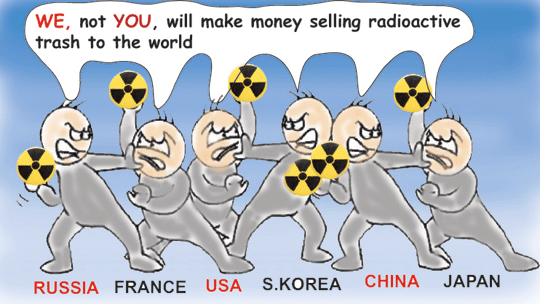
Nuclear power firms woo Middle East http://www.eco-business.com/news/nuclear-power-firms-woo-middle-east/ Middle Eastern countries are welcoming nuclear power firms promising to meet their energy needs, while most of the world worries over reactor costs. from Climate News Network. 5 Apr 18
Nuclear power firms are scrambling to sell reactors to countries in one of the most troubled parts of the world, the Middle East. Many lack domestic customers and see this new market as a potential lifesaver.
A report last year by the US-based Center for Climate & Security included the Middle East in a list of what it called “potential crisis regions where combining security, climate, and nuclear risks must be addressed urgently.”
The biggest prize is the oil-rich kingdom of Saudi Arabia, which has announced plans to build 16 nuclear plants over the next 25 years at a cost of US$80 billion, part of an effort to diversify away from fossil fuels. South Korea, China, France, Russia, Japan and the United States are all bidding to build them.
In a region where renewables are half the price of nuclear power – because the sun shines for longer and with greater intensity than almost anywhere else in the world – building new nuclear plants may seem strange.
Saudi Arabia, which is also investing heavily in solar power, points to rapidly rising domestic demand for electricity and says renewables will not provide enough for its needs.
Other countries in the region that are already building or have signed contracts to build new reactors are Iran, United Arab Emirates, Jordan, Egypt and Turkey.
All say the decision to go for nuclear power is entirely a consequence of the local need for more electricity, although perhaps the Saudi rulers also have an eye on their power rival Iran, which already has an operating nuclear power station and is building more.
Mohammad bin Salman, the Saudi crown prince who effectively runs Saudi Arabia for his father King Salman, was asked about this on the US TV network CBS in March. He replied: “Saudi Arabia doesn’t want to own a nuclear bomb. But without a doubt, if Iran develops a nuclear bomb, we will follow suit as soon as possible.”
Rival contenders
Despite this, the Trump administration remains keen to sell its Westinghouse-designed nuclear power stations to the Saudis. Russia, China, Japan and South Korea also want to sell their own designs.
As well as the need to keep their national nuclear companies ticking over and grabbing lucrative exports, all these countries would welcome the political influence that providing such important infrastructure would give them in the Middle East.
Well ahead of Saudi Arabia in developing nuclear power is the neighbouring United Arab Emirates. Its first reactor was due to open this year and is almost complete, though its start-up date has been pushed back to 2019.
The UAE’s $24.4bn Barakah power plant is the world’s largest currently under construction. It will contain four reactors, is being built by the Korea Electric Power Corporation (KEPCO) and appears to be going well.
Too few operators
The postponement seems not to have been caused by construction delays but by lack of trained crew to operate the first of the four reactors. When it is up and running, the UAE will become the first country to start operating a nuclear plant in more than 20 years.
Again, the country has plenty of oil reserves and renewable resources, but wants nuclear power to provide a guaranteed electricity supply instead of having to rely on imported gas.
Jordan, which has no fossil fuel resource, and Egypt, with the region’s largest population, are also going nuclear. In both cases they have signed deals with the Russian state-owned giant Rosatom. Egypt has signed a deal for four nuclear plants costing $30bn, and Jordan for an energy package worth $12bn, but which also includes some American involvement, according to Bloomberg New Energy Finance.
Avoiding imports
Turkey, again a populous nation that has to import most of its energy in the form of fossil fuels, is building a nuclear power station at Akkuyu on its Mediterranean coast in partnership with Rosatom. The first reactor was expected to be operating by now, but the opening date has been put back to 2020. It has other plants planned on its northern Black Sea coast.
This sudden enthusiasm for nuclear power in such a volatile region has prompted a debate about some governments’ motives. Israel is the only country in the Middle East that has long had the means to make nuclear weapons with its Negev Nuclear Research centre in the desert near Dimona.
It is already alarmed by Iran’s nuclear programme. A number of other potentially hostile states may also soon have the means to produce highly enriched uranium or plutonium.
If they do, they will face an already fully armed Israel. According to an estimate by the Washington-based Carnegie Endowment for International Peace, Israel, which began operating a plutonium-production reactor in 1963, possesses enough material for between 100 and 170 atomic weapons. Israel has never admitted this.
1 This Month


Tell the Ukrainian Government to Drop Prosecution of Peace Activist Yurii Sheliazhenko

Petition to revoke the licensing of the Near Surface Nuclear Disposal Facility (NSDF) at Chalk River. https://www.ourcommons.ca/petitions/en/Petition/Details?Petition=e-7247


of the week – STOP SMALL MODULAR REACTORS IN CANADA
To see nuclear-related stories in greater depth and intensity – go to https://nuclearinformation.wordpress.com
-
Archives
- March 2026 (193)
- February 2026 (268)
- January 2026 (308)
- December 2025 (358)
- November 2025 (359)
- October 2025 (376)
- September 2025 (258)
- August 2025 (319)
- July 2025 (230)
- June 2025 (348)
- May 2025 (261)
- April 2025 (305)
-
Categories
- 1
- 1 NUCLEAR ISSUES
- business and costs
- climate change
- culture and arts
- ENERGY
- environment
- health
- history
- indigenous issues
- Legal
- marketing of nuclear
- media
- opposition to nuclear
- PERSONAL STORIES
- politics
- politics international
- Religion and ethics
- safety
- secrets,lies and civil liberties
- spinbuster
- technology
- Uranium
- wastes
- weapons and war
- Women
- 2 WORLD
- ACTION
- AFRICA
- Atrocities
- AUSTRALIA
- Christina's notes
- Christina's themes
- culture and arts
- Events
- Fuk 2022
- Fuk 2023
- Fukushima 2017
- Fukushima 2018
- fukushima 2019
- Fukushima 2020
- Fukushima 2021
- general
- global warming
- Humour (God we need it)
- Nuclear
- RARE EARTHS
- Reference
- resources – print
- Resources -audiovicual
- Weekly Newsletter
- World
- World Nuclear
- YouTube
-
RSS
Entries RSS
Comments RSS
 nuclear-news