Drastic action on fossil fuels is needed, as the Poles melt – with unpredictable consequences
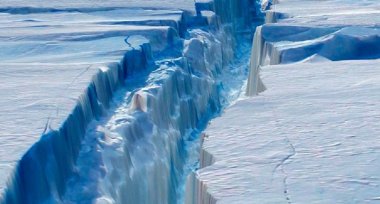 Both the north pole and the south pole are situated in the middle of huge ice deserts which are melting around the edges under the influence of human activity. The difference that matters between them is that the ice of the Arctic floats: if it melted nothing much would happen to aggregate sea levels. The ice of Antarctica, like that of Greenland, rests on land. If it all were to melt, as it has done in the far distant past, sea levels could rise by as much as 60 metres. That is most unlikely to happen. What is possible, though, is that the smaller portion of the continent, west Antarctica, which is divided from the rest by a mountain range, could lose much of its ice. Even that would be catastrophic. A significant retreat in west Antarctica, as seems to be already under way, could raise sea levels by between one and three metres by the end of this century. Children now alive will see that happen across their lifetimes. That is what is meant by the urgency of global warming.
Previous surveys have concentrated on a few of the glaciers that are an obvious danger but the research released this week analysed satellite data covering the whole of the coastline of west Antarctica to reach its worrying conclusions. The problem is worsened by the shape of the seabed on which the glaciers now rest. It does not slope towards the deep ocean, but inwards, forming a bowl of which the far side is the mountain range that divides the continent. That means that the process of erosion will be working downhill as it moves inwards, with faster and less predictable results.
The present danger was discovered by measuring the thickness of the ice sheet from space and deducing from this the shape of the glacier beneath. This is much easier than knowing what to do. The contrast between the exquisite technological sophistication employed in the diagnosis of the problem and the lack of international coordination or political sophistication when it comes to solving it, illustrates the crisis of technological civilisation. As a species we have shown enough cleverness to disrupt the world’s climate, but may not have enough to remedy the damage that we’ve done. Things are of course made very much worse by the presence in the White House of an aggressively ignorant and anti-scienceadministration.
Predicting the future of these changes isn’t an exact science, which is one of the things which makes them so frightening, but neither is it entirely guesswork. Ignorance about the size of the threatened rise in sea levels is no excuse for inaction. We know it’s coming. We know it will be disruptive. We don’t know if it will be catastrophic. But the possibility must spur us into drastic action on fossil fuels. Keep them in the ground.
No comments yet.
1 This Month

of the week – Shut Down Drone Warfare!


Tell the Ukrainian Government to Drop Prosecution of Peace Activist Yurii Sheliazhenko

Petition to revoke the licensing of the Near Surface Nuclear Disposal Facility (NSDF) at Chalk River. https://www.ourcommons.ca/petitions/en/Petition/Details?Petition=e-7247
To see nuclear-related stories in greater depth and intensity – go to https://nuclearinformation.wordpress.com
-
Archives
- April 2026 (114)
- March 2026 (251)
- February 2026 (268)
- January 2026 (308)
- December 2025 (358)
- November 2025 (359)
- October 2025 (376)
- September 2025 (257)
- August 2025 (319)
- July 2025 (230)
- June 2025 (348)
- May 2025 (261)
-
Categories
- 1
- 1 NUCLEAR ISSUES
- business and costs
- climate change
- culture and arts
- ENERGY
- environment
- health
- history
- indigenous issues
- Legal
- marketing of nuclear
- media
- opposition to nuclear
- PERSONAL STORIES
- politics
- politics international
- Religion and ethics
- safety
- secrets,lies and civil liberties
- spinbuster
- technology
- Uranium
- wastes
- weapons and war
- Women
- 2 WORLD
- ACTION
- AFRICA
- Atrocities
- AUSTRALIA
- Christina's notes
- Christina's themes
- culture and arts
- Events
- Fuk 2022
- Fuk 2023
- Fukushima 2017
- Fukushima 2018
- fukushima 2019
- Fukushima 2020
- Fukushima 2021
- general
- global warming
- Humour (God we need it)
- Nuclear
- RARE EARTHS
- Reference
- resources – print
- Resources -audiovicual
- Weekly Newsletter
- World
- World Nuclear
- YouTube
-
RSS
Entries RSS
Comments RSS
 nuclear-news
Leave a comment