
 Seoul sends envoy to North Korea in hope of opening nuclear talks, Telegraph UK , Nicola Smith, taipei 4 MARCH 2018
South Korea is to send its national security chief to Pyongyang on Monday to discuss how to resume dialogue between the US and North Korea over its nuclear and weapons programme.
President Moon Jae-in announced on Sunday that Chung Eui-yong, head of the National Security Office, and his intelligence chief Suh Hoon, would lead a ten member delegation on a two day trip to the North.
The envoys will deliver a letter from Mr Moon to North Korean leader, Kim Jong-un, although it is still uncertain if they will meet with him personally. It would be the first time for Kim to meet with a South Korean official since he came to power in 2011.
The delegation is expected to hold talks that would pave the way for a possible summit meeting between the leaders of South and North Korea after Kim Jong-un last month invited Mr Moon to visit Pyongyang.
The envoys are “expected to hold talks with North Korea’s high level officials to discuss ways to establish peace on the Korean Peninsula and develop the South-North Korea relationship,” presidential chief press secretary Yoon Young-chan said.
………https://www.telegraph.co.uk/news/2018/03/04/seoul-sends-envoy-north-korea-hope-opening-nuclear-talks/
March 5, 2018
Posted by Christina Macpherson |
politics international, South Korea |
Leave a comment
 Audit Finds Pentagon Waived Requirement to Repay Taxpayers $16 Billion to Advance Foreign Military Sales http://www.pogo.org/straus/issues/defense-budget/2018/audit-finds-pentagon-waived-requirement-to-repay-taxpayers-16-billion.html?utm_source=weekly-reader&utm_medium=email&utm_campaign=wr-180303&utm_content=header By: Mandy Smithberger, Director, CDI Straus Military Reform Project February 28, 2018
Under the law, when a foreign government buys U.S. weapon systems through the Department of Defense those governments are required to reimburse the Department for research, development, and other one-time costs for those systems. A recent audit by the Government Accountability Office (GAO) found the Department has waived $16 billion it could have recovered for taxpayers on $250 billion worth of weapons sold under the Foreign Military Sales program from 2012 to 2017.
Under the law, foreign governments can request a waiver from repaying these costs, which the Department can grant for factors like interoperability or to avoid the loss of a sale. Defense contractors argued this requirement for foreign governments to repay the U.S. taxpayers raises the price of our weapon systems, making it more difficult to complete a sale. When the Department waives these repayments, that usually gives a competitive edge that defense contractors benefit from enormously.
The contractors invest very little of their own money in research and development—those costs are generally paid by the taxpayers as part of the original acquisition process. The contractors are then able to sell these weapons, developed at taxpayer expense, to foreign governments at a significant profit and only a minimal corporate investment. Allowing foreign governments to skate on the legally required repayments is little more than welfare for defense contractors, and this audit makes a compelling case for why Congress should close this loophole.
Under the Arms Export Control Act the Defense Security Cooperation Agency (DSCA), the Pentagon’s “point person” for all foreign military sales, evaluates waivers. As Bill Hartung, the Director of the Arms and Security Project at the Center for International Policy explains, that office has perverse financial incentives to prioritize sales over what’s best for taxpayers or U.S. national security:
In a typical sale, the US government is involved every step of the way. The Pentagon often does assessments of an allied nation’s armed forces in order to tell them what they “need”—and of course what they always need is billions of dollars in new US-supplied equipment. Then the Pentagon helps negotiate the terms of the deal, notifies Congress of its details, and collects the funds from the foreign buyer, which it then gives to the US supplier in the form of a defense contract. In most deals, the Pentagon is also the point of contact for maintenance and spare parts for any US-supplied system. The bureaucracy that helps make all of this happen, the Defense Security Cooperation Agency, is funded from a 3.5 percent surcharge on the deals it negotiates. This gives it all the more incentive to sell, sell, sell.
Given DSCA’s incentives to promote foreign military sales, it’s unsurprising DSCA approved 810 of the 813 waivers it reviewed from 2012 to 2017—an approval rate of 99 percent. When it came to waivers for loss of sale, the GAO found “none included any additional information on competing offers or spending limits” as evidence that the sale would be lost if the payment wasn’t waived. As Hartung notes, the Obama Administration brokered more weapons sales than any other administration since World War II.
For most of the duration of the GAO’s audit, the head of DSCA was Vice Admiral Joseph Rixey. Before he left that position, The Intercept reported he was the guest of honor at a reception co-hosted by the Senate Aerospace Caucus and the Aerospace Industries Association, the latter representing contractors like Lockheed Martin, Boeing, Northrop Grumman, and Raytheon. “Thank you admiral for all that you do…in helping us to sell our products,” Lockheed Martin CEO Marilyn Hewson said at the event. Perhaps unsurprisingly, shortly after his retirement Rixey joined Lockheed Martin as Vice President for International Program Support for Lockheed Government Affairs.
The Trump Administration may be on track to increasing foreign military sales even more. The Security Assistance Monitor found that foreign military sales in the first year of the Trump Administration slightly surpassed sales in the last year of the Obama Administration. Waivers cost taxpayers approximately $1.3 billion in 2016 and $6 billion in 2017.
Costs to taxpayers may increase further without more oversight. In January Reutersreported plans to increase the role of diplomats and military attaches to promote U.S. weapons sales. As part of that effort the State Department sent Ambassador Tina Kaidanow, Principal Deputy Assistant Secretary of State for Political-Military Affairs and the top diplomat for overseeing arms sales, to the Singapore Airshow to promote U.S. weapons, including the F-35 Joint Strike Fighter.
Congress shares plenty of blame for betraying taxpayers, as well, by continually revising the Arms Export Control Act to further subsidize weapon sales. For instance, the law didn’t always allow loss-of-sale waivers from recouping research and development costs. But in 1996—at the urging of the Aerospace Industries Association—the law was changed to allow such waivers if not recouping those costs could result in the loss of a sale. The Project On Government Oversight fought the change and other efforts to get rid of recoupment payments, calling it “corporate welfare at its worst.” The GAO found that change alone resulted in substantial losses for taxpayers, since 338 loss-of-sale waivers totaling almost $9.2 billion were given under that authority between 2012 and 2017.
In POGO’s 2017 Baker’s Dozen of recommendations to Congress we noted more must be done to make the Pentagon financially accountable. Reimbursing taxpayers must be part of the equation. Taxpayers invest a lot of money in the research and development of weapon systems—the Pentagon’s most recent budget request asks for $92.4 billion for research, development, test, and evaluation—and they deserve a fair return on their investment. It’s time to revise the Arms Export Control Act to get rid of this multi-billion crony-capitalism loophole.
March 5, 2018
Posted by Christina Macpherson |
USA, weapons and war |
Leave a comment

 https://www.aljazeera.com/news/2018/03/france-police-battle-protesters-nuclear-waste-storage-plans-180304113529227.html
Police used tear gas during clashes with anti-nuclear protesters at a waste site in northeastern France on Saturday. by David Chater 4 Mar 18 Police in France have used tear gas on environmentalists protesting against plans to store nuclear waste near a town in the northeast.
The two groups clashed in a field near the proposed site.
Protesters are upset by plans to place nuclear waste 500 metres below the ground.
Al Jazeera’s David Chater reports from Lorraine.
March 5, 2018
Posted by Christina Macpherson |
France, opposition to nuclear |
Leave a comment
 Thorium ‒ a better fuel for nuclear technology? Nuclear Monitor, by Dr. Rainer Moormann 1 March 2018 An important, detailed critique of thorium by Dr. Rainer Moormann, translated from the original German by Jan Haverkamp. Dr. Moormann concludes:
“The use of technology based on thorium would not be able to solve any of the known problems of current nuclear techniques, but it would require an enormous development effort and wide introduction of breeder and reprocessing technology. For those reasons, thorium technology is a dead end.”
Author: Dr. Rainer Moormann, Aachen (r.moormann@gmx.de) Thorium is currently described by several nuclear proponents as a better alternative to uranium fuel.
Thorium itself is, however, not a fissile material. It can only be transformed into fissile uranium-233 using breeder and reprocessing technology. It is 3 to 4 times more abundant than uranium.
Concerning safety and waste disposal there are no convincing arguments in comparison to uranium fuel. A severe disadvantage is that uranium-233 bred from thorium can be used by terror organisations for the construction of simple but high-impact nuclear explosives. Thus development of a thorium fuel cycle without effective denaturation of bredfissile materials is irresponsible.
Introduction
Thorium Introduction
Thorium (Th) is a heavy metal of atomic number 90
(uranium has 92). It belongs to the group of actinides, is
around 3 to 4 times more abundant than uranium and is
radioactive (half-life of Th-232 as starter of the thorium
decay-chain is 14 billion years with alpha-decay). There
are currently hardly any technical applications. Distinctive
is the highly penetrating gamma radiation from its decaychain
(thallium-208 (Tl-208): 2.6 MeV; compared to
gamma radiation from Cs-137: 0.66 MeV). Over the past
decade, a group of globally active nuclear proponents is
recommending thorium as fuel for a safe and affordable
nuclear power technology without larger waste and
proliferation problems. These claims should be submitted
to a scientific fact check. For that reason, we examine
here the claims of thorium proponents.
Dispelling Claim 1: The use of thorium expands the
availability of nuclear fuel by a factor 400
Thorium ‒ a better fuel for nuclear technology? Nuclear Monitor, by Dr. Rainer Moormann 1 March 2018
Thorium itself is not a fissile material. It can, however, be
transformed in breeder reactors into fissile uranium-233
(U-233), just like non-fissile U-238 (99.3% of natural
uranium) can be transformed in a breeder reactor to fissile
plutonium. (A breeder reactor is a reactor in which more
fissile material can be harvested from spent nuclear fuel
than present in the original fresh fuel elements. It may be
sometimes confusing that in the nuclear vocabulary every
conventional reactor breeds, but less than it uses (and
therefore it is not called a breeder reactor).)
For that reason, the use of thorium presupposes the use
of breeder and reprocessing technology. Because these
technologies have almost globally fallen into disrepute, it
cannot be excluded that the more neutral term thorium is
currently also used to disguise an intended reintroduction
of these problematic techniques.
The claimed factor 400: A factor of 100 is due to the
breeder technology. It is also achievable in the uraniumplutonium
cycle. Only a factor of 3 to 4 is specific to
thorium, just because it is more abundant than uranium
by this factor…….
March 5, 2018
Posted by Christina Macpherson |
2 WORLD, ENERGY, Reference, thorium |
Leave a comment
CNBC 4 Mar 18
- Iran will not negotiate over its ballistic missiles until the United States and Europe dismantle their nuclear weapons, a top Iranian military official said on Saturday.
- While Iran has accepted curbs on its nuclear work — which it says is for purely peaceful purposes — it has repeatedly refused to discuss its missile program.
- Iran says its nuclear program is defensive because of its deterrent nature.
March 5, 2018
Posted by Christina Macpherson |
Iran, politics international, weapons and war |
Leave a comment
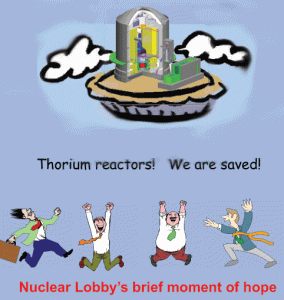 Dispelling Claim 2: Thorium did not get a chance in the nuclear energy development because it is not usable for military purposes Thorium ‒ a better fuel for nuclear technology? Nuclear Monitor, by Dr. Rainer Moormann 1 March 2018
In the early stages of nuclear technology in the USA (from 1944 to the early 1950s), reprocessing technology was not yet well developed. Better developed were graphite moderated reactors that used natural uranium and bred plutonium.
For the use of thorium (which, other than uranium, does not contain fissile components), enriched uranium or possibly plutonium would have been indispensable.
Initially, neither pathway for thorium development was chosen because it would have automatically reduced the still limited capacity for military fissile materials production. (Thorium has a higher capture cross section for thermal (that means slow) neutrons than U-238. For that reason, it needs as fertile material in reactors a higher fissile density than U-238.)
Only when the US enrichment capacity at about 1950 delivered sufficient enriched uranium, the military and later civil entry into thorium technology started: in 1955 a bomb with U-233 from thorium was exploded, and a strategic U-233 reserve of around 2 metric tons was created. The large head-start of the plutonium bomb could not be overtaken any more, and plutonium remained globally the leading military fission material (although, according to unconfirmed sources, Indian nuclear weapons contain U-233).
The US military research concluded in 1966 that U-233 is a very potent nuclear weapon material, but that it offers hardly any advantages over the already established plutonium. Because light water reactors with low-enriched uranium (LEU) were already too far developed, thorium use remained marginal also in civil nuclear engineering: for instance, the German “thorium reactor” THTR-300 in Hamm operated only for a short time, and in reality it was a uranium reactor (fuel: 10% weapon-grade 93% enriched U-235 and 90% thorium) because the amount of energy produced by thorium did not exceed 25%.
March 5, 2018
Posted by Christina Macpherson |
2 WORLD, business and costs, Reference, spinbuster, thorium |
Leave a comment
 THE MIDDLE EAST’S NUCLEAR TECHNOLOGY CLOCK STARTS TICKING, INTERNATIONAL POLICY DIGEST JAMES DORSEY, 04 MAR 2018
The Middle East’s nuclear technology clock is ticking as nations pursue peaceful capabilities that potentially leave the door open to future military options.
Concern about a nuclear arms race is fuelled by uncertainty over the future of Iran’s 2015 nuclear agreement, a seeming US willingness to weaken its strict export safeguards in pursuit of economic advantage, and a willingness by suppliers such as Russia and China to ignore risks involved in weaker controls.
The Trump administration was mulling loosening controls to facilitate a possible deal with Saudi Arabia as Israeli Prime Minister Benyamin Netanyahu prepared, in an address this week to a powerful Israeli lobby group in Washington, to urge US President Donald J. Trump to scrap the Iranian nuclear deal unless the Islamic republic agrees to further military restrictions and makes additional political concessions.
Israel has an undeclared nuclear arsenal of its own and fears that the technological clock is working against its long-standing military advantage. The US has signaled that it may be willing to accede to Saudi demands in a bid to ensure that US companies, with Westinghouse in the lead, have a stake in the kingdom’s plan to build by 2032 16 reactors that would have 17.6 gigawatts (GW) of nuclear capacity.
In putting forward demands for parity with Iran by getting the right to controlled enrichment of uranium and the reprocessing of spent fuel into plutonium, potential building blocks for nuclear weapons, Saudi Arabia was backing away from a 2009 memorandum of understanding with the United States in which it pledged to acquire nuclear fuel from international markets.
“The trouble with flexibility regarding these critical technologies is that it leaves the door open to production of nuclear explosives,” warned nuclear experts Victor Gilinsky and Henry Sokolski in an article in the Bulletin of the Atomic Scientists.
While Israeli opinion is divided on how the US should respond to the Saudi demands, Messrs Trump and Netanyahu’s opposition to the Iranian nuclear accord has already produced results that would serve Saudi interests……https://intpolicydigest.org/2018/03/04/middle-east-s-nuclear-technology-clock-starts-ticking/
March 5, 2018
Posted by Christina Macpherson |
MIDDLE EAST, weapons and war |
Leave a comment
 Dispelling Claim 3: Thorium use has hardly any proliferation risk Thorium ‒ a better fuel for nuclear technology? Nuclear Monitor, by Dr. Rainer Moormann 1 March 2018
The proliferation problem of Th / U-233 needs a differentiated analysis ‒ general answers are easily misleading. First of all, one has to assess the weapon capability of U-233. Criteria for good suitability are a low critical mass and a low rate of spontaneous fission. The critical mass of U-233 is only 40% of that of U-235, the critical mass of plutonium-239 is around 15% smaller than for U-233. A relatively easy to construct nuclear explosive needs around 20 to 25 kg U-233.
The spontaneous fission rate is important, because the neutrons from spontaneous fission act as a starter of the chain reaction; for an efficient nuclear explosion, the fissile material needs to have a super-criticality of at least 2.5 (criticality is the amount of new fissions produced by the neutrons of each fission.)
When, because of spontaneous fissions, a noticeable chain reaction already starts during the initial conventional explosion trigger mechanism in the criticality phase between 1 and 2.5, undesired weak nuclear explosions would end the super-criticality before a significant part of the fissile material has reacted. This largely depends on how fast the criticality phase of 1 to 2.5 is passed. Weapon plutonium (largely Pu-239) and moreover reactor plutonium have – different from the mentioned uranium fission materials U-235 and U-233 – a high spontaneous fission rate, which excludes their use in easy to build bombs.
More specifically, plutonium cannot be caused to explode in a so-called gun-type fission weapon, but both uranium isotopes can. Plutonium needs the far more complex implosion bomb design, which we will not go into further here. A gun-type fission weapon was used in Hiroshima – a cannon barrel set-up, in which a fission projectile is shot into a fission block of a suitable form so that they together form a highly super-critical arrangement. Here, the criticality phase from 1 to 2.5 is in the order of magnitude of milliseconds – a relatively long time, in which a plutonium explosive would destroy itself with weak nuclear explosions caused by spontaneous fission.
One cannot find such uranium gun-type fission weapons in modern weapon arsenals any longer (South Africa’s apartheid regime built 7 gun-type fission weapons using uranium-235): their efficiency (at most a few percent) is rather low, they are bulky (the Hiroshima bomb: 3.6 metric tons, 3.2 meters long), inflexible, and not really suitable for carriers like intercontinental rockets.
On the other hand, gun-type designs are highly reliable and relatively easy to build. Also, the International Atomic Energy Agency (IAEA) reckons that larger terror groups would be capable of constructing a nuclear explosive on the basis of the gun-type fission design provided they got hold of a sufficient amount of suitable fissile material.1
Bombs with a force of at most 2 to 2.5 times that of the Hiroshima bomb (13 kt TNT) are conceivable. For that reason, the USA and Russia have tried intensively for decades to repatriate their world-wide delivered highly enriched uranium (HEU).
A draw-back of U-233 in weapon technology is that – when it is produced only for energy generation purposes – it is contaminated with maximally 250 parts per million (ppm) U-232 (half-life 70 years).2 That does not impair the nuclear explosion capability, but the uranium-232 turns in the thorium decay chain, which means ‒ as mentioned above ‒ emission of the highly penetrating radiation of Tl-208. A strongly radiating bomb is undesirable in a military environment – from the point of view of handling, and because the radiation intervenes with the bomb’s electronics.
In the USA, there exists a limit of 50 ppm U-232 above which U-233 is no longer considered suitable for weapons.
Nevertheless, U-232 does not really diminish all proliferation problems around U-233. First of all, simple gun-type designs do not need any electronics; furthermore, radiation safety arguments during bomb construction will hardly play a role for terrorist organisations that use suicide bombers.
Besides that, Tl-208 only appears in the end of the decay chain of U-232: freshly produced or purified U-233/U-232 will radiate little for weeks and is easier to handle.2 It is also possible to suppress the build-up of uranium-232 to a large extent, when during the breeding process of U-233 fast neutrons with energies larger than 0.5 MeV are filtered out (for instance by arranging the thorium in the reactor behind a moderating layer) and thorium is used from ore that contains as little uranium as possible.
A very elegant way to harvest highly pure U-233 is offered by the proposed molten salt reactors with integrated reprocessing (MSR): During the breeding of U-233 from thorium, the intermediate protactinium-233 (Pa-233) is produced, which has a half-life of around one month. When this intermediate is isolated – as is intended in some molten salt reactors – and let decay outside the reactor, pure U-233 is obtained that is optimally suited for nuclear weapons.
An advantage of U-233 in comparison with Pu-239 in military use is that under neutron irradiation during the production in the reactor, it tends to turn a lot less into nuclides that negatively influence the explosion capability. U-233 can (like U-235) be made unsuitable for use in weapons by adding U-238: When depleted uranium is already mixed with thorium during the feed-in into the reactor, the resulting mix of nuclides is virtually unusable for weapons.
However, for MSRs with integrated reprocessing this is not a sufficient remedy. One would have to prevent separation of protactinium-233.9
The conclusion has to be that the use of thorium contains severe proliferation risks. These are less in the risk that highly developed states would find it easier to lay their hands on high-tech weapons, than that the bar for the construction of simple but highly effective nuclear explosives for terror organisations or unstable states will be a lot lower.
March 5, 2018
Posted by Christina Macpherson |
Reference, spinbuster, thorium, weapons and war |
Leave a comment
 How much nuclear waste has gone into dry storage at San Onofre? Here are the latest numbers, Orange County Register, 4 Mar 18, After “safely and successfully” loading the first multi-purpose spent fuel canister into its new home inside a concrete monolith at San Onofre in early February, Southern California Edison continues to move spent fuel into containers just a short distance from where surfers take on waves at the world-famous surf break.
The most recent fuel tally as of Feb. 20 shows that:
- The reactor known as Unit 2 had 1,207 fuel assemblies in its spent fuel pool. Three canisters, containing 111 fuel assemblies, had been moved to dry storage.
- Unit 3 had 1,350 fuel assemblies in its pool, with none yet moved to dry storage.
Dry storage is far safer than pools, nuclear experts say. All of the spent fuel is slated to be moved into the “concrete bunker” that is the Holtec HI-STORM UMAX dry storage system by the middle of 2019, Edison said.
Opponents fear it will remain there for decades and pose grave danger to people and the environment.
The most recent fuel tally as of Feb. 20 shows that:
- The reactor known as Unit 2 had 1,207 fuel assemblies in its spent fuel pool. Three canisters, containing 111 fuel assemblies, had been moved to dry storage.
- Unit 3 had 1,350 fuel assemblies in its pool, with none yet moved to dry storage.
Dry storage is far safer than pools, nuclear experts say. All of the spent fuel is slated to be moved into the “concrete bunker” that is the Holtec HI-STORM UMAX dry storage system by the middle of 2019, Edison said.
Opponents fear it will remain there for decades and pose grave danger to people and the environment………
The most recent fuel tally as of Feb. 20 shows that:
- The reactor known as Unit 2 had 1,207 fuel assemblies in its spent fuel pool. Three canisters, containing 111 fuel assemblies, had been moved to dry storage.
- Unit 3 had 1,350 fuel assemblies in its pool, with none yet moved to dry storage.
Dry storage is far safer than pools, nuclear experts say. All of the spent fuel is slated to be moved into the “concrete bunker” that is the Holtec HI-STORM UMAX dry storage system by the middle of 2019, Edison said.
Opponents fear it will remain there for decades and pose grave danger to people and the environment………https://www.ocregister.com/2018/03/02/how-much-nuclear-waste-has-gone-into-dry-storage-at-san-onofre-here-are-the-latest-numbers/
March 5, 2018
Posted by Christina Macpherson |
USA, wastes |
Leave a comment
 Azer News, 5 Mar 18 On the day of the 26th anniversary of Kazakhstan’s accession to the United Nations, an official ceremony was held at the UN Headquarters for signing the Treaty on the Prohibition of Nuclear Weapons by the Republic of Kazakhstan, Kazinform to the Foreign Office’s press service reports.
The agreement was signed by the Permanent Representative of Kazakhstan to the United Nations, Ambassador Kairat Umarov, in accordance with the authority granted to him by Decree, No617 of 9 January 2018, of the President of Kazakhstan Nursultan Nazarbayev.
Kazakhstan had participated actively in the elaboration and adoption of the Treaty, which became the first legally binding document in the history of nuclear disarmament. Its main provisions are in line with the principled position of Kazakhstan, which has taken an ambitious path of becoming a leader in nuclear disarmament and non-proliferation after being a one-time holder of the world’s fourth nuclear arsenal. This was inspired by the historical decisions of President Nursultan Nazarbayev, in particular, on the closure of the second largest nuclear test site and renunciation of the nuclear legacy of the Cold War. Our country’s denuclearization was not an accidental decision, but a well-considered and thoughtful act by a responsible state that had learned the horrors of nuclear tests which have resulted in the suffering with worst possible consequences, subsequently even in the third generation.
Despite the unwillingness of some states, including the leading ones, to pursue disarmament, President of Kazakhstan continues to tirelessly urge the international community to achieve a world free of nuclear weapons……..
As is known, among the three types of WMDs – nuclear, chemical and biological – nuclear weapons are the only ones not prohibited by law. In this regard, the core of the Treaty is Article 1 “Prohibitions”, which contains provisions on the comprehensive ban of nuclear weapons. The Treaty is designed to remove this glaring gap in existing international legal instruments and is the first step towards eliminating nuclear weapons.
The Treaty on the Prohibition of Nuclear Weapons was adopted on 7 July 2017 with the support of 122 UN Member States. It was the outcome of two sessions of a UN Conference to negotiate a legally binding instrument to prohibit nuclear weapons, leading towards their total elimination. The conference took place on March and June-July 2017 in New York. It was open to the participation of all UN member states. However, nine de facto and de jure nuclear weapons possessing states, and their allies boycotted these talks.
To date, the Treaty has been signed by 56 states, five of which have ratified it. Kazakhstan has become the 57th signatory state. The Treaty shall enter into force 90 days after the fiftieth instrument of ratification has been deposited. https://www.azernews.az/region/128206.html
March 5, 2018
Posted by Christina Macpherson |
Kazakhstan, weapons and war |
Leave a comment
Dispelling Claim 4: Thorium reactors are safer than conventional uranium reactors Thorium ‒ a better fuel for nuclear technology? Nuclear Monitor, by Dr. Rainer Moormann 1 March 2018
The fission of U-233 results in roughly the same amounts
of the safety-relevant nuclides iodine-131, caesium-137
and strontium-90 as that of U-235. Also, the decay heat is
virtually the same. The differences in produced actinides (see
next claim) are of secondary importance for the risk during
operation or in an accident. In this perspective, thorium use
does not deliver any recognisable safety advantages.
Of greater safety relevance is the fact that uranium-233
fission produces 60% less so-called delayed neutrons than
U-235 fission. Delayed neutrons are not directly created
during the fission of uranium, but from some short-lived
decay products. Only due to the existence of delayed
neutrons, a nuclear reactor can be controlled, and the
bigger their share (for instance 0.6% with U-235), the
larger is the criticality range in which controllability is given
(this is called delayed criticality). Above this controllable
area (prompt criticality) a nuclear power excursion can
happen, like during the Chernobyl accident. The fact that
the delayed super-critical range is with U-233 considerably
smaller than with U-235, is from a safety point of view an
important technical disadvantage of thorium use.
During the design of thermal molten salt reactors (breeders),
the conclusion was that the use of thorium brings problems
with criticality safety that do not appear with classical
uranium use in this type of reactors. For that reason, it was
necessary to turn the attention to fast reactors for the use
of thorium in molten salt reactors. Although this conclusion
cannot be generalised, it shows that the use of thorium can
lead to increased safety problems.
As mentioned, a serious safety problem is the necessity to
restart breeder and reprocessing technology with thorium.
Thorium is often advertised in relation to the development
of so-called advanced reactors (Generation IV). The
safety advantages attributed to thorium in this context are
mostly, however, not germane to thorium (the fuel) but
rather due to the reactor concept. Whether or not these
advanced reactor concepts bring overall increased safety
falls outside the scope of this article, but that is certainly
not a question with a clear “yes” as the answer.
March 5, 2018
Posted by Christina Macpherson |
2 WORLD, Reference, safety, spinbuster, thorium |
Leave a comment
Dispelling Claim 5: Thorium decreases the waste problem
Thorium ‒ a better fuel for nuclear technology? Nuclear Monitor, by Dr. Rainer Moormann 1 March 2018
Thorium use delivers virtually the same fission products
as classical uranium use. That is also true for those
isotopes that are important in issues around long-term
disposal. Those mobile long-lived fission products
(I-129, Tc-99, etc.) determine the risk of a deep geological
disposal when water intrusion is the main triggering event
for accidents. Thorium therefore does not deliver an
improvement for final disposal.
Proponents of thorium argue that thorium use does not
produce minor actinides (MA)5, nor plutonium. They argue
that these nuclides are highly toxic (which is correct) and
they compare only the pure toxicity by intake into the body
for thorium and uranium use, without taking into account
that these actinides are hardly mobile in final disposal
even in accidents.
March 5, 2018
Posted by Christina Macpherson |
2 WORLD, Reference, spinbuster, thorium, wastes |
Leave a comment
Toshiba gets out of GoviEx deal, Mining Journal , 4 Mar 18,
Japanese conglomerate Toshiba has severed an offtake and bond agreement with uranium producer GoviEx Uranium (CN:GXU) following the sale of its Westinghouse nuclear division to Brookfield.
Toshiba and the Africa-focused uranium explorer signed a US$40 million deal in 2012 in which the Japanese company lent the equivalent of 200,000 pounds of U3O8 (with the bond now worth 382,193Ib because of the compounded interest), as well as an offtake and shareholding agreement.
GoviEx will pay $4.5 million to get out of the bond by the end of the month, it said.
The developer is still working on financing the $220 million Madaouela project…..http://www.mining-journal.com/project-finance/news/1316062/toshiba-gets-out-of-goviex-deal
March 5, 2018
Posted by Christina Macpherson |
general |
Leave a comment
Nuclear Subsidies, Tax Bill Top NJ Rate Watchdog’s Agenda, By Jeannie O’Sullivan Law360 March 2, 2018, — The New Jersey Division of Rate Counsel will be busy going to bat for utility ratepayers in the coming months by fighting legislation calling for a $300 million subsidy for Public Service Enterprise Group Inc.’s nuclear plants and hunting for savings that utilities may owe consumers in the wake of recent federal tax legislation, according to division Director Stefanie Brand.
Ratepayers can likewise count on the division to scrutinize requests by PSEG and New Jersey American Water for rate increases, according to Brand, the attorney who has… (subscribers only)https://www.law360.com/articles/1016715/nuclear-subsidies-tax-bill-top-nj-rate-watchdog-s-agenda
March 5, 2018
Posted by Christina Macpherson |
general |
Leave a comment











 nuclear-news