North Korea might send Kim Jong-un’s sister to USA for diplomatic talks on the nuclear crisis

 Kim Jong-un’s sister could be sent to US to launch talks on ending nuclear crisis, South Korean envoy Chung Eui-yong is to deliver an ‘unconventional’ and ‘very unusual’ message to US National Security Adviser H.R. McMaster this week, the Post has learned SCMP, Robert Delaney, US correspondent, 08 March, 2018 North Korean leader Kim Jong-un may propose sending his sister, Kim Yo-jong, to the US as part of efforts to launch direct talks between Washington and Pyongyang, according to a South Korean diplomatic source.
Kim Yo-jong was the first member of the North’s ruling dynasty to visit South Korea.
The younger Kim’s presence in Pyeongchang laid the groundwork for visits by two South Korean government delegations to Pyongyang after the Games ended.
What has followed represents a reversal from the militaristic threats Kim Jong-un and US President Donald Trump lobbed at each other – Kim via North Korea’s state media and Trump via Twitter – throughout the second half of last year………
The message Chung and Suh are bringing from Pyongyang is likely to include a freeze or moratorium on the country’s nuclear weapons development programme in exchange for a downgraded or scaled-back version of joint US-South Korea military exercises, Korea Society senior director Stephen Noerper said in an interview.
“It’s a different tack for North Korea to go through South Korea,” Noerper said. “There could be an attempt to try to drive a wedge between the US and South Korea by saying ‘look, here’s all we’re offering and the Americans just aren’t listening’.
……… Other items in the six-point plan agreed upon during Chung’s most recent visit to Pyongyang include an assertion by the North Korean government that “it will not resume strategy of provocations such as additional nuclear and missile tests while conversation is ongoing”. http://www.scmp.com/news/asia/article/2136217/kim-jong-uns-sister-could-be-sent-us-launch-talks-ending-nuclear-crisis
Trump aims for global ‘energy dominance’ through pushing ahead the nuclear industry
 White House: Nuclear power dominates ‘energy dominance’, Washington Examiner, by John Siciliano |
The White House says President Trump’s biggest achievements in his energy dominance agenda are all about nuclear energy.
The White House Office of Science and Technology Policy underscored the president’s achievements Wednesday in a report that highlights a number of scientific advancements made under Trump’s watch.
The biggest energy achievements were on nuclear power, not coal, oil, or natural gas, which are typically promoted as key parts of the administration’s energy dominance agenda.
The report linked Trump’s recently released nuclear policy review, which has much to do with nuclear weapons, with moving the country closer to energy dominance. Trump issued a directive in June ordering his administration to look for ways to expand nuclear power domestically.
“The White House is leading the nuclear policy review, which includes a focus on restoring U.S. nuclear [research and development] capabilities and enabling innovation in the development and deployment of new reactors,” the new report read.
It also pointed out that on Nov. 13, Energy Secretary Rick Perry authorized national lab contractors to strike agreements with the private sector on nuclear technology licensing to help commercialize new reactors.
“The authorization adds a new and powerful technology transfer tool to help unleash American energy innovation by removing barriers for businesses and other entities interested in working with DOE’s National Laboratories,” the report said.
It also pointed out that Trump reopened a program that had been dormant for 23 years, which will boost nuclear power research and development.
“For the first time in 23 years, the U.S. Department of Energy has resumed operations at the Transient Reactor Test Facility,” the White House said. “TREAT is a crucial part of the nation’s nuclear [research and development] infrastructure, and provides the capability to test nuclear reactor fuels and materials under extreme conditions. Such testing can help to improve safety and performance of the current and future nuclear reactor fleet.”
The TREAT reactor at the Idaho National Lab operated for 35 years until it was closed under former President Bill Clinton. The TREAT website said the Energy Department had been considering reopening the test reactor, which is used to experiment with new nuclear power plant fuels. …http://www.washingtonexaminer.com/white-house-nuclear-power-dominates-energy-dominance/article/2650941
Henry Sokolski Blows Up 5 Myths about Saudi Arabia’s Nuclear Program
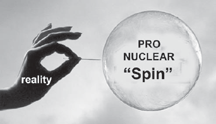
 5 Myths about Saudi Arabia’s Nuclear Program, Enabling Riyadh would only make the region’s nuclear landscape riskier. http://nationalinterest.org/feature/5-myths-about-saudi-arabias-nuclear-program-24771
Much has been written about Saudi Arabia’s plans for nuclear power since the Trump administration announced last fall that it would conclude a civilian nuclear cooperative agreement with Riyadh. Almost all of this commentary suggests Washington must accommodate the kingdom’s desire to enrich uranium and reprocess plutonium, two activities that bring states to the brink of making bombs. In particular, commentators repeatedly raise five points—none of which are sound.
Myth #1: Saudi Arabia needs nuclear power to meet its growing electrical demand.
Most recently, the Saudis announced that instead of sixteen large power reactors, they are only building two. Some have argued that this slippage reflects the kingdom’s desire to finance reactor construction with its oil revenues. With the price of oil dropping from $100 a barrel several years ago to roughly $60 a barrel today, the schedule for nuclear construction had to slide. If true, this suggests the Saudi nuclear “imperative” is less than urgent.
A more compelling explanation is that Saudis don’t need nuclear power. In fact, recent studies found that the Saudis could more cheaply meet their energy and environmental requirements by developing its natural-gas resources and investing in renewables—photovoltaic, concentrated solar power and wind. They also found economic value in upgrading the kingdom’s electrical grid and reducing subsidies that artificially drive up electrical demand. This should not be surprising. The United Arab Emirates, Riyadh’s next-door neighbor, which began construction of four power reactors several years ago, just announced that the UAE would not be building any more nuclear plants. Why? Cheaper alternatives: in addition to plentiful natural gas and wind resources, the Emirates are now investing in photovoltaic systems and solar thermal storage systems, which together can operate twenty-four hours a day more cheaply than nuclear. These findings also apply to Saudi Arabia.
Myth #2: Without a formal nuclear cooperative agreement with Riyadh, America will forgo billions of dollars of nuclear hardware and know-how exports to the kingdom.
This point presumes that the kingdom will stick with its 2012 energy plan, which it has already backed away from. It also mistakenly assumes that America still manufactures export reactors. The only American-headquartered firm that is actively interested in exporting to the kingdom is Westinghouse. It is entirely foreign owned and is a reactor designer, not a manufacturer. It’s currently in bankruptcy proceedings, and is eager to be bought by a Canadian holding firm. Naturally, Westinghouse would like its prospective buyers to believe that it has a clear shot at the Saudi market.
Unfortunately it’s, at best, a long shot. Westinghouse’s design, the AP1000, has yet to operate anywhere. The reactor’s construction is embarrassingly behind schedule and over budget both in China and the United States. Mismanagement by Westinghouse caused two reactors in South Carolina to be terminated after an expenditure of $9 billion, which, in turn, nearly bankrupted Westinghouse’s Japanese owner, Toshiba. Finally, American nuclear know-how and other nonnuclear electrical generating parts can and have been exported in support of non-American reactors abroad without a formal nuclear cooperative agreement. These goods would likely make up a majority of American nuclear exports to the kingdom but, again, their export does not require negotiating a nuclear cooperative agreement.
Myth #3: If Westinghouse does not win the bid, the Russians or Chinese will, reducing American nuclear influence in the region.
This argument is perhaps the most egregious. Consider: an unspoken motive for the kingdom to pursue a nuclear program is to develop an option to make nuclear weapons, if needed, to deter Iran. This would all but preclude buying Russian. Rosatom, after all, is building Iran’s reactors. If Saudi Arabia buys Russian, it is all but asking Moscow to let Iran know exactly what the kingdom is doing in the nuclear realm. Consider also Russia’s recent ill-fated nuclear dealings with South Africa (a contributing factor in forcing President Zumafrom office) and Turkey (where Rosatom’s financial inflexibility prompted Turkey’s private financiers, who were underwriting half of the undertaking, to pull out of the project).
As for buying Chinese, doing so is also risky. The Chinese recently encountered “safety concerns” that delayed operation in Taishan of both its Westinghouse AP1000, and a French-based design. As for China’s top export nuclear design, the Hualong One (HPR 1000) reactor, the British won’t be done certifying it until 2022. China’s other possible export system, the CAP 1400, based on the yet-unproven AP1000, has yet to operate anywhere.
What’s left? The kingdom’s original bid requirements were for two reactors that would produce 2,800 megawatts. The only country that has a reactor that is operating, that is properly licensed, and that has been built roughly on time and on budget that could meet this requirement is Korea’s APR-1400. The Saudis only changed their original bid requirements after the United States, China, Russia and France all complained. Given Korea’s relative success in building four APR-1400 reactors on time and on budget in the United Arab Emirates, and its success in operating a licensed APR-1400 in South Korea, the Korean reactor is still the odds-on favorite to win the Saudi bid.
No, it doesn’t. Saudi nuclear backers argue that the kingdom should enrich, given the uranium reserves the Saudis have discovered. Uranium, however, is plentiful globally and priced at historic lows (less than $22 a pound), as are uranium-enrichment services. More important, the kingdom would have to spend billions on a variety of plants to enrich uranium and produce its own nuclear fuel. Starting such an undertaking might make economic sense if the kingdom had roughly a dozen large reactors up and running. It currently has none, and has only opened a process to buying two.
Myth #5: United States has more to gain by accommodating Saudi Arabia’s demand that it be allowed to enrich uranium than resisting it.
Trumpeting these myths, proponents of a permissive U.S.-Saudi nuclear deal argue that Washington lacks the leverage to secure a Saudi pledge not to make enrich or reprocess. The best Washington can do, it is argued, is to ask Riyadh to defer such dangerous nuclear activities for several years. Some even suggestthat acceding to Riyadh’s wishes is in Washington’s interest, since allowing the Saudis the capacity to make nuclear weapons–usable fuels might help “deter” Iran from acquiring nuclear weapons.
None of this seems sound. As already noted, the Korean APR-1400 is most likely to win the Saudi contract. Given this reactor’s American technical content, senior Korean officials are convinced they cannot export it to the kingdom unless the Saudis first reach a nuclear cooperative agreement with the United States. For this reason (and others besides), Seoul is inclined to take American guidance. Meanwhile, President Trump is trying to get the European parties to the Iran nuclear deal to devise a tighter follow-on understanding. A riskier approach would be for the United States to break from its policy (solidified in the 2009 U.S.-UAE nuclear cooperative agreement) to get non-weapons states in the Middle East to forswear enriching and reprocessing.
Besides the odd optics of looking like a version of the 2015 Iran nuclear deal (which President Trump says is “the worst deal ever”), allowing Riyadh to enrich and reprocess would immediately excite the humors of the UAE and Egypt. Both have U.S. nuclear cooperative agreements that allow them to request their agreements be modified if the United States offers any of their neighbors a more generous nuclear deal. Then there’s Morocco and Turkey: their nuclear agreements with Washington are up for renewal in 2021 and 2023. They too are likely to ask for equal treatment as soon as possible. How this serves anyone’s long-term interest is, at best, unclear.
Henry Sokolski is executive director of the Nonproliferation Policy Education Center and the author of Underestimated: Our Not So Peaceful Nuclear Future. He served as deputy for nonproliferation policy in the office of the U.S. secretary of defense from 1989 to 1993.
If Saudi Arabia is to have a prosperous economic future, we are told, it must meet its growing power requirements by burning less oil. For this, nuclear proponents insist, the Saudis need sixteen large reactors. Although often repeated, this is not true. In 2012, the Saudis announced their intention to build sixteen reactors by 2032. By 2017, Saudi planners had pushed this back to 2040. Shortly thereafter, Crown Prince Mohammed bin Salman backed an national development plan for 2030 that didn’t mention nuclear power, but instead focused on investing in renewables.
Most recently, the Saudis announced that instead of sixteen large power reactors, they are only building two. Some have argued that this slippage reflects the kingdom’s desire to finance reactor construction with its oil revenues. With the price of oil dropping from $100 a barrel several years ago to roughly $60 a barrel today, the schedule for nuclear construction had to slide. If true, this suggests the Saudi nuclear “imperative” is less than urgent.
A more compelling explanation is that Saudis don’t need nuclear power. In fact, recent studies found that the Saudis could more cheaply meet their energy and environmental requirements by developing its natural-gas resources and investing in renewables—photovoltaic, concentrated solar power and wind. They also found economic value in upgrading the kingdom’s electrical grid and reducing subsidies that artificially drive up electrical demand. This should not be surprising. The United Arab Emirates, Riyadh’s next-door neighbor, which began construction of four power reactors several years ago, just announced that the UAE would not be building any more nuclear plants. Why? Cheaper alternatives: in addition to plentiful natural gas and wind resources, the Emirates are now investing in photovoltaic systems and solar thermal storage systems, which together can operate twenty-four hours a day more cheaply than nuclear. These findings also apply to Saudi Arabia.
Myth #2: Without a formal nuclear cooperative agreement with Riyadh, America will forgo billions of dollars of nuclear hardware and know-how exports to the kingdom.
This point presumes that the kingdom will stick with its 2012 energy plan, which it has already backed away from. It also mistakenly assumes that America still manufactures export reactors. The only American-headquartered firm that is actively interested in exporting to the kingdom is Westinghouse. It is entirely foreign owned and is a reactor designer, not a manufacturer. It’s currently in bankruptcy proceedings, and is eager to be bought by a Canadian holding firm. Naturally, Westinghouse would like its prospective buyers to believe that it has a clear shot at the Saudi market.
Unfortunately it’s, at best, a long shot. Westinghouse’s design, the AP1000, has yet to operate anywhere. The reactor’s construction is embarrassingly behind schedule and over budget both in China and the United States. Mismanagement by Westinghouse caused two reactors in South Carolina to be terminated after an expenditure of $9 billion, which, in turn, nearly bankrupted Westinghouse’s Japanese owner, Toshiba. Finally, American nuclear know-how and other nonnuclear electrical generating parts can and have been exported in support of non-American reactors abroad without a formal nuclear cooperative agreement. These goods would likely make up a majority of American nuclear exports to the kingdom but, again, their export does not require negotiating a nuclear cooperative agreement.
Myth #3: If Westinghouse does not win the bid, the Russians or Chinese will, reducing American nuclear influence in the region.
This argument is perhaps the most egregious. Consider: an unspoken motive for the kingdom to pursue a nuclear program is to develop an option to make nuclear weapons, if needed, to deter Iran. This would all but preclude buying Russian. Rosatom, after all, is building Iran’s reactors. If Saudi Arabia buys Russian, it is all but asking Moscow to let Iran know exactly what the kingdom is doing in the nuclear realm. Consider also Russia’s recent ill-fated nuclear dealings with South Africa (a contributing factor in forcing President Zumafrom office) and Turkey (where Rosatom’s financial inflexibility prompted Turkey’s private financiers, who were underwriting half of the undertaking, to pull out of the project).
As for buying Chinese, doing so is also risky. The Chinese recently encountered “safety concerns” that delayed operation in Taishan of both its Westinghouse AP1000, and a French-based design. As for China’s top export nuclear design, the Hualong One (HPR 1000) reactor, the British won’t be done certifying it until 2022. China’s other possible export system, the CAP 1400, based on the yet-unproven AP1000, has yet to operate anywhere.
What’s left? The kingdom’s original bid requirements were for two reactors that would produce 2,800 megawatts. The only country that has a reactor that is operating, that is properly licensed, and that has been built roughly on time and on budget that could meet this requirement is Korea’s APR-1400. The Saudis only changed their original bid requirements after the United States, China, Russia and France all complained. Given Korea’s relative success in building four APR-1400 reactors on time and on budget in the United Arab Emirates, and its success in operating a licensed APR-1400 in South Korea, the Korean reactor is still the odds-on favorite to win the Saudi bid.
Myth # 4: It makes economic sense for the kingdom to enrich uranium to fuel its own reactors.
No, it doesn’t. Saudi nuclear backers argue that the kingdom should enrich, given the uranium reserves the Saudis have discovered. Uranium, however, is plentiful globally and priced at historic lows (less than $22 a pound), as are uranium-enrichment services. More important, the kingdom would have to spend billions on a variety of plants to enrich uranium and produce its own nuclear fuel. Starting such an undertaking might make economic sense if the kingdom had roughly a dozen large reactors up and running. It currently has none, and has only opened a process to buying two.
Myth #5: United States has more to gain by accommodating Saudi Arabia’s demand that it be allowed to enrich uranium than resisting it.
Trumpeting these myths, proponents of a permissive U.S.-Saudi nuclear deal argue that Washington lacks the leverage to secure a Saudi pledge not to make enrich or reprocess. The best Washington can do, it is argued, is to ask Riyadh to defer such dangerous nuclear activities for several years. Some even suggestthat acceding to Riyadh’s wishes is in Washington’s interest, since allowing the Saudis the capacity to make nuclear weapons–usable fuels might help “deter” Iran from acquiring nuclear weapons.
None of this seems sound. As already noted, the Korean APR-1400 is most likely to win the Saudi contract. Given this reactor’s American technical content, senior Korean officials are convinced they cannot export it to the kingdom unless the Saudis first reach a nuclear cooperative agreement with the United States. For this reason (and others besides), Seoul is inclined to take American guidance. Meanwhile, President Trump is trying to get the European parties to the Iran nuclear deal to devise a tighter follow-on understanding. A riskier approach would be for the United States to break from its policy (solidified in the 2009 U.S.-UAE nuclear cooperative agreement) to get non-weapons states in the Middle East to forswear enriching and reprocessing.
Besides the odd optics of looking like a version of the 2015 Iran nuclear deal (which President Trump says is “the worst deal ever”), allowing Riyadh to enrich and reprocess would immediately excite the humors of the UAE and Egypt. Both have U.S. nuclear cooperative agreements that allow them to request their agreements be modified if the United States offers any of their neighbors a more generous nuclear deal. Then there’s Morocco and Turkey: their nuclear agreements with Washington are up for renewal in 2021 and 2023. They too are likely to ask for equal treatment as soon as possible. How this serves anyone’s long-term interest is, at best, unclear.
Henry Sokolski is executive director of the Nonproliferation Policy Education Center and the author of Underestimated: Our Not So Peaceful Nuclear Future. He served as deputy for nonproliferation policy in the office of the U.S. secretary of defense from 1989 to 1993.
Falsified data on analyses of burying radioactive waste – Kobe Steel again
https://mainichi.jp/english/articles/20180307/p2a/00m/0na/017000c (Mainichi Japan) Sixteen pieces of data relating to the underground disposal of highly radioactive waste generated by nuclear reactors, which scandal-hit Kobe Steel Ltd. and a subsidiary analyzed at the request of the Japan Atomic Energy Agency (JAEA), were falsified, forged or flawed in other ways, the nuclear research organization said.
The government-affiliated JAEA, which commissioned Kobe Steel and its subsidiary Kobelco Research Institute Inc. to analyze data on the impact of burying highly radioactive waste deep underground, has demanded that the steelmaker redo the work.
Kobe Steel expressed regret over the matter. “We’ll do our best to prevent a recurrence,” said a company official.
According to the JAEA, the data in question includes that on the corrosion of metal used for cladding tubes and containers for spent nuclear fuel. Between fiscal 2012 and 2016, the Nuclear Regulation Authority and the Ministry of Economy, Trade and Industry (METI) commissioned the JAEA to conduct the analyses, and the agency farmed out the work to the steelmaker and its subsidiary.
JAEA officials said most of the data was not accompanied by records of experiments conducted in the analyses, or had intentionally been altered.
According to METI’s Agency for Natural Resources and Energy and other sources, the report detailing the results of the analyses will be partially corrected following the discovery of the data falsification.
New York Times inadequate coverage of South Australia’s problem about nuclear waste dumping
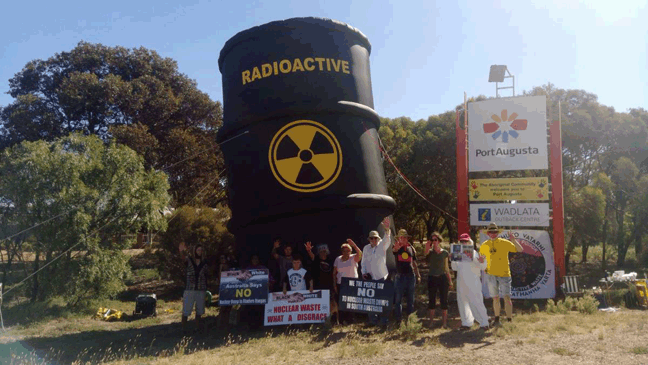
This New York Times author gives a fair coverage to the Kimba radioactive waste dump issue. But it’s misleading in 3 important ways, as if the author completely buys the nuclear lobby’s propaganda.:
- States that “The country has no nuclear power plants.” But fails to mention the Lucas Heights nuclear reactor [which is the source of the really important radioactive trash for Kimba]
- Fails to mention the fact that South Australia has a clear law prohibiting establishment of any nuclear waste facility
- Seems unaware of the huge distances (2000 km) involved, which would mean that the vast majority of medical wastes would no longer be radioactive, in transport from the main points of production and use.
A Farming Town Divided: Do We Want a Nuclear Site that Brings Jobs?, NYT, By MARCH 7, 2018 “……… Now, as the federal government considers whether to build the site on one of these two farms in Kimba, this community of about 650 people finds itself divided and angry. The prospect of jobs and subsidies that the site would bring has split locals between those who want to preserve rural Australia’s way of life and those who say the glory days of farming are over…..
Despite the distances, locals say Kimba always had a strong sense of community, at least until the nuclear site was proposed. Some said the allure of millions of dollars’ worth of grants and subsidies that the government was offering the host community had blinded people to the risks.
Animals around Chernobyl and Fukushima are NOT flourishing, despite the nuclear lobby’s claims

Bird at left normal, at right – Chernobyl bird with facial cancer
Beyond Nuclear International 4th March 2018, It started with wolves. The packs around the Chernobyl nuclear plant, which exploded on April 26, 1986, were thriving, said reports. Benefitting from the absence of human predators, and seemingly unaffected by the high radiation levels that still persist in the area, the wolves, they claimed, were doing better than ever.
Appearances, however, can be deceptive. Abundant does not necessarily mean healthy. And that is exactly what
evolutionary biologist, Dr. Timothy Mousseau and his team began to find out as, over the years, they traveled to and researched in and around the Chernobyl disaster site in the Ukraine.
Then, when a similar nuclear disaster hit in Japan — with the triple explosions and meltdowns at
Fukushima Daiichi on March 11, 2011 — Mousseau’s team added that region to its research itinerary.
Mousseau has now spent more than 17 years looking at the effects on wildlife and the ecosystem of the 1986 Chernobyl
nuclear disaster. He and his colleagues have also spent the last half dozen years studying how non-human biota is faring in the wake of Fukushima. Ninety articles later, they are able to conclude definitively that animals and plants around Chernobyl and Fukushima are very far indeed from flourishing.
https://beyondnuclearinternational.org/2018/03/04/not-thriving-but-failing/
Who will pay the astronomic cost of storing America’s nuclear trash? NRC reviews New Mexico proposal
 Goodbye Yucca? NRC to review New Mexico nuclear waste storage proposal, https://www.utilitydive.com/news/goodbye-yucca-nrc-to-review-new-mexico-nuclear-waste-storage-proposal/518653/ Robert Walton
Dive Brief:
- agreed to review a spent fuel storage site proposed for New Mexico by a private company, raising the possibility of a solution for a decades-old problem.
- Yucca Mountain, in Nevada, was identified by legislation as a permanent solution in 1987, but has been debated even since. Funding was canceled by the Obama administration in 2010, and continuing development will require significant capital.
- In March 2017, Holtec International submitted an application to construct a facility to store up to 8,680 metric tons of uranium, using a canister storage system for a 40-year license term.
Dive Insight:
Lawmakers are reportedly not going to fund Yucca Mountain development this year, despite a $120 million request from President Trump who has indicated he wants to revive development. That will maintain the status quo for dealing with spent fuel, a process which involves companies suing the federal government to recover their costs.
Processing and storing the spent fuel was supposed to be done by the government under the terms of a 1983 contract. Instead, generators file breach of contract lawsuits to cover the costs, and so far there have been more than 70 judgments resulting in payments to nuclear operators upwards of $6 billion.
Holtec is proposing an interim storage site, and last month the NRC informed the company that it would review the project. Regulators said the application “is sufficiently complete for the staff to begin its detailed safety, security and environmental reviews.”
Holtec is just the second private company to file such an application, according to Power Magazine. Waste Control Specialists proposed a site in Texas, but subsequently put its application on hold due to escalating
costs.
NRC staff informed Holtec that the cost to review its application would likely reach $7.5 million. The company would use a the Hi-Storm UMAX canister storage system, which stores loaded canisters underground. According to Holtec, the Hi-Storm system “is widely considered by industry experts to be the last word on public safety and security.”
The facility would be constructed on 1,000 acres of unused land, about midway between the cities of Carlsbad and Hobbs, N.M. The company says the area has many advantages, not least of which is being located 35 miles from the nearest populations.
The costs to store spent nuclear fuel are astronomical: The U.S. Department of Energy has estimated the government’s total liability will be $29 billion by 2022, assuming that the government starts accepting nuclear waste by then. Some estimates put the cost as high as $50 billion.
UK police say Sergei Skripa, former Russian spy, was poisoned with nerve agent
Sergei Skripal: former Russian spy poisoned with nerve agent, say police, Former Russian spy’s case being treated as attempted murder, with police officer also ‘seriously ill’ Sergei Skripal Guardian, Vikram Dodd, Luke Harding and Ewen MacAskill 8 Mar 2018
Scotland Yard assistant chief commissioner Mark Rowley said the police officer who was first to the spot where Skripal was found in Salisbury on Sunday afternoon was “seriously ill” in hospital. His condition had deteriorated, Rowley said, adding: “Wiltshire police are providing full support to his family.”
Describing the poisoning as a major incident, Rowley said scientists had identified the substance used. He refused to reveal what the specific poison was.
Suspected Skripal poisoning: who might have ordered it and why?
All three were suffering from “exposure to a nerve agent”. Detectives now believed that Sergei and Yulia Skripal were specifically targeted, he added, in a deliberate act. They remain critically ill in hospital.
Although further details are awaited, the suspicion in Downing Street will be that the Kremlin has attempted another brazen assassination operation on British soil. Moscow will furiously deny involvement, but Theresa May will have to consider how the government might respond should the police and other evidence point to Russia and its multiple spy outfits.
Unlike in the case of Alexander Litvinenko, poisoned with a slow-acting radioactive cup of tea, detectives got to the scene in Salisbury quickly. Hundreds of officers were now working around the clock, Rowley said. They were examining CCTV footage from the city centre and building a detailed timeline of events, he added……….. https://www.theguardian.com/uk-news/2018/mar/07/russian-spy-police-appeal-for-witnesses-as-cobra-meeting-takes-place
Need to monitor beaches near Dounreay, as another toxic radioactive fragment is found
 Energy Voice 8th March 2018, A leading independent nuclear expert has called for increased monitoring of
a Caithness beach after an “alarming” radioactive fragment was found.
Dr John Large, who oversaw the salvage of Russian nuclear sub Kursk in 2000
and advises governments around the world, said the situation was
“serious” and could threaten local communities.
The tiny particle of reprocessed fuel from Dounreay was discovered to contain radioactive
americium. Dr Large said the first recorded presence of the so-called
“daughter of plutonium” in nuclear waste washed up on Sandside beach,
near Reay, was probably discharged into the sea decades ago.
He added: “The trouble is that 20 or 30 or so years later it has turned up on a
beach. If it reaches the surface – which is quite possible given natural
disturbance by the tide etc – and gets dried out it can become airborne,
thus threatening local communities. It is alarming. “Of course it is
serious.
There’s not a lot you can do either – because finding these
particles is a random process, you cannot predict where they are.
“Monitoring needs to be stepped up because there is a real risk these
particles could end up in areas of population.”
A spokeswoman for Dounreay said: ”Addressing the legacy of radioactive particles in the
marine environment around Dounreay is an important part of the site’s
decommissioning programme. The particle monitoring regime for external
beaches has been carried out for many years and is reported on our
website.”
The particle was the 275th to be unearthed on the beach since
the discovery of the first in 1984. Found 18 centimetres under the surface
during a routine sweep on January 11, it has a caesium 137 count of 110,000
bequerels of radioactivity.
If ingested, americium-241 can work its way
into the bones, liver and, in males, the testicles, and remain in the body
for some time. Sand-sized fragments of irradiated nuclear fuel were flushed
into the sea from Dounreay in the 1960s and 1970s. Particles of irradiated
nuclear fuel were first detected on the Dounreay site coastal strip in 1983
and on the beach at Sandside in 1984. Work to recover particles from the
seabed was done between the 1990s and 2012.
https://www.energyvoice.com/other-news/165626/beach-needs-nuclear-monitoring/
Radioactive leaks from Bugey nuclear power plant, near Lyon, France
 Sortir du Nucleaire 7th March 2018, In December 2017, a radioactive leak was detected at the Bugey nuclear
power plant, 35 km from Lyon. Four associations complain and call for the
immediate shutdown of the plant, which combines risks of all kinds.
On December 20, 2017, EDF detected an abnormal concentration of tritium in a
piezometer (tube allowing access to the water table) on the site of the
Bugey nuclear power station. The concentration of this radioactive
substance, which can cause serious damage to the DNA, reached 670
Becquerels per liter.
Larger concentration peaks (up to 1600 Bq / l) were
detected on subsequent days and at other locations on the site. This
presence of tritium in the Rhône water table suggests the release into the
environment of other radioelements and probably chemical elements.
Contaminated water has also certainly reached the Rhône.
http://www.sortirdunucleaire.org/Fuite-radioactive-a-la-centrale-nucleaire-du
Funding for Yucca nuclear waste project is not likely
NUCLEAR WASTE: Slim odds for Yucca Mountain funding in omnibus, Sam Mintz and Geof Koss, E&E News reportersy, March 8, 2018
South Carolina House cuts customers bills over failed nuclear project, but Senate delays decision
 S.C. House cuts customers’ bills over failed nuke project, Aiken Standard. By MEG KINNARD Associated Press, 7 Mar 18,
Waste Isolation Pilot Plant (WIPP) seeks permit to allow more nuclear waste storage
 WIPP Facility Officials Seek Permit Changes http://krwg.org/post/wipp-facility-officials-seek-permit-changes, By KRWG NEWS AND PARTNERS , CARLSBAD, N.M. (AP) 7 Mar 18, — Officials are seeking permit changes to allow more nuclear waste to be stored in an underground facility in southeastern New Mexico.
The Carlsbad Current-Argus reports Waste Isolation Pilot Plant officials are looking to redefine how the volume of the waste is calculated at the facility near Carlsbad.
The facility is about halfway to capacity under the current calculations, which take into account the air between the waste containers for the total volume.
The drums of waste are packed into another case to protect against spills.
Officials are seeking to change the volume calculations to be based on the inner containers, which they say is a more accurate measurement.
Officials say the facility is about a third full under the new volume calculations.
Washington State to give more help to sick Hanford nuclear workers and former workers
Ill Hanford workers will no longer have to prove to the state that their poor health was caused by working at the nuclear reservation.
On Wednesday, Gov. Jay Inslee signed sweeping legislation that should help more Hanford workers win approval for state worker compensation claims.
“Washington state has recognized the often terrible price Hanford workers on the front lines of nuclear production and cleanup have to pay for their service to the nation,” Tom Carpenter, executive director of the Seattle-based watchdog group Hanford Challenge, said in a statement………
Workers who spend as little as one eight-hour day at many areas of the nuclear reservation will no longer have to show that working at Hanford caused illnesses ranging from respiratory disease to many cancers.
Instead, the state Department of Labor and Industries must presume that the sickness was the result of a chemical or radiological exposure at Hanford.
The presumption may be rebutted by evidence that proves other causes for the disease, including smoking, lifestyle, hereditary factors, physical fitness or exposures to toxic substances at other jobs or at home.
The bill was first introduced in 2017 out of concern for central Hanford workers who can be exposed to toxic chemical vapors associated with chemicals held in underground tanks.
In March 2017, Lawrence Rouse stood before a state Senate committee and attempted to talk about his illness called toxic encephalopathy, a brain dysfunction caused by exposure to chemicals. He had worked at Hanford for more than 20 years.
As he struggled to get a few clipped words out, his wife took over saying, “He doesn’t speak well. I pretty much speak for him all the time.”
Hanford Challenge and the pipefitters union Local 598 promoted the bill, saying tank farm workers have developed serious neurological and chemical diseases from exposure to chemical vapors………
Under the new law, workers, and families of workers who have died, and been denied compensation in the past can refile a claim under the new standards, according to Hanford Challenge.
…………The claims may be filed any time within the lifetime of the worker, since many illnesses can take years to develop after exposure.
………. Covered diseases under the law include:
▪ respiratory disease
▪ beryllium sensitization or disease
▪ heart problems experienced within 72 hours of an exposure
▪ neurological disease
▪ many cancers, including leukemia, some lymphomas and cancer of the thyroid, breast, esophagus, colon, bone, brain and others, with some exceptions.
The state compensation program is separate from a federal program, the Energy Employees Occupational Illness Compensation Program, that also offers compensation and medical coverage for cancers and other diseases that could have been caused by Hanford exposure.
DOE plans to open a new center to help ill Hanford workers and their survivors sort out their options for compensation and care, including available federal and state programs.
The center is expected to open this spring at 309 Bradley Blvd., Suite 120, Richland.
Protest: President Macron should not impose a problematic French EPR reactor on India
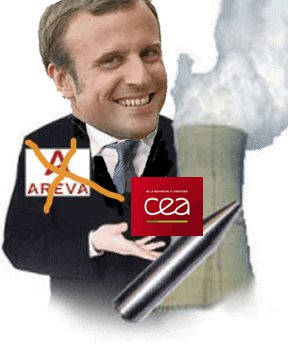 Counterview 6th March 2018, French president Emmanuel Macron should not be imposing the “untested,
expensive and technically troubled” French EPR reactor on India, say two
international groups, India-based DiaNuke and US-based Beyond Nuclear,
campaigning against nuclear power in India and across the world.
The French-supported Jaitapur Nuclear Power Project of the Nuclear Power
Corporation of India has been proposed at Madban village of Ratnagiri
district in Maharashtra.
The two well-known non-profit organizations’ statement comes amidst plans to hold a massive protest, with the
participation of 5,000 people of the villages surrounding the Jaitapur
site, on the eve of Macron’s visit on March 11. The Jaitapur EPR project
would be the biggest nuclear power plant site in the world if built,
producing 9,900 MW of electricity. https://www.counterview.net/2018/03/anti-nuclear-protest-to-greet-french.html
1 This Month
Chernobyl: The Lost Tapes – A good documentary on Chernobyl on SBS available On Demand for the next 3 weeks– https://www.sbs.com.au/ondemand/tv-program/chernobyl-the-lost-tapes/2352741955560

of the week–London Campaign for Nuclear Disarmament

Tell the Ukrainian Government to Drop Prosecution of Peace Activist Yurii Sheliazhenko
To see nuclear-related stories in greater depth and intensity – go to https://nuclearinformation.wordpress.com
-
Archives
- April 2026 (139)
- March 2026 (251)
- February 2026 (268)
- January 2026 (308)
- December 2025 (358)
- November 2025 (359)
- October 2025 (376)
- September 2025 (257)
- August 2025 (319)
- July 2025 (230)
- June 2025 (348)
- May 2025 (261)
-
Categories
- 1
- 1 NUCLEAR ISSUES
- business and costs
- climate change
- culture and arts
- ENERGY
- environment
- health
- history
- indigenous issues
- Legal
- marketing of nuclear
- media
- opposition to nuclear
- PERSONAL STORIES
- politics
- politics international
- Religion and ethics
- safety
- secrets,lies and civil liberties
- spinbuster
- technology
- Uranium
- wastes
- weapons and war
- Women
- 2 WORLD
- ACTION
- AFRICA
- Atrocities
- AUSTRALIA
- Christina's notes
- Christina's themes
- culture and arts
- Events
- Fuk 2022
- Fuk 2023
- Fukushima 2017
- Fukushima 2018
- fukushima 2019
- Fukushima 2020
- Fukushima 2021
- general
- global warming
- Humour (God we need it)
- Nuclear
- RARE EARTHS
- Reference
- resources – print
- Resources -audiovicual
- Weekly Newsletter
- World
- World Nuclear
- YouTube
-
RSS
Entries RSS
Comments RSS
 nuclear-news