On the seventh anniversary of the 2011 earthquake, tsunami and Fukushima nuclear accident, our thoughts and deepest sympathies continue to be with the people of Japan.
Every one of the tens of thousands evacuees from the 2011 Fukushima Daiichi triple reactor meltdown has a story to tell.
In our latest radiation survey we had the privilege to hear the experience of Mrs Mizue Kanno. As we entered the exclusion zone of Namie, Ms Kanno told us of the events seven years ago that were to change her life, her family and those of thousands of others.
Mrs Kanno was a social worker in Futaba less than 10 km from the nuclear plant. Eventually she made her way home after the devastating earthquake, and over the next few days thousands of people were evacuated to her home district of Tsushima. Families moved into her home. But soon they were warned by men in gas masks and protective clothing to get out immediately. The radioactive fallout from the nuclear plant, about 32 km away, had deposited high levels of contamination in this mountainous area of Namie.
Mrs Kanno now lives in western Japan, many hundreds of kilometres from her home in Fukushima. While she is a victim of nuclear power, she isn’t passive observer – instead she’s a female activist determined to tell her story. She campaigns across the Kansai region against nuclear power and for renewable energy.
Like thousands of other evacuees, she has joined lawsuits filed against the Tokyo Electric Power Company (TEPCO), and the Japanese government. Already found guiltyin multiple court proceedings of being criminally negligent in failing to take measures to prevent the meltdown, TEPCO and the government can expect many more rulings against them.
Because of the support of Mrs Kanno and her friends and neighbours, Greenpeace has been able to conduct a wide ranging survey inside the exclusion zone of Namie, published in our report, Reflecting in Fukushima.
While our survey report is filled with microsieverts and millisieverts, it’s far more about the lives and the land of Mrs Kanno her family, friends and neighbours.
Measuring thousands of points around homes, forests and farmland, it’s clear that this is an area that should not be opened to the public for many decades. Yet the government opened a main artery, route 114, while we were working in Namie.
One consequence is that people are stopping off and visiting areas high in radiation. At one house, radiation hot spots were over 11 microsieverts per hour (μSv/h) at one meter, and 137μSv/hat 10 centimetres. These levels are thousands of times the background level before the nuclear accident, and mean you’d reach your recommended maximum annual exposure in six days.
Yet, two people were working 10 meters away from the hot spot with no dosimeters or protective clothing. Mrs Kanno and our radiation specialists explained the levels of contamination and why it was necessary to take precautions.
In one zone in Obori, we measured radiation that would expose a decontamination worker to the 1 mSv/y limit in just 10 working days. The whole area is contaminated to varying high levels that will remain a threat into next century. How could the government be thinking of opening this area as early as 2023? More importantly, why?
It’s actually simple and wholly cynical. The Japanese government is desperate to restart nuclear reactors. Today only three are operating. Having areas of Japan closed to human habitation because of radioactive contamination is a very major obstacle to the government’s ambitions to operate 30-35 nuclear reactors. It’s a constant reminder to the people of Japan of the risks and consequences of nuclear power.
Yet, there are signs of positive change. Last month a panel of experts established by the Foreign Minister called for a mass scaling up of renewables, and warned of the risks from depending on coal plants and nuclear power. The voices of Mrs Kanno, the other thousands of Fukushima evacuees and the majority of people in Japan, and their demand for a different energy future, will be heard.
Throughout our time in Namie, as we visited the highly contaminated area of Obori and Tsushima – quiet, remote areas of natural beauty – Mrs Kanno told us about the life and traditions of families who for generations had supported themselves by farming. Now all of them are displaced and scattered across Japan. Yet the government is failing to even acknowledge their rights under domestic and international human rights law.
This week, we will be traveling to Geneva with mothers who are evacuees from Fukushima to the United Nations Human Rights Council session on Japan. The Japanese government has been under pressure to stop its violations of the human rights of Fukushima evacuees. Last week it accepted all recommendations at the UN to respect the human rights of Fukushima citizens. This included the German government recommendation to restore to a maximum annual public exposure of 1 mSv. This global safety standard has been abandoned by the Abe government.
The government’s decision is important, but now they need to be implemented if they are genuine in their commitments to the United Nations. On the 16 March this year, Mrs Kanno and other evacuees and their lawyers will attend the Tokyo high court for a ruling on Fukushima against TEPCO and the Government. One of the evacuee mothers, Akiko Morimatsu, together with Greenpeace, on the same day will speak at the United Nations to challenge the Japanese government to now fully apply the UN recommendations.
While we will be thousands of kilometers apart, we will be with Mrs Kanno on her day in court in Tokyo and she will be with us in Geneva. The Fukushima nuclear disaster has shattered lives but it has also brought us together determined to prevent such a terrible event from ever happening again and to transition Japan to a secure and safe energy future based on renewables.
Kazue Suzuki is an Energy Campaigner at Greenpeace Japan and Shaun Burnie is a Senior Nuclear Specialist at Greenpeace Germany
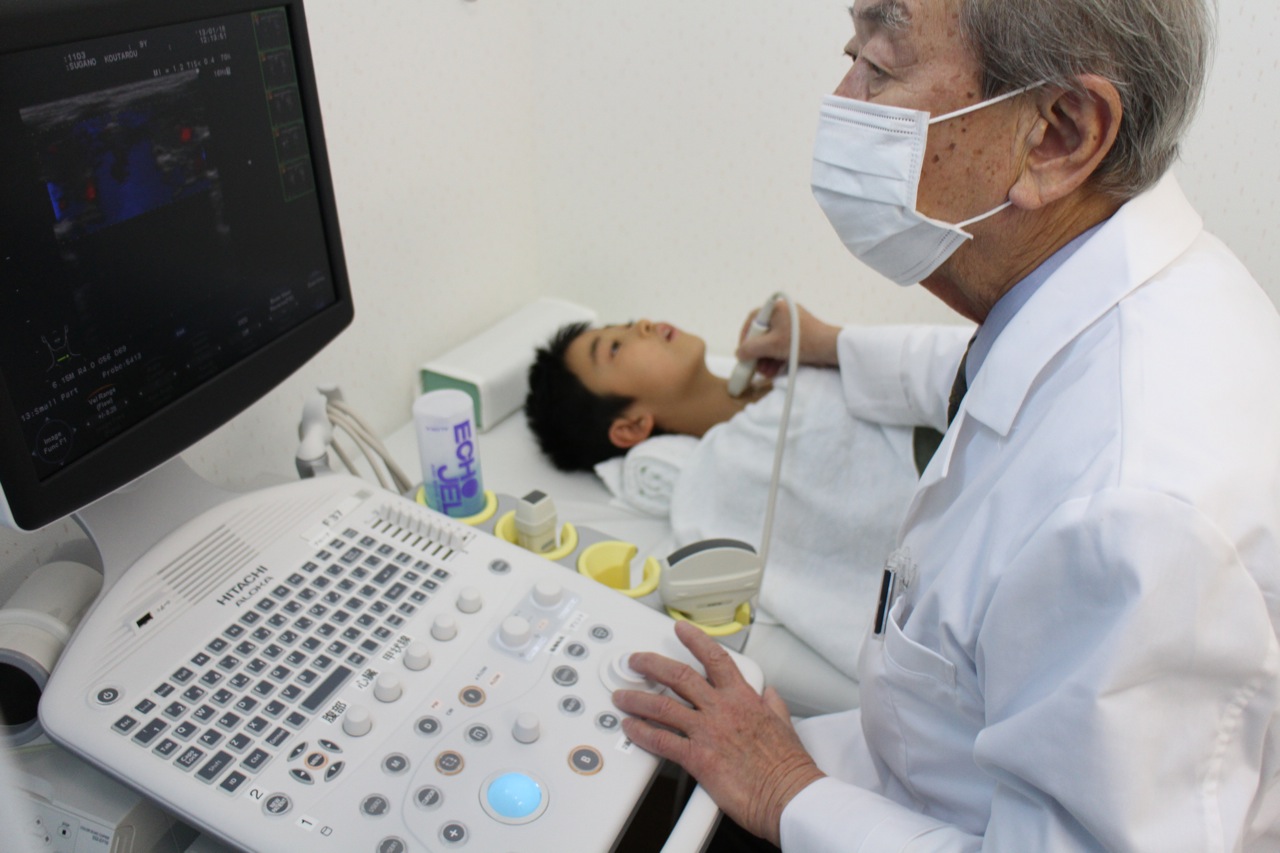
Porquoi Docteur 11th March 2018, [Machine Translation]In this population, an abnormal number of children
and adolescents develop in fact thyroid cancer, according to a study
revealed in August 2015 conducted among 300,000 young Japanese in the
prefecture of Fukushima.
Published in the journal Epidemiology, it
indicates that 103 cases of thyroid cancer have been reported in children
and adolescents under 18 who resided in Fukushima prefecture between 2011
and 2014.
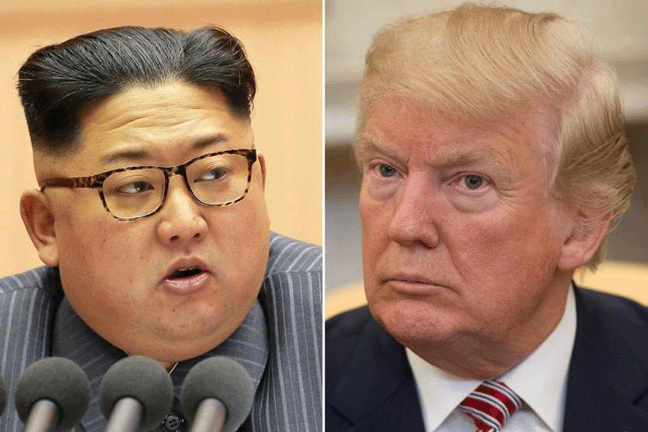
Trump under pressure over chaotic approach to North Korea nuclear talks, Guardian Jon Swaine 12 Mar 18
Republicans: denuclearisation must be prerequisite for meeting
CIA director and White House spokesman contradict each otherDonald Trump faced criticism from Republican allies on Sunday after apparentlyagreeing to meet Kim Jong-unwithout demanding that North Korea start scrapping its nuclear program.North Korea talks: Trump praises own role but Washington frets over details
Senators from Trump’s own party expressed scepticism and urged him to set tougher preconditions, amid growing concerns over the administration’s chaotic approach to nuclear diplomacy.
Senator Cory Gardner of Colorado said Trump should not meet Kim until North Korea produces proof it has begun reversing its years-long pursuit of a nuclear weapon.
“What we have to hear more of is how we are going to get to those concrete, verifiable steps towards denuclearisation before this meeting occurs,” Gardner told Face the Nation on CBS.
Trump’s team has given a series of muddled statements on that precondition. No mention of it was made during an abrupt announcement on Thursday that Trump was willing to hold a summit with Kim by May, in what would be the first ever meeting of the two countries’ leaders…….
The president has offered little clarity. After tweeting about conversations with world leaders on the issue he returned to it in a rambling speech to supporters in Pennsylvania on Saturday evening, saying of North Korean denuclearisation: “They are thinking about that – who knows what’s going to happen?”
The uneven public statements followed an eccentric unveiling of Trump’s historic acceptance of Kim’s invitation. The decision was announced to journalists on the White House driveway by a South Korean official, shortly after Trump’s secretary of state, Rex Tillerson, had said direct negotiations were a distant prospect.
Having lambasted Barack Obama for what they deemed an overly conciliatory approach to Iran during nuclear talks, Republicanswere left struggling to defend Trump’s position.
……. Democrats, too, expressed concerns. “I am very worried that he’s going to go into these negotiations and be taken advantage of,” Senator Elizabeth Warren of Massachusetts said on CNN.Warren said Trump should urgently address a lack of senior diplomats who would probably be needed for successful negotiations. The US has no permanent ambassador to South Korea or assistant secretary of state for the region.
That view was echoed by Ben Rhodes, a former senior aide to Obama, who was involved in the Iran deal and said the Trump administration appeared unprepared for discussions of similar gravity.
What the president and his supporters really mean, of course, is that experts have not shown the proper deference to people who do not understand anything about the world around them. The president seems to believe that no one shows him the proper deference.
Trump and the new Know-Nothings who support him are exploiting this for short-term political gain, but in the longer run, these policies will hurt the very people who voted for Trump in the first place.
Trump is delivering what he promised: A government with no experts, Washington Post, By Tom NicholsMarch 8 Tom Nichols is a professor at the Naval War College and the Harvard Extension School and the author of “The Death of Expertise.”
President Trump kept an important campaign promise this week. Not the one about tariffs — that was incidental — but the one where he vowed to give his supporters the satisfaction of seeing him ignore experts.
The president has plunged ahead with his plans to reverse 70 years of U.S. policy, against the advice of his secretaries of defense and state. His top economic adviser, Gary Cohn — who was unfazed by Trump’s equivocation about Nazis but has found his personal red line on trade policy, apparently — also advised against the tariffs and has now walked out in defeat.
None of this really has very much to do with actual policy. By the time Trump announced the details of the steel and aluminum tariffs on Thursday, his facile public statements about how trade wars are easy to win had already made it clear that he has no actual grasp of what a trade war is, or what it could mean for the United States to start one.
But like so many Trump positions (the wall, the Muslim ban, gun control) the actual content of the policy is irrelevant. His presidential campaign, at its core, operated on a simple premise of social revenge, a notion that only Donald Trump could get even with the shadowy experts who run (and ruin) the lives of ordinary Americans. He vowed to push the eggheads out of the way — not because they are wrong, but because they are eggheads, and nobody likes eggheads……….
Since taking office, however, intelligent people in the administration have been trying to pad the sharp corners around the West Wing in an attempt to prevent these campaign promises from becoming ill-advised realities that could harm both the country and the administration. So with the chaotic point the White House has now reached, the president’s supporters are finally going to get what they want: Their rallying cry all along has been to let Trump be Trump and to ignore people who actually know what they’re doing. ………..
They [the pro Trump expert advocates] are smart enough to know that this campaign against expertise is a sham. They are leading the charge now not only because it is profitable, but also perhaps because they hope that when all this is over, the Jacobins will come for them last.
What the president and his supporters really mean, of course, is that experts have not shown the proper deference to people who do not understand anything about the world around them. The president seems to believe that no one shows him the proper deference. But others have a point, at least about workers who have been hurt by globalization. Experts do lack a certain empathy when it comes to these issues. We tend to be the people who, when asked a question by someone who’s just lost their job, point to low unemployment rates — as though that matters to a recently jobless person. We might be right, but it rankles nonetheless.
This is why the attack on experts appeals both to Trump and his voters: It scratches a deep itch of resentment that has nothing to do with intelligent policy and everything to do with feeling ignored by the people who have to make things work every day.
In the same way that the president fulminates at being told that his ideas might be flawed or wrong, a fair number of Americans now bristle when told that they have to do anything they don’t like: vaccinate their children, eat a healthy diet, put down their phones while driving. None of this is really about steel imports or fortified borders or Muslim travelers; it is about regaining a sense of empowerment.
The world is a complex place. It frightens people to think how much of their daily life is in the hands of their fellow citizens. This has been true since the beginning of the 20th century, and life in the 21st century is not going to get any less dizzying or complicated. Trump and the new Know-Nothings who support him are exploiting this for short-term political gain, but in the longer run, these policies will hurt the very people who voted for Trump in the first place.
Gary Cohn could probably explain all this to the president, if he were still around.
Trump’s nuclear summit with Kim ‘will have preconditions’ SMH, 12 Mar 18 Washington: US President Donald Trump’s condition for meeting North Korean leader Kim Jong-un is that there be no nuclear or missile testing, Treasury Secretary Steve Mnuchin said on Sunday.”There shouldn’t be confusion,” Mnuchin told NBC’s Meet the Press when asked about White House press secretary Sarah Sanders’ statement on Friday that there would be no meeting without concrete and verifiable actions by North Korea.
The President has made it clear that the conditions are that there’s no nuclear testing and there’s no missiles and those will be a condition through the meeting.”
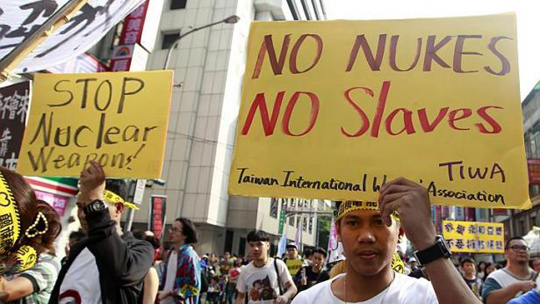
Taiwanese protesters rally for ‘nuclear-free’ island,Agence France Presse 11 Mar 18
Government has promised to phase out nuclear energy by 2025. Hundreds of anti-nuclear protesters staged a rally in Taiwan on Sunday to demand the island’s government honour its pledge to abolish the use of atomic energy by 2025
Waving placards reading “nuclear go zero”, and “abolish nuclear, save Taiwan”, they gathered outside the presidential office in Taipei on the same day Japan marked the seventh anniversary of the Fukushima disaster.
Taiwan’s cabinet-level Atomic Energy Council recently decided to allow state-owned energy company Taipower to restart a reactor at a facility near Taipei, pending parliament’s final approval.
The reactor has been offline since May 2016 after a glitch was found in its electrical system, which the company said had since been resolved.
Anti-nuclear groups are now questioning whether Taiwanese President Tsai Ing-wen’s Democratic Progressive Party (DPP) will keep its promise to phase out nuclear energy.
“It would be violating the spirit of creating a nuclear-free homeland by 2025 pledged by the DPP,” said Tsui Shu-hsin of the prospect of restarting the reactor. Tsui is the spokeswoman for the Nuclear Go Zero Action Platform, which organised the rally.
Lawmaker Huang Kuo-chang, head of the opposition New Power Party, echoed the sentiment.
“The government should move forward, not backwards and restarting the reactor would be a regression,” he told reporters at the rally.
…….Taiwan started annual anti-nuclear rallies to commemorate Japan’s nuclear disaster on March 11, 2011, when the Fukushima energy plant was hit by a tsunami following an earthquake, knocking out power to its cooling systems and sending reactors into meltdown.
Taiwan, like Japan, is prone to frequent quakes as the island lies on a number of fault lines.
“The nuclear disaster was not a natural disaster, it was a very man-made disaster,” Watanabe says. “So we felt that there was now a need for clean energy and greater energy independence.”
“It was at that symposium that I started to really think about the need for an energy shift away from nuclear power and about how rich the prefecture of Fukushima is in renewable resources,” Sato says.
“Nuclear power companies are not prepared for the cost of decommissioning and could in some cases go bankrupt. Banks and pension funds have lent them a lot of money because they have been regarded as stable, so bankruptcies could become a national financial problem. This would be difficult for the government to handle and might directly hurt pensioners,” he says. “But now the government is just hiding the problem and postponing managing it.”
Fukushima looks to renewable energy sources in the aftermath of nuclear disaster, Japan Times, BYKAJSA SKARSGÅRD ,
Yauemon Sato | CHRISTINA SJOGREN11 Mar 18,
Steam rises from outdoor pools overlooking a waterfall at a 90-year-old hotel in Fukushima Prefecture’s Tsuchiyu Onsen.
“What has saved us since the disaster are the loyal regular guests and the new visitors who have come to study our town’s renewable energy plant. Without them, I’m sure we would have had to close,” says Izumi Watanabe, who has been director of Sansuiso Tsuchiyu Spa for 37 years.
“People come from other onsen areas all over Japan to learn how they can become energy independent and how the binary plant we have doesn’t affect our hot springs,” she says, challenging the preconception that onsen communities, fearing a negative impact on their tourism business, typically hold back the development of geothermal energy in Japan.
Watanabe was at a meeting in the city of Fukushima when the Great East Japan Earthquake struck seven years ago. She returned to Tsuchiyu Onsen to find her hotel intact, but two other hotels in the area damaged and the entire community without power.
or three snowy days, Watanabe sheltered 70 of her own and other hotels’ guests without electricity, telephones or working internet. Gathered together, they ate whatever stored food they could find. Over the next six months, her spa served as accommodation for police and rescue workers, grieving families and people displaced by the tsunami and nuclear crisis.
In total, this town of about 340 residents took in around 1,000 evacuees after the 2011 disasters. Five of the 16 hotels in Tsuchiyu Onsen have since gone out of business: two as a result of earthquake damage, the others on the back of a decline in visitor numbers from approximately 230,000 a year to about 70,000 as rumors of elevated radiation levels swirled. Members of the local community gathered together in October 2011 to discuss their future at what was dubbed the “Tsuchiyu Onsen reconstruction conference.” The locals decided they couldn’t simply go back to doing what they had done before — something new was needed to revive the town and create a safer future.
“The nuclear disaster was not a natural disaster, it was a very man-made disaster,” Watanabe says. “So we felt that there was now a need for clean energy and greater energy independence.”
A renewable energy plant and shrimp farm……….
A local, national concern
An hour’s drive inland, past Mount Adatara and Mount Bandai in the city of Aizu-Wakamatsu, people also started organizing after the nuclear disaster. In July 2011, around 200 people met in the sake brewery owned by Yauemon Sato, a ninth-generation brewer, to discuss the disaster and the future.
“It was at that symposium that I started to really think about the need for an energy shift away from nuclear power and about how rich the prefecture of Fukushima is in renewable resources,” Sato says.
Sato had no background in electricity production, but he did have experience in trying to get small breweries into markets dominated by larger manufacturers. He took one of the leading roles in the growing community power movement.
With the help of the Institute for Sustainable Energy Policies, which had also worked to promote locally owned renewable electricity production before the disaster, Aizu Electric Power Co. was established to manage the planned solar parks.
Today, the company has 70 solar power sites and Sato has become a vocal critic of the large nuclear- and fossil-fuel companies that control the grid through regional monopolies, thereby hindering the new renewable energy companies from getting into the market.
The monopolies argue that they are protecting the stability of the grid, so at present newcomers in some regions can only connect a maximum voltage of 50 kilowatts onto the network.
“This is a severe problem,” Sato says. “In 2020, the government is going to separate the power transmission business from the power production business, but these big electric companies are creating sister companies to run the grid, so it will still be in the control of the same big companies and continue to be difficult for other producers to use.”
The Aizu region is where shogun Tokugawa Yoshinobu’s rebels fought one of the last big battles against government troops in 1868. The people’s rights movement flourished here after the civil war. It matters here that it is the people of Fukushima who have paid the ultimate price for the nuclear power that was sold mainly to Tokyo.
Aizu Electrical Power Co., its logo a fist held up in the air over the letters AiPower, is challenging the electricity establishment of Japan, and is part of a bigger movement.
The first World Community Power Conference was held in the city of Fukushima in November 2016 on the same day as the Paris climate accord came into force. One of the organizers was the Japan Community Power Association, in which Sato is a board member. He is also the vice president of Genjiren, an anti-nuclear power association that, with the help of the former prime ministers Junichiro Koizumi and Morihiro Hosokawa, pitched a bill to the opposition parties in January calling for an immediate halt to nuclear power, together with a more ambitious national goal for renewables.
“Finally I feel that we have a political movement for an energy shift,” Sato says. “We want to make this a national citizens’ movement.”
Unsustainable politics defied
The grass-roots movement pushing for renewables is not alone. Both at home and abroad, the Japanese government has been criticized for failing to embrace broader renewable energy policies in the wake of the 2011 disasters while remaining open to the construction of additional coal plants and nuclear reactor restarts.
……… Tomas Kaberger, executive board chairman of the Renewable Energy Institute in Tokyo. believes the government is willing to restart more reactors because it fears the financial consequences of failing to do so. The reactors are valuable for the balance sheets of the power companies, but in reality they represent a significant decommissioning liability.“Nuclear power companies are not prepared for the cost of decommissioning and could in some cases go bankrupt. Banks and pension funds have lent them a lot of money because they have been regarded as stable, so bankruptcies could become a national financial problem. This would be difficult for the government to handle and might directly hurt pensioners,” he says. “But now the government is just hiding the problem and postponing managing it.”…….https://www.japantimes.co.jp/life/2018/03/10/environment/fukushima-looks-renewable-energy-sources-aftermath-nuclear-disaster/#.WqWVhx1ubGg
North Korean leader Kim Jong Un provides guidance on a nuclear weapons program in this undated photo released by North Korea’s Korean Central News Agency (KCNA) in Pyongyang September 3, 2017. KCNA via REUTERS
North Korea’s Nuclear Ambitions And Abilities, NPR’s Renee Montagne talks with Siegfried Hecker, a former director of the Los Alamos National Laboratory, about North Korea’s nuclear program. National Public Radio. 11 Mar 18
………. HECKER: Well, first of all, I think it’s not very likely to happen, [the meeting between Trump and Kim] . What’s significant in the current situation is they’ve actually said that they would be willing to give up nuclear weapons, you know, if their security is assured, and they’re not threatened. However, to think that’s going to happen in the short term is just not realistic because to build a nuclear weapons program, it’s an enormous number of facilities. It’s a large number of people. It took, well, more or less 50 years but particularly the last 25 years to get to where they are today. They’re not going to turn that over overnight.
…….. MONTAGNE: Well, short of full denuclearization, what other steps could North Korea take to prove, you know, its sincerity in this?
HECKER: So there are very important steps. And one can lay those out. In other words, I look at the things that are highest risk. And those are the things you want them to stop first. So two that were highest on my list – they have, for the time being, said they would do a moratorium. And that’s no more missile tests and no more nuclear tests – because to increase the sophistication of your bombs, you have to do more nuclear tests. The next one would be not to make any more bomb-grade material, which means stop the operation of the reactors. All three of those are verifiable. The problem is on the bomb-grade material, you can also go the uranium route. Those are the centrifuge halls. We know where one of them is. We don’t know where the other one or two are. And that will be extremely difficult to verify. And that’s going to take a long time and a real detailed process with them to get there.
MONTAGNE: From what you know of North Korea from your time on the ground, are they motivated to use these weapons? Is this something to really be afraid of?
HECKER: What I worry about when it comes to the weapons is – one is capability. Second is motivation. And capability – for many years, I was able to say, look. You know, they have the bomb, but they don’t have much. They don’t have a nuclear arsenal. Then comes the motivation part. And would they be motivated to go ahead and attack the United States, Japan or South Korea basically out of the blue? I say absolutely not. They want those weapons to make sure to protect them. Perhaps they want the weapons so that they actually have sort of sufficient maneuvering room, you know, on the Korean Peninsula. What I’ve worried about is not so much that they’re motivated to attack us but rather that we’re going to stumble into a nuclear war.
The government has yet another consultation out on new build – on where to site new nuclear reactors. This entirely vicious consultation to enable new nuclear build has been difficult to reply to as there should be no new reactors anywhere. Today is Mothers Day and this is for all those whose children are no […]
“Russian companies are working in the exploration, mining, energy and petrochemical sectors in Africa and are taking part in national programmes to build natural gas pipelines and storage facilities and provide technical maintenance for hydropower plants, he said, as well as carrying out feasibility studies for the construction of nuclear power plants and nuclear research and […]
Seven years on, since the Fukushima Daiichi Nuclear Power Plant (FDNPP) accident, it is useful to start to bring together information from scientific studies of the impact of the contamination on the North American environment and its people. I recently wrote to communicate the most recent results of the Integrated Fukushima Ocean Radionuclide (InFORM) project. […]
PAWB 11th March 2018, Members and supporters of PAWB will meet near the Menai bridge on the Ynys
Môn side between 8.00 and 9.00 am on Monday, March 12 to note that seven
years have passed since the explosions and meltdowns at three nuclear
reactors at the Fukushima Daiichi station.
The crisis there continues despite all efforts by the Japanese Government to mislead people that the
situation is better. 300 tonnes of radioactive water still flows through
the site every day in to the Pacific Ocean, and much more radioactive water
is being stored in hundreds of tanks on the site.
The Japanese Government
also wants to pour this water in to the Pacific Ocean. Following recent
research by an international team of scientists, evidence has been found of
the presence of the radioactive elements, uranium, caesium and technetium
in the environment in the area around the Fukushima Daiichi station. The
research was published in February in ‘Environmental Science and
Technology’.
At the same time, the Japanese Government are pressurising
people who had to leave their homes following the nuclear disaster to
return there, maintaining that the area has been cleaned up.
PAWB supports the campaign of our friends in Greenpeace and Friends of the Earth Japan
who are putting pressure on their government not to invest huge amounts of
public money in Hitachi’s irresponsible plans to export the dangerous,
outdated and extortionately expensive Advanced Boling Water Reactor to
Wylfa.
We also appreciate the efforts of the ex-Prime Minister of Japan,
Naoto Kan and his party to halt restarting nuclear reactors there, and to
prevent the export of Hitachi and Toshiba nuclear technology to other
countries. The Constitutional Democratic Party of Japan will be presenting
the Nuclear Zero Bill to the Japanese parliament this week, and we wish
them success in their battle to keep nuclear reactors shut and to halt
export of nuclear technology. http://stop-wylfa.org/wp/
NRDC 5th March 2018, Yucca has long been viewed as the expedient solution, but that attempt to
foist a solution on an unconsenting state has instead been a failure. If
Congress decides to waste tens of millions of dollars to restart the
licensing process for the Yucca site, more anger and further delay is sure
to follow. https://www.nrdc.org/experts/geoffrey-h-fettus/final-resting-place-nuclear-waste
National assembly 9th March 2018, [Machine Translation]
La Hague: the boss of Orano (ex-Areva) minimizes the risks in the event of a plane crash on spent fuel pools. According to
Philippe Knoche, a plane crash or rocket fire could not damage enough spentfuel storage tanks to dewater them. “I would like to take this example
because our opponents use it a lot …”
Thursday, before the parliamentary commission of inquiry on the safety and security of nuclear facilities, the director general of Orano (formerly Areva) Philippe Knoche tried to reassure the deputies on the resistance of the reprocessing site of La Hague. According to him, spent nuclear fuel storage pools are not vulnerable to falling or rocket fire. http://www.lcp.fr/la-politique-en-video/la-hague-le-patron-dorano-ex-areva-minimise-les-risques-en-cas-de-chute-davion











 nuclear-news