Mahlobo must accept death knell of Nuclear Deal – Gavin Davis, Politics Web, Gavin Davis | 22 February 2018
DA MP says President must stop the gazetting of Integrated Resource Plan
Nuclear Deal: Ramaphosa must stop the gazetting of the Integrated Resource Plan
22 February 2018
Minister Gigaba’s Budget Speech, which contained no funding for a new nuclear build, should signal the death knell of the nuclear deal.
The time has come for Minister Mahlobo to accept that his attempt to deliver the nuclear deal has failed. With Zuma gone, he has outlasted his usefulness and should be removed from Cabinet without delay.
The Integrated Resource Plan (IRP), that was apparently approved by the Zuma Cabinet in December, left the door open for a new nuclear build. This was despite every credible study rejecting new investment in nuclear as part of the IRP and recommending investment in renewables and gas instead.
We call on President Ramaphosa to put a stop to the gazetting of Mahlobo’s IRP. Instead, Minister Mahlobo should be removed from office and a new Minister appointed to ensure that the new IRP is based on the latest cutting-edge modelling and research……..
https://fr.reuters.com/article/africaTech/idAFL8N1QC7B5 Rédaction Reuters PARIS, Feb 22 (Reuters) – France has no need to build new nuclear reactors in addition to the one currently being assembled in Flamanville, in western France, Environment Minister Nicolas Hulot said on Thursday.
President Emmanuel Macron said last week he would not rule out France building new nuclear reactors to replace state-controlled utility EDF’s ageing reactors.
“For the moment, frankly, there is no need to consider building other nuclear reactors in addition to Flamanville,” Hulot told lawmakers.
Hulot said in November last year that reducing the share of nuclear energy in France’s power mix to 50 percent from 75 percent would probably take until 2030-35, dropping an initial 2025 target date.
Reporting by Simon Carraud; Writing by Matthias Blamont. Editing by Jane Merriman
Energy Voice 22nd Feb 2018, A Labour former Cabinet minister has warned of the “cataclysmic
consequence” of leaving the EU without having nuclear safeguarding
arrangements in place. Lord Hutton of Furness said it would be a
“terrible event” and argued it was for ministers to ensure the UK did
not “walk off the edge of this cliff”. The peer, who is chairman of the
Nuclear Industry Association, stressed the need for an agreement to be
reached with Europe’s nuclear regulator to cover the two-year post-Brexit
transition period. https://www.energyvoice.com/other-news/164349/failure-reach-post-brexit-nuclear-deal-risks-cataclysmic-consequence/
New Power 22nd Feb 2018, The Office for Nuclear Regulation (ONR) has begun procuring a system to
track nuclear materials in the UK and ensure they are not diverted from
civilian uses, which will be required if, as planned, the UK exits the
Euratom treaty as it leaves the EU.
ONR said it has to develop and deliver a UK State System of Accountancy for and Control of Nuclear Material by 29
March 2019. It will include a Safeguards Information Management and
Reporting System that meets international reporting obligations. Without
the system, ONR said it will not be able to effectively deliver the
necessary nuclear materials accountancy.
It must be ready for parallel running by the end of December 2018 and go live by 29 March 2019. ONR has
published a procurement notice on the government’s digital marketplace
website. It says questions can be asked until 28 February and applications
must be made by midday on 7 March. The contract award is expected on 1 May
and by then the bidder must have security clearance for all personnel
involved. https://www.newpower.info/2018/02/onr-begins-procurement-to-replace-euratom-nuclear-safeguards-system/
Now 10 Workers Contaminated With Radioactive Waste At Hanford, OPB, by Anna KingFollow Northwest News Network Feb. 22, 2018
As many as 11 workers may have ingested or inhaled radioactive contamination at the Plutonium Finishing Plant demolition site at Hanford in southeast Washington state. Ten workers are confirmed to have tested positive and one needs more testing to confirm the results.
That’s up from the previous count of six.
The amounts of that contamination are small when compared with an average person’s yearly background exposure. The majority have between 1 and 10 millirems. The average person gets 350 millirems per year from natural and man-made substances.
The US Air Force is reportedly planning to develop an advanced satellite that will continue to provide communications for the top brass US Government officials in times of nuclear or space wars. To ensure effective communication, the US Air Force relies on what they call Advanced Extremely High Frequency satellites that sit in geostationary orbit.
US Air Force preparing for the worst day in human history
The Advanced Extremely High Frequency (AEHF) satellite is specially designed to keep the military and US administration in a proper working order during times of emergencies. It should be also noted that these satellites cannot be hacked or jammed.
“We need systems that work on the worst day in the history of the world,” said Todd Harrison, director of the Aerospace Security Project at the Center for Strategic and International Studies, Popular Mechanics reports.
There are four AEHF satellites already in the geostationary orbit. The US Government is now planning to launch two more, one in 2019 and another in 2020. The proposed US Air Force 2019 budget has allocated $29.8 million for this upcoming project. Air Force staffers have reportedly said that more money has been set aside in 2019 for the development of software used for running the satellites.
The US Air Force considers these AHEF satellites as a part of its new focus on advancing the country’s nuclear abilities.
“We must concurrently modernize the entire nuclear triad and the command and control systems that enable its effectiveness,” said Heather Wilson, the Air Force secretary.
The US Government is also planning to pour in a whopping sum for the development of jam-resistant GPS satellites.
How AEHF satellites work?
If a nuclear war breaks out, the atmosphere will be completely filled with charged particles that emit energy across the electromagnetic spectrum. In these times, ordinary signals will find it difficult to cut through this clutter, and as a result, all the communication means will be cut off.
During these moments, the only way of communication will be using AEHF satellites. Unlike traditional communication satellites, AEHF satellites send multiple beams to the ground, and it will increase the chances of getting through the clutters. Just like a car moving between lanes to avoid stagnant traffic, signals from AEHF satellites will reach the ground.
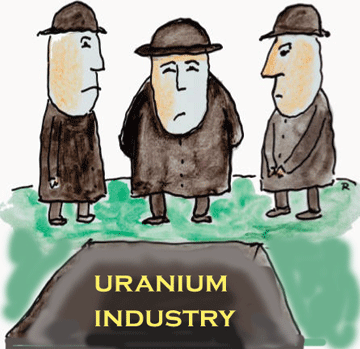
As with other commodity markets, the uranium market is a curious beast at the best of times ‒ keen to spot a bargain, investors get more and more excited the further the uranium price and company stock prices fall. They’ve had plenty to get excited about in recent years.
These days, the market exhibits multiple levels of weirdness, all stemming from the growing acknowledgment that nuclear power and the uranium industry face a bleak future.
The uranium market has a “subdued outlook” and Cameco’s uranium is now “more valuable in the ground” according to Warwick Grigor from Far East Capital, because the cost of production is higher than the prices currently being offered. Cameco CEO Tim Gitzel agrees, saying in January 2018 that at current prices “our supply is better left in the ground.” So uranium industry executives and market analysts are finally coming around to rallying cry of the anti-uranium movement: Leave it in the ground!
Lizards Revenge, Olympic Dam, 2012.
We’ve also had the odd situation over the past year of nuclear lobbyists arguing repeatedly that the nuclear power industry is in “crisis” and wondering what if anything can be salvaged from “the ashes of today’s dying industry“. Usually such claims come from the anti-nuclear movement ‒ sometimes more in hope that expectation.
And we’ve had the odd situation of industry bodies (such as the US Nuclear Energy Institute) and supporters (such as former US energy secretary Ernest Moniz) openly acknowledging the connections between nuclear power and weapons ‒ connections they have strenuously denied for decades.
Such arguments are now being used in an effort to secure preferential treatment for uranium mining companies in the US. Ur-Energy and Energy Fuels have lodged a petition with the Department of Commerce seeking a mandated requirement for US power utilities purchase a minimum 25% of their requirements from US mines. Uranium is “the backbone of the U.S. nuclear deterrent and fuels ships and submarines in the U.S. Navy”, the companies state.
The arguments might appeal to President Trump and they would dovetail neatly with his silly conspiracy theory about Hillary Clinton threatening national security by allowing the sale of a uranium mining company with US interests to Russia’s Rosatom. But the arguments don’t appear to enjoy any support from the US nuclear weapons complex and they certainly don’t enjoy any support from power utilities. According to market analysts FNArena, the petition lodged by Ur-Energy and Energy Fuels “brought the uranium market to a screaming halt” and US power utilities warned that a quota would force the early shutdown of some nuclear plants.
Another miserable year for the uranium industry
Nuclear power has been stagnant for the past 20 years. Although power reactors account for an overwhelming majority of uranium demand, uranium production ‒ and prices ‒ have been up and down and all over the place.
Uranium mine production increased by 50% from 2007 to 2016. The increase was driven, initially at least, by expectations of the nuclear renaissance that didn’t eventuate. Mine production plus secondary sources (e.g. stockpiles and ex-military material) have consistently exceeded demand ‒ 2017 was the eleventh consecutive year of surplus according to the CEO of uranium company Bannerman Resources.
Stockpiles (inventories) have grown steadily over the past decade to reach enormous levels ‒ enough to keep the entire global reactor fleet operating for around eight years. Supply from mines and secondary sources in recent years has exceeded demand by about 18%.
Those dynamics have put downward pressure on prices. After six years of steady decline, uranium prices were flat in 2017. The spot price as of 1 December 2017 was less than one-third of the pre-Fukushima price and the long-term contract price less than half the pre-Fukushima price.
Countless would-be uranium mining companies have given up, some trying their luck in other areas such as property development or growing dope. Some mines have closed, others have been put into care-and-maintenance, and others have reduced output. But supply has continued to exceed demand ‒ and to exert downward pressure on prices.
Very few mines could operate at a profit at current prices. Some mines are profitable because earlier contracts stipulated higher prices, while many mines are operating at a loss. Many companies have been loathe to close operating mines, or to put them into care-and-maintenance, even if the only other option is operating at a loss. They have been playing chicken, hoping that other companies and mines will fold first and that the resultant loss of production will drive up prices. “We have to recognise that we over-produce, and we are responsible for this fall in the price,” said Areva executive Jacques Peythieu in April 2017.
Current prices would need to more than double to encourage new mines ‒ a long-term contract price of about US$70–$80 is typically cited as being required to encourage the development of new mines.
The patterns outlined above were repeated in 2017. It was another miserable year for the uranium industry. A great year for those of us living in uranium producing countries who don’t want to see new mines open and who look forward to the closure of existing mines. And a great year for the nuclear power industry ‒ in the narrow sense that the plentiful availability of cheap uranium allows the industry to focus on other problems.
Cut-backs announced
The patterns that have prevailed over the past five years or so might be changed by decisions taken by Cameco and Kazatomprom (Kazakhstan) in late 2017 to significantly reduce production. Canada closed McArthur River in Canada in January and plans to keep it closed for around 10 months ‒ it had been producing more uranium than any other mine in the world. Kazakhstan has been producing almost 40% of world supply in recent years and plans to reduce production by 20% from 2018‒2020.
Previous cut-backs in Canada and Kazakhstan have had little or no effect, and so far the late-2017 announcements have only resulted in a small, short-lived upswing in uranium prices. But the cut-backs are significant and their impact might yet be felt.
A late-2017 report by Cantor Fitzgerald equity research argued that the decisions by Cameco and Kazatomprom could result in a “step change” for uranium prices. But Warwick Grigor from Far East Capital was downbeat about Cameco’s announcement. “I don’t see this as a turnaround for the uranium price; at best they will stay where they are, but it doesn’t signal a boom in price,” he said in November 2017.
BHP marketing vice-president Vicky Binns said in December 2017 that uranium markets would remain oversupplied for close to a decade, with downward pressure remaining on uranium prices despite Cameco’s production cuts. She said that demand for uranium could outstrip supply by the late 2020s but that could change if developed nations close their nuclear reactors earlier than expected, or if renewables take a larger than expected market share.
Equally downbeat comments have been made by other industry insiders and analysts in recent years. Former Paladin Energy chief executive John Borshoff said in 2013 that the uranium industry “is definitely in crisis” and “is showing all the symptoms of a mid-term paralysis”. Former World Nuclear Association executive Steve Kidd in May 2014 predicted “a long period of relatively low prices”. Nick Carter from Ux Consulting said in April 2016 that he did not see a supply deficit in the market until “the late 2020s”.
Perhaps a uranium price increase is on the way but it will do little to salvage Australia’s uranium industry. Apart from BHP’s Olympic Dam mine in SA, the only other operating uranium mine in Australia is Beverley Four Mile in SA. At Ranger in the NT, mining has ceased, stockpiles of ore are being processed, and ERA is planning a $500 million project to decommission and rehabilitate the mine site.
Meanwhile, Mirarr Traditional Owners in the NT and their many supporters are celebrating the 20th anniversary of the mass movement that defeated the plan to mine the Jabiluka uranium deposit. South Australians are celebrating the successful campaign to stop the state being turned into the world’s high-level nuclear waste dump. The Aboriginal-led Australian Nuclear Free Alliance recently celebrated 20 years of ‘radioactive resistance’.
And with the cost of a single power reactor climbing to as much as $20 billion, proposals to introduce nuclear power to Australia seem more and more quixotic and are now largely limited to the far right ‒ in particular, Australians Conservatives’ luminary Senator Cory Bernardi and the Minerals Council of Australia.
Even Dr Ziggy Switkowski ‒ who used to be nuclear power’s head cheerleader in Australia and was appointed to lead the Howard government’s review of nuclear power ‒ recently said that “the window for gigawatt-scale nuclear has closed”. He said nuclear power is no longer cheaper than renewables and the levelised cost of electricity is rapidly diverging in favour of renewables.
Dr Jim Green is the national nuclear campaigner with Friends of the Earth Australia and editor of the Nuclear Monitor newsletter produced by the World Information Service on Energy and the Nuclear Information & Resource Service.
Supporters of nuclear power hope that small nuclear reactors, unlike large plants, will be able to compete economically with other sources of electricity. But according to M.V. Ramana, a Professor at the University of British Columbia, this is likely to be a vain hope. In fact, according to Ramana, in the absence of a mass market, they may be even more expensive than large plants.
In October 2017, just after Puerto Rico was battered by Hurricane Maria, US Secretary of Energy Rick Perry asked the audience at a conference on clean energy in Washington, D.C.: “Wouldn’t it make abundant good sense if we had small modular reactors that literally you could put in the back of a C-17, transport to an area like Puerto Rico, push it out the back end, crank it up and plug it in? … It could serve hundreds of thousands”.
As exemplified by Secretary Perry’s remarks, small modular reactors (SMRs) have been suggested as a way to supply electricity for communities that inhabit islands or in other remote locations.
In the past decade, wind and solar energy have become significantly cheaper than nuclear power
More generally, many nuclear advocates have suggested that SMRs can deal with all the problems confronting nuclear power, including unfavorable economics, risk of severe accidents, disposing of radioactive waste and the linkage with weapons proliferation. Of these, the key problem responsible for the present status of nuclear energy has been its inability to compete economically with other sources of electricity. As a result, the share of global electricity generated by nuclear power has dropped from 17.5% in 1996 to 10.5% in 2016 and is expected to continue falling.
Still expensive
The inability of nuclear power to compete economically results from two related problems. The first problem is that building a nuclear reactor requires high levels of capital, well beyond the financial capacity of a typical electricity utility, or a small country. This is less difficult for state- owned entities in large countries like China and India, but it does limit how much nuclear power even they can install.
The second problem is that, largely because of high construction costs, nuclear energy is expensive. Electricity from fossil fuels, such as coal and natural gas, has been cheaper historically ‒ especially when costs of natural gas have been low, and no price is imposed on carbon. But, in the past decade, wind and solar energy, which do not emit carbon dioxide either, have become significantly cheaper than nuclear power. As a result, installed renewables have grown tremendously, in drastic contrast to nuclear energy.
How are SMRs supposed to change this picture? As the name suggests, SMRs produce smaller amounts of electricity compared to currently common nuclear power reactors. A smaller reactor is expected to cost less to build. This allows, in principle, smaller private utilities and countries with smaller GDPs to invest in nuclear power. While this may help deal with the first problem, it actually worsens the second problem because small reactors lose out on economies of scale. Larger reactors are cheaper on a per megawatt basis because their material and work requirements do not scale linearly with generation capacity.
“The problem I have with SMRs is not the technology, it’s not the deployment ‒ it’s that there’s no customers”
SMR proponents argue that they can make up for the lost economies of scale by savings through mass manufacture in factories and resultant learning. But, to achieve such savings, these reactors have to be manufactured by the thousands, even under very optimistic assumptions about rates of learning. Rates of learning in nuclear power plant manufacturing have been extremely low; indeed, in both the United States and France, the two countries with the highest number of nuclear plants, costs rose with construction experience.
Ahead of the market
For high learning rates to be achieved, there must be a standardized reactor built in large quantities. Currently dozens of SMR designs are at various stages of development; it is very unlikely that one, or even a few designs, will be chosen by different countries and private entities, discarding the vast majority of designs that are currently being invested in. All of these unlikely occurrences must materialize if small reactors are to become competitive with large nuclear power plants, which are themselves not competitive.
There is a further hurdle to be overcome before these large numbers of SMRs can be built. For a company to invest in a factory to manufacture reactors, it would have to be confident that there is a market for them. This has not been the case and hence no company has invested large sums of its own money to commercialize SMRs.
An example is the Westinghouse Electric Company, which worked on two SMR designs, and tried to get funding from the US Department of Energy (DOE). When it failed in that effort, Westinghouse stopped working on SMRs and decided to focus its efforts on marketing the AP1000 reactor and the decommissioning business. Explaining this decision, Danny Roderick, then president and CEO of Westinghouse, announced: “The problem I have with SMRs is not the technology, it’s not the deployment ‒ it’s that there’s no customers. … The worst thing to do is get ahead of the market”.
Delayed commercialization
Given this state of affairs, it should not be surprising that no SMR has been commercialized. Timelines have been routinely set back. In 2001, for example, a DOE report on prevalent SMR designs concluded that “the most technically mature small modular reactor (SMR) designs and concepts have the potential to be economical and could be made available for deployment before the end of the decade provided that certain technical and licensing issues are addressed”. Nothing of that sort happened; there is no SMR design available for deployment in the United States so far.
There are simply not enough remote communities, with adequate purchasing capacity, to be able to make it financially viable to manufacture SMRs by the thousands
Similar delays have been experienced in other countries too. In Russia, the first SMR that is expected to be deployed is the KLT-40S, which is based on the design of reactors used in the small fleet of nuclear-powered icebreakers that Russia has operated for decades. This programme, too, has been delayed by more than a decade and the estimated costs have ballooned.
South Korea even licensed an SMR for construction in 2012 but no utility has been interested in constructing one, most likely because of the realization that the reactor is too expensive on a per-unit generating-capacity basis. Even the World Nuclear Association stated: “KAERI planned to build a 90 MWe demonstration plant to operate from 2017, but this is not practical or economic in South Korea” (my emphasis).
Likewise, China is building one twin-reactor high- temperature demonstration SMR and some SMR feasibility studies are underway, but plans for 18 additional SMRs have been “dropped” according to the World Nuclear Association, in part because the estimated cost of generating electricity is significantly higher than the generation cost at standard-sized light-water reactors.
No real market demand
On the demand side, many developing countries claim to be interested in SMRs but few seem to be willing to invest in the construction of one. Although many agreements and memoranda of understanding have been signed, there are still no plans for actual construction. Good examples are the cases of Jordan, Ghana and Indonesia, all of which have been touted as promising markets for SMRs, but none of which are buying one.
Neither nuclear reactor companies, nor any governments that back nuclear power, are willing to spend the hundreds of millions, if not a few billions, of dollars to set up SMRs just so that these small and remote communities will have nuclear electricity
Another potential market that is often proffered as a reason for developing SMRs is small and remote communities. There again, the problem is one of numbers. There are simply not enough remote communities, with adequate purchasing capacity, to be able to make it financially viable to manufacture SMRs by the thousands so as to make them competitive with large reactors, let alone other sources of power. Neither nuclear reactor companies, nor any governments that back nuclear power, are willing to spend the hundreds of millions, if not a few billions, of dollars to set up SMRs just so that these small and remote communities will have nuclear electricity.
Meanwhile, other sources of electricity supply, in particular combinations of renewables and storage technologies such as batteries, are fast becoming cheaper. It is likely that they will become cheap enough to produce reliable and affordable electricity, even for these remote and small communities ‒ never mind larger, grid- connected areas ‒ well before SMRs are deployable, let alone economically competitive.
Editor’s note:
Prof. M. V. Ramana is Simons Chair in Disarmament, Global and Human Security at the Liu Institute for Global Issues, as part of the School of Public Policy and Global Affairs at the University of British Columbia, Vancouver. This article was first published in National University of Singapore Energy Studies Institute Bulletin, Vol.10, Issue 6, Dec. 2017, and is republished here with permission.
Hanford cars deemed clean, test positive for radiation, A Hanford employee was told their family car filter was clean, but an independent scientist determined it tested positive for radiation. King5.com Susannah Frame, February 21, 2018
A veteran worker of the Hanford nuclear site has learned that a car filter removed and tested by a scientist in Boston came up contaminated with the radioactive isotope of americium 241. The worker’s car had been deemed “clean” in surveys conducted in December and February by the Hanford government contractor, CH2M Hill.
“I’m just stunned. I’m angry, but that goes without saying. Now I wonder, ‘How far has it gone? Did I take it home? How long has this been going on?’” said the worker who did not want to be identified for fear of retaliation.
Five filters total were collected by the Seattle-based watchdog group, Hanford Challenge, and sent to Kaltofen. The two that came up with radioactive isotopes had previously been declared free of contamination, said Tom Carpenter, executive director of Hanford Challenge.
“Americium is a rare radioactive element, and does not belong in anybody’s engine compartment,” said Carpenter. “The fact that vehicles were checked and released to these workers, only to find that they were still contaminated, raises disturbing questions about the credibility of Hanford’s program.”
“The kind of materials we’re talking about at Hanford are suspected to cause cancer or known to cause cancer. A person’s personal car shouldn’t contain radio-isotopes for weapons manufacturing. That’s pretty simple,” said Kaltofen.
Americium is a radioactive material used in the production of plutonium for nuclear bombs at Hanford from World War II through the Cold War. According to the Environmental Protection Agency (EPA), americium-241 emits alpha particles “poses a significant risk if enough is swallowed or inhaled. Once in the body…it generally stays in the body for decades and continues to expose the surrounding tissues to radiation. This may eventually increase a person’s chance of developing cancer.”
“I’ve driven to Oregon and others have taken their cars out of state. We have no idea how far we’ve spread (radioactive matter),” said the worker with americium on the car filter.
The US Dept. of Energy, which owns Hanford, and its contractor CH2M Hill, have been plagued with a spread of radioactive particles from a demolition project that was supposed to be completed by September 2017. Instead, the project to take down the historic and lethally contaminated Plutonium Finishing Plant (PFP) is on hold as Hanford officials try to find ways to continue the work in a safe manner………..
Since June, the Dept. of Energy reports that 41 PFP workers have tested positive for internal contamination. Forty-three more test results are yet to be returned. In the December loss of control of radiation, 27 government-owned vehicles were found to have contamination on them in addition to the seven private cars.
Pentagon’s New Nuclear Strategy Is Unsustainable And A Handout To Defense Industry Considering the arsenal we have is extremely costly to maintain not to mention update, expanding it will be fiscally unsustainable in the long run. The Drive, BY TYLER ROGO, WAYFEBRUARY 21, 2018
I had high hopes that the Pentagon’s Nuclear Posture Review would lay out a creative new strategy that would save money when it comes to sustaining and modernizing America’s hideously expensive nuclear arsenal. It ended up doing just the opposite.
Basically an “and the kitchen sink too” document, it not only maintains and modernizes the current nuclear triad, but also expands upon it with calling for new iterations of established delivery systems as well as a developing a whole new one as well. Most controversially it looks to field more “usable” nuclear weapons in some nebulous attempt to deter an enemy’s own use of low-yield tactical nukes during a limited conflict. This is sometimes referred to as “escalate to de-escalate,” but regardless of the tactics involved, really this document represents a handout to defense contractors of monumental proportions and above all else, a unsustainable and highly expensive strategy overall.
Just modernizing the nuclear arsenal we have today was slated to cost roughly $1.5T with inflation over the next 30 years and that is without the new initiatives laid out by the Strategic Posture Review. These include the introduction of low-yield warheads for the D5 Trident submarine-launched ballistic missile, the reintroduction of a nuclear-tipped naval cruise missile, and the development of nuclear-armed hypersonic weapons that will become a whole new medium of delivery in the coming decades. ……….
In the end, substantially increasing the number of America’s nuclear delivery systems and making nuclear weapons “easier to use” is a reckless and extremely costly path to go down, especially without giving up something in return. And the cold hard truth is that $700B defense budgets are notsustainable. As America is forced to confront its reckless spending habits in the years to come, sustaining the nuclear arsenal we already have will become fiscally challenging—doing so with an expanded arsenal will be all but impossible. ……….
So who wins in all this? Defense contractors, and in a huge way. Nuclear weapons contracts are extremely expensive and the secrecy surrounding them helps with limiting public ridicule and even congressional oversight.
But don’t blame the contractors, blame those who are making these decisions. Just going on a nuclear shopping spree while the dollars are many sets the Pentagon up for some tough, if not embarrassing triaging of fiscal priorities down the road. As such, the chances are very high that these initiatives will end up being viewed as highly wasteful and nearsighted in the not so distant future, and even integrating them into existing arms treaties is a whole other issue altogether.
Trump floats pay bonus for teachers who carry guns in class, NBC News 22 Feb 18 byALI VITALI WASHINGTON— President Donald Trump expanded on his idea to train and arm some teachers with guns Thursday, suggesting that firearm-adept school staff be given “a little bit of a bonus” for carrying weapons, and promising federal funds for their training.
At a White House discussion of school safety solutions with state and local officials, Trump said “highly adept people…who understand weaponry” could carry guns in schools, estimating that between 10 and 40 percent of teachers could be qualified for such a task. Those who are would undergo “rigorous training,” he said, later adding that he’d consider offering federal money for that effort. Officials “can’t just give a teacher a gun,” he said.
Austria’s new government, an alliance between Chancellor Sebastian Kurz’s conservatives and the far-right Freedom Party, has pledged to continue Vienna’s decades-long policy of opposing nuclear power.
It said last month that it would file the legal challenge against the expansion of the Paks power plant situated near the border it shares with Hungary.
“We must take up this David-versus-Goliath struggle for the sake of our nature, our environment and our unique countryside,” the minister for sustainability and tourism, Elisabeth Koestinger, said in a statement on Thursday announcing the government had started the case.
“Nuclear energy has no place in Europe. We will not deviate from this line by even a centimeter.”
A spokesman for the EU executive said: “The Commission will defend its decision in Court.”
In March, EU state aid regulators approved Hungary’s plan to build two new reactors at its Paks nuclear site with the help of Russia’s Rosatom, saying Hungarian authorities had agreed to several measures to ensure fair competition.
The two new reactors will double the plant’s nominal capacity of 2,000 megawatts. Hungary aims to start construction on the reactors this year, with the first facility expected due to be completed in 2025.
In most complex cases of this kind, the Luxembourg-based European Court of Justice has found in favor of the Commission.
($1 = 0.7174 pounds)
Reporting by Francois Murphy; Additional reporting by Alissa de Carbonnel in Brussels; Editing by Alison Williams
Independent 20th Feb 2018, Global sea level to rise by up to 1.2 metres despite Paris agreement, say
scientists. ‘Even if we stop emitting today, the effects of our past
emissions will be felt for centuries to come and every year that we delay
action has consequences for the future’ The research, compiled by climate
scientists from a number of international institutions, analysed the
long-term impacts of different emission levels and concluded oceans will
rise by over one metre even if the world sticks to the Paris agreement.
Overall, the researchers estimated a global rise of between 0.7 and 1.2
metres – adding that if emissions are not curbed as soon as possible it
will be even greater. http://www.independent.co.uk/environment/sea-level-rise-climate-change-paris-agreement-global-warming-greenhouse-gas-a8219681.html
MKG 20th Feb 2018,Translation into English of the Swedish Environmental Court’s opinion on
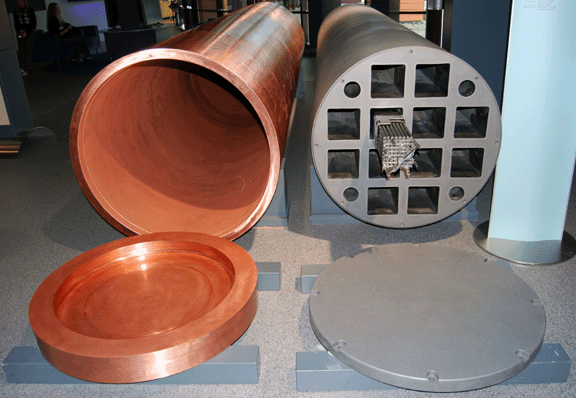
the final repository for spent nuclear fuel – as well as some comments onthe decision and the further process. The court said no to the application because it considered that there were problems with the copper canister that had to be resolved now and not later.
The translation shows the court’s judicial argumentation and why it decided not to accept the regulator
SSM’s opinion that the problems with the integrity of the copper canister were not serious and could likely be solved at a later stage in the decision-making process.
The main difference between the court’s and the regulator’s decision-making was that the court decided to rely on a multitude of scientific sources and information and not only on the material provided by SKB.








 nuclear-news