All utilities lack disposal sites for low-level waste from reactors http://www.asahi.com/ajw/articles/AJ201802160049.htmlBy TSUNEO SASAI/ Staff Writer, February 16, 201 8
Seven electric power companies that plan to decommission nuclear reactors have yet to secure disposal sites for the low-level radioactive waste produced in the dismantling process, an Asahi Shimbun survey showed on Feb. 16.
It may take years for the utilities to gain approval from local governments to dispose of the waste, some of which must remain buried for 100,000 years, meaning that the decommissioning work could be suspended.
Low-level radioactive waste generated during conventional operations of nuclear reactors can be buried at a disposal site of Japan Nuclear Fuel Ltd. in Rokkasho, Aomori Prefecture.
However, the electric power companies themselves must dispose of the low-level radioactive waste produced during decommissioning work.
The Asahi Shimbun asked 10 electric power companies, including Japan Atomic Power Co., about whether they have secured disposal sites for low-level radioactive waste.
Seven companies–Tokyo Electric Power Co., Chubu Electric Power Co., Kansai Electric Power Co., Chugoku Electric Power Co., Shikoku Electric Power Co., Kyushu Electric Power Co. and Japan Atomic Power–replied that they have not secured sites despite their plans to decommission reactors.
In total, they plan to decommission 17 reactors.
The demolition of a 1.1 gigawatt-class nuclear reactor produces more than 10,000 tons of low-level radioactive waste.
The three other companies–Hokkaido Electric Power Co., Tohoku Electric Power Co. and Hokuriku Electric Power Co.–also have not secured disposal sites, but they have no decommissioning plans at the moment.
“We are not considering decommissioning our nuclear reactors,” a Hokuriku Electric Power official said. “As of now, we have not yet decided on a plan to secure disposal sites.”
There are three categories of nuclear waste–L1, L2 and L3–depending on their radioactivity levels.
L1 waste, which has the highest radioactivity level and includes control rods, must be buried more than 70 meters deep into the ground for 300 to 400 years.
After that, the government manages the waste for 100,000 years.
The government is currently studying regulation standards for such waste.
Electric power companies decided to decommission some of their nuclear reactors after the March 2011 disaster unfolded at the Fukushima No. 1 nuclear power plant.
Full-fledged decommissioning work is expected to start soon, but parts removed from the reactors have high radiation levels and cannot be placed temporarily in the compounds of nuclear power plants.
High-level radioactive waste is also produced as a result of the reprocessing of spent nuclear fuel. The government is looking for a disposal site for such waste.
Electric power companies could heighten their demands that the government get involved in efforts to secure disposal sites for low-level radioactive waste.
February 17, 2018
Posted by Christina Macpherson |
Japan, wastes |
Leave a comment

WNN 17 Feb 18 US-based GE Hitachi Nuclear Energy (GEH) has been awarded a three-year contract to dismantle the reactor internals of units 1 and 2 at the Oskarshamn nuclear power plant in Sweden
Under a contract signed with plant operator OKG AB on 19 December, Wilmington, North Carolina-based GEH will segment the reactor pressure vessel internals of both units. The work includes dismantling, cutting and packing the reactor internals for final disposal.
Segmentation of the reactor internals of Oskarshamn 2 is scheduled to begin in January 2018, with that of unit 1 set for 2019. The segmentation project is expected to be completed by the beginning of 2020.
Lance Hall, executive vice president of GEH’s nuclear services business, said today: “This is a breakthrough project for us in the decommissioning space in Europe and we look forward to drawing upon the many resources of the ‘GE Store’, including the depth of the global supply chain of GE and the former Alstom power businesses to deliver superior safety and cost efficient performance for our customer.”…….http://www.world-nuclear-news.org/WR-GE-Hitachi-to-dismantle-Oskarshamn-units-0301174.html
February 17, 2018
Posted by Christina Macpherson |
Sweden, wastes |
Leave a comment
Daily Mail UK, 17 Feb 18 A ‘salted bomb’ is a type of nuclear weapon that has been branded ‘highly immoral’ by some experts. The device aims to spread deadly radioactive fallout as far as possible rather than maximise explosive force.
The result is lasting environmental damage and vast areas of land left uninhabitable for decades.
Salted bombs take their name from the phrase ‘to salt the earth’, meaning to render soil unable to host life.
They are able to contaminate a much larger area than a traditional ‘dirty’ atomic bomb, like those used on Hiroshima and Nagasaki in 1945.To increase the radioactive destruction of salted bombs, certain radioactive isotopes are added to the device.
Heavy metals like gold, cobalt or tantalum can be used. Incorporating these metals into an atomic bomb would send high-energy neutrons at the stable element and turn it into a highly radioactive version. The radioactive isotope would then contaminate huge swathes of land.
A salted bomb is believed to be of lesser energy than other bombs due to these changes but could cause more long-term damage.
The idea of a salted bomb was first proposed by Hungarian-American physicist Leo Szilard during the Cold War.
February 17, 2018
Posted by Christina Macpherson |
2 WORLD, Reference, weapons and war |
Leave a comment
Disadvantages of thorium reactors: High start-up costs: Huge investments are needed for thorium nuclear power reactor, as it requires significant amount of testing, analysis and licensing work. Also, there is uncertainty over returns on the investments in these reactors. For utilities, this factor can weigh on the decisions to go ahead with plans to deploy the reactors. The reactors also involve high fuel fabrication and reprocessing costs.
High melting point of thorium oxide: As melting point of thorium oxide is much higher compared to that of uranium oxide, high temperatures are needed to make high density ThO2 and ThO2–based mixed oxide fuels. The fuel in nuclear fission reactors is usually based on the metal oxide.
Emission of gamma rays: Presence of Uranium-232 in irradiated thorium or thorium based fuels in large amounts is one of the major disadvantages of thorium nuclear power reactors. It can result in significant emissions of gamma rays. http://nuclear.energy-business-review.com/news/major-pros-and-cons-of-thorium-nuclear-power-reactor-6058445
February 17, 2018
Posted by Christina Macpherson |
2 WORLD, Reference, thorium |
Leave a comment
https://www.japantimes.co.jp/news/2018/02/15/business/japan-posts-delivery-vehicles-measure-radiation-fukushima/#.WodGLVpubGg, JIJI FUKUSHIMA – Japan Post Co. and the Fukushima Prefectural Government have signed a comprehensive partnership agreement that includes a plan for it to measure radiation in areas tainted by the 2011 nuclear disaster.
“The agreement is very assuring, as we will be able to receive support for efforts on the safety and security of the region,” Gov. Masao Uchibori said during the signing ceremony at the prefecture’s office on the same day.
It is the 15th time the unit of Japan Post Holdings Co. has concluded an agreement with a prefectural government.
Under the plan, Japan Post’s delivery minivehicles will be equipped with radiation gauges. Data will be collected automatically and wirelessly transmitted to the prefectural government. The prefecture’s coast was heavily damaged by the March 2011 mega-quake and tsunami, while much larger parts of it were contaminated by radiation by the subsequent core meltdowns at the Fukushima No. 1 nuclear plant, run by Tokyo Electric Power Company Holdings Inc.
In addition, the two parties agreed that posters to promote Fukushima goods will be put up at post offices in areas around Tokyo, in Fukushima and five other prefectures in the Tohoku region.
Japan Post’s delivery staff will also alert the prefectural government and others when several days’ worth of newspapers are seen accumulating outside of the homes of elderly people, and when damage to roads is observed.
“We will provide maximum assistance for Fukushima Prefecture’s revitalization,” said Kunio Yokoyama, president of Japan Post.
February 17, 2018
Posted by Christina Macpherson |
environment, Fukushima continuing, radiation |
Leave a comment
Quak e rattles anti-nuclear activists in N.H.http://www.bostonherald.com/news/local_coverage/2018/02/quake_rattles_anti_nuclear_activists_in_nh, Dan Atkinson Friday, February 16, 2018
Government officials said an earthquake centered less than 10 miles from Seabrook Station Nuclear Power Plant didn’t seem to have caused any damage yesterday, but anti-nuclear activists are worried the tremors could have increased instability in already-cracking containment walls.
The 9:28 a.m. quake, which shook the ground in northern Massachusetts and southern New Hampshire but only hit 2.7 on the Richter scale, didn’t trigger any emergency procedures at Seabrook Station, Nuclear Regulatory Commission spokesman Neil Sheehan said. The station is just down the road from the earthquake’s epicenter in East Kingston.
Sheehan said workers walked through the plant yesterday in search of any signs of damage, but stressed Seabrook Station is built to withstand much stronger earthquakes.
But activists said many of the plant’s walls — including in the spent fuel pool and the reactor dome — are already weakened. And though they’re several feet thick, they’ve been damaged by water mixing with compounds in the walls’ concrete and cement, creating a gel that expands and cracks the walls.
Paul Gunter, a director at activist group Beyond Nuclear and a former member of the Clamshell Alliance that led large protests against Seabrook coming online in the 1970s, said activists have long been concerned by the power plant’s proximity to an earthquake zone. He said yesterday’s tremor was a “wake-up call.”
“Even these small earthquakes are a wake-up call to look at the broader issues of vulnerability at the plant and the inherent danger of the operation,” Gunter said. “These are legitimate reasons to question the continued operation of Seabrook Station.”
Natalie Hildt Treat, executive director of C-10, a Newburyport-based group that monitors emissions at the plant, agreed.
“You would think a measurable earthquake would put further stress on that,” she said. “Little cracks can lead to bigger cracks … it’s definitely a safety concern.”
But Seabrook Town Manager William M. Manzi III said he wasn’t concerned that the quake caused any structural damage, saying, “We’re confident that the plant will be able to withstand any seismic event.”
Plant owner NextEra Energy didn’t respond to multiple requests for comment. The company is seeking to extend its license to operate from 2030 to 2050, and Sheehan said the NRC is currently reviewing NextEra’s plans to address deterioration before it considers an extension.
“The real issue here is longer-term,” Sheehan said. “In terms of the earthquake today, we don’t believe it poses a safety issue.”
February 17, 2018
Posted by Christina Macpherson |
safety, USA |
Leave a comment
More workers tested positive for Hanford radiation, The 6 people are added to 31 who tested positive for inhaling or ingesting contamination in June, February 15, 2018 By Annette Cary / Tri-City Herald
Another spread of radioactive contamination has been confirmed at the Hanford nuclear reservation’s Plutonium Finishing Plant.
In addition, more central Hanford workers have tested positive for inhaling or ingesting radioactive contamination from demolition of the plant.
For the second time since workers were moved in January to offices away from the plant, contamination has been found on the steps of the newly assigned offices.
Most recently, a spot of radioactive contamination described as about the size of a 50-cent piece was found on the step outside an office on Feb. 8. The step has been removed.
In some cases radiation detected at Hanford is determined to have come from naturally occurring radon, but in this case it appears to be related to demolition of the heavily contaminated plant.
Demolition and the packing and hauling away of the debris has been stopped at the plant since mid-December after a spread of particles of radioactive contamination was discovered.
February 17, 2018
Posted by Christina Macpherson |
health, USA |
Leave a comment
 A year in review: the trends in nuclear construction, Global Construction, By DAN BRIGHTMORE . Feb 12, 2018 “……Small Modular Reactors (SMRs) and other kinds of so-called ‘advanced reactors’ continue to be positioned as a solution to the problems confronting nuclear power and the still costly renewal requirements of monolithic reactors. SMRs are nuclear power reactors with an electrical output below 300MWe and distinguishable from large reactors by modular design, with prefabrication in offsite factories and the potential for multiple reactors to be deployed at the same site to create bigger power plants. Proponents claim they will be faster, cheaper and less risky to build while safer to operate than large nuclear plants.
NuScale has claimed that “once approved, global demand for SMR plants will create thousands of jobs during manufacturing, construction and operation” and “re-establish US global leadership in nuclear technology, paving the way for NRC approval and subsequent deployment of other advanced nuclear technologies”. It predicts “about 5,575GWe of global electricity will come from SMRs by 2035, equivalent to over 1,000 NuScale Power Modules”.
However, Danny Roderick, former president and CEO of (now bankrupt nuclear services market leader) Westinghouse, once countered: “The problem I have with SMRs is not the technology, it’s not the deployment – it’s that there’s no customers… The worst thing to do is get ahead of the market.” Currently there are no operational NPPs in the world that can be considered fully-fledged SMRs. Several countries and companies are at different stages in the development of SMR technologies. NuScale is the frontrunner to deliver a SMR in Idaho with the initial operational date of 2024. Meanwhile, mPower (another previous beneficiary of Department of Energy funding to the tune of $80m per year) has been struggling to advance a similar project mooted in Tennessee which was terminated in March last year. Elsewhere, South Korea’s System-Integrated Modular Advanced Reactor (SMART) is the first land based SMR to receive regulatory approval anywhere in the world. However, SMR’s are often found to be too expensive on a per-unit generating-capacity basis which has led to this project being shelved. The words of incoming South Korean premier President Moon echo the sentiments of many world leaders now exploring other forms of energy creation: “We will scrap the nuclear-centred policies and move toward a nuclear-free era. We will eliminate all plans to build new nuclear plants.”…. http://www.constructionglobal.com/infrastructure/year-review-trends-nuclear-construction
February 17, 2018
Posted by Christina Macpherson |
2 WORLD, Small Modular Nuclear Reactors |
Leave a comment
On February 13, 1960, France carried out its first nuclear test in Algeria’s southern Reggane region. According to official statistics, 17 nuclear tests were carried out in total over the next 6 years. The area remains affected, and local scientists say that radioactive contamination has caused genetic mutations and irreversibly changed the region.
There are no official statistics on the number of victims. The only figures can be found in the records kept by the French representative of the local church, which lists 42,000 victims of nuclear tests. Three years ago, the French Ministry of Defense issued a statement, putting the number at 27,000 people. The victims include French soldiers as well as local Algerians who lived in the surrounding areas.
However, these figures do not take into account the untimely deaths of the descendants of these people, who were affected by cancer and other nuclear radiation-related illnesses. To this day, the contaminated areas pose a danger to life and health.
A representative of the ‘Desert Detainees’ (a community of people who served sentences in prisons located in the desert regions of Algeria from 1992 to 1996), Nureddin Mauhub, said that many prisoners were exposed to radiation while serving their sentences in jails in the desert.
Nuclear engineer Ammar Mansuri told the newspaper Arabi al-Jadid, that in fact, there were more nuclear tests carried out in Algeria.
“France conducted 13 underground nuclear tests, 4 ground tests, 4 plutonium tests and 35 other tests,” he said.
According to him, the nuclear tests documentation was passed on to the Algerian government only 10 years ago.
Some of the documents are still classified. For these reasons, no systematic observations or studies have been conducted in the area in the past century. Therefore, no timely measures were taken to reduce the negative impact on the environment. It is difficult to say how the level of contamination has changed over the past decades and what to expect in the future.
The Algerian government claims that the contaminated area is more than 100 square km, according to the Al-Arabi al-Jadid website. However, problems aren’t limited to this exclusion zone. The desert winds carry contaminated particles to formally clean areas. There’s now a need to study the level of radiation in the desert to accurately determine the boundaries of the contaminated area.
February 17, 2018
Posted by Christina Macpherson |
EUROPE, France, weapons and war |
Leave a comment
 World Nuclear News 15th Feb 2018, Holtec International and GE Hitachi Nuclear Energy (GEH) are to collaborate
on accelerating the commercialisation of Holtec’s SMR-160 small modular
reactor (SMR). Their cooperation will initially include nuclear fuel
development and control rod drive mechanisms. Under a memorandum of
understanding, GEH, Global Nuclear Fuel (GNF), Holtec and SMR Inventec LLC
(SMR LLC) have agreed to enter into a “procompetitive collaboration” to
progress the SMR-160. GNF, a GE-led joint venture with Hitachi and Toshiba,
is primarily known as a supplier of boiling water reactor fuel. SMR LLC is
a wholly-owned subsidiary of Holtec established in 2011 to manage the
development of the SMR-160.
http://www.world-nuclear-news.org/NN-Holtec-and-GEH-team-up-on-advancing-SMR-160-1502184.html
February 17, 2018
Posted by Christina Macpherson |
Japan, Small Modular Nuclear Reactors, USA |
Leave a comment
The “Versatile Fast Neutron Source”: A Misguided Nuclear Reactor Project, UCS,
ED LYMAN, SENIOR SCIENTIST | FEBRUARY 15, 2018The Union of Concerned Scientists (UCS) supports a moderate level of Department of Energy (DOE) research funding to make nuclear power safer and more secure—for example the agency’s program to develop accident tolerant fuels for nuclear reactors. Conversely, UCS does not support programs that not only would cost a lot of money, but also could make nuclear power more dangerous and less secure. That’s why the organization is troubled by a bill that was passed by the House of Representatives on February 13.
The bill in question, H.R. 4378, authorizes the secretary of energy to spend nearly $2 billion over the next seven years to build what’s called a “versatile reactor-based fast neutron source.” As its name indicates, the primary purpose of this facility would be to provide a source of high-energy neutrons to help researchers develop fuels and materials for a class of advanced nuclear reactors called fast reactors.
What is it?
What may not be clear from the name is that this facility itself would be an experimental fast reactor, likely fueled with weapon-usable plutonium.
Compared to conventional light-water reactors, fast reactors are less safe, more expensive, and more difficult to operate and repair. But the biggest problem with this technology is that it typically requires the use of such weapon-usable fuels as plutonium, increasing the risk of nuclear terrorism. Regardless, the House passed the bill with scant consideration of the risks and benefits of building it. Hopefully, the Senate will conduct a due diligence review before taking up a companion bill. Caveat emptor.
Based on what little public information there is available about the plans for this facility, it would be a fast reactor of at least 300 thermal megawatts (or about 120 MW of electricity if it is also used for power generation). This power level is the minimum necessary to achieve the desired rate of neutron production. This would make the reactor about five times larger than the last experimental fast reactor operated in the United States, the EBR-II, which shut down in 1994. One proposed design, called FASTER, would have a peak power density three times higher than the EBR-II, making it much more challenging to remove heat from the core. This design would require about 2.6 metric tons of metallic fuel containing about 500 kilograms of plutonium per year. One third of the reactor fuel would be replaced every 100 days. (The DOE also is apparently considering a different fast reactor design that would use high-assay, low-enriched uranium fuel, but this material is in short supply and a new production source would have to be established. In any case, the DOE has not yet determined if it is feasible to use low-enriched uranium.)
Cost?
The amount of funding authorized by H.R. 4378 for designing and constructing this fast reactor is less than 60 percent of its estimated cost of $3.36 billion, and the aggressive timeline mandated by the bill, which calls for full operation by the end of 2025, is significantly shorter than the optimistic 11- to 13-year schedule anticipated by its designers. By low-balling the initial authorization and construction time, H.R. 4378’s sponsors may have been trying to make it more palatable, but they are also undermining their project.
It’s also important to keep in mind that the estimated cost of $3.36 billion is just a fraction of the project’s total cost. ……….
Finally, what agency will oversee the safety and security of this risky project? The DOE. By designating this reactor as a neutron source, and building it at a DOE site, it will be exempt from licensing and oversight by the Nuclear Regulatory Commission. While NRC licensing is far from perfect, it would be far superior to DOE self-regulation.
To summarize, H.R. 4378 authorizes constructing a fast reactor without assessing the need or evaluating its costs and benefits. It compels the DOE to build an experimental fast reactor, using an experimental fuel, at a scale and power density that has never been demonstrated, on a rushed schedule, with insufficient funding.
This is simply the wrong way to pursue nuclear energy research and development. Instead, DOE should undertake projects only if they pass a rigorous peer review and make safety and security a priority. https://allthingsnuclear.org/elyman/a-misguided-nuclear-reactor-project
February 17, 2018
Posted by Christina Macpherson |
technology, USA |
Leave a comment
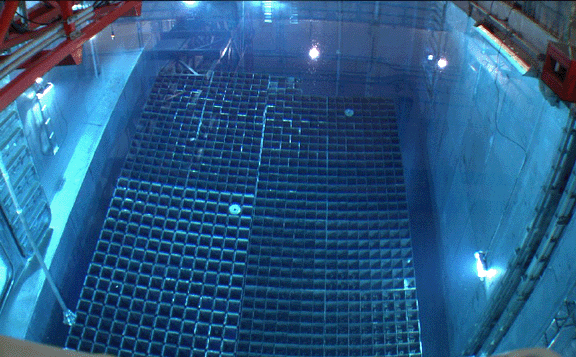
EDF plans to build a giant nuclear garbage pool in Belleville-sur-Loire instead of stopping producing unmanageable waste!http://www.sortirdunucleaire.org/EDF-projette-de-construire-une-piscine-poubelle February 13, 2018
On February 13, 2018, the Reporterre site revealed the new EDF project. In view of the prolongation of the operation of nuclear reactors and to unclog the four basins of the La Hague plant where used fuel is stored, the electrical firm wants to build a giant new “pool of deactivation” near the Belleville plant -sur-Loire (Cher). We strongly condemn this imposed, dangerous and expensive project. Rather than create a new trash, EDF must turn off the tap and dry up the production of unmanageable radioactive waste!
In France, spent fuel is stored in “deactivation pools” for the time needed to cool them (between 3 and 5 years). If each nuclear power plant has its own pool adjoining the reactor building, the La Hague plant (Manche) hosts 4 pools in which are immersed more than 10,000 tons of spent fuel, representing a hundred reactor cores waiting for a improbable “reprocessing”. Supposedly temporary, storage in these pools has been going on for 40 years. Consequences: the pools are full and the space is running out. Instead of starting a decline in spent fuel stocks by stopping the production of electricity from nuclear power, EDF is stubborn and plans to build an additional pool in Belleville-sur-Loire. But the experience of La Hague shows that the use of these pools goes hand in hand with disproportionate risks.
Vulnerable pools and potentially dramatic accidents The 4 cooling pools at the La Hague plant concentrate the largest volume of radioactivity in Europe. Belleville-sur-Loire could soon compete with this facility. Oversized, the giant basin that EDF plans to build in Belleville-sur-Loire could accommodate up to 8,000 tons of spent fuel, the equivalent of 93 cores of reactors.
This project is all the more worrying because EDF is never very concerned about the protection of the reactor deactivation pools it operates. Will the centralized Belleville pool be protected as recommended by nuclear safety authorities around the world since Fukushima? Nobody can say it. And the risk increases even if EDF chooses not to bunkerize the building that contains the pool, as is the case at the Orano factory in La Hague, where the basins are protected by a vulgar tin roof
… But even with a concrete hull, in the event of an accident, the amount of radioactivity released into the atmosphere would be incommensurate with the releases resulting from an accident in the core of a reactor: to concentrate in the same place such a quantity of radioactive material has intrinsic risks. And what about the dangers of transporting such large quantities of radioactive waste across France?
The Belleville-sur-Loire swimming pool project poses even more safety problems because it is supposed to house the assemblies of MOX – a mixture of uranium and plutonium oxides – a particular fuel that, when it is used, releases much more radioactivity than “normal” uranium assemblages. And since MOX can not be reprocessed or reused, temporary storage in this pool could well become permanent storage.
Finally, in normal operation, these pools are allowed to reject radioactivity. If a new bin of this kind were built, dangerous radioelements like tritium or krypton 85 would inevitably end up in the environment.
An opaque and expensive project EDF led this project with complete opacity. At the time Greenpeace submitted a report that points to the fragility and dangerousness of the 62 cooling pools scattered over the hex, EDF plans to build a 63rd, size XXL. Discussed on the sly, well protected from democratic choices and far from energy issues, the project was kept secret by EDF.
Once again, citizens and residents of the region are faced with a fait accompli. Still, the idea is in the pipes for a long time. Urged by ASN – which invited it in 2013 to “revise its spent fuel management and storage strategy, by proposing new storage methods” – EDF, to comply with the National Plan management of radioactive materials and waste, once again chose the worst option.For EDF and the promoters of the atom, the construction of such an installation is only one way of guaranteeing new outlets for a declining nuclear industry and of claiming to ensure the management of spent fuel for a new period.
The “Sortir du nucléaire” Network strongly denounces this project and, alongside the associations of the region, will resolutely oppose its implementation. In no case this pool is a “solution” to the problem of the accumulation of radioactive waste. In order not to generate new risks and to put the costs of a disproportionate installation on the citizens, the only solution is to dry up the production of this unmanageable waste. Press contacts: Martial CHATEAU: 06 45 30 74 66 Catherine FUMÉ: 06 62 84 13 88
February 16, 2018
Posted by Christina Macpherson |
France, safety, wastes |
Leave a comment
 The West risks missing a chance at peace if it continues to treat North Korea’s change of heart with cynicism Could it be that Trump’s bombast over the airwaves cut through in Pyongyang in a way that conventional diplomacy had failed to do? The Independent UK, Mary Dejevsky @IndyVoices 16 Feb 18
“”…………The mixed messages about the North Korean skaters, however, highlighted – or so it seemed to me – something else: a reluctance on the part of the foreign policy establishment, including the media, to look good news in the face, especially when it has not been expected.
How long ago was it –in fact, a bare six weeks – that Kim Jong-un and the US President were trading very public, very macho, insults, culminating in Donald Trump’s memorable boast that his nuclear button was “much bigger and more powerful” than Kim’s and, what is more, “my button works”.
Even the most hardened pessimist would have to admit that between then and now there has been something of a mood swing. Less than three weeks after the “big button” exchange, North Korea suddenly acted on overtures in Kim’s New Year address to broach talks with the South, and even participated in the Olympics. The IOC delayed its deadline for entries, permitted North Korea’s participation, and the next thing we knew was that North and South were concocting a joint ice hockey team, the North’s nonagenarian de facto head of state was on his way to Seoul, and Kim announced that his sister – his sister – would be going to the opening ceremony, too.
Far from hailing these developments as the possible start of a North-South thaw, however, the Western response seemed – to me, at least, – both fearful and curmudgeonly. Kim Jong-un was suspected of the basest of motives. Might he not be deviously stringing the South along, it was asked, just waiting to demand all sorts of impossible concessions at the last moment that would cast the Seoul government as the villain if it refused?
And was Kim not also staging a vast military parade in Pyongyang on the eve of the official Olympic opening? Well, of course, he was. No self-respecting national leader, least of all an autocrat in the mould of Kim, can be seen to be weak in front of his own people. Shows of strength have a habit of going hand in hand with diplomatic U-turns.
As the North Korean nuclear threat vanished from the headlines, however, it was only to be replaced with another menace from the North. Kim’s very presentable little sister, Kim Yo-jong, was accused of stealing the limelight, diluting the world’s attention that should have been Seoul’s, and presenting an image of the North that was scandalously at odds with the cruel and earth-scorched reality. Don’t allow yourself to be fooled, was the message.
That she was received in Seoul at the highest level and filmed handing over an invitation to President Moon Jae-in to visit Pyongyang was also somehow seen as out of order, another trick to gain diplomatic advantage. Surely it would all turn sour even before the Olympic glow over the South had faded. The North Korean threat was still there.
Far from hailing these developments as the possible start of a North-South thaw, however, the Western response seemed – to me, at least, – both fearful and curmudgeonly. Kim Jong-un was suspected of the basest of motives. Might he not be deviously stringing the South along, it was asked, just waiting to demand all sorts of impossible concessions at the last moment that would cast the Seoul government as the villain if it refused?
And was Kim not also staging a vast military parade in Pyongyang on the eve of the official Olympic opening? Well, of course, he was. No self-respecting national leader, least of all an autocrat in the mould of Kim, can be seen to be weak in front of his own people. Shows of strength have a habit of going hand in hand with diplomatic U-turns.
As the North Korean nuclear threat vanished from the headlines, however, it was only to be replaced with another menace from the North. Kim’s very presentable little sister, Kim Yo-jong, was accused of stealing the limelight, diluting the world’s attention that should have been Seoul’s, and presenting an image of the North that was scandalously at odds with the cruel and earth-scorched reality. Don’t allow yourself to be fooled, was the message.
That she was received in Seoul at the highest level and filmed handing over an invitation to President Moon Jae-in to visit Pyongyang was also somehow seen as out of order, another trick to gain diplomatic advantage. Surely it would all turn sour even before the Olympic glow over the South had faded. The North Korean threat was still there.
Nor should the use by potentates – and not just potentates – of close relatives as personal representatives and trusted go-betweens – be discounted as a ploy. Rather than being designed to detract from the South’s Olympic show, Kim Jong-yo’s trip to Seoul might rather be seen as evidence of her brother’s serious intent and esteem.
And what might have changed the equation? How about the US Secretary of State’s low-key offer of direct talks without preconditions that he made in December? Repeated in Seoul by Vice-President Mike Pence this week (once he had done cold-shouldering the North Koreans for the benefit of the US audience back home), this is what first broke the deadlock. There have been concessions on all sides.
So while the doomwatchers see the Olympic thaw as, at best, a deceptive interlude before the nuclear stand-off inevitably resumes, I would argue, for more optimism. A basis has been laid for detente; there is a real chance now to step back from the brink. The risk now is less that the North is insincere, than that suspicion and cynicism everywhere cause this chance to be missed. http://www.independent.co.uk/voices/north-korea-war-nuclear-us-uk-europe-world-peace-conflict-a8212656.html
February 16, 2018
Posted by Christina Macpherson |
North Korea, politics international, USA |
Leave a comment
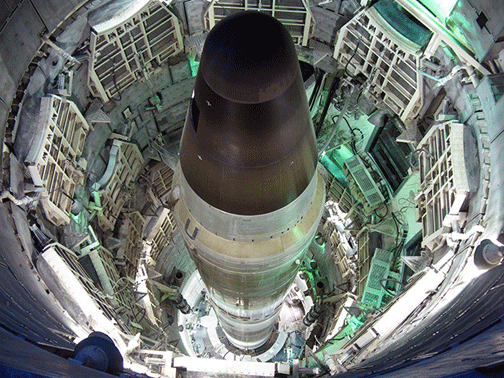 US wasting billions on nuclear bombs that serve no purpose and are security liability – experts https://www.theguardian.com/world/2018/feb/15/us-nuclear-bomb-risks-security-report
Washington to spend billions upgrading cold war era B61 bombs
NTI report says weapons are potentially catastrophic liability, Guardian. Julian Borger , 15 Feb 18,
US wasting billions on nuclear bombs that serve no purpose and are security liability – experts https://www.theguardian.com/world/2018/feb/15/us-nuclear-bomb-risks-security-report
Washington to spend billions upgrading cold war era B61 bombs
NTI report says weapons are potentially catastrophic liability, Guardian. Julian Borger , 15 Feb 18,
A third of the B61 bombs in Europe under joint US and Nato control are thought to be kept at Incirlik base in Turkey, 70 miles from the Syrian border, which has been the subject of serious concerns.

The threat to the base posed by Islamic State militants was considered serious enough in March 2016 to evacuate the families of military officers.During a coup attempt four months later, Turkish authorities locked down the base and cut its electricity. The Turkish commanding officer at Incirlik was arrested for his alleged role in the plot.
A report on the future of the B61 bombs by arms control advocacy group the Nuclear Threat Initiative (NTI) , and made available to the Guardian, said the 2016 events “shows just how quickly assumptions about the safety and security of US nuclear weapons stored abroad can change.”
Since then US-Turkish relations have soured further, largely over Washington’s support for Kurd forces in Syria. The national security adviser, HR McMaster, and secretary of state, Rex Tillerson, have both made trips to Turkey this week to try to heal the rift.
There have been reports that the bombs have been quietly moved out because of safety concerns, but that has not been confirmed.
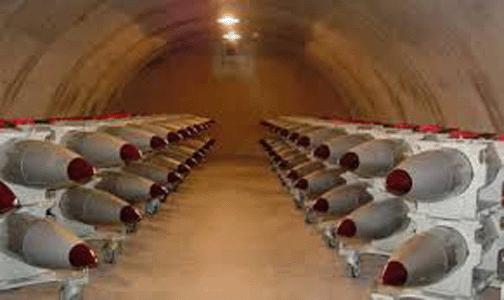
The remaining B61 bombs are stored at five other locations in four countries: Italy, the Netherlands, Belgium and Germany, according to the Federation of American Scientists, which tracks the weapons. The NTI report said it “should be assumed that they are targets for terrorism and theft”.
The bombs are the remnants of a much larger cold war nuclear arsenal in Europe, and critics have said they serve no military purpose, as the nuclear deterrent against Russia relies largely on the overwhelming US strategic missile arsenal.
Using the B61s in any conflict would involve an agreement between the US and the host country in consultation with other Nato members.
“It is hard to envision the circumstances under which a US president would initiate nuclear use for the first time in more than 70 years with a Nato [dual-capable aircraft] flown by non-US pilots delivering a US B61 bomb,” said the NTI report, titled Building a Safe, Secure and Credible Nato Nuclear Posture.
Since the cold war, the B61 has played a symbolic role, as reassurance for some Nato members of US commitment to defending Europe. They are also considered potential bargaining chips against Russia’s much greater arsenal of nearly 2,000 tactical nuclear weapons.
However, the NTI report argues they are also serious liabilities, because of the threat of terrorism or accident, and because they could become targets in the early stages of any conflict with Russia.
“Forward-deployed US nuclear weapons in Europe increase the risk of accidents, blunders, or catastrophic terrorism and invite pre-emption. Given these added risks, it is past time to revisit whether these forward-based weapons are essential for military deterrence and political reassurance” the Obama administration’s energy secretary Ernest Moniz and former Democratic senator Sam Nunn, both NTI co-chairmen, argue in the preface to the report.
The Obama administration considered withdrawing the B61s from Europe as part of the president’s nuclear disarmament initiative but the idea lost support as relations with Russia deteriorated. Instead, the administration approved a Pentagon programme to upgrade the bombs over the next decade with a tailfin assembly to make them more accurate.
The plan has been embraced by the Trump administration’s nuclear posture review, despite the fact that the estimated cost of the 460 new model bombs, the B61-12, has doubled in recent years to $10bin, a part of a huge increase of overall defence spending.
February 16, 2018
Posted by Christina Macpherson |
EUROPE, USA, weapons and war |
Leave a comment
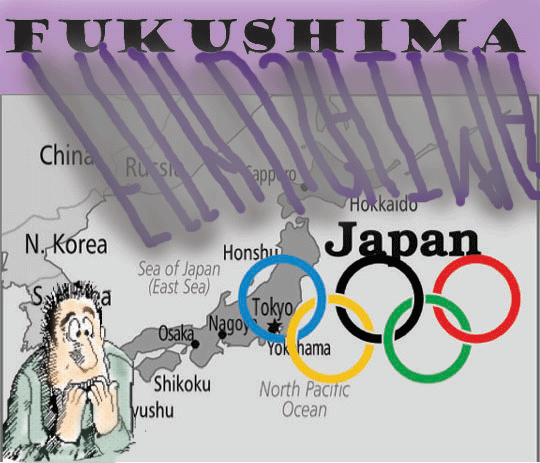 Japan, IAEA agree to cooperate on Tokyo 2020 nuclear counterterrorism, Nikkei Asian Review, 16 Feb 18, VIENNA (Kyodo)
 — The Japanese government and the International Atomic Energy Agency signed an agreement on Thursday to work together to keep the Tokyo 2020 Olympics and Paralympics safe from the threat of terrorism involving nuclear materials.
According to the Japanese Foreign Ministry, the agreement includes measures to support IAEA experts’ participation in events relating to the Tokyo games, the exchange of information on nuclear security issues and the loan to Japan of equipment to detect radiation.
Foreign Minister Taro Kono and IAEA Director General Yukiya Amano observed the signing in Vienna before holding a meeting at which Kono said they agreed to flesh out cooperation in thwarting nuclear terrorism.
“We want to thoroughly cooperate with the IAEA to make sure the Olympics are safe,” Kono said at the outset of the meeting……..https://asia.nikkei.com/Politics-Economy/International-Relations/Japan-IAEA-agree-to-cooperate-on-Tokyo-2020-nuclear-counterterrorism
February 16, 2018
Posted by Christina Macpherson |
Japan, safety |
Leave a comment





 nuclear-news