US preparing ‘bloody nose’ cyber attacks on North Korea, Telegraph, UK, Julian Ryall, Tokyo Danielle DemetriouThe United States is drawing up plans for cyber attacks on North Korea in an effort to bring the regime of Kim Jong-Un to heel, according to intelligence sources, as Pyongyang says it is ready for “both dialogue and war” as the Winter Olympics draws to a close.
A cyber assault could cripple Pyongyang’s online communications and ability to control its military, causing huge disruption but avoiding the loss of life. It may also assuage concerns that a conventional attack against missile sites or nuclear facilities by the US could trigger a massive counter-strike by Kim Jong-Un.
In the last six months, the US has been covertly laying the groundwork for cyber attacks that would be routed through South Korea and Japan, where the US has extensive military facilities. The preparations include
installing fibre cables into the region and setting up remote bases and listening posts from where hackers will attempt to gain access to North Korea’s version of the Internet, which is walled off from the rest of the world.
Another official told the magazine that a large part of the US spying and cyber warfare capability is being refocused on North Korea, including analysis of signals intelligence, overhead imagery and geospatial intelligence
………. North Korea has reportedly set up a 6,000-strong hacking unit and is strongly suspected of being behind a number of cyberattacks on South Korean banks, media companies and infrastructure, including nuclear power plants, in recent years
As well as gathering intelligence on military, scientific and political developments in the North, US cyber warfare experts are likely to be tasked with accessing the regime’s command-and-control structure in order to interfere with Pyongyang’s ability to communicate with its military and launch counterattacks.
A North Korean cyberspy group known as “Reaper” is rapidly expanding its operations and scope of capability posing a global threat to overseas networks, according to a new report from the California cybersecurity firm FireEye Inc.
The group is also identified by FireEye as APT37 and has been active since at least 2012, focusing primarily on the public and private sectors in South Korea. In 2017, the group began attacks on Japan, Vietnam, and the Middle East, according to the report.
FireEye said it had “high confidence” the activities carried out by APT37 are on behalf of the North Korean government and include use of wiper malware and zero-day vulnerabilities, where hackers exploit vulnerabilities in computer software on the same day those vulnerabilities become known, preventing developers from the opportunity to fix problems before they occur.
“Our concern is that this could be used for a disruptive attack rather than a classic espionage mission, which we already know that the North Koreans are regularly carrying out,” FireEye Director of Intelligence Analysis John Hultquist said to the Washington Post.
APT37 joins North Korean leader Kim Jong Un’s growing list of hacking units that have been accused of being behind massive cyberattacks in the past, including the group “Lazarus’” hack on Sony Pictures in 2014.
. U.S. officials also blamed the Kim regime for the WannaCry virus last year.
“Ignored, these threats enjoy the benefit of surprise, allowing them to extract significant losses on their victims, many of whom have never previously heard of the actor,” FireEye said in an emailed statement to Bloomberg.
Is China Really Threatening America with Nuclear Weapons? , National Interest, Asia Times, 20 Feb 18China, according to the Federation of American Scientists, has 270 warheads in its nuclear arsenal.
The Washington-based research group’s estimate has never been challenged by the Pentagon. It compares with an official tally of 4,480 nuclear warheads for the US. Unlike the American side, China also renounces “first use” of nuclear weapons and holds that its ability to retaliate is sufficient to deter attack.
Why, then, is Beijing’s modernization of its nuclear arsenal — something that Washington is also doing — considered a major security threat requiring a sharp turn in US policy regarding the use of nuclear weapons?
That’s part of the reasoning behind the Pentagon’s 2018 Nuclear Posture Review(NPR) issued on February 2. The document is a benchmark US statement on nuclear policy and is drawn up by new presidents. The Trump administration’s first policy position on the issue focuses on creating new nuclear deterrents to Russia and China, while addressing North Korean and Iranian nuclear ambitions.
…….. critics contend the latest NPR reverses years of bipartisan consensus on the use of US nuclear weapons. The review also gives the go-ahead to develop low-yield tactical nukes and sub-launched cruise missiles in the first roll-out of new US nuclear weapons since the end of the Cold War. It also expands the circumstances under which the US would consider using nukes to include “non-nuclear strategic attacks” such as cyberattacks.
……….Chinese not on nuclear ‘alert’
Gregory Kulacki, the China project manager for the Union of Concerned Scientists (UCS), a Washington-based science advocacy group, argues that Trump’s NPR is surfacing at a time when China isn’t preparing to fight a nuclear war with the US. He says his talks with Chinese nuclear strategists indicate they don’t believe such an attack from the US is possible because the Americans know a sufficient number of Chinese missiles would survive to launch a nuclear counter-strike.
……… China, for its part, has urged the US to drop its “Cold War mentality” and not misread its intentions in modernizing its nuclear forces following the NPR’s release.
Miscalculation leading to war
Kulacki notes in his article that Chinese strategists have one worry: they fear the US might miscalculate by thinking it could escape full nuclear retaliation by using a massive first strike along with an anti-missile shield that can down any Chinese missiles that a pre-emptive attack would miss.
US negotiators, he says, are exacerbating such fears by declining to assure their Chinese counterparts that a US first strike is “off the table.”
China’s relatively modest nuclear modernization efforts, according to Kulacki, are designed to ensure that enough of its intercontinental ballistic missiles (ICBMs) can survive a pre-emptive US attack and penetrate US missile defenses.
South Africa’s Electricity Choice, Part 4: The dangers of dealing with Russia, Daily Maverick, ANTON EBERHARD & AMORY LOVINS, SOUTH AFRICA, 19 FEB 2018
Read parts 1, 2 and 3 of this series here,here and here
.
Courts may have struck down the nuclear agreement between South Africa and Russia but ministers in the Zuma government have indicated they are not done discussing nuclear power and Russian involvement. This is of major concern to many – not only because of a possible compromise in SA’s national sovereignty and independence but also due to the ulterior motives Russia might have due to its economic troubles and the dubious need to build nuclear power plants despite lacking the capital to finance it.
Procurement and financial risks
South African officials have made a wide range of statements in the past few years about whether the government intends a “fair, transparent and competitive procurement process”, or a process with that form but not its substance (as vendors may expect), or an opaque direct negotiation between the South African government and another government, most likely that of the Russian Federation. During a series of private presidential meetingsover the past seven years, these two countries concluded an unusually strong and specific nuclear agreement. It gave Russia a veto over South Africa’s nuclear co-operation with any other country, enabled Russia to withhold any data it wishes from public scrutiny, exempted Russia from any accident liability and promised Russia favourable tax and financial treatment. While denying favouritism, South Africa did not appear to have offered similar terms to any other potential partner. Though the April 2017 decision of the Western Cape High Court set aside this agreement, officials have continued to imply that a nuclear deal with the Russians is likely……..
is Russia a credible and reliable financial partner?Its National Wealth Fund, estimated at $72-billion, is under pressure; by early 2015 it was already overextended by $24-billion pledged to finance nuclear exports to four countries. (Those included the Hungarian Paks nuclear deal, whose low-interest loan commitment helped crash Russia’s foreign-trade bank needing an $18-billion bailout.) About another $64-billion would be needed to fulfil other offers already extended. And even that couldn’t go far if more than a handful of deals were like the proposed Bangladeshi Rooppur plant mentioned above – 90% financed ($12-billion) at 2.55 percent annual interest with a 10-year grace period, then an 18-year repayment.
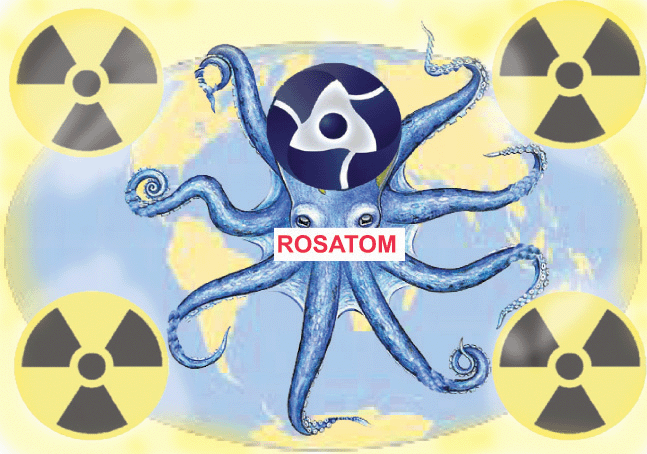
Rosatom, the self-regulated state nuclear enterprise, is led by a former prime minister reporting to President Vladimir Putin and exempted from all normal state controls. Independent experts agree that Rosatom (or any other state entity) would be lucky to build half the 30 additional nuclear projects it’s trying to sell for $300-billion to a dozen more countries including South Africa. Russia’s interest rate in early 2016 was twice (and in an earlier spike, over three times) what any coal-competitive nuclear project would require. The Russian state’s capacity to absorb the spread is quickly vanishing. Russia’s domestic reactor starts halved in 2015; all state nuclear subsidies are to halt in 2016. Yet without those subsidies, “Rosatom wouldn’t complete a single project anywhere”.
Russia needs huge amounts of outside capital to finance its nuclear commitments. …….
Not just Russian but any nuclear new-build is a poor choice for South Africa. It cannot compete with efficiency and renewables, by every relevant measure: cost, timeliness, financing, jobs, economic development, environmental and safety risk, independence, security, abundance of eternally free local energy sources, and the social good of “energy democracy”. These goals support and are advanced by the agenda of “an electricity sector that will deliver, transparently, competitively, reliably and sustainably, the electric services that will power economic growth and improve the welfare of all our people”.
It has come to this: ever more sales-starved nuclear vendors, seeking ever less solvent customers, now offer a risky project the seller can’t finance to a customer who can’t pay – a customer with no need, enchanted by the same nuclear devotees whose broken promises already cost the nation dearly, and with no apparent accountability.
Nuclear football’ scuffle broke out during Donald Trump’s visit to China , ABC News 20 Feb 18
A scuffle broke out between Chinese and US officials over the “nuclear football” — the briefcase containing the US nuclear launch codes — during a visit to Beijing by US President Donald Trump last year, according to media reports.
Key points:
Report says Chinese official tackled to ground
Secret Service confirms scuffle but not tackle
Chinese not believed to have taken possession of briefcase
US news website Axios said multiple sources confirmed an incident in which Chinese officials tried to block a military aide with the briefcase from following Mr Trump into the Great Hall of the People, despite the aide being required to stay close to the President at all times.
The report said when Mr Trump’s chief of staff Mike Kelly attempted to intervene, a Chinese official tried to grab him before a US Secret Service agent tackled the Chinese official to the ground.
The Secret Service did not initially deny the incident took place, but in a tweet said reports that a host nation official was “tackled” to the ground were “false”.
The federal law enforcement agency later confirmed an incident had taken place……..
The “nuclear football” is a leather briefcase that contains the codes needed to launch a nuclear strike while away from fixed command centres.
US and South Korea to announce plans for military manoeuvres with more than 320,000 troops, Express UK. 20 Feb 18
SOUTH KOREA and the United States will announce plans before April for a postponed joint military drill, South Korea’s defence minister said today. Seoul and Washington had agreed to postpone the regular joint military exercise until after the Winter Olympics being hosted in South Korea, which end on March 18.
After the decision to delay the joint exercise, North Korea agreed to hold the first official talks with South Korea in more than two years and send athletes to the Winter Games, easing a standoff over Pyongyang’s nuclear and missile programmes.
Asked when the two countries will hold the postponed drill, Song Young-moo told parliament he and his US counterpart, Jim Mattis, would make an announcement between March 18 and the start of April.
“The exercise was postponed according to the spirit of the Olympics,” Song said.







 nuclear-news