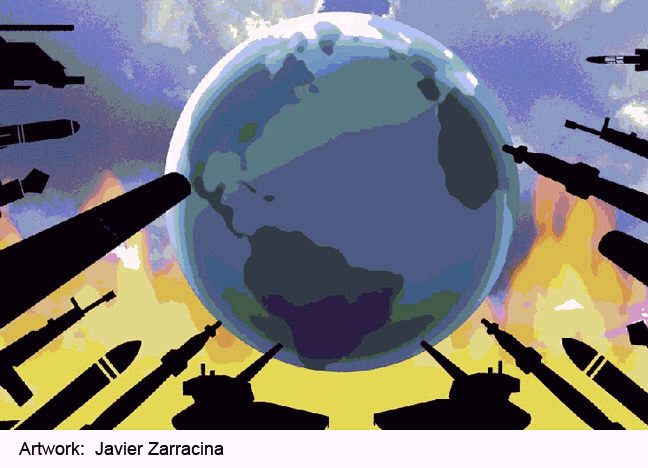
Moscow’s decided return to Great Power competition,” stated the Nuclear Posture Review.[1]
Dmitry Suslov, a veteran America-watcher and program director of the Valdai Discussion Club noted in his assessment of the review, that a troubling aspect of the new U.S. nuclear doctrine is the “considerable erosion of nuclear employment terms.” Suslov stated: “The current document says that the United States allows the possibility of using nuclear weapons in response to a non-nuclear attack not only against the U.S. itself and its allies but also against its ‘partners,’ a category that can include just about anyone apart from those the US openly calls its adversaries (today these are Russia, China, Iran and North Korea) or unfriendly countries (Syria, Venezuela, etc.). Officially, the United States’ ‘strategic partners’ are Ukraine and Georgia, to name just these two. Does this mean that Washington will seriously contemplate using nuclear weapons if their security is under threat?”
Like many Russian experts Suslov regards the situation as worse than during the Cold War and urges the expert communities in both the U.S. and Russia to share their concerns with the policy makers.
Below are excerpts from Suslov’s article, titled “Militarizing The Confrontation: Risks Of The New U.S. Nuclear Posture Review,” published in the Valdai Discussion Club:[2]
‘The General Strategic Situation Is Much More Complex And Multifaceted Than During The Cold War’
“During the last four years, Russian-American confrontation has been mostly confined to the political, information and economic (sanctions) areas and has been minimal in terms of the military. The military establishments in Russia and America and their proponents among the Russian and U.S. political elite regarded each other as potential adversaries even before the current confrontation. Moscow’s 2010 military doctrine (incidentally, approved at the peak of the Russian-U.S. ‘reset’) described globalization and NATO expansion as the main military threat. NATO’s official pivot in 2014 to the open military and political containment of Russia was until recently of a predominantly declarative and political nature. In the military respect, it was rather modest since the real scale of NATO’s infrastructural expansion in the Baltic and Black Sea areas was not great. In the Middle East, too, the U.S. refrained from creating military obstacles to the Russian operation in Syria, which would have risked a direct clash between the two powers.
“However, the situation may change radically quite soon. On February 2, 2018, Washington presented its new nuclear doctrine (Nuclear Posture Review), which outlined a qualitative change in U.S. nuclear policy. ……..
“The main change in the U.S. nuclear doctrine is that the Trump administration, based on the qualitatively new realities of the great-power confrontation with Russia and China as compared with the period after the Cold War, has decided on a higher role for nuclear weapons and emphasizes them in its defense strategy, whereas the Obama and Bush administrations on the contrary sought to downplay it. ……….



 nuclear-news
Leave a comment