Very dangerous to put low-yield nuclear weapons on submarines

 THE DISCRIMINATION PROBLEM: WHY PUTTING LOW-YIELD NUCLEAR WEAPONS ON SUBMARINES IS SO DANGEROUS, VIPIN NARANG , War on the Rocks, 8 Feb 18
The United States has the most diverse and potent nuclear force on the planet, capable of deterring and, if necessary, defeating and destroying any military and any nation on earth. The Trump administration’s recently released Nuclear Posture Review doesn’t think that’s enough. Going beyond the modernization program that upgrades and maintains the existing force, the document calls for a variety of capabilities and missions for American nuclear forces that have long been on Republicans’ wish list. Specifically, the document places a renewed emphasis on expanding the role and size of the low-yield nuclear weapon force (with low yields not being all that low since they include 20 kiloton nuclear weapons, the same as those dropped on Hiroshima and Nagasaki).
The most notable low-yield capabilities on the wish list include submarine-launched ballistic missiles (SLBMs) and sea-launched cruise missiles (SLCMs), which could be based on surface ships or submarines. The administration seeks to deploy low-yield nuclear weapons on both missiles to achieve the ultimate mission of the Nuclear Posture Review: to generate more flexible and tailored nuclear responses to a wide spectrum of nuclear and non-nuclear attacks against the United States and its allies. Proponents argue that incorporating more low-yield nuclear weapons into the force posture gives the United States the ability to respond to various forms of aggression with more calibrated responses on the so-called escalation ladder (and in theory, deter or defeat that aggression without escalation to the strategic nuclear level). In other words, the Trump administration hopes to generate options beyond “suicide or surrender.”
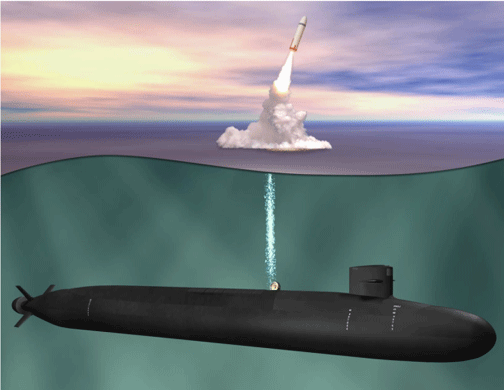
Although the aim of the low-yield SLBM and SLCM is to close this perceived “deterrence gap,” proponents of these capabilities have elided one key problem: how the adversary may perceive and react to their use. I call this the “discrimination problem.” Right now, all the SLBMs in the American inventory carry multiple — up to eight! — thermonuclear warheads. Mixing these missiles with one or several of the proposed low-yield warheads creates a very real problem: How will the adversary know which of the two is coming its way? It cannot. If the adversary sees a single SLBM headed toward it — even if that missile turns out to only be carrying a low-yield warhead — it must react as if it is facing the full brunt of American strategic nuclear use. It would be catastrophic—potentially nation-ending—to hope otherwise and be wrong………
If the adversary detects even a single missile launch, it has no choice but to react as if the United States has decided to escalate to the strategic nuclear level. …….
When it comes to waging a nuclear war, it is simply unrealistic to base a whole strategy on hoping that an adversary assumes the best-case scenario. The adversary’s most logical move is to respond as though full-scale nuclear war has started ………
While the idea of a low-yield SLBM may be attractive in a sterile game theory seminar, in a real conflict with real decision-makers, it is a recipe for uncontrollable nuclear escalation.
Vipin Narang is associate professor of political science and a member of the Security Studies Program at the Massachusetts Institute of Technology.
https://warontherocks.com/2018/02/discrimination-problem-putting-low-yield-nuclear-weapons-submarines-dangerous/
February 9, 2018 -
Posted by Christina Macpherson |
USA, weapons and war
No comments yet.

 THE DISCRIMINATION PROBLEM: WHY PUTTING LOW-YIELD NUCLEAR WEAPONS ON SUBMARINES IS SO DANGEROUS, VIPIN NARANG , War on the Rocks, 8 Feb 18




 nuclear-news
Leave a comment