After meeting with South Korean Vice Unification Minister Chun Hae-sung in Seoul, Joseph Yun also told reporters that he sees the resumed inter-Korean talks and easing tensions after the North’s decision to join the upcoming Winter Olympics as a “good opportunity” for denuclearization efforts.
“We want to open dialogue with North Korea, we want to have a credible dialogue, a dialogue that could lead steps towards denuclearization,” he said. “That is our goal and of course President Moon has also emphasized that goal too.”
Santee Cooper is dropping two retirement plans that the state-owned utility has offered for years to its executives, part of an effort to cut costs following a multibillion-dollar nuclear fiasco and appease state lawmakers, livid the perks existed in the first place.
“Clearly, it’s a way to make sure we demonstrate we’re hearing what the folks in the Legislature are saying,” interim Santee Cooper Chief Executive Jim Brogdon told The State newspaper Thursday.
Later this month, the utility’s board is expected to vote to get rid of the two extra retirement plans, which offered some Santee Cooper executives benefits in addition to the normal retirement plan that is open to all state employees, Brogdon said.
Thirty-three Santee Cooper managers currently are enrolled in an extra pension-style plan. Nine employees are enrolled in an additional 401(k)-type plan.
Those plans pay benefits in addition to the normal state retirement plan’s payments.
Longtime Santee Cooper Chief Executive Lonnie Carter decided which employees were allowed to enroll in the two extra plans, which the utility said it offered to retain top executives.
Carter’s retirement came a month after Santee Cooper abandoned its decadelong joint effort with Cayce-based SCE&G to build two nuclear reactors in Fairfield County.
The failed project saddled Santee Cooper with $4 billion in debt, cost S.C. power customers at least $2 billion in higher bills and brought fresh scrutiny to the way the state-owned power company rewards its executives.
“The fact that they had three separate retirement plans for their executives, and the fact that the CEO chose the members of those plans, to me, was ridiculous,” said Senate Minority Leader Nikki Setzler, the Lexington Democrat who co-chaired the Senate committee that investigated the nuclear fiasco. “That is an abuse of the system.”
During a Senate hearing Thursday, Setzler told Brogdon he was pleased with the proposal to ditch the special retirement plans.
Santee Cooper’s board vote later this month would close the extra retirement plans to future executives but leave them in place for current employees and 32 retirees who already are enrolled.
Nuclear plant to close ahead of schedule, Washington Examiner, by John Siciliano | One of the oldest nuclear power plants in the country will be shutting down more than a year ahead of schedule.
Exelon, the largest nuclear utility in the country, said Friday that it would shut down the Oyster Creek power station in New Jersey in October, more than a year ahead of schedule.
The power plant decided to close early, even though it is licensed by the federal government to provide electricity through 2029. The early closure stems from costly regulations in New Jersey requiring it to install new cooling towers.
Exelon entered into an agreement with the state’s environmental regulators in 2010 to phase out the plant’s operations, after it decided that it could not justify the cost of meeting the new water cooling rules. It instead agreed to a planned phaseout in which it would close the plant in December 2019.
But on Friday, things changed, and now the company wants to close the plant more than a year earlier than under the agreement with the state. It explained that the shutdown decision was made to help employees in finding new employment, while dealing with higher maintenance cost and lower prices for electricity……….
Environmentalists and other staunch opponents of nuclear power plants welcomed the decision, pointing out that the Oyster Creek plant is the same design as the one that experienced multiple reactor core meltdowns and explosions during the 2011 Fukushima disaster in Japan.
The Oyster Creek plant is the “first and the oldest Fukushima-design nuclear reactor in the world,” a General Electric model called the Mark I, said the anti-nuclear energy group Beyond Nuclear in reacting to Exelon’s new closure timeline.
“It’s clear that Oyster Creek and the entire, aging U.S. nuclear reactor fleet is hemorrhaging financially,” said Paul Gunter, the head of the group’s reactor oversight program. “The fact that the U.S. Nuclear Regulatory Commission and the nuclear industry continue to prioritize financial margins over public safety margins is a growing concern, especially at the remaining 29 Fukushima style reactors still operating in the U.S.” http://www.washingtonexaminer.com/nuclear-plant-to-close-ahead-of-schedule/article/2647965
Fairfield County is weighing whether to sue utility SCE&G over the shutdown of a project to build to two nuclear reactors in Jenkinsville after the utility blocked county officials from assessing improvements at the site.
SCE&G shut down the nuclear project six months ago after the projected costs of building the two reactors soared from $11 billion to $14 billion to $20 billion. The shutdown put an estimated 5,000 people out of work.
Now, officials in the small rural county north of Columbia want to collect property taxes on the incomplete reactors and the land they sit on.
“They built a small city out there,” county administrator Jason Taylor said. “And that small city should be taxed.”
But that process got off to a rocky start when SCE&G last month allowed a county tax assessor access to the site on a tour bus, but didn’t let him and his team off to take measurements or other calculations needed.
Cellphone radiation study finds mixed effects in rodents without clear implications for human health, WP, By Ariana Eunjung ChaFebruary 2 2018
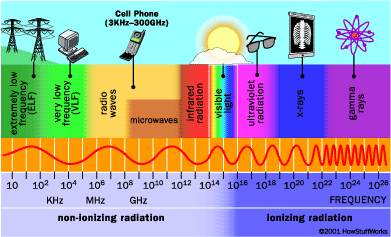
The long-awaited results of a $25 million National Institutes of Health study on the effects of cellphone radio frequency radiation exposure on animals is out, and the results are mixed. They showed a higher risk of tumors, DNA or tissue damage and lower body weight in some groups of rodents, but no obvious ill effect in others and no clear implications for human health.
John Bucher, a senior scientist involved in the 10-year study, was cautious in his interpretation of the results in a conference call with journalists on Friday. Given the inconsistent pattern of the findings, the fact that the subjects were rats and mice rather than people and the high level of radiation used, he said he could not extrapolate from the data to potential health effects on humans.
“At this point we don’t feel that we understand enough about the results to place a huge degree of confidence in the findings,” he said.
Bucher also said “I have not changed the way I use a cellphone, no.”
The study by the National Toxicology Program is believed to be the most comprehensive assessment of the health effects of such radiation on rats and mice and involved 3,000 test animals. A draft report was released on Friday for public comment and peer review, in advance of an external expert review on March 26-28. Among other things, reviewers will examine whether some of the results might be statistical noise.
The issue of cellphone radiation’s impact on human health is one that has been hotly debated for years. In 2010, the Federal Communications Commission came under fire after it dropped a long-standing recommendation that consumers buy phones with lower radiation emissions. In 2015, the city council in Berkeley, Calif., approved a disclosure ordinance that directed sellers to let buyers know of the risk of carrying devices too close to their bodies. The CTIA, which represents the wireless industry, has sued, saying the warnings are “ill-informed” and violates retailers’ First Amendment rights.
The strongest finding in the new study involved male rats — but not female rats or male or female mice — which developed tumors in the nerves surrounding their hearts. Researchers also saw increases in damage to heart tissue in both male and female rats. If these results are confirmed, Bucher said, they appear to suggest this type of radiation could be a “weak” carcinogen.
The male rat tumors were so-called malignant schwannomas. Based on limited research that shows a potentially elevated risk of schwannomas near the brain in people, the International Agency for Research on Cancer lists radio-frequency fields as “possibly carcinogenic to humans.”
China goes nuclear with latest state-brokered power deal, Josephine Mason, David Stanway BEIJING (Reuters) 2 Feb 18, –China National Nuclear Corp (CNNC), China’s No. 2 nuclear power producer, will take over the country’s top nuclear power plant builder to create a company worth almost $100 billion, the latest state-orchestrated marriage in the nation’s vast power sector.
Approval for the tie-up between CNNC and China Nuclear Engineering & Construction (CNEC) was announced by the State-Owned Assets Supervision and Administration Commission (SASAC) on Wednesday in a one-line statement posted on its website…….
Beijing wants to overhaul its nuclear sector in order to create globally competitive firms and reduce overcapacity across its broader power market. The nuclear industry is struggling with project delays and a slowdown in approvals for new domestic projects.
By creating a unified home-brand series of reactors, and combining firms, China will be better positioned to bid for and finance overseas projects, experts say.
The study is, in fact, an updated version of a report done last year at the request of Febeliec, the Belgian federation of large electricity consumers. Greenpeace asked the research centre, which links the Catholic University of Leuven and the University of Hasselt, to modify two initial parameters: the price of gas, which is lower than expected, and the availability of nuclear reactors.
The nuclear plants are scheduled to close in 2025. In that case, the annual cost of Belgium’s electricity system will be 5.415 billion euros in 2030, three times more than the current cost. If the two most recent reactors are kept working until 2035, the cost would drop to 5.130 billion euros.
On the other hand, by 2040, the two scenarios would amount to roughly the same cost, about 7.19 billion euros, with just a difference of about two million euros between them.
According to Jan Vande Putte, an energy expert at Greenpeace, prolonging nuclear generation merely postpones the required investments in replacement capacity.
Xinhuanet 1st Feb 2018,China General Nuclear Power Corporation (CGN), a major Chinese nuclear
power operator, said Wednesday that nuclear projects in Britain were
proceeding well. He Yu, chairman of the board of CGN, said since the deals
were inked in 2016 with French energy company EDF and the British
government, CGN has invested 1.7 billion British pounds in order to advance
the projects. CGN signed agreements in 2016 for Hinkley Point C (HPC), a
nuclear project in Somerset, and a suite of agreements relating to the
Sizewell C (SZC) in eastern England and Bradwell B projects (BRB) in Essex.
“A total of 15 Chinese suppliers and contractors have passed a preliminary
qualification assessment for the HPC project,” He said. “HPC, which is
Britain’s first new nuclear power station in a generation, is the largest
construction in Europe.” http://www.xinhuanet.com/english/2018-02/01/c_136940068.htm
Reuters 31st Jan 2018, Notable Chinese investments in Britain include the Hinkley C nuclear power
station which is being built by China General Nuclear Power Corp and the
British arm of France’s EDF (EDF.PA), while British firms, such as Rolls
Royce (RR.L), have won large deals from Chinese firms to supply items like
plane engines. Both May and senior Chinese officials have restated their
commitment to the “golden era” in ties but a row over May’s decision
to delay approval for the Chinese-funded Hinkley nuclear plant in late 2016
chilled relations. However, Britain was the first Western country to sign
up to the China-backed Asian Infrastructure Investment Bank and it sent
Finance Minister Philip Hammond to a Beijing summit last year about
President Xi Jinping’s flagship ‘Belt and Road Initiative’ – a
trillion-dollar infrastructure-led push to build a modern Silk Road. https://www.reuters.com/article/us-china-britain/chinas-li-says-ties-with-britain-to-stay-unchanged-through-brexit-idUSKBN1FK023
NDA 1st Feb 2018,Specialist scuba divers are plumbing new depths to haul radioactive waste
out of the nuclear fuel storage pond at Sizewell A. The team of American
underwater experts tackled their first UK ‘nuclear dive’ at Dungeness A
in 2016 where, wearing full protective suits and shielded from radiation by
the water, they were able to cut up empty fuel storage skips and retrieve
other pieces of submerged equipment.
The ponds were used to store thousands
of used nuclear fuel rods, held in metal skips, after they were discharged
from the reactors. After the last of the fuel was transported to Sellafield
for reprocessing, the skips and a range of redundant items, including
sludge, were left behind in the water.
Pond clean-out conventionally takes
place using remotely operated equipment to lift the whole radioactive skips
clear of the water, exposing them to the air, where they are carefully cut
up before decontamination, storage and eventual disposal. This process is
slow with potential radiation dose risks for workers. By doing the work
under water, the divers can cut up the skips more safely, access awkward
areas more easily, making the whole process safer, faster and more
productive. https://www.gov.uk/government/news/diving-into-innovation-at-sizewell
NDA 31st Jan 2018,Robots controlled by smart auto-navigation systems are doing battle in an
£8.5 million competition to find ways to tackle Sellafield radioactive
hotspots. Last year, the Nuclear Decommissioning Authority (NDA) and fellow
government agency Innovate UK launched a search for innovative technologies
that could be combined into a single seamless process for use in facilities
that will soon embark on a major decommissioning journey.
Working closely with Sellafield Ltd, who would use the technology, submissions to a
competitive process were invited from all industrial sectors. Five
promising ideas have now made it through to the final stages after being
whittled down from a shortlist of 15. The newly formed consortia are each
set to receive up to £1.5 million to build prototype demonstrators for
testing in a simulated radioactive environment. https://www.gov.uk/government/news/robots-compete-in-nuclear-decommissioning-challenge
Former national monuments shrunk by Trump to be opened for mining claims
Presidential order reduced protections for land once part of Utah’s Bears Ears and Grand Staircase-Escalante monuments, Guardian, Alastair Gee , 2 Feb 18,
Hundreds of thousands of acres of land that were part of two US national monuments shrunk by Donald Trump are being opened on Friday to mining claims for uranium and other minerals.
It is a symbolic step in a broader conflict over the fate of America’s public lands, on which Trump hopes to encourage greater access for extractive industries.
His proclamation judged that large portions of the monuments were not unique or of particular scientific or historic interest, a point fiercely contested by environmentalists, Native American groups and scientists, who have brought five lawsuits.
On February 4, 2004, the Pakistani scientist Abdul Qadeer (A.Q.) Khan, then famous for his role in developing Pakistan’s nuclear arsenal, confessed on live television to having illegally proliferated nuclear weapons technology to Iran, Libya, and North Korea over the course of decades. Today Khan is enjoying a resurrection at home, where he is again touted as the “Mohsin e-Pakistan,” or the savior of Pakistan. He appears as the guest of honor at official ceremonies, and last year Sir Syed University of Engineering and Technology declared him a distinguished alumnus in recognition of his “meritorious services and valuable contributions towards scientific research and its practical application for the productive use for mankind.”
Outside of Pakistan, Khan has largely been forgotten, despite the fact that his fingerprints are all over the world’s most volatile nuclear hot spots. Indeed, three of the United States’ most significant national security challenges—Iran, North Korea, and Pakistan—are largely the results of Khan’s handiwork.
Between the start of Khan’s nuclear black market in the mid-1970s and his forced confession in 2004, the United States and other countries had many opportunities to stop him. Yet each time, policymakers decided that preventing the spread of nuclear weapons was less important than pursuing other foreign policy goals. These decisions haunt U.S. leaders today. Pakistan’s nuclear deterrent makes it impossible for U.S. commanders to force the country to close its safe havens for Afghan extremists. Iran’s nuclear program—though frozen for now—could still lead to a nuclear arms race in the Middle East. And North Korea, which Khan helped turn from a thorn in the world’s side into an unstable nuclear power, now threatens the lives of millions.
How were Khan’s activities allowed to continue for so long? And what lessons might the failures to contain him hold for policymakers today?
GOING NUCLEAR
Born in British India in 1936, Khan…. (subscribers only)









 nuclear-news