The Era of Nuclear Decommissioning
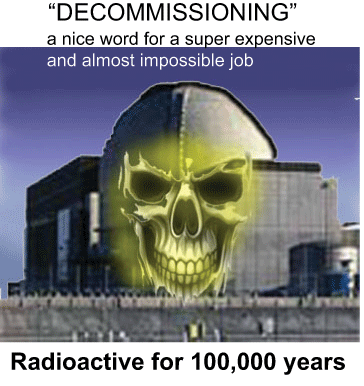
Nuclear power in crisis: we are entering the Era of Nuclear Decommissioning, Energy Post, by Jim Green “…………The Era of Nuclear Decommissioning The ageing of the global reactor fleet isn’t yet a crisis for the industry, but it is heading that way. In many countries with nuclear power, the prospects for new reactors are dim and rear-guard battles are being fought to extend the lifespans of ageing reactors that are approaching or past their design date.
Perhaps the best characterisation of the global nuclear industry is that a new era is approaching ‒ the Era of Nuclear Decommissioning ‒ following on from its growth spurt from the 1960s to the ’90s then 20 years of stagnation.
The Era of Nuclear Decommissioning will entail:
- A slow decline in the number of operating reactors.
- An increasingly unreliable and accident-prone reactor fleet as ageing sets in.
- Countless battles over lifespan extensions for ageing reactors.
- An internationalisation of anti-nuclear opposition as neighbouring countries object to the continued operation of ageing reactors (international opposition to Belgium’s ageing reactors is a case in point ‒ and there are numerous other examples).
- Battles over and problems with decommissioning projects (e.g. the UK government’s £100+ million settlement over a botched decommissioning tendering process).
- Battles over taxpayer bailout proposals for companies and utilities that haven’t set aside adequate funds for decommissioning and nuclear waste management and disposal. (According to Nuclear Energy Insider, European nuclear utilities face “significant and urgent challenges” with over a third of the continent’s nuclear plants to be shut down by 2025, and utilities facing a €118 billion shortfall in decommissioning and waste management funds.)
- Battles over proposals to impose nuclear waste repositories and stores on unwilling or divided communities.
The Era of Nuclear Decommissioning will be characterised by escalating battles (and escalating sticker shock) over lifespan extensions, decommissioning and nuclear waste management. In those circumstances, it will become even more difficult than it currently is for the industry to pursue new reactor projects. A feedback loop could take hold and then the nuclear industry will be well and truly in crisis ‒ if it isn’t already.
Editor’s Note
Dr Jim Green is the editor of the Nuclear Monitor newsletter, where a longer version of this article was originally published.
No comments yet.
1 This Month


Tell the Ukrainian Government to Drop Prosecution of Peace Activist Yurii Sheliazhenko

Petition to revoke the licensing of the Near Surface Nuclear Disposal Facility (NSDF) at Chalk River. https://www.ourcommons.ca/petitions/en/Petition/Details?Petition=e-7247


of the week – STOP SMALL MODULAR REACTORS IN CANADA
To see nuclear-related stories in greater depth and intensity – go to https://nuclearinformation.wordpress.com
-
Archives
- March 2026 (204)
- February 2026 (268)
- January 2026 (308)
- December 2025 (358)
- November 2025 (359)
- October 2025 (376)
- September 2025 (258)
- August 2025 (319)
- July 2025 (230)
- June 2025 (348)
- May 2025 (261)
- April 2025 (305)
-
Categories
- 1
- 1 NUCLEAR ISSUES
- business and costs
- climate change
- culture and arts
- ENERGY
- environment
- health
- history
- indigenous issues
- Legal
- marketing of nuclear
- media
- opposition to nuclear
- PERSONAL STORIES
- politics
- politics international
- Religion and ethics
- safety
- secrets,lies and civil liberties
- spinbuster
- technology
- Uranium
- wastes
- weapons and war
- Women
- 2 WORLD
- ACTION
- AFRICA
- Atrocities
- AUSTRALIA
- Christina's notes
- Christina's themes
- culture and arts
- Events
- Fuk 2022
- Fuk 2023
- Fukushima 2017
- Fukushima 2018
- fukushima 2019
- Fukushima 2020
- Fukushima 2021
- general
- global warming
- Humour (God we need it)
- Nuclear
- RARE EARTHS
- Reference
- resources – print
- Resources -audiovicual
- Weekly Newsletter
- World
- World Nuclear
- YouTube
-
RSS
Entries RSS
Comments RSS
 nuclear-news
Leave a comment