Egypt to go into big debt to buy Russian nuclear reactors that it doesn’t need

 Egypt to sign contracts for nuclear power plant during Putin’s visit: sources, CAIRO (Reuters) 10 Dec 17 – Egypt will sign contracts with Moscow during Russian President Vladimir Putin’s visit to Cairo on Monday for the country’s first nuclear power plant, three senior sources told Reuters on Sunday.
The construction of the 4,800 megawatt (MW) capacity plant, which is supposed to be built at Dabaa in the north of the country, is expected to be completed within seven years, added the sources, who spoke on condition of anonymity because they were not authorized to speak to the media……
Moscow and Cairo signed an agreement in 2015 for Russia to build a nuclear power plant in Egypt, with Russia extending a loan to Egypt to cover the cost of construction.
Egypt’s official gazette said last year the loan was worth $25 billion and would finance 85 percent of the value of each work contract, services and equipment shipping. Egypt would fund the remaining 15 percent.
The trial operation of the first nuclear reactor is expected to take place in 2022……
The nuclear plant is expected not to just cover the country’s energy needs, but to produce excess which can be exported, the sources told Reuters on Sunday.
Putin is scheduled to visit Cairo on Monday to meet with his counterpart Abdel Fattah al-Sisi, where they will discuss bilateral relations, trade and Middle Eastern issues, the Kremlin said last week.
Reporting by Momen Abdelkhalek; Writing by Amina Ismail; Editing by Toby Chopra
Russioa denies USA allegations : says it is fully committed to nuclear missile pact
Russia says it is fully committed to nuclear missile pact, Reuters Staff, MOSCOW (Reuters) 9 Dec 17 – Russia said on Saturday it was fully committed to a Cold War-era pact with the United States banning intermediate-range cruise missiles, a day after Washington accused Moscow of violating the treaty.
The U.S. State Department said on Friday Washington was reviewing military options, including new intermediate-range cruise missile systems, in response to what it said was Russia’s ongoing violation of the 1987 Intermediate-Range Nuclear Forces Treaty.
The warning was the first response by President Donald Trump’s administration to U.S. charges first leveled in 2014 that Russia had deployed a ground-launched cruise missile that breaches the pact’s ban on testing and fielding missiles with ranges of 500-5,500 kms (310-3,417 miles).
Russian Deputy Foreign Minister Sergei Ryabkov said those allegations were “absolutely unfounded”……
Echoing previous Russian statements, Ryabkov said Moscow was fully committed to the treaty, had always rigorously complied with it, and was prepared to continue doing so.
“However, if the other side stops following it, we will be forced, as President of the Russian Federation Vladimir Putin has already said, to respond in kind,” he added.
The U.S. allegation has further strained relations between Moscow and Washington, and the State Department on Friday hinted at possible economic sanctions over the issue…… https://www.reuters.com/article/us-russia-usa-nuclear/russia-says-it-is-fully-committed-to-nuclear-missile-pact-idUSKBN1E30HZ
Israel’s 54-year-old nuclear reactor a safety risk
 Aljazeera, by Harry Fawcett
The Dimona reactor, which began its life in 1963, is one of Israel’s most closely guarded secret installations.
A study made public last year found more than 1500 fissures within the reactor core.
Israel is estimated to have more than 100 nuclear warheads, the plutonium for which comes from its Dimona reactor…….http://www.aljazeera.com/news/2017/12/israels-54-year-nuclear-reactor-safety-risk-171209153124924.html
Revelations that Westinghouse knew of nuclear reactor problems
Sounding new nuclear alarms https://www.postandcourier.com/opinion/editorials/sounding-new-nuclear-alarms/article_be2fb7ca-dc42-11e7-8c26-0305d23937e2.html Westinghouse knew, as far back as 2011, that its designs for two new nuclear reactors in South Carolina were virtually guaranteed to face construction delays and serious cost overruns.
A shocking document published on Friday by The Post and Courier reveals that a Westinghouse engineer raised several alarms about the viability of the reactor plans just two years after construction began.
Worse, it suggests that Westinghouse officials all but ignored the conclusions and proceeded with construction on the now abandoned reactors anyway.
“The AP1000 Design is not complete, although it is currently under construction,” reads the document. “This virtually assures large numbers of changes will occur to both systems and structures.”
The author estimated that related delays could cost as much as $300 million in “claims which will be difficult to defend.”
The report also drew attention to the fact that Westinghouse chose not to require a “professional engineer seal” on plans for the reactors, which could call into question both the designs’ legal status and whether they could be safely built.
That particular flaw, and the existence of the report, were both documented in a September article by The Post and Courier.
If state lawmakers and officials can prove that SCANA or Santee Cooper were aware of Westinghouse’s own internal concerns about the nuclear project as far back as 2011, it would be the most damning piece of evidence yet that the utilities acted imprudently in continuing to funnel money into the new reactors at customer expense.
Today, The Post and Courier is publishing a thorough investigation not just of the failure of the two South Carolina reactors, but of a number of other projects in other states that have cost electric ratepayers tens of billions of dollars.
The report paints a troubling picture of money and influence wielded to shape public policy that benefits electric utilities at the cost of their customers.
In South Carolina, the 2007 Base Load Review Act paved the way for a $9 billion nuclear disaster that could impact hundreds of thousands of ratepayers for the next six decades. The law passed with near unanimous support at the Statehouse.
At least 11 states have similar pieces of legislation. That leaves millions of people nationwide at risk of similarly devastating economic impacts.
Even if Westinghouse never mentioned its concerns to SCANA or Santee Cooper officials, the two South Carolina power companies certainly knew that they were facing problems. Cost overruns and delays plagued the project almost from the start.
Then in 2015, engineering firm Bechtel produced an alarming audit that raised numerous red flags about construction schedules, design flaws and other potentially fatal problems. But work continued and utility officials publicly touted the project’s progress.
That shameful duplicity insults the electric ratepayers of South Carolina, who are paying higher rates for the project, and are faced with years more without state intervention. The situation must be rectified by state lawmakers, regulatory officers and Gov. Henry McMaster when the Legislature returns to session in January.
And as today’s report confirms, other states should take notice.
Ontario frighteningly unprepared for nuclear emergencies
IFPress 7th Dec 2017,Ontario’s lack of readiness for nuclear emergencies is a frightening
situation that should alarm every resident, especially those in
Southwestern Ontario, says Sarnia Mayor Mike Bradley. “The province
preaches to municipalities about emergency plans. It turns out the preacher
isn’t following his own gospel,” Bradley said Thursday. Bradley joined
a chorus of critics slamming the Liberal government a day after Ontario’s
auditor general revealed shortcomings in provincial emergency and nuclear
response plans, concluding it’s not ready for a large-scale emergency.
Southwestern Ontario is home to the world’s largest operating nuclear
plant, the Bruce nuclear complex near Kincardine.
http://www.lfpress.com/2017/12/07/sarnia-mayor-weighs-in-after-auditors-less-than–glowing-review-of-provincial-preparedness
There is no way to be prepared for nuclear war – International Red Cross and Red Crescent
 Francesco Rocca: No one can prepare for nuclear war Aljazeera, 10 Dec 17, The incoming president of the International Federation of Red Cross and Red Crescent Societies (IFRC) has expressed hope that dialogue will prevail in escalating tensions between North Korea and the West, saying that nothing could prepare the world for nuclear war.
“There is no training, no preparation that could cope with a disaster where we could assist if this weapon would be used,” Francesco Rocca told Al Jazeera.
“This is something I don’t even want to think about … I hope love for humanity will prevail.”
Rocca was elected as the new head of the IFRC by his peers from 178 National Red Cross and Red Crescent Societies at the humanitarian aid organisation’s general assembly in Antalya, Turkey, on November 6.
Speaking to Al Jazeera, Rocca vowed to denounce actors who target humanitarian professionals and facilities, and called the international community’s response to the migrant crisis a “failure”. Here is the full interview……..http://www.aljazeera.com/indepth/features/2017/12/francesco-rocca-prepare-nuclear-war-171205132112294.html
December 10 Energy News

Opinion:
¶ “Utahns won’t benefit from more oil and gas production – just the companies that operate here” • The Trump administration’s retrograde policies to increase fossil fuel subsidies will damage our air, land, water and public health. Trump’s Energy, EPA, and Interior directors are moving to further privilege coal, gas and oil with taxpayer money. [Salt Lake Tribune]
 Oil well on public land (Josh Ewing | Friends of Cedar Mesa)
¶ “India faces painful move to cleaner energy” • Hundreds of millions of people in India are forced to live with the fallout of the dirtiest fuels. It is not just air pollution that is killing people and animals. Coal waste is getting into fields and causing underground fires. The government blames a lack of funds to pay for greener power. [The Straits Times]
Science and Technology:
¶ The worst-case predictions regarding the effects of global warming…
View original post 674 more words
1 This Month
To see nuclear-related stories in greater depth and intensity – go to https://nuclearinformation.wordpress.com/
12 February – Webinar The Big Push: New Nuclear Projects in Canada
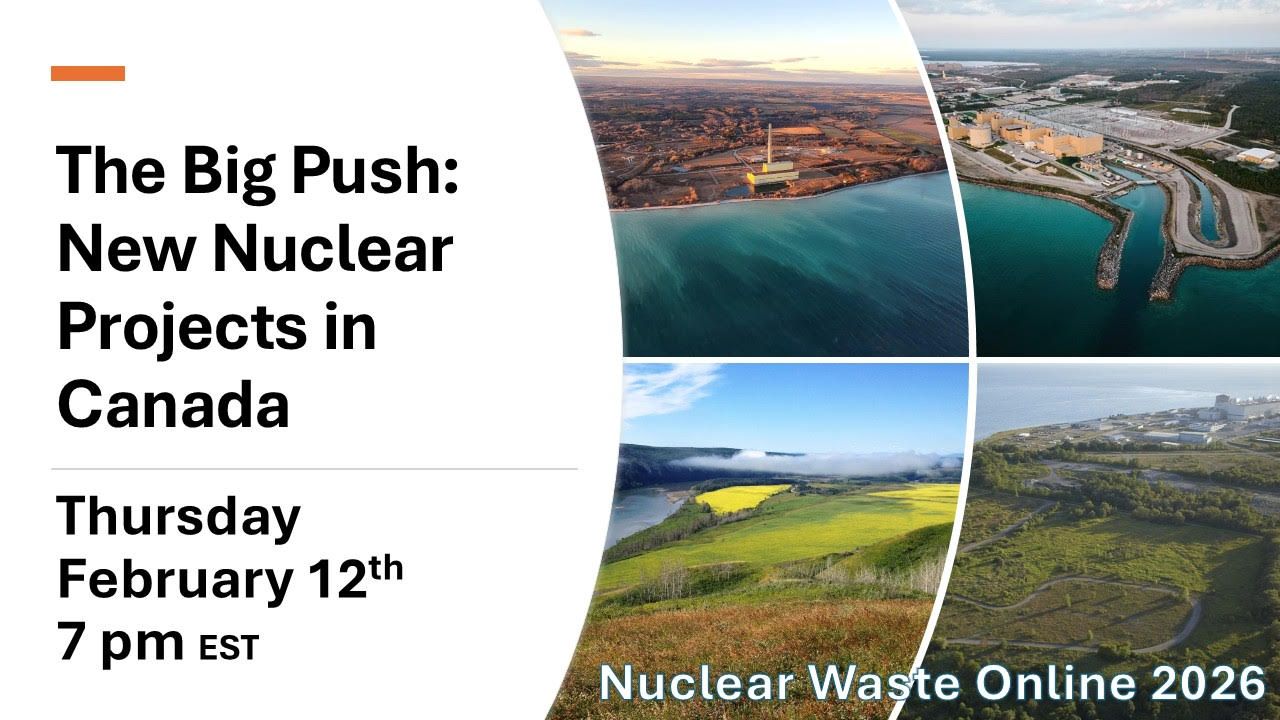
Thursday, February 12, 7 pm Eastern | 2nd of 4 sessions in the 2026 Nuclear Waste Online webinar series
Join a webinar on the push for new nuclear generation in Canada. Go to Northwatch.org to register or use the registration link https://us02web.zoom.us/webinar/register/WN_ZfWOf1GITqSRIZX8CB-A9w
-
Archives
- February 2026 (115)
- January 2026 (308)
- December 2025 (358)
- November 2025 (359)
- October 2025 (376)
- September 2025 (258)
- August 2025 (319)
- July 2025 (230)
- June 2025 (348)
- May 2025 (261)
- April 2025 (305)
- March 2025 (319)
-
Categories
- 1
- 1 NUCLEAR ISSUES
- business and costs
- climate change
- culture and arts
- ENERGY
- environment
- health
- history
- indigenous issues
- Legal
- marketing of nuclear
- media
- opposition to nuclear
- PERSONAL STORIES
- politics
- politics international
- Religion and ethics
- safety
- secrets,lies and civil liberties
- spinbuster
- technology
- Uranium
- wastes
- weapons and war
- Women
- 2 WORLD
- ACTION
- AFRICA
- Atrocities
- AUSTRALIA
- Christina's notes
- Christina's themes
- culture and arts
- Events
- Fuk 2022
- Fuk 2023
- Fukushima 2017
- Fukushima 2018
- fukushima 2019
- Fukushima 2020
- Fukushima 2021
- general
- global warming
- Humour (God we need it)
- Nuclear
- RARE EARTHS
- Reference
- resources – print
- Resources -audiovicual
- Weekly Newsletter
- World
- World Nuclear
- YouTube
-
RSS
Entries RSS
Comments RSS
 nuclear-news