The long work of achieving the abolition of nuclear weapons
 A long road to abolishment of nuclear weapons, http://www.timescolonist.com/opinion/op-ed/comment-a-long-road-to-abolishment-of-nuclear-weapons-1.23115603 JONATHAN DOWN / Times Colonist , DECEMBER 7, 2017 With the Doomsday Clock now set at 2.5 minutes to midnight, the key role of the International Campaign to Abolish Nuclear Weapons in building the historic UN Treaty on the Prohibition of Nuclear Weapons is more remarkable than ever.
On July 7, 122 United Nations member countries adopted the treaty, and 50 nations have signed it since Sept. 20. It is anticipated that by the end of 2018, the treaty will become international law.
Recognizing that the risk of nuclear war is even higher today than during the Cold War, the Nobel Committee is honouring ICAN’s work with the 2017 Nobel Peace Prize to be awarded in Oslo on Sunday. Canadian peace campaigner and Hiroshima bomb survivor Setsuko Thurlow, together with ICAN’s executive director Beatrice Fihn, will accept the prize.
However, although a Canadian activist will receive the Nobel in Oslo, Canada has turned its back on the treaty and refused to sign. Pressure from the United States is considered the main reason for this decision, which directly contradicts Canada’s international reputation as a supporter of nuclear disarmament. It also flouts the treaty’s vision of a world where nuclear weapons are stigmatized, prohibited and eventually eliminated.
The idea of ICAN came from a 2007 meeting of the International Physicians for the Prevention of Nuclear War. The humanitarian consequences of the use of any nuclear weapon had been the central focus of physician concern for many years. However, after years of government inaction on the part of both nuclear and non-nuclear nations, a decision was made to launch an international campaign to abolish nuclear weapons, and ICAN was born.
Run almost entirely by enthusiastic, highly motivated young people from different parts of the world, ICAN clearly understands that 21st-century threats such as terrorism, cyber-security, failed states and climate change can’t be solved with nuclear weapons. Inflammatory rhetoric threatening “fire and fury” moves the world ever closer to the catastrophe of a nuclear war. Rather than acting as a deterrent, the threat of nuclear weapons encourages nations such as North Korea to accelerate their efforts to acquire their own nuclear arsenal.
ICAN-affiliated organizations are found in more than a hundred countries, including Canada, and the Nobel prize is a tribute to the millions of activists such as Thurlow who have worked to abolish the worst weapons of mass destruction. Victoria-based Vancouver Island Peace and Disarmament Network is affiliated with ICAN through member organizations, and several members participated in the negotiations leading up to the landmark treaty.
Canadians should be extremely proud of ICAN and the huge amount of work that has been done to advance the cause of global peace. We have a long way to go before nuclear weapons are finally abolished — but this year’s Nobel Peace Prize shows that the civil world is on the right track.
Jonathan Down is a pediatrician in Victoria and president-elect of Physicians for Global Survival, the Canadian affiliate of IPPNW. He is a member of the Vancouver Island Peace and Disarmament Network.
North Korea – open to talks with USA?


 North Korea ready to open direct talks with US, says Russia’s Sergei Lavrov https://www.theguardian.com/world/2017/dec/07/north-korea-ready-direct-talks-us-sergei-lavrov
Pyongyang ‘wants above all to talk to the US about guarantees for its security’
Lavrov says he informed Rex Tillerson in Vienna on Thursday, Guardian, Julian Borger in Washington, 8 Dec 17, North Korea is open to direct talks with the US over their nuclear standoff, according to the Russian foreign minister, Sergei Lavrov, who said he passed that message to his counterpart, Rex Tillerson, when the two diplomats met in Vienna on Thursday.
There was no immediate response from Tillerson but the official position of the state department is that North Korea would have to show itself to be serious about giving up its nuclear arsenal as part of a comprehensive agreement before a dialogue could begin.
Lavrov conveyed the apparent offer on the day a top UN official, Jeffrey Feltman, met the North Korean foreign minister, Ri Yong-ho, in Pyongyang, during the first high-level UN visit to the country for six years. Feltman is an American and a former US diplomat, but the state department stressed he was not in North Korea with any message from Washington.
“We know that North Korea wants above all to talk to the United States about guarantees for its security. We are ready to support that, we are ready to take part in facilitating such negotiations,” Lavrov said at an international conference in Vienna, according to the Interfax news agency. “Our American colleagues, [including] Rex Tillerson, have heard this.”
The diplomatic moves come amid an increased sense of urgency to find a way of defusing the tensions over North Korea’s increasingly ambitious nuclear and missile tests. The standoff reached a new peak on 29 November, when North Korea tested a new intercontinental ballistic missile (ICBM), the Hwasong-15, capable of reaching Washington, New York and the rest of the continental United States. The missile launch followed the test of what was apparently a hydrogen bomb in September.
Pyongyang has said that current joint exercises by the US and South Korea involving hundreds of warplanes, along with “bellicose remarks” by US officials have “made an outbreak of war on the Korean peninsula an established fact”.
“The remaining question now is: when will the war break out,” a foreign ministry spokesman said on Wednesday.
North Korean officials have said in recent informal meetings that they are particularly concerned by the threat of a surprise “decapitation” strike, aimed at killing the country’s leaders and paralysing military command and control systems before Pyongyang could launch its missiles.
The heightened tensions and threatening language have increased fears around the world that the two sides could blunder into war through miscalculation, mistaking war games for a real attack or misreading blurred red lines.
US and North Korean positions are currently far apart, with Pyongyang rejecting any suggestion that its nuclear disarmament would be on the table at any future negotiation. The regime wants the US to recognise it as a nuclear weapons power and cease its “hostile policies” to North Korea, including sanctions and military manoeuvres off the Korean peninsula.
For its part, the US has rejected a “freeze-for-freeze” proposal advanced by Russiaand China, by which North Korea would suspend nuclear and missile tests while the US would curtail its military exercises.
State department spokeswoman Heather Nauert said on Thursday that direct talks with North Korea were “not on the table until they are willing to denuclearize.”
However, the two sides have had informal contacts this year, involving Joseph Yun, the US special representative for North Korea policy. Those contacts, known as the “New York channel” were cut by the North Koreans after threatening remarks by Donald Trump during the UN general assembly in September. But there have been some recent signs that Pyongyang might be interested in restoring the channel.
At a meeting in Stockholm that brought together western experts and officials from Pyongyang in late November, a North Korean representative appeared to raise, for the first time, the possibility of a channel for military-to-military communication with the US.
“In an informal discussion that we had in Stockholm, an official made an observation that there isn’t at present a way for the US and North Korea to work together to prevent an accident. I thought that was an interesting observation that I had not heard them say before,” said Suzanne DiMaggio, a senior fellow at the New America thinktank who has played a leading role in back-channel contacts with Iran and North Korea, and who attended the Stockholm meeting.
“I think the US would be best served by putting aside the focus on denuclearisation and instead look at ways to prevent accidents, reduce risks and de-escalate. Those to me seem like achievable goals.”
Sue Mi Terry, a former CIA analyst who was director for Korea, Japan and Oceanic affairs at the national security council in the Bush and Obama administrations, said Washington might be amenable to such a military hotline being established.
“I think even this administration recognises that some sort of an open channel is needed for that, not to negotiate but to have a little more transparency,” she said. “I think everyone recognises that is needed.”
Terry, who was deputy national intelligence officer for east Asia at the national intelligence council from 2009 to 2010, said that it was also possible that Yun could re-establish the New York channel with Pyongyang. But she added there was little sign such contacts would lead to substantive negotiations in the current climate.
“This latest test put a big hole in the possibility of negotiation at this moment, she said. “Ambassador Yun might do that but it’s different with the White House. I’m not sure he has strong White House support.”
USA internationally isolated as Donald Trump continues menacing North Korea
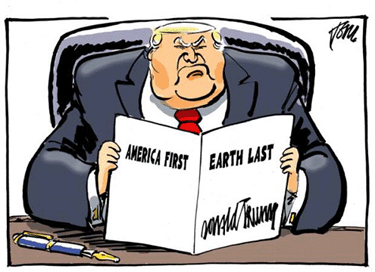 Donald Trump’s menacing talk on North Korea is leaving the US isolated https://www.theguardian.com/us-news/2017/nov/30/donald-trump-menacing-talk-north-korea-us-isolated
The US president seems oblivious to the consequences of war, and international support for his belligerence is weakening, Guardian, Simon Tisdall, 1 Dec 17, Donald Trump’s latest threat to destroy North Korea’s regime by force produced an angry response from Russia on Thursday. Yet elsewhere, the menacing talk from Washington was mostly met with uncomfortable silence.
While there is no shortage of international concern about Kim Jong-un’s latest, “breakthrough” missile test on Wednesday, Trump’s bellicose talk of war is rendering the US increasingly isolated.
Sergei Lavrov, Russia’s foreign minister, appeared to voice doubts shared by other countries when he claimed on Thursday that Trump was deliberately pushing Pyongyang towards military confrontation. “It seems they have done everything on purpose to make Kim lose control and make another desperate move,” he said.
Lavrov rejected imposing additional sanctions demanded by Trump. Lavrov suggested previously unscheduled US military exercises in December were part of an undisclosed plan to trigger a conflict. “The Americans need to explain to us all what they are actually up to. If they seek a pretext to destroy North Korea, they should openly say so.”
Reacting to Wednesday’s test, Trump’s ambassador to the UN, Nikki Haley, upped the ante again, pinning blame wholly on Kim’s shoulders. “If war does come, it will be because of continued acts of aggression like we witnessed yesterday … If war comes, make no mistake, the North Korean regime will be utterly destroyed,” she said.
It’s a view rejected by China which, like Russia, has repeatedly urged Trump to halt the military buildup and start talking. The official China Daily said opportunities created by Beijing to launch a dialogue had been “casually wasted” by the US. By re-designating North Korea as a sponsor of state terrorism, Trump had reignited a crisis that had abated since September, the paper said.
Trump’s uncanny ability to lose friends and alienate people makes it unlikely Xi Jinping, China’s president, will heed his latest appeal, made in a personal telephone call, for a full oil embargo on North Korea.
Trump continues to taunt Kim. Speaking in Missouri this week, he added the insult “sick puppy” to his previous, mocking description of Kim as “little rocket man”. This kind of playground name-calling and casual presidential rudeness is becoming familiar to allies as well as foes, as Theresa May discovered this week.
Whatever his military advisers may be telling Trump about the feasibility of “taking out” Kim’s regime, there seems scant understanding in Trump’s White House of the human, political and diplomatic consequences of forcible regime change. The US relationship with Xi’s China would be wrecked by any unilateral, potentially illegal military action in Beijing’s backyard. It could dash Trump’s hopes for more balanced economic ties. It might also induce China to increase defence spending and redouble its efforts to supplant the US as the Asia-Pacific’s leading military power.
Russia would take full advantage of such a rift, which could extend to the US-Europe and Nato relationships. It cannot be assumed the western alliance, frequently denigrated by Trump, would support the US in such a scenario. On past form, France and Germany would be reluctant to back what most of the world would certainly view as US aggression against a weaker adversary. The split over Iraq in 2003 might be magnified many times over.
An outbreak of hostilities undoubtedly risks large-scale loss of life. Even if North Korea failed to retaliate effectively – a big if – public and political outrage in South Korea and Japan would seriously damage America’s regional interests. Japan’s hawkish prime minister, Shinzo Abe, a Trump golf buddy, would be likely to face a fierce backlash. There would be renewed pressure to close US bases in both countries.
Meanwhile, the negative effect on the global economy, stock markets, oil prices and business can only be guessed at. Trump’s obliviousness to the possible consequences of his actions is the main reason why international support for Washington’s increasingly menacing stance seems to be weakening, even as the North Korean conundrum intensifies. By threatening Armageddon, Trump may ensure Kim wins.
President Trump throws a diplomatic bomb into the Middle East peace process
 With Jerusalem Move, Trump Sabotages His Own Mideast Peace Process, By Robin Wright December 6, 2017
The unsolved hazard of damaged spent nuclear fuel rods – Andreeva Bay
In 2023, the risky part of Andreeva Bay nuclear cleanup starts https://thebarentsobserver.com/en/ecology/2017/12/2023-risky-part-andreeva-bay-nuclear-cleanup-starts
Donor countries agree to fund an additional study on how to extract the damaged spent nuclear fuel from Tank 3A. By Thomas Nilsen, December 08, 2017

Horizon nuclear venture wants direct tax-payer funding for its Wylfa nuclear station project

Times 8th Dec 2017. Hitachi could stop funding the development of a new nuclear plant on
Anglesey unless the government agrees a viable financial support package by
the middle of next year, the head of the project has warned.
Duncan Hawthorne, chief executive of the Horizon venture, said that its Japanese
owners had already spent £2 billion and would not keep “throwing a
bottomless pit of cash at a project without some certainty it can get to a
successful conclusion”.
Horizon is in talks with the UK and Japanese governments about possible direct state funding for its proposed plant at
Wylfa Newydd. Ministers appeared yesterday to move closer to agreeing
direct funding as the Nuclear Industry Council, a joint industry-government
body that is co-chaired by Richard Harrington, the energy minister,
recommended looking at models including the government taking an equity
stake in projects.
The National Audit Office has said that such models
could significantly reduce the cost to consumers compared with Hinkley
Point C, Britain’s first new plant in a generation. In further nuclear
industry developments yesterday The Nuclear Industry Council set targets
for reducing the costs to consumers of nuclear plants by up to 30 per cent
by 2030. The head of the Nugen venture developing reactors in Cumbria said
that its proposed acquisition from Toshiba by South Korea’s Kepco, which
plans to use its own reactor design, could delay its first power until
2030.
The government announced a fresh review into ways of financing small
nuclear reactors, and £4 million funding for feasibility studies into
other early-stage technologies. Mr Hawthorne acknowledged that the
government as a whole was yet to be convinced on the idea of direct
financing, with the Treasury concerned about anything that would put a
plant on its balance sheet, but said time was running out. He told The
Times: “We have been saying we need to have some confidence that the basis
of a transaction exists and we need to see some documentary evidence of
that. By the middle of 2018, we need to have something tangible to show to
our shareholders that allows them to keep funding.”
https://www.thetimes.co.uk/edition/business/hitachi-will-stop-anglesey-nuclear-plant-funds-without-deal-mbjzk6jj2
Scrutiny on Small Modular Nuclear Reactors as UK govt ploughs money into them , despite financial risks
 Telegraph 7th Dec 2017, Ministers are poised to plough almost £150m into developing new nuclear
technologies even after the Government’s own investigation revealed deep
uncertainties about the economics of next generation reactors.
The Government’s plan to reboot its stalled nuclear ambitions by investing in
research and development has been mired by indecision and delay since it
promised in 2015 to provide £250m to help developers find new, cheaper
ways to invest in the low-carbon power.
Government provoked furtherconfusion today after issuing a flurry of funding announcements for small
modular reactors, known as ‘baby nukes’, alongside findings that they may
prove even more expensive than traditional nuclear plants.
The new reactors, being developed by industrial giants including Rolls Royce and
NuScale, will face another round of financial scrutiny by industry experts,
the Government said. But in the meantime as much as £460m has been
promised for new nuclear research and development by the end of the decade.
The money will come from the Government, Innovate UK, and the Research
Councils, a Government spokeswoman said. The research funding windfall
includes £86m to develop nuclear fusion technology and a further £56m
towards research and development of next generation nuclear reactors.
http://www.telegraph.co.uk/business/2017/12/07/nuclear-windfall-new-technologies-concerns-cost-persist/
Climate crisis in America – California’s wildfires
California’s Climate Emergency, Rolling Stone, By Eric Holthaus, 8 Dec 17 Fires continue to burn Southern California, and climate scientists have warned us for years that the region was entering a year-round fire regime In the hills above the Pacific Ocean, the world crossed a terrifying tipping point this week.

As holiday music plays on the radio, temperatures in Southern California have soared into the 80s, and bone-dry winds have fanned a summer-like wildfire outbreak. Southern California is under siege.
As the largest of this week’s fires skipped across California’s famed coastal highway 101 toward the beach, rare snowflakes were falling in Houston, all made possible by a truly extreme weather pattern that’s locked the jet stream into a highly amplified state. It’s difficult to find the words to adequately describe how weird this is. It’s rare that the dissonance of climate change is this visceral.That one of California’s largest and most destructive wildfires is now burning largely out of control during what should be the peak of the state’s rainy season should shock us into lucidity. It’s December. This shouldn’t be happening.
The Thomas fire is the first wintertime megafire in California history. In a state known for its large fires, this one stands out. At 115,000 acres, it’s already bigger than the city of Atlanta. Hundreds of homes have already been destroyed, and the fire is still just 5 percent contained.
In its first several hours, the Thomas fire grew at a rate of one football field per second, expanding 30-fold, and engulfing entire neighborhoods in the dead of night. Hurricane force winds have produced harrowing conditions for firefighters. Faced with such impossible conditions, in some cases, all they could do is move people to safety, and stand and watch.
“We can’t control it,” firefighter and photographer Stuart Palley told me from a beach in Ventura. “In these situations, you can throw everything you’ve got at it, tanker planes dropping tens of thousands of gallons of flame retardant, thousands of firefighters, hundreds of engines, you can do everything man has in their mechanical toolbox to fight these fires and they’re just going to burn and do whatever the hell they want. We have to learn that.” As we spoke, another wall of flames crested a nearby ridge, reflecting its orange glow off the sea.
The Thomas fire isn’t the only one burning right now. At least six major fires threaten tens of thousands of homes and have forced hundreds of thousands of people to flee in recent days. “California fires enter the heart of Los Angeles” read one New York Timesheadline, a statement so dire it could double as a plot synopsis in a nearby Hollywood movie studio. Million-dollar mansions in Bel Air were evacuated, and the 405 freeway, one of L.A.’s busiest, was transformed into a dystopian hellscape during the morning commute. Ralph Terrazas, the Los Angeles fire chief, called the conditions the worst he’s seen in his entire 31-year career. “There will be no ability to fight fires in these kinds of winds,” said Ken Pimlott, the state fire chief. Shortly after these statements, state officials sent an unprecedented push notification to nearly everyone in Southern California, ominously warning millions of people to “stay alert.”
For years, climate scientists have warned us that California was entering a year-round fire regime. For years, climate campaigners have been wondering what it would take to get people to wake up to the urgency of cutting fossil fuel emissions. For years, we’ve been tip-toeing as a civilization towards a point of no return.
That time is now.
The advent of uncontrollable wintertime megafires in California is a turning point in America’s struggle to contain the impacts of a rapidly changing climate. …….http://www.rollingstone.com/culture/features/southern-california-wildfires-climate-change-emergency-w513659
Those who campaign for a nuclear weapon-free world are worthy winners of the Nobel Prize for Peace
 http://www.heraldscotland.com/opinion/15711736.Those_who_campaign_for_a_nuclear_weapon_free_world_are_worthy_winners_of_the_Nobel_Prize_for_Peace/ WHEREVER one stands on nuclear weapons, no one can begrudge the valiant efforts of campaigners who have passionately fought to be rid of them. Whether they are right or wrong in seeking complete disarmament in a world of grim realities (not least North Korea and Donald Trump) their sincerity and dedication is admirable.
As the Nobel Committee prepares to present its Peace Prize to the International Campaign Against Nuclear Weapons, campaigners will be celebrating this weekend. Among them will be many Scots, including members across various churches.
The Church of Scotland has highlighted the sterling efforts of members Molly Harvey of Glasgow and Judith McDonald of Cromarty. Molly Harvey’s work with poverty meant she could not thole the cost of nuclear weapons. Judith MacDonald, a doctor, could not countenance the carnage nuclear war would bring.
This terrible issue of our times is one some people might wish away while others make calculations based on realpolitik. No one in their right mind wants nuclear weapons. The issue is whether we can rationally do without them. We have to hope that the same human intelligence that invented them can devise ways to control them. Those with the courage to confront the issue deserve our admiration. Regardless of its feasibility, a nuclear-free world is a noble goal worth a Nobel Prize.
Russian authorities deny that radioactive cloud came from its Mayak nuclear plant
Russia claims radioactivity spike not due to nuclear plant http://abcnews.go.com/Technology/wireStory/russia-spike-radioactivity-unrelated-nuclear-plant-51665118, By VLADIMIR ISACHENKOV, ASSOCIATED PRESS, Russian authorities denied Friday that a radioactivity spike in the air over Europe this fall resulted from a nuclear fuel processing plant leak in the Ural mountains, saying their probe has found no release of radioactivity there.
Coal-fired power stations in Europe now facing a financial “death spiral”
FT 8th Dec 2017, More than half of the coal-fired power stations in the EU are lossmaking
and almost all will be by 2030, according to a study that says the fossil
fuel faces a “death spiral” in Europe. Analysis of more than 600 power
plants by Carbon Tracker, the climate think-tank, estimates that £22bn of
losses could be avoided by phasing out coal in the EU by the end of the
next decade. The research comes ahead of a climate summit to be hosted by
French president Emmanuel Macron in Paris on Tuesday aimed at building on
the international agreement on emissions cuts struck in the same city two
years ago.
https://www.ft.com/content/f32c3caa-daf3-11e7-a039-c64b1c09b482
USA claims that Russia is violating 1987 Intermediate-Range Nuclear Forces Treaty
U.S. presses Russia to comply with nuclear missile treaty WASHINGTON (Reuters) 9 Dec 17, – The United States is reviewing military options, including new intermediate-range cruise missile systems, in response to what it says is Russia’s ongoing violation of a Cold War-era pact banning such missiles, the State Department said on Friday.
Washington is prepared “to cease such research and development activities” if Russia returns to compliance with the 1987 Intermediate-Range Nuclear Forces Treaty, State Department spokeswoman Heather Nauert said in a statement.
The warning was the Trump administration’s first response to U.S. charges first leveled in 2014 that Russia had deployed a ground-launched cruise missile that breaches the pact’s ban on the testing and fielding of missiles with ranges of between 500-5,500 kms (310-3,417 miles).
U.S. officials have said the Russian cruise missile is capable of carrying a nuclear warhead, and that Moscow has refused to hold indepth discussions about the alleged breach.
Russia has denied that it is violating the accord.
The U.S. allegation has added to strains in relations between Moscow and Washington. U.S. and Russian officials are due to discuss the issue at a meeting in coming weeks of the special commission that oversees the treaty, said a U.S. official, who requested anonymity…….https://www.reuters.com/article/us-usa-nuclear-russia/u-s-presses-russia-to-comply-with-nuclear-missile-treaty-idUSKBN1E224A
How nuclear war with North Korea would unfold
This is how nuclear war with North Korea would unfold
In one all-too-plausible worst-case scenario, millions die from mistakes and a tweet. WP, Jeffrey Lewis is a scholar at the Middlebury Institute of International Studies at Monterey.
No one wants to fight a nuclear war. Not in North Korea, not in South Korea and not in the United States. And yet leaders in all three countries know that such a war may yet come — if not by choice then by mistake. The world survived tense moments on the Korean Peninsula in 1969 , 1994 and 2010. Each time, the parties walked to the edge of danger, peered into the abyss, then stepped back. But what if one of them stumbled, slipped over the edge and, grasping for life, dragged the others down into the darkness?
America’s EPA removes climate change and renewable energy references from its website
EPA removes climate change references from website, report says (CNN) By Madison Park,
December 8, 2017 References to climate change and the Environmental Protection Agency’s use of renewable energy have been removed from several of its web pages, according to an analysis by the Environmental Data and Governance Initiative.
The group regularly monitors tens of thousands of federal environmental agency web pages to document what has been changed or scrubbed. It released a report Friday, noting changes to the website in the fall, including links to the EPA’s climate change adaptation plan and policy that have been removed.
This is not the first time references to climate change have been cut from its website.
CNN reported previously that the Trump administrationhas been swapping out the phrase “climate change,” while avoiding references to global warming. And in April, environmental groups were dismayed when climate change information was removed from the EPA site with a message that the page was being updated to “reflect the approach of new leadership.”
CNN has reached out to the EPA for comment.
However, there are more than 5,000 results when the term “climate change” is searched on the EPA’s website.
Here are some of the changes reported by the Environmental Data and Governance Initiative:…….http://edition.cnn.com/2017/12/08/politics/epa-climate-change-references/index.html
Solar power – now a winner for Chile
FT 7th Dec 2017, About 200 megawatts per hour pulse from Latin America’s largest solar
power station into nearby transmission lines that stretch more than 600km
south to the capital Santiago from its location in the Atacama Desert, one
of the driest and sunniest places on earth.
“This is the face of the future of Chile,” says José Ignacio Escobar, general manager in Latin
America for Spain’s Acciona, which built and operates El Romero. “Chile
may be poor in old energy, but it is very rich in renewables. Can you see a
single cloud?” he asks, gesturing towards the indigo sky that is so clear
that the world’s most powerful telescopes are built in the Atacama.
It is only recently that Chile began to harvest the formidable power of the
Atacama’s sun. Just five years ago, the country produced negligible
amounts of renewable energy and was heavily dependent on imports from its
unreliable neighbours, suffering from blackouts and some of the highest
energy prices in the world. But this shortage of fossil fuels has
stimulated an unprecedented boom in investment in renewable — and
especially solar — energy since then, despite a contraction in investment
in almost all other sectors during a period of economic stagnation at the
end of the commodities boom.
https://www.ft.com/content/f175ba48-d96e-11e7-a039-c64b1c09b482
1 This Month

of the week – Shut Down Drone Warfare!


Tell the Ukrainian Government to Drop Prosecution of Peace Activist Yurii Sheliazhenko

Petition to revoke the licensing of the Near Surface Nuclear Disposal Facility (NSDF) at Chalk River. https://www.ourcommons.ca/petitions/en/Petition/Details?Petition=e-7247
To see nuclear-related stories in greater depth and intensity – go to https://nuclearinformation.wordpress.com
-
Archives
- April 2026 (103)
- March 2026 (251)
- February 2026 (268)
- January 2026 (308)
- December 2025 (358)
- November 2025 (359)
- October 2025 (376)
- September 2025 (257)
- August 2025 (319)
- July 2025 (230)
- June 2025 (348)
- May 2025 (261)
-
Categories
- 1
- 1 NUCLEAR ISSUES
- business and costs
- climate change
- culture and arts
- ENERGY
- environment
- health
- history
- indigenous issues
- Legal
- marketing of nuclear
- media
- opposition to nuclear
- PERSONAL STORIES
- politics
- politics international
- Religion and ethics
- safety
- secrets,lies and civil liberties
- spinbuster
- technology
- Uranium
- wastes
- weapons and war
- Women
- 2 WORLD
- ACTION
- AFRICA
- Atrocities
- AUSTRALIA
- Christina's notes
- Christina's themes
- culture and arts
- Events
- Fuk 2022
- Fuk 2023
- Fukushima 2017
- Fukushima 2018
- fukushima 2019
- Fukushima 2020
- Fukushima 2021
- general
- global warming
- Humour (God we need it)
- Nuclear
- RARE EARTHS
- Reference
- resources – print
- Resources -audiovicual
- Weekly Newsletter
- World
- World Nuclear
- YouTube
-
RSS
Entries RSS
Comments RSS
 nuclear-news