We should dismantle our nuclear stash, not expand it, WHYY, By Aaron Kase, November 17, 2017
There is no better time than today to re-evaluate our country’s nuclear stance toward the rest of the world. Tensions with Russia are rising. China grows ever more powerful. And North Korea claims it has the capacity to reach the United States with a nuclear weapon, and it is willing to use it.
In that context, the United States is considering a large-scale weapon modernization program, upgrading the bombs and their delivery systems over the next several decades. Some reporting even suggests that the president has called for a tenfold increase of our arsenal. Although the proposition doesn’t have serious policy ramifications, it does represent a mindset that more is better when it comes to nuclear weapons.
Our nuclear deterrent force, one might think, is more important than ever, including the collection of 400 intercontinental ballistic missile — or ICBM — silos scattered throughout the country, ready to launch death and destruction at a moment’s notice. Conventional wisdom holds that all three legs of the triad — ICBMs, bombers and submarines — are necessary to prevent our adversaries from launching an attack on American soil. However, it’s increasingly clear that there’s no need to update the ICBM force at all, and, in fact, we would be better off dismantling the missiles that we currently have.
“Deterrence is so widely baked into American consciousness that it’s not even questioned,” says Ryan Snyder, a visiting research fellow at the Arms Control Association. “We have all these weapons to deter attacks on us.”
But, he points out, there’s no deterrence objective that ICBMs accomplish that our fleet of submarines and bombers can’t handle just as well. In the macabre scenario that we decided it necessary to launch a strike on another country, there is more than enough firepower on the subs and planes to target any plausible sites in Russia, China, North Korea, and Iran combined, with more weapons left over. No rational actor would strike the U.S. first under those conditions, and, if we aren’t dealing with rational actors, there’s no reason the ICBMs would stop them…..
a key problem with the ICBM force — the silos are just sitting there, on our homeland, and would be the first targets if Russia launched an attack to try to limit our retaliatory capabilities. Therefore if we suspect missiles are on their way toward American soil, we have to launch our own within half an hour or risk their destruction. That makes the system and, by extension, the world, critically vulnerable to a computer glitch or false alarm. It’s happened before.
By the same token, if Russia or another country even suspects we are preparing a first strike from our missile silos, it’s plausible they could launch their own to pre-empt it, detonating nuclear explosions across the country. That’s not an appealing scenario, to put it mildly.
To reduce the odds of any of these events, the best tack is to limit the number of nuclear weapons in the world, whether they are controlled by the U.S. government or others. And if the nation wants to take a realistic stance on nonproliferation, consider how little credibility we have to convince other countries not to develop weapons without making efforts to reduce the number and volatility of our own stash. “You don’t get to simply go around the world and say we have nuclear weapons and you don’t get to have them,” Snyder says. “I don’t think that’s a sustainable plan.”
Instead, we’re more likely to incite another arms race if we keep pouring money into our weapons, leading to a world with more nukes, not less. “We have to have a strategy that works toward trying to get rid of this kind of stuff,” Snyder continues. “That strategy is probably impossible without the United States making a unilateral reduction.”
On a less visceral level, the expense is another consideration. The plan to update our arsenal is estimated by various sources to cost between $1 trillion and $1.46 trillion, and that’s before we get into the inevitable delays and overruns. Up to $140 billion of that is geared toward new ICBMs, money that could be far better spent on other defense or domestic needs.
Finally, amid the discussions of technical capabilities and dollars and cents, don’t lose sight of the human component, taking into account the millions and millions of people who would be incinerated in the event of an all-out war, not to mention the very real possibility of rendering the planet uninhabitable to human life. Any action we can take to reduce those odds is the only rational way to go. What difference does it make if Russia has a few hundred more weapons than we do if everyone ends up dead anyway? https://whyy.org/articles/dismantle-nuclear-stash-not-expand/
Probe Finds Ongoing Radioactive Leaks at Illinois Nuclear Plants VOA News, 17 Nov 17, Radioactive waste continues to pour from Exelon’s Illinois nuclear power plants more than a decade after the discovery of chronic leaks led to national outrage, a $1.2 million government settlement and a company vow to guard against future accidents, an investigation by a government watchdog group found.
Since 2007, there have been at least 35 reported leaks, spills or other accidental releases in Illinois of water contaminated with radioactive tritium, a byproduct of nuclear power production and a carcinogen at high levels, a Better Government Association review of federal and state records shows.
No fines were issued for the accidents, all of which were self-reported by the company.
The most recent leak of 35,000 gallons (132,000 liters) occurred over two weeks in May and June at Exelon’s Braidwood plant, southwest of Chicago. The same facility was the focus of a community panic in the mid-2000s after a series of accidents stirred debate over the safety of aging nuclear plants.
A 2014 incident at Exelon’s Dresden facility in Grundy County involved the release of about 500,000 gallons (1,900,000 liters) of highly radioactive water. Contamination was later found in the plant’s sewer lines and miles away in the Morris, Illinois, sewage treatment plant.
Another leak was discovered in 2007 at the Quad Cities plant in Cordova. It took eight months to plug and led to groundwater radiation readings up to 375 times of that allowed under federal safe drinking water standards.
Exelon had threatened to close the Quad Cities plant, but relented last year after Gov. Bruce Rauner signed bailout legislation authorizing big rate hikes……..
David Lochbaum, an analyst with the nonprofit Union of Concerned Scientists, says “Leaks aren’t supposed to happen. Workers and the public could be harmed. There is a hazard there.”
Among the 61 nuclear power plants operating in the U.S., more than half have reactors that are at or near the end of their originally expected lifespans — including the Dresden and Quad Cities plants.
Faulty Areva fuel rods sent to nuclear reactors, Swiss plant closed
* Areva sent faulty fuel roads to several nuclear plants
* Says no danger, declines to identify which reactors
* Swiss Leibstadt closed, no comment on EDF reactors
By Geert De Clercq and John Revill PARIS/ZURICH, Nov 17 (Reuters) – French nuclear group Areva delivered defective fuel rods for nuclear reactors but said on Friday that there was no safety risk. Swiss media, however, reported that a Swiss nuclear plant was closed due to problems with the rods.
Areva said in a statement that following the discovery of a leaking fuel rod at its Paimboeuf, France, zirconium-tube manufacturing plant, tests had showed that some fuel rods which should have been rejected were delivered to utilities companies.
Fuel rods which already have been loaded in reactors can continue operating without impairing plant safety and none of the affected rods have caused leaks, Areva said.
An Areva spokesman said that utilities operating the faulty tubes had been informed but declined say to which companies were involved, citing “industrial confidentiality”.
He declined to say whether French utility EDF, Areva’s main customer, had received faulty rods. EDF has had to close several reactors in the past two years due to manufacturing problems at Areva foundry Creusot Forge.
Swiss broadcaster SRF reported that the Leibstadt nuclear plant in northern Switzerland has been closed till the end of the year because of faulty Areva fuel rods.
A spokeswoman for the Leibstadt plant confirmed that a supplier had informed the utility that there was a problem with 16 new fuel rods, but declined to identify the supplier.
She added that the supplier later also said that six fuel rods which had already been installed were also faulty. The rods – which hold the uranium pellets that generate heat in the reactor core – had been installed in the last three-four years.
“The rods that were already installed had not caused any problems but we removed them as a precaution. There was no safety issue,” she said.
The Swiss Federal Nuclear Safety Inspectorate has been informed and that the plant – which had been set to reopen Nov. 7 following maintenance – will remain closed till end December.
Pope Francis rebukes ‘perverse’ climate change deniers over rejection of science behind global warming
Pontiff encourages policymakers to accelerate their efforts to curb greenhouse gas emissions at Bonn summit Independent, Nicole Winfield, 17 Nov 17,Pope Francis has rebuked those who deny the science behind global warming and urged negotiators at climate talks in Germany to avoid falling prey to such “perverse attitudes” and instead accelerate efforts to curb greenhouse gas emissions.
Francis issued a message to the Bonn meeting, which is working to implement the 2015 Paris accord aimed at capping global emissions.
In it, Francis called climate change “one of the most worrisome phenomena that humanity is facing.” He urged negotiators to take action free of special interests and political or economic pressures, and to instead engage in an honest dialogue about the future of the planet. ……. In his message, the Argentine pope denounced that efforts to combat climate change are often frustrated by those who deny the science behind it or are indifferent to it, those who are resigned to it or think it can be solved by technical solutions, which he termed “inadequate.” “We must avoid falling into these four perverse attitudes, which certainly don’t help honest research and sincere, productive dialogue,” he said. http://www.independent.co.uk/environment/pope-france-climate-change-deniers-perverse-global-warming-greenhouse-gas-emissions-bonn-germany-a8060746.html
¶ “What the UN Climate Summit is teaching us about environmental action” • This year’s UN Climate Summit is almost over. Clear leaders have emerged, and the US is not one of them. Syria has agreed to sign the Paris agreement on climate change. The US is alone in refusing to make a voluntary climate change commitment. [GlobalComment.com]
Glacier (Photo: derwiki | Pixabay)
COP23:
¶ World leaders took center stage at the COP23 climate change conference in Bonn this week to promise dramatic new actions aimed at reducing global climate emissions. They also used the occasion to castigate the United States and Donald Trump for being entirely out of step with the rest of the world community on this issue. [CleanTechnica]
¶ India has announced some good news for COP23. Just a few years ago, India relied almost exclusively on coal to fuel its rapid…
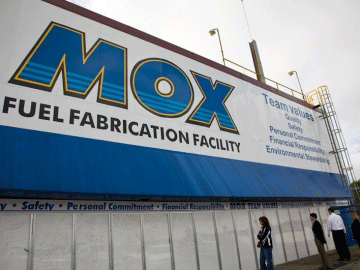
Associated Press Augusta Chronicle, 17 Nov 17 WASHINGTON — Congress on Thursday sent President Donald Trump a sweeping defense policy bill authorizing a $700 billion budget for the military, including $340 million for MOX at Savannah River Site. The defense authorization bill for 2018 sailed through the Senate by voice vote. The House had approved the measure earlier this week.
Public Watchdogs Files Lawsuit to Stop Burial of Spent Nuclear Waste at SONGS San Clemente Times, By Staff, November 16, 2017 By Eric Heinz
An organization that scrutinizes government activity is making a last effort to prevent the storage of spent nuclear fuel rods at San Onofre.
Public Watchdogs, a nonprofit organization based in La Mesa, filed a lawsuit in federal court on Wednesday against the United States government, the Department of Defense and Secretary James Mattis, as well as Southern California Edison, the operators of San Onofre Nuclear Generating Station (SONGS), and San Diego Gas and Electric to prevent the storage of more than 3.6 million pounds of radioactive fuel rods.
The lawsuit claims that under Public Law 88-82, a declaration from 1963 that allows the secretary of the Navy to authorize a permit for the nuclear power plant, storage of the spent nuclear waste was not authorized in the law.
The Navy owns the land where SONGS and Camp Pendleton are established.
Public Watchdogs is seeking an injunction that would find the “storage of spent nuclear fuel at SONGS is not authorized by, and is outside the scope of the authority granted to the Federal Defendants under, Public Law 88-82,” as well as “an order or judgment enjoining Federal Defendants from authorizing SCE and SDGE from storing spent nuclear fuel at SONGS and further enjoining SCE and SDGE from storing spent fuel at SONGS……. http://www.sanclementetimes.com/public-watchdogs-files-lawsuit-stop-burial-spent-nuclear-waste-songs/
Strong demand is set to give a huge boost to renewable energy growth in sub-Saharan Africa over the next five years, driving cumulative capacity up more than 70 percent, a senior international energy official said Wednesday. From Ethiopia to South Africa, millions of people are getting access to electricity for the first time as the […]
Unfortunately, with human-caused climate change, these kinds of devastating events have become far more frequent. With the Earth warming by around 1.1 to 1.2 C above pre-industrial averages, there are now four times as many instances of extreme weather than there were as recently as the 1970s.
There are now 400 extreme weather events every year, four times as many as in 1970 pic.twitter.com/XU1JyOIehe
What this means is that anywhere around the world now, the hammer of severe weather and related damages is four times more likely to fall than in the past. That the tempo of such events is now greatly increased. All thanks to continued fossil fuel burning, atmospheric CO2 levels that will average around 407 ppm over the coming months, the heat that these greenhouse gasses are continuing to add to the Earth’s climate system, and…
Renewable energy is a hot topic in Europe at the moment. Billions are being invested, and expectations are sky high. So, in this scenario, what expectations should we have for Norwegian hydropower? This was the back-drop for the discussion HydroCen lead at a work shop in Brussels during the NTNU alumni conference this month. At […]
Feinstein seeks contact with FBI informant in Russia nuclear bribery case, The Hill
BY JOHN SOLOMON – 11/16/17Sen. Dianne Feinstein (D-Calif.) has sought access to an undercover informant who helped the FBI chronicle bribery, kickbacks and money laundering inside Moscow’s nuclear industry as part of an Obama-era Russia corruption case.
Heather Sawyer, the general counsel for Feinstein — the top Democrat on the Senate Judiciary Committee — sent an email this week to the lawyer for the former FBI informant, William Campbell, seeking to be included in conversations involving the committee.
Sen. Chuck Grassley (R-Iowa), the chairman of the committee, secured an agreement with the Justice Department to allow Campbell to talk to Congress about the evidence he gathered for the FBI from 2009 to 2014 when he worked as a consultant for Tenex, a subsidiary of Russia’s state-owned commercial nuclear arm Rosatom.
Campbell’s work led to the indictments of three major players, including Tenex official Vadim Mikerin, a key Russian nuclear figure inside the United States who was sentenced to 48 months in prison in December 2015.
Grassley wants to know what the FBI did with the evidence it first gathered in 2009 that Mikerin and others inside the Russian nuclear industry were engaged in illegal activity.
The GOP chairman also wants to know whether the Obama administration was alerted to the illegal activity before it approved the sale of U.S. uranium assets to Rosatom and made other favorable decisions worth billions of dollars to Russia’s nuclear industry………
Continuing Conflict S. Korean Gov’t Stops Virtually Construction of New Nuclear Power Plants Seoul, Korea, Business Korea, 17 November 2017 , Choi Mun-hee
Korea Hydro & Nuclear Power (KHNP) held a board meeting on November 16 and decided to stop the construction of the third and fourth units of the Shin Hanul Nuclear Power Plant and the first and second units of the Cheonji Nuclear Power Plant. Controversies are likely to continue with hundreds of billions of won already invested in the construction projects and the government having yet to prepare a plan for compensation.
Those in favor of the construction of the nuclear power plants are claiming that nuclear power plants are safe tools for power generation as seen in the case of those that endured the magnitude 5.4 earthquake in Pohang on November 15. Those opposed to the construction are claiming that South Korea is not an earthquake-free zone and, as such, no more nuclear power plant should be allowed.
The Joint Action for a Nuclear Free Society, which is a local environmental group, held a press conference in Seoul on November 16. “Both the earthquake in Gyeongju last year and the recent earthquake in Pohang occurred in the Yangsan fault zone in the southeastern region of the Korean Peninsula and the latter’s epicenter was shallower and the latter caused more damage although the former had a larger magnitude,” it said, adding, “At present, a total of 18 nuclear power plants are in operation and five are under construction in the southeastern region of the peninsula including Gyeongju, Busan, and Ulsan, where big earthquakes have occurred one after another, and the operation of the power plants should be stopped and safety measures should be prepared immediately.”…… http://www.businesskorea.co.kr/english/news/national/19848-continuing-conflict-s-korean-gov%E2%80%99t-stops-virtually-construction-new-nuclear
Environmental groups that support the current administration’s nuclear energy phaseout policy have based their arguments on the potential dangers posed by natural disasters like earthquakes.
In a statement made yesterday, the Korean Federation for Environmental Movement reiterated the need to scale back nuclear energy operations in southeastern Korea, saying, “On the heels of the Gyeongju earthquake last year, there has been a quake on the Yansan fault line.”
Last September’s 5.8-magnitude earthquake in Gyeongju was the most powerful recorded in South Korean history. With the November 15 earthquake in nearby Pohang, only about 20 km away, the Yeongnam region has seen record-setting natural disasters in successive years.
SCE&G proposes gas, solar for Summer replacement , WNN, 17 November 2017
South Carolina Electric & Gas Company (SCE&G) has unveiled a proposal that would see some of the capacity that should have been provided by the VC Summer nuclear power plant project replaced with gas and solar generation. The company’s shareholders would absorb the net construction costs of the abandoned nuclear project.
The proposal issued yesterday by the Scana Corporation subsidiary provides about $4.8 billion in benefits to SCE&G customers, and will require approval from South Carolina’s Public Service Commission (PSC).
SCE&G proposes acquiring a 540 MWe gas-fired power plant to replace “more than” 40% of the power that was projected to be provided from the two-unit Summer plant. The $180 million purchase price of the gas-fired plant will be borne by Scana shareholders, who will also forego any shareholder return over the life of the plant. The company said it will also add about 100 MWe of large-scale solar capacity to its system.
Electric rates for SCE&G’s customers – commercial, industrial and residential – will roll back to where they would have been in March 2015, which represents a reduction of about 3.5%. Scana shareholders will absorb the net nuclear construction costs through lower earnings over 50 years, which the company says will account for about $2.9 billion of the total $4.8 billion.
Nuclear safety board warns of trouble ahead at Hanford, but could lose role under Trump, Seattle Times Nuclear safety board report finds serious problems persist with a massive facility to help treat Hanford’s chemical and radioactive wastes. The report comes as the Trump administration considers a proposal to downsize or do away with the independent oversight board. By Hal BerntonSeattle Times staff reporter An unfinished $16.8 billion complex to treat chemical and radioactive waste at the Hanford site in Central Washington continues to suffer design problems that risk explosions and radioactive releases from unintended nuclear reactions, according to a Defense Nuclear Facilities Safety Board report.
The board’s findings are at odds with a much more optimistic assessment offered by the U.S. Energy Department of the efforts to treat the toxic leftovers of decades of atomic weapons production. In a written statement last February, the Energy Department declared that major issues previously identified by the safety board had been “resolved,” and found that design work could resume on what the department calls a critical pretreatment plant needed to process highly radioactive waste.
The latest report is more sobering news for a project first conceived more than two decades ago that has suffered from huge increases in costs and repeated delays amid safety concerns.
The report’s release comes at a difficult time for the board. The Trump administration is considering a proposal to downsize or abolish the board, which for nearly 30 years has provided independent oversight of defense nuclear sites across the country. The board’s backers say this report — challenging Energy Department assumptions — is more evidence of its vital review role.
“They don’t want to hear what the board has to say, but they absolutely need to,” said Dirk Dunning, a retired Oregon Department of Energy engineer who worked on Hanford issues for more than 20 years.
The board has been deeply involved in watchdogging the development of Hanford’s waste-treatment complex, the largest of its kind in the world, which broke ground in 2002 on 65 acres of the nuclear reservation. The goal is to transform some 56 million gallons of chemical and radioactive waste into glass rods that can be safely put into long-term storage. The process requires a hugely complex engineering effort due — in part — to the wide range of waste materials currently stored in 177 underground tanks, more than a third of which have leaked over the years.
But safety concerns, including those cited in the latest board report, have plagued the pretreatment facility for years even as billions of dollars have been budgeted for engineering, labor, equipment and other costs……..
The board has no regulatory powers to require the Energy Department to take action. But its reports are made public and the Energy Department is required to respond to the panel’s formal recommendations.










 nuclear-news