Argayash, close to Russia’s Mayak Nuclear Facility, at the centre of radiation leaking
The Russian town in the shadow of a leaking nuclear plant https://www.ft.com/content/2d853158-d064-11e7-b781-794ce08b24dc
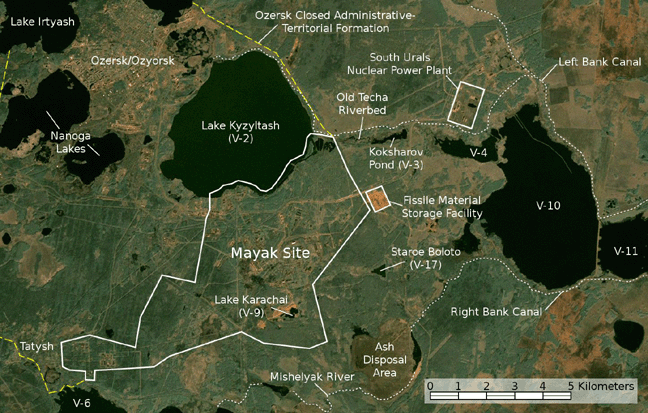
Authorities finally admit that Argayash was at the centre of a radiation cloud.
Henry Foy in Argayash , 24 Nov 17
Argayash is a cynical, mistrustful town. Decades of being lied to by the government about being down the road from a leaking nuclear plant does that to a place. So too does watching generations of people dying of radiation-related ailments while officials assure them nothing is amiss.
A small, two-road settlement where homes roofed with corrugated iron and Soviet-era Lada cars nod to its poverty, Argayash is one of a handful of towns surrounding the Mayak Production Facility in southern Russia, one of the world’s biggest radiation emitters where a litany of tragic accidents has made it a byword for the dangers of the atomic industry.
This week, 76 years after radiation first began seeping from Mayak into the surrounding rivers, lakes and atmosphere, Russian authorities admitted that Argayash was at the centre of a radiation cloud containing “exceptionally high” levels of radioactive isotope ruthenium-106, which spread so far west that it reached France. The radiation was detected by Russia’s meteoological agency in late September, but only revealed on Monday, after local politicians had spent weeks denying rumours of a leak and rubbishing reports from EU agencies that had tracked the cloud’s movement.
The levels of the isotope in Argayash were almost 1,000 times the normal level. Officials say it is not harmful to public health. “Nobody tells us anything. They keep it secret,” says Lilia Galimzhanova, a cook at a café in the town. “We are afraid. We are afraid for our children and grandchildren.” “But we know that the air, the environment is very bad here,” she says. Her 80-year-old mother suffers from radiation poisoning from Mayak. “We are not protected by anyone here . . . We are survivors.”
Ms Galimzhanova only heard of the radiation that had enveloped her town when a friend in Germany read about it in a western newspaper. Before the authorities admitted its existence, text messages had been sent to residents saying that high levels of pollution from nearby industrial factories meant people should stay indoors. Regardless of the potential health risks, many here say the government’s initial silence, denial and obfuscation has dredged up painful memories of a past that refuses to stay buried. Secretly constructed in the 1940s, Mayak was at the forefront of the USSR’s scramble to catch up with the US nuclear programme. As it raced to produce weapons-grade plutonium, a vast amount of nuclear waste was discharged into nearby lakes and the Techa river. Then, in 1957, nuclear waste storage tanks at the site exploded, raining fallout over hundreds of towns — and releasing more radiation than any other nuclear accident except Chernobyl and Fukushima. Ten years later, an adjacent reservoir used for waste disposal dried out, and powdered radioactive dust was blown over the area.
No comments yet.
1 This Month


Tell the Ukrainian Government to Drop Prosecution of Peace Activist Yurii Sheliazhenko

Petition to revoke the licensing of the Near Surface Nuclear Disposal Facility (NSDF) at Chalk River. https://www.ourcommons.ca/petitions/en/Petition/Details?Petition=e-7247


of the week – STOP SMALL MODULAR REACTORS IN CANADA
To see nuclear-related stories in greater depth and intensity – go to https://nuclearinformation.wordpress.com
-
Archives
- March 2026 (212)
- February 2026 (268)
- January 2026 (308)
- December 2025 (358)
- November 2025 (359)
- October 2025 (376)
- September 2025 (258)
- August 2025 (319)
- July 2025 (230)
- June 2025 (348)
- May 2025 (261)
- April 2025 (305)
-
Categories
- 1
- 1 NUCLEAR ISSUES
- business and costs
- climate change
- culture and arts
- ENERGY
- environment
- health
- history
- indigenous issues
- Legal
- marketing of nuclear
- media
- opposition to nuclear
- PERSONAL STORIES
- politics
- politics international
- Religion and ethics
- safety
- secrets,lies and civil liberties
- spinbuster
- technology
- Uranium
- wastes
- weapons and war
- Women
- 2 WORLD
- ACTION
- AFRICA
- Atrocities
- AUSTRALIA
- Christina's notes
- Christina's themes
- culture and arts
- Events
- Fuk 2022
- Fuk 2023
- Fukushima 2017
- Fukushima 2018
- fukushima 2019
- Fukushima 2020
- Fukushima 2021
- general
- global warming
- Humour (God we need it)
- Nuclear
- RARE EARTHS
- Reference
- resources – print
- Resources -audiovicual
- Weekly Newsletter
- World
- World Nuclear
- YouTube
-
RSS
Entries RSS
Comments RSS
 nuclear-news
Leave a comment