America’s “overkill” with nuclear weapons – but Trump still wants more
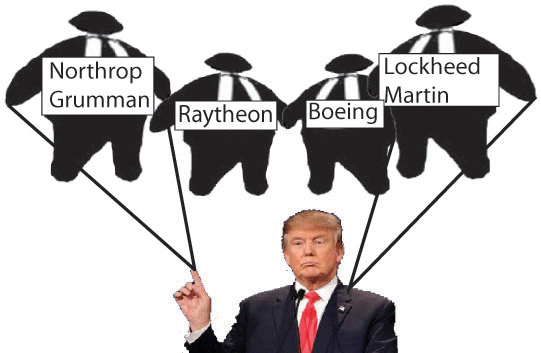 The Sway of the Nuclear Arms Industry Over Donald Trump and Congress Is Terrifying
Without the development of such weapons, that complex simply would not exist in its present form. The Manhattan Project, the vast endeavor that produced the first workable nukes during World War II, was one of the largest government-funded research and manufacturing projects in history. Today’s nuclear warhead complex is still largely built around facilities and locations dating back to that time…….
Eisenhower couldn’t have been more clear-eyed about all of this. He saw the missile gap for the fiction it was or, as he put it, a “useful piece of political demagoguery” for his opponents. “Munitions makers,” he insisted, “are making tremendous efforts towards getting more contracts and in fact seem to be exerting undue influence over the senators.”
The techniques that the arms lobby and its allies in government used more than half a century ago to promote sky-high nuclear weapons spending continue to be wielded to this day. The 21st-century arms complex employs tools of influence that Kennedy and his compatriots would have found familiar indeed—including millions of dollars in campaign contributions that flow to members of Congress and the continual employment of 700 to 1,000 lobbyists to influence them; that’s nearly two arms lobbyists for every member of Congress. Much of this sort of activity remains focused on ensuring that nuclear weapons of all types are amply financed and that the funding for the new generations of the bombers, submarines, and missiles that will deliver them stays on track.
When traditional lobbying methods don’t get the job done, the industry’s argument of last resort is jobs—in particular, jobs in the states and districts of key members of Congress. This process is aided by the fact that nuclear weapons facilities are spread remarkably widely across the country. There are labs in California and New Mexico; a testing and research site in Nevada; a warhead assembly and disassembly plant in Texas; a factory in Kansas City, Missouri, that builds nonnuclear parts for such weapons; and a plant in Oak Ridge, Tennessee, that produces weapon-grade uranium. There are factories or bases for ICBMs, bombers, and ballistic missile submarines in Connecticut, Georgia, Washington State, California, Ohio, Massachusetts, Louisiana, North Dakota, and Wyoming. Such a nuclear geography ensures that a striking number of congressional representatives will automatically favor more spending on nuclear weapons.
In reality, the jobs argument is deeply flawed. As the experts know, virtually any other activity into which such funding flowed would create significantly more jobs than Pentagon spending. A study by economists at the University of Massachusetts, for example, found infrastructure investment would create one and one-half times as many jobs as Pentagon funding and education spending twice as many.
In most cases it hasn’t seemed to matter that the jobs claims for weapons spending are grotesquely exaggerated and better alternatives litter the landscape. The argument remains remarkably potent in states and communities that are particularly dependent on the Pentagon. Perhaps unsurprisingly, members of Congress from such areas are disproportionately represented on the committees that decide how much will be spent on nuclear and conventional weaponry………. http://www.motherjones.com/politics/2017/11/devastation-very-important-nuclear-weapons-industry-donald-trump-1/
Grave threat that Trump may be seriously considering a first strike on North Korea
 Is the Trump Administration Planning a First Strike on North Korea? Saturday, November 18, 2017 By Gareth Porter, Truthout | News Analysis Ever since the Trump administration began a few months ago to threaten a first strike against North Korea over its continued missile tests, the question of whether it is seriously ready to wage war has loomed over other crises in US foreign policy.
The news media have avoided any serious effort to answer that question, for an obvious reason: The administration has an overriding interest in convincing the North Korean regime of Kim Jong-un that Trump would indeed order a first strike if the regime continues to test nuclear weapons and an intercontinental ballistic missile (ICBM). Therefore, most media have shied away from digging too deeply into the distinction between an actual policy of a first strike and a political ruse intended to put pressure on Pyongyang.
The use of military threat for “diplomatic coercion” is such a basic tool of US policy in dealing with weaker adversaries that it is almost taken for granted in Washington. Even diplomats who have been deeply involved in negotiating with North Korea are supportive of using that threat as part of a broader diplomatic strategy. Robert Gallucci, the State Department official who negotiated the “Agreed Framework” with North Korean officials in 1994, noted in an email to Truthout, “We do want the North to understand that their actions could lead the US to a preventive strike — wise or not.”
The linkage between the Trump administration’s threat of a “military option” and US diplomatic pressure on North Korea was clear from its first suggestion that it might carry out a first strike. That suggestion came on April 13, immediately upon the completion of the administration’s policy review on North Korea, when NBC News reported that “multiple senior intelligence officials” had said that the administration was “prepared to launch a preemptive strike” if officials “became convinced that North Korea is about to follow through with a nuclear weapon test.” A story in the Washington Post published the following day offered a slightly different version: The administration was “prepared to respond to another North Korean nuclear test” and had “a range of options at its disposal” but would not “telegraph its response in advance.”
However, an unnamed military official told the Associated Press that same day that the policy that had been approved by the National Security Council did not envision the use of force in response to a nuclear or missile test, thus revealing that the leaks involving the threat of a preemptive or retaliatory attack over North Korean testing were part of a clumsy effort at “coercive diplomacy.”……
The Trump administration could seek to increase the pressure on North Korea still further by making one or more moves preparing for — but short of — war. For example, it could bring more US ground troops into South Korea or Japan. However, the North Korean regime might well interpret that move as a signal that the US intends to attack and invade the North, since that would seem to be precisely the purpose of moving reinforcements into the theater. In fact, according to Jackson, the North Koreans told US diplomats during the 1994 crisis that they had studied carefully the US large-scale troop movements in preparation for the first Gulf War in 1990-91, and warned that they would respond to a move like that one in their region by launching their own preemptive attack.
It isn’t yet possible to know definitely whether the Trump administration intends to strike first against North Korea. The official threats of such a strike can be discounted as obviously related to an elaborate — if somewhat crude — psychological warfare campaign. But more twists and turns in US policy can be expected in the coming months, and the desperate desire to coerce Pyongyang may also have given rise to wishful thinking on the part of McMaster and, more dangerously, Trump himself, about deterring that regime’s response to a US first strike. That in turn could still pose a grave threat of yet another unnecessary and terrible war. http://www.truth-out.org/news/item/42640-is-the-trump-administration-planning-a-first-strike-on-north-korea
1 This Month


18 March Webinar @ 1 PM EST: An Assessment of SMR Projects: The Case of Canada
register for the zoom:
https://us02web.zoom.us/webinar/register/WN_o8BIIOUvQ2ONJR1nta65DQ#/registration


of the week – STOP SMALL MODULAR REACTORS IN CANADA
To see nuclear-related stories in greater depth and intensity – go to https://nuclearinformation.wordpress.com
-
Archives
- March 2026 (129)
- February 2026 (268)
- January 2026 (308)
- December 2025 (358)
- November 2025 (359)
- October 2025 (376)
- September 2025 (258)
- August 2025 (319)
- July 2025 (230)
- June 2025 (348)
- May 2025 (261)
- April 2025 (305)
-
Categories
- 1
- 1 NUCLEAR ISSUES
- business and costs
- climate change
- culture and arts
- ENERGY
- environment
- health
- history
- indigenous issues
- Legal
- marketing of nuclear
- media
- opposition to nuclear
- PERSONAL STORIES
- politics
- politics international
- Religion and ethics
- safety
- secrets,lies and civil liberties
- spinbuster
- technology
- Uranium
- wastes
- weapons and war
- Women
- 2 WORLD
- ACTION
- AFRICA
- Atrocities
- AUSTRALIA
- Christina's notes
- Christina's themes
- culture and arts
- Events
- Fuk 2022
- Fuk 2023
- Fukushima 2017
- Fukushima 2018
- fukushima 2019
- Fukushima 2020
- Fukushima 2021
- general
- global warming
- Humour (God we need it)
- Nuclear
- RARE EARTHS
- Reference
- resources – print
- Resources -audiovicual
- Weekly Newsletter
- World
- World Nuclear
- YouTube
-
RSS
Entries RSS
Comments RSS
 nuclear-news