IMF chief Christine Lagarde warns of ‘dark future’ over climate change
 Economic Times, AFP|2017, RIYADH: The world faces a “dark future” if it fails to tackle climate change and inequality, IMF managing director Christine Lagarde warned on Tuesday.
“If we don’t address these issues… we will be moving to a dark future” in 50 years, she told a major economic conference in the Saudi capital.
On climate change, Lagarde said that “we will be toasted, roasted and grilled” if the world fails to take “critical decisions” on the issue……….https://economictimes.indiatimes.com/news/international/business/imf-chief-christine-lagarde-warns-of-dark-future-over-climate-change/articleshow/61205708.cms
Potential for a wind-powered world: : take wind farming onto the high seas.
 Climate News Network 25th Oct 2017, Two Californian scientists have worked out how to achieve a wind-powered
world that provides the entire planet with wind energy without spoiling the
view with turbines on every hilltop.
The answer: take wind farming onto the
high seas. The force of the winds sweeping across the open ocean would be
enough to generate 18 billion kilowatts – which is about the global
annual energy demand right now.
The scientists report in the Proceedings of
the National Academy of Sciences that although the best that wind farms on
land can deliver is electricity at the rate of 1.5 watts per square metre,
the mid-latitudes of the North Atlantic could do much better: up to 6 watts
per square metre.
http://climatenewsnetwork.net/23244-2/
Britain’s ‘Greater Manchester Big Clean Switch’ welcomed by The Nuclear Free Local Authorities (NFLA)

 NFLA 25th Oct 2017, The Nuclear Free Local Authorities (NFLA) warmly welcomes an exciting
initiative by Greater Manchester local authorities in its ‘Big Clean
Switch’ campaign. This scheme is encouraging both larger organisations
and members of the public to switch on to cheaper 100% renewable energy
providers for their electricity needs.
The ‘GM Big Clean Switch’ is acollaboration between the 10 Greater Manchester Councils and the
organisation ‘The Big Clean Switch’, which is encouraging greater
take-up with energy companies developing renewable gas and electricity
solutions. ‘The Big Clean Switch’ is a partnership between the climate
change campaigners at Purpose and the social enterprise Clean Energy UK.
This partnership with the GM Combined Authority is the first attempt to
encourage such a large switching to renewable energy companies and plans
are being made to look at delivering it elsewhere over the future. As the
‘Big Clean Switch’ note, this campaign is unique. It is the first time
a town or city has tried to save residents money by helping them switch to
green energy (let alone 10 local authorities working together), and it is
the first time an energy switching campaign of any kind has attracted such
city-wide support from other organisations, from universities to football
clubs. http://www.nuclearpolicy.info/news/nfla-welcomes-gm-big-clean-switch-support-decentralised-renewable-energy-solutions/
UK’s ban on developing new onshore wind farms – an expensive mistake
Business Green 25th Oct 2017, The government’s “outdated” ban on developing new onshore wind farms on
mainland Britain is blocking access to the cheapest available form of new
electricity generation, and having a negative impacts on bills, climate
change targets, and businesses.
That is the conclusion of new research by
the Energy and Climate Intelligence Unit (ECIU) think tank, which estimates
electricity from 1GW of new onshore wind farms would cost £30m a year less
than obtaining the same amount of power from new offshore wind farms, even
when recent cost reductions from the offshore wind sector are taken into
account.
https://www.businessgreen.com/bg/news/3019755/report-uks-outdated-onshore-wind-ban-blocks-cheapest-form-of-new-energy
Radiocesium in Fish from the Savannah River and Steel Creek: Potential Food Chain Exposure to the Public
Radiocesium in Fish from the Savannah River and Steel Creek: Potential Food Chain Exposure to the Public http://onlinelibrary.wiley.com/doi/10.1111/0272-4332.213131/abstract
Authors, Joanna Burger, K. F. Gaines, J. D. Peles, W. L. Stephens Jr., C. Shane Boring, I. L. Brisbin Jr., J. Snodgrass, A. L. Bryan, Jr., M. H. Smith, M. Gochfeld First published: June 2001
Abstract
This study examined radiocesium (137Cs) levels in fish from the vicinity of the Department of Energy’s Savannah River Site (SRS), a former nuclear weapons production facility in South Carolina. Fish from the Savannah River were sampled above (upstream), along, and below (downstream) the SRS, and from Steel Creek, a tributary that runs through the SRS. There was some off-site contamination of 137Cs in the Savannah River watershed due to low-level releases from past nuclear production on the SRS. The null hypotheses tested were that there would be no differences in 137Cs levels as a function of location along the river, and between species collected from the river and from Steel Creek on the SRS. For six of eight species of fish collected from the Savannah River, there were no differences in 137Cs levels in muscle from fish collected above, along, or below the SRS; exceptions were bowfin and shellcracker. Fish collected from Steel Creek had significantly higher levels (by about an order of magnitude) of 137Cs in muscle tissue than fish collected in the Savannah River. However, no fish from either Steel Creek or the Savannah River had 137Cs levels above the European Economic Community limit for fresh meat of 0.6 Bq/g. Lifetime cancer risk was calculated using the cancer slope factor of 3.2 × 10⁻¹¹/pCi, and various fish consumption scenarios reflecting actual data from Savannah River fishermen. Using mean 137Cs concentrations and median fish consumption for 70 years for Black males—the group with the highest consumption—the excess lifetime risk associated with the eight species of fish in the Savannah River ranged from 9.0 × 10⁻⁷ to 1.0 × 10⁻⁵. The same calculation for fish from Steel Creek gave risk estimates from 1.4 to 8.0 × 10⁻⁵. The 95% level for consumption by Blacks, however, was about 70 kg/year. Black fishermen consuming that amount of bass from Steel Creek would sustain a lifetime risk of 3.1 × 10⁻⁴, whereas the same consumption of Savannah River bass would yield a risk estimate of 1.5 × 10⁻⁵.
Stop coal power by 2050- or sea level will rise by 1.3m – new report
Sea levels to rise 1.3m unless coal power ends by 2050, report says https://www.theguardian.com/environment/2017/oct/26/sea-levels-to-rise-13m-unless-coal-power-ends-by-2050-report-says
University of Melbourne paper combines latest understanding on Antarctica and current emissions projection scenarios, Guardian, Michael Slezak, Coastal cities around the world could be devastated by 1.3m of sea level rise this century unless coal-generated electricity is virtually eliminated by 2050, according to a new paper that combines the latest understanding of Antarctica’s contribution to sea level rise and the latest emissions projection scenarios.
It confirms again that significant sea level rise is inevitable and requires rapid adaptation. But, on a more positive note, the work reveals the majority of that rise – driven by newly recognised processes on Antarctica – could be avoided if the world fulfils its commitment made in Paris to keep global warming to “well below 2C”.
In 2016, Robert DeConto from the University of Massachusetts Amherst revealed that Antarctica could contribute to massive sea level rise much earlier than thought, suggesting ice sheet collapse would occur sooner and identifying a new process where huge ice cliffs would disintegrate.
But that paper only examined the impact of Antarctica on sea level rise, ignoring other contributions, and didn’t examine the details of what measures society needed to take to avoid those impacts.
The new paper by Alexander Nauels from the University of Melbourne and colleagues uses simplified physical models that allowed them to explore all known contributions to sea level rise, and pair them with the new generation of emissions scenarios which the Intergovernmental Panel on Climate Change (IPCC) will use in the next set of reports.
But the extra contribution from Antarctica would not kick in if warming was kept at less than 1.9C above preindustrial levels, the researchers found. Temperatures above that threshold risked triggering the additional processes in Antarctica identified in the 2016 paper, causing much greater sea level rise.
“The 1.5C limit in the Paris Agreement is a much safer bet to avoid this additional contribution than only achieving 2C,” Nauels said.
In 2016, Robert DeConto from the University of Massachusetts Amherst revealed that Antarctica could contribute to massive sea level rise much earlier than thought, suggesting ice sheet collapse would occur sooner and identifying a new process where huge ice cliffs would disintegrate.
But that paper only examined the impact of Antarctica on sea level rise, ignoring other contributions, and didn’t examine the details of what measures society needed to take to avoid those impacts.
The new paper by Alexander Nauels from the University of Melbourne and colleagues uses simplified physical models that allowed them to explore all known contributions to sea level rise, and pair them with the new generation of emissions scenarios which the Intergovernmental Panel on Climate Change (IPCC) will use in the next set of reports.
They found that if nothing is done to limit carbon pollution, then global sea levels will rise by an estimated 1.32m. That is 50% more than was previously thought, with the IPCC’s AR5 report suggesting 85cm was possible by the end of the century.
But the extra contribution from Antarctica would not kick in if warming was kept at less than 1.9C above preindustrial levels, the researchers found. Temperatures above that threshold risked triggering the additional processes in Antarctica identified in the 2016 paper, causing much greater sea level rise.
“The 1.5C limit in the Paris Agreement is a much safer bet to avoid this additional contribution than only achieving 2C,” Nauels said.
Those scenarios suggested coal could only make up 5% of the world’s energy mix by 2050 if sea level rise is to be limited to about half a metre.
Similarly, those scenarios suggested a global carbon price would have to be well over US$100 per tonne, since at that cost, sea level would rise by 65cm by 2100.
John Church, a leading sea level rise expert from the University of New South Wales who was co-convening lead author of the chapter on sea level in the third and fifth IPCC Assessment Reports, told the Guardian the work was further confirmation that the world needed to prepare now for substantial sea level rises.
“Under all scenarios we are going to have to adapt,” Church said. “We cannot stop all sea level rise.”
He said the research community was not in consensus yet about the accelerated contribution of Antarctica to sea level rise, identified in the 2016 paper and modelled in this study, but examining the implications of those findings was still important.
DeConto, the lead author of the landmark paper from 2016, said it was important to recognise the good news in his original findings and this extension of that work.
“In the aggressive mitigation pathways, where we assume that the global community gets its act together and we reduce emissions, it’s a much rosier picture. There’s a much reduced risk of dramatic sea level rise from Antarctica,” he told the Guardian. “This study fully reinforces that.”
Nauels said his team’s work assumed that Antarctica would contribute to sea level rise as was suggested by the 2016 paper by DeConto, but more work was needed to confirm those findings.
“We still have to find out what’s going on in Antarctica,” he told the Guardian. “We can’t base all future sea level rise projects on just one paper. And the Antarctic ice sheet community are frantically working on the new insights.”
October 26 Energy News

Opinion:
¶ “Donald Trump, Bird Killer” • He campaigned as a guardian of birds against windpower. His secretary of the Department of Interior, Ryan Zinke, recently noted renewable energy’s risks to birds in arguing against using public lands for solar power. Now, his administration is pushing policies that could send billions of birds to their deaths. [New Republic]
 Victim of obsolete technology (Historical Picture Archive | Getty)
¶ “Game 1 of the World Series breaks heat record” • In a year of catastrophic hurricanes and devastating wildfires, the heat wave in Southern California this week is another urgent reminder that climate change is already here. Evening temperatures at Dodger Stadium reached 103° F. The average October high in Los Angeles is 75° F. [ThinkProgress]
Science and Technology:
¶ New research suggests that the oceans hundreds of millions of years ago were much cooler than we thought. If this…
View original post 795 more words
October 25 Energy News
Opinion:
¶ “‘Can You Say Corruption?’ Puerto Rico Contract for Trump-Connected Raises Concerns” • Two-year-old Whitefish Energy won $300 million no-bid contract to restore Puerto Rico’s electrical grid. Its financiers have important connections to the Trump administration. It had two employees when the hurricane struck. [Common Dreams]
 Downtown Whitefish, Montana, home of Whitefish Energy,
Interior Secretary Ryan Zinke, and a major donor to Trump campaign (Photo: WikiCapa, Wikimedia Commons)
How can I help the people of Puerto Rico? One way is
to donate at [Sunnyside Solar’s crowdfunding website].
World:
¶ Nicaragua has signed on to the Paris Agreement, so now the United States and Syria are now the only two nations in the world that have refused to be members of the climate pact. The Central American country held out on signing the deal for two years, based on its government’s criticisms that the pact was “insufficient”…
View original post 816 more words
RSPB Slam Coal Mine Plan for Cumbria Citing Earthquake Risk and More —

Below is the RSPB’s opposition to West Cumbria Mining’s proposal for a new coal mine off St Bees. Despite “further information” asked for from the developers the RSPB’s objections still stand (how could they not!) It is so very bizarre that the many objections to the mine are not front page news in the national […] […]
via RSPB Slam Coal Mine Plan for Cumbria Citing Earthquake Risk and More —
Hundreds of Billions of Dollars in Damages, ‘Toasted, Roasted, and Grilled’ — That’s What Trump’s Refusal to Support the Paris Climate Agreement Gets Us

So far, in the past three months, we’ve had four major U.S. disasters whose impacts we can certainly say were made worse by human caused climate change.
The costs from these disasters to U.S. society and, in the end, to citizens and taxpayers is tremendous. Thousands of people have lost their homes. Irreplaceable lives were forever stripped from us. Many have lost access to work and livelihoods. And in the case of Puerto Rico, hundreds of thousands of people have been thrust back into what amounts to a modern rendition of the dark ages.

(A satellite image of the burn scar left following the North Bay fires. Human-caused climate change is a primary enabler for these kinds of disasters. Image source: NASA.)
As a measure of money alone and leaving aside the untold human misery, hurricane Harvey may ultimately cost the U.S. $180 billion, Irma may cost the U.S…
View original post 707 more words
USA nuclear bombers to go back on 24 hour alert
 US Preparing to Put Nuclear Bombers Back on 24-Hour Alert, Defense One, OCTOBER 22, 2017 BARKSDALE AIR FORCE BASE, LA. — THE U.S. Air Force is preparing to put nuclear-armed bombers back on 24-hour ready alert, a status not seen since the Cold War ended in 1991.
That means the long-dormant concrete pads at the ends of this base’s 11,000-foot runway — dubbed the “Christmas tree” for their angular markings — could once again find several B-52s parked on them, laden with nuclear weapons and set to take off at a moment’s notice…….
Goldfein and other senior defense officials stressed that the alert order had not been given, but that preparations were under way in anticipation that it might come. That decision would be made by Gen. John Hyten, the commander of U.S. Strategic Command, or Gen. Lori Robinson, the head of U.S. Northern Command. STRATCOM is in charge of the military’s nuclear forces and NORTHCOM is in charge of defending North America……http://www.defenseone.com/threats/2017/10/exclusive-us-preparing-put-nuclear-bombers-back-24-hour-alert/141957/
30 October: National Day of Remembrance commemorating atomic energy workers
National Day of Remembrance commemorating atomic energy workers RIVER BENDER.com October 24 2017 ST. PETERS, MO – Each year on Oct. 30th atomic energy workers across the nation are commemorated for the National Day of Remembrance. “……Many atomic energy workers unknowingly worked with hazardous chemicals and radiation without consent or proper protective gear during this construction. As a result, countless numbers of individuals are now sick or deceased because of occupational induced illnesses……… Today, the sacrificial work displayed by nuclear weapons workers for their nation and families is remembered……..
ARC is a 501(c)(3) non-profit corporation that assists and educates current and former atomic energy workers, as well as their family members, about the benefits which may be available to them under the Department of Labor’s Energy Employees Occupational Illness Compensation Program Act. Workers and survivors of workers that have been effected by an occupational illness at a nuclear weapons plant are encouraged to contact ARC to see if they qualify for medical benefits and/or monetary compensation. https://www.riverbender.com/articles/details/national-day-of-remembrance-commemorating-atomic-energy-workers-24387.cfm
Over 10,000 calls to USA’s Federal Energy Regulatory Commission oppose subsidies to nuclear and coal
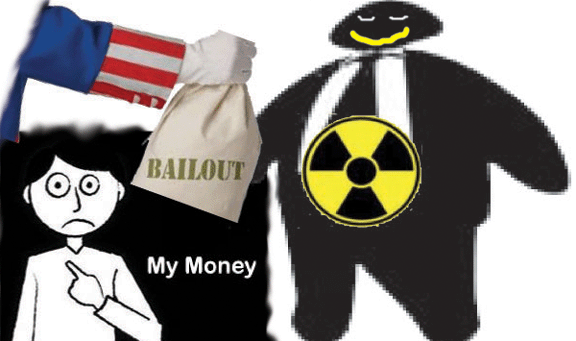 “NO BAILOUT!” BACKLASH BUILDS: 10,000+ COMMENTS AGAINST NUCLEAR, COAL HANDOUTS TO BE DELIVERED TO FERC https://www.nirs.org/press/no-bailout-backlash-builds-10000-comments-nuclear-coal-handouts-delivered-ferc/Signers Oppose Crowding Out Renewables With “Old, Unsafe and Dying” Energy WASHINGTON, D.C.///October 11, 2017///More than 10,000 comments were submitted today for the record at the Federal Energy Regulatory Commission (FERC) in opposition to Trump Administration plans for the Commission to enact massive bailouts of the coal and nuclear industry at the expense of renewable energy and with the added downside of higher bills for consumers. The comments were delivered at 9 a.m. shortly after an 8:45 a.m. protest organized by the Nuclear Information and Resource Service (NIRS) outside the main entrance of FERC at 888 First St NE, Washington, D.C.
NIRS noted that the stakes for wind, solar, and the pocketbooks of U.S. ratepayers is very high. A November 2016 report by NIRS concluded that a federal bailout for nuclear alone could add up to $280 billion by 2030. When a major nuclear reactor project in South Carolina failed this year, ratepayers were left holding the bag for $9 billion or more—even though they will never see a single electron of electricity for their steep investment.
NIRS Executive Director Tim Judson said: “Survey after survey shows that Americans want more clean and safe renewable energy and there is very little support for perpetuating the old, unsafe and dying coal and nuclear industries. To artificially prop up these dirty energy industries and then to force consumers to pay the bill to enrich these already astonishingly profitable companies would have to rank as one of the most anti-environment and anti-consumer steps of the last 50 years.”
Most of the 10,000 individuals’ public comments to FERC submitted by NIRS read as follows:
“Call off your plans to promote coal and nuclear power, and commit to a transition to 100% clean, efficient, renewable energy. Nuclear and coal are two of the dirtiest, most polluting, dangerous, and uneconomical energy sources in the world.”
“If you really want to revive our economy, create jobs, revitalize local communities, and boost small businesses—then clean energy is the only way to go. Our green energy economy can keep the lights on and create millions more jobs than dirty energy could ever provide. Solar and wind are already creating twice as many jobs as coal and nuclear combined—that is ten times as many for the amount of energy generated, and at lower cost.”
“Renewable energy is now providing more electricity than nuclear power. Wind and solar are growing by leaps and bounds, are already cheaper than coal and nuclear, and will soon be the cheapest sources of power available.”
“America needs to get off of dirty sources of energy, not spend billions of dollars propping them up. No coal and nuclear bailout—invest in our clean energy future.”…..FERC https://www.nirs.org/press/no-bailout-backlash-builds-10000-comments-nuclear-coal-handouts-delivered-ferc/
Concern over condition of France’s aging nuclear reactors: 20 of the 58 currently shut down
 Reporterre 23rd Oct 2017, [Machine Translation] To date, 20 reactors out of 58 of the French nuclear fleet are shut down. Many are expected to restart by the end of November, but their aging and general condition is worrying.
Reporterre takes stock with a map detailing the situation of each plant. Winter will be tough for
French nuclear power plants. This Monday, October 23, 20 of their reactors are stopped. Of these, at least 8 were put to rest because of a malfunction or a safety problem. On the others, many are currently undergoing maintenance that also seek to repair the anomalies that accumulate in recent years.
A situation highlighted by Reporterre in a map detailing the central location by central. Last malfunction, the Nuclear Safety Authority (ASN) unveiled in mid-October that the cooling pumps of 29 nuclear reactors were affected by significant corrosion. In case of earthquake or flood, the
pipes could yield. This is one of the causes of the Fukushima accident. According to the ASN, the renovation of the ducts was started immediately on all the reactors, but these will require more complete repairs before being totally secure.
https://reporterre.net/CARTE-EXCLUSIVE-Les-deux-tiers-du-parc-nucleaire-francais-en-panne-ou-a-l-arret
BBC finally apologises for its uncritical interview with climate denialist Lord Lawson
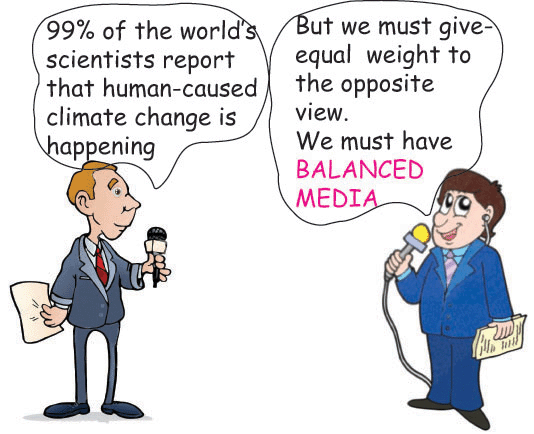
BBC apologises over interview with climate sceptic Lord Lawson https://www.theguardian.com/environment/2017/oct/24/bbc-apologises-over-interview-climate-sceptic-lord-nigel-lawson Lawson’s claim that global temperatures are not rising went unchallenged, breaching guidelines on accuracy and impartiality, Guardian, Damian Carrington, 25 Oct 17, The BBC has apologised for an interview with the climate sceptic Lord Lawson after admitting it had breached its own editorial guidelines for allowing him to claim that global temperatures have not risen in the past decade.
BBC Radio 4’s flagship news programme Today ran the item in August in which Lawson, interviewed by presenter Justin Webb, made the claim. The last three years have in fact seen successive global heat records broken.
The Today programme rejected initial complaints from listeners, arguing that Lawson’s stance was “reflected by the current US administration” and that offering space to “dissenting voices” was an important aspect of impartiality.
However, some listeners escalated their complaint and, in a letter seen by the Guardian, the BBC’s executive complaints unit now accepts the interview breached its guidelines on accuracy and impartiality.
The complaint centred on two statements by Lawson: that the UN’s Intergovernmental Panel on Climate Change “has confirmed that there has been no increase in extreme weather events” and “according to the official figures, during this past 10 years, if anything, mean global temperature, average world temperature, has slightly declined”.
It is not the first time the Today programme has been censured by the BBC complaints unit for an interview with Lawson. A broadcast in February 2014 was judged to have “given undue weight to Lord Lawson’s views, and had conveyed a misleading impression of the scientific evidence on the matter”.
“I really thought the climate change debate had finished and that these voices of the very rich and well connected had lost relevance in the whole argument,” said Dr Tim Thornton, a recently retired GP from Yorkshire who made one of the complaints. “It’s fine that they don’t like the idea of climate change but they are on a par with flat-earthers.”
Thornton highlighted the claim that global temperatures had not risen: “Even a sixth-former would be able to tell you that wasn’t so. So the BBCinterviewer, if they are talking about climate change, should have done a little bit of homework.”
In his letter to Thornton, Colin Tregear, BBC complaints director, said: “I hope you’ll accept my apologies, on behalf of the BBC, for the breach of editorial standards you identified.”
Bob Ward, policy director at the Grantham Research Institute on Climate Change at the London School of Economics, welcomed the upholding of the complaint but said: “There needs to be a shift in BBC policy so that these news programmes value due accuracy as much as due impartiality.
“As well as taking account of the rights of marginal voices like Lord Lawson to be heard, the BBC should also take account of the harm that its audiences can experience from the broadcast of inaccurate information,” said Ward. “His inaccurate assertion that there has been no change in extreme weather was harmful to the programme’s listeners because they may have been misled into believing that they do not need to take precautions against the increasing risk of heatwaves and flooding from heavy rainfall in the UK.”
Lawson did not respond to the Guardian’s request for comment.
Neither the Global Warming Policy Forum or its charitable arm, the Global Warming Policy Foundation, disclose the source of their funding. On their websites, the groups state: “In order to make clear its complete independence, it does not accept gifts from either energy companies or anyone with a significant interest in an energy company.”
The programme in August featuring the interview with Lawson also included an interview with Al Gore, the former US vice president and climate campaigner, who discussed his new film An Inconvenient Sequel: Truth to Power, and another interview with the director Fisher Stevens, who made Before the Flood, also about climate change, starring Leonardo DiCaprio.
The BBC complaints team told Thornton that “the BBC accepts there is broad scientific agreement on climate change” and that “the global climate is changing and the change is predominantly manmade”. The complaints unit said a 2011 review by the BBC Trust had made clear “the requirement to avoid the impression a minority view stands on the same footing as the views of climate scientists”.
Simon Bullock, at Friends of the Earth, said: “It was a real choke-on-cornflakes interview, with Lord Lawson’s misleading climate-denial views given undue weight, and passing unchallenged. After this ruling hopefully the BBC will now move the climate debate on to how to stop our planet warming, not denying that it is happening.”
1 This Month
Chernobyl: The Lost Tapes – A good documentary on Chernobyl on SBS available On Demand for the next 3 weeks– https://www.sbs.com.au/ondemand/tv-program/chernobyl-the-lost-tapes/2352741955560

of the week–London Campaign for Nuclear Disarmament

Tell the Ukrainian Government to Drop Prosecution of Peace Activist Yurii Sheliazhenko
To see nuclear-related stories in greater depth and intensity – go to https://nuclearinformation.wordpress.com
-
Archives
- April 2026 (126)
- March 2026 (251)
- February 2026 (268)
- January 2026 (308)
- December 2025 (358)
- November 2025 (359)
- October 2025 (376)
- September 2025 (257)
- August 2025 (319)
- July 2025 (230)
- June 2025 (348)
- May 2025 (261)
-
Categories
- 1
- 1 NUCLEAR ISSUES
- business and costs
- climate change
- culture and arts
- ENERGY
- environment
- health
- history
- indigenous issues
- Legal
- marketing of nuclear
- media
- opposition to nuclear
- PERSONAL STORIES
- politics
- politics international
- Religion and ethics
- safety
- secrets,lies and civil liberties
- spinbuster
- technology
- Uranium
- wastes
- weapons and war
- Women
- 2 WORLD
- ACTION
- AFRICA
- Atrocities
- AUSTRALIA
- Christina's notes
- Christina's themes
- culture and arts
- Events
- Fuk 2022
- Fuk 2023
- Fukushima 2017
- Fukushima 2018
- fukushima 2019
- Fukushima 2020
- Fukushima 2021
- general
- global warming
- Humour (God we need it)
- Nuclear
- RARE EARTHS
- Reference
- resources – print
- Resources -audiovicual
- Weekly Newsletter
- World
- World Nuclear
- YouTube
-
RSS
Entries RSS
Comments RSS
 nuclear-news
