The growing threat of cyber attacks on nuclear weapons systems
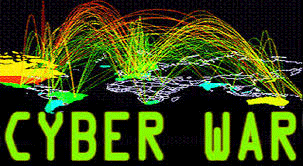 Growing threat: Cyber and nuclear weapons systems, Bulletin of the Atomic Scientists, Page Stoutland, 18 Oct 17, Every day, it seems, news of another cyber breach emerges. From huge entertainment companies to credit agencies to fast-food operations, cyber attackers are doing their dirty work and putting the public at risk. Name a company—Sony, Experian, Blue Cross Blue Shield, Arby’s, Saks Fifth Avenue—and it has been victimized. The implications are staggering—recent disclosures show that a 2013 attack on Yahoo e-mail compromised 3 billionaccounts. Governments and government systems also have been hit, including the US Office of Personnel Management. In that 2015 incident, hackers targeted millions of people’s Social Security numbers and other personal information.
Given the frequency and scope of cyber threats and cyberattacks worldwide, it’s easy to imagine waking up one day to find even more frightening headlines. What if the targets compromised in a cyberattack were not just e-mail accounts or even banking systems, but nuclear weapons (or related systems)? What if:
A nuclear watch officer’s computer screens indicated that nuclear missiles were on the way? Could the officer be sure that she wasn’t the victim of a cyber-spoof? How would she respond?
Military officials were unable to communicate with the men and women controlling US nuclear weapons during an international security crisis? What would they think had happened? How would they respond?
Officials discovered malware on a nuclear-critical system—and suspected that it was just the tip of a cyber iceberg?
Unfortunately, these scenarios are all too plausible. Many experts believe it’s only a matter of time before truly devastating cyberattacks are mounted against critical civilian infrastructure—or even key military systems. Nuclear weapons and related systems, like all digital systems, are vulnerable to cyberattack. Though nations give the highest priority to the security of nuclear weapons systems, a successful cyberattack is possible and could be catastrophic. (Systems related to nuclear weapons include those involved in delivery, communication, planning, warning, and the like; nuclear weapons, along with these related systems, can be called “nuclear weapons systems” for short.)
Cyberattacks could compromise nuclear planning or delivery systems, interrupt critical communications, lead to false warnings of attack, or potentially even allow an adversary to take control of a nuclear weapon. Indeed, an increasing risk of cyberattacks could undermine confidence in nuclear deterrent forces—generating uncertainty about whether a nuclear-armed state could both assure the authorized use of its nuclear weapons and prevent their accidental, mistaken, or unauthorized use. (A “disabling” attack could prevent authorized use of a nuclear weapon; an “enabling” attack could lead to unauthorized nuclear use.) Such uncertainty could jeopardize strategic and crisis stability.
If the threat doesn’t feel vivid yet, consider the following hypothetical scenarios.
Scenario 1. Seeking to start a nuclear war, a terrorist organization uses a cyberattack to disrupt a nation’s early warning systems and credibly spoof a large nuclear attack by a rival government. National decision makers would have to rapidly determine the appropriate course of action, perhaps with erroneous information flowing from the warning system……..
Scenario 2. In preparation for a nuclear attack (or perhaps as part of an extortion attempt), an adversary government uses cyberattacks to disrupt vital communications—between or among officials, operators, and nuclear systems themselves—eliminating the possibility of retaliation………
Scenario 3. Seeking to compromise an adversary’s nuclear deterrent, and exploiting vulnerabilities in the adversary’s supply chains, a nation-state places malware on a key nuclear weapon delivery platform. During an escalating crisis, it communicates that it has done so. In this situation, decision makers would have to consider whether and how to react as they tried to determine whether the problem was targeted or widespread and whether additional flaws might exist…… https://thebulletin.org/growing-threat-cyber-and-nuclear-weapons-systems11201
No comments yet.
1 This Month


Tell the Ukrainian Government to Drop Prosecution of Peace Activist Yurii Sheliazhenko

Petition to revoke the licensing of the Near Surface Nuclear Disposal Facility (NSDF) at Chalk River. https://www.ourcommons.ca/petitions/en/Petition/Details?Petition=e-7247


of the week – STOP SMALL MODULAR REACTORS IN CANADA
To see nuclear-related stories in greater depth and intensity – go to https://nuclearinformation.wordpress.com
-
Archives
- March 2026 (212)
- February 2026 (268)
- January 2026 (308)
- December 2025 (358)
- November 2025 (359)
- October 2025 (376)
- September 2025 (258)
- August 2025 (319)
- July 2025 (230)
- June 2025 (348)
- May 2025 (261)
- April 2025 (305)
-
Categories
- 1
- 1 NUCLEAR ISSUES
- business and costs
- climate change
- culture and arts
- ENERGY
- environment
- health
- history
- indigenous issues
- Legal
- marketing of nuclear
- media
- opposition to nuclear
- PERSONAL STORIES
- politics
- politics international
- Religion and ethics
- safety
- secrets,lies and civil liberties
- spinbuster
- technology
- Uranium
- wastes
- weapons and war
- Women
- 2 WORLD
- ACTION
- AFRICA
- Atrocities
- AUSTRALIA
- Christina's notes
- Christina's themes
- culture and arts
- Events
- Fuk 2022
- Fuk 2023
- Fukushima 2017
- Fukushima 2018
- fukushima 2019
- Fukushima 2020
- Fukushima 2021
- general
- global warming
- Humour (God we need it)
- Nuclear
- RARE EARTHS
- Reference
- resources – print
- Resources -audiovicual
- Weekly Newsletter
- World
- World Nuclear
- YouTube
-
RSS
Entries RSS
Comments RSS
 nuclear-news
Leave a comment