The Senate’s top climate advocate explains why Congress is doing nothing about global warming
“Trajectory points on the horizon aren’t part of our battle”: Sheldon Whitehouse on Democrats’ climate strategy.VOX, by Jeff SteinCombating climate change couldn’t be further from the Senate’s legislative agenda, but one Democratic senator claims a deal to enact a carbon tax may be closer than many realize.
Sen. Sheldon Whitehouse (D-RI), widely seen as the Senate’s most active advocate on climate change, says he is in routine communication with “six to 10” Senate Republicans who, he says, privately support his carbon tax bill but are unwilling to publicly back it. Only one Senate Republican, South Carolina’s Lindsey Graham, is willing to publicly support that idea.
In an interview with Vox, Whitehouse talked excitedly about the former Republican officeholders and George W. Bush officials who have formally voiced their support as well.
“If you want to have a valid Republican Party 10 years from now, you can’t have a generation of people that grows up seeing the Republican Party as climate deniers,” Whitehouse said in an interview, explaining his confidence that Republicans will move to address an issue their party’s president has called a “Chinese hoax.”
New wind turbine efficiency so great utilities ‘repowering’ farms early https://electrek.co/2017/10/16/new-wind-turbine-efficiency-so-great-utilities-repowering-farms-early/ John Fitzgerald Weaver – Oct. 16th 2017 @SolarInMASS
Warren Buffett owned MidAmerican Energy is upgrading wind turbines in Iowa early in their lifetimes in order to take advantage of the newest innovations in gear boxes and blades. Since only small parts of the already developed wind farms need be upgraded – these moves will increase the profitability of the farms. Wind turbines are evolving at a fast enough pace that waiting for standard end of life (30 years) means leaving money on the table.
I estimate an additional $51M/year in revenue from MidAmerican’s repowering.
John Hensley, deputy director for industry data and analysis at the American Wind Energy Association, says 700MW of wind power has been repowered in the USA. MidAmerican stated that they’re upgrading 1,000MW of their 4,000MW of wind (in Iowa). Their project will take through 2020 to complete.
As the article above notes – Wind projects started before 2017 qualified for the full production tax credit of 2.4 cents per kilowatt hour. The credit falls to 80 percent of that for projects started in 2017; 60 percent for those started in 2018; and 40 percent for those started in 2019. Most of the life of these system upgrades will be long after the wind production credit diminishes.
Interestingly –
After refurbishing some of the turbines at the Diablo Winds project in the Altamont Pass in California, researchers found that the fatality rates fell by 54 percent for raptors and 66 percent for all birds.
MidAmerican estimates that repowering the farms would increase output from the turbines by 19-28%. Annually, wind farms lower in output by about 1.7% per year. The lifetime of a wind farm has historically been around 30 years.
Electrek’s Take
With capacity factors around 40% on the newest projects (33% on older projects) – combined with 1,000MW of upgraded hardware – there will be an additional 613 million kWh/year coming from these turbines. The average American home uses about 10,000kWh/year for comparison. If the average price of electricity in Iowa (before taxes) is around .0835¢/kWh, then that’s $51M a year in new revenue. If this 1GW of wind cost $1B to install – that’s an extra 5% return on investment per year after accounting for the cost of upgrades (roughly of course).
This expanding evolution – adding future revenue to projects via strategic plant repowering in an age of fast maturing hardware – changes operations and maintenance in renewable technology giving those building today’s utility-scale power plants an improved tool to lower up front pricing. These towers are being repowered in their 14th to 11th years (plus or minus a few depending on order). There is a spreadsheet inside of MidAmerican which did some calculus to determine when money earning and repowering cost curves intersected – and that intersection was when the new investment was acted on. Thirty years with a constant declining power output will now change to developers signing contracts with large manufacturers at time of original construction to upgrade hardware in 8 to 10 years. These contracts will depend on developers and finance houses trusting that these manufacturers can continue the technological march forward in an aggressive manner.
Repowering is an old concept – but it’s getting more headlines today in renewables because large number of systems are hitting that age and the burning pace of technological innovation.
National lab is cheerleader and umpire for reactors’ future Peter Behr, E&E News reporter, SCOVILLE, Idaho— Nuclear power for the grid was born here in 1951, when an experimental reactor’s football-sized core sent current flowing to a quartet of lightbulbs at the isolated government laboratory on Idaho’s southeast desert.
And the nuclear industry’s future may be written here, as well — at least key parts of it — inside the Energy Department’s Idaho National Laboratory testing complex.
INL’s scientists, with colleagues at other DOE labs, are keeping a close watch on the health of the nation’s commercial nuclear reactors, most of them built before the mid-1980s in the flush of excitement about nuclear energy that would be “too cheap to meter,” as an early promoter predicted. How long can the plants keep going before critical steel, concrete and wiring systems are overcome by the aging effects of heat, radiation and mechanical stresses?
And now, with the nuclear industry struggling to compete against low-cost natural gas generation, INL is also stepping up a search for ways to lower reactor operating costs, from research on “accident tolerant” reactor fuels to designing more efficient control rooms and using technology to reduce reactor safety inspection time and costs……..
The NRC has licensed 84 reactors to continue operating beyond the initial 40-year span for an additional 20 years. Nine more relicensing applications are pending, and four reactors are expected to apply, the NRC said……..
The Energy Department’s 2016 report on the reactor longevity campaign notes the potential for damaging surprises. The specialized stainless steel alloys chosen for reactors in the 1960s had many plus factors, DOE said, but concerns, as well. Reactor radiation can add to stress-related corrosion cracking, threatening structural integrity. DOE researchers noted this year that “limited information is known about the long-term performance” of these alloys. Concrete structures have borne thermal shock and radiation, and reactor wiring has lived in harsh environments. Aging issues are “expected to become more severe” as time passes, DOE said.
An essential test process at Idaho and other DOE labs is to bombard sample reactor materials with enormous radiation levels inside test reactors, accelerating stress testing to mimic impacts of operations far beyond 40 years.
“It’s possible plants could run into aging problems that were too expensive to fix, and the operators would decide to shut it down,” Wagner said.
“Nearly all of the fleet will go offline between 2029 and 2055” if plants cannot operate beyond 60 years, Wagner said. “That may seem like a long time away, but it’s really not when you consider replacing that level of assets.”…….https://www.eenews.net/stories/1060063769
Jubilation as nuclear vetoed for Thyspunt, Herald Live,Guy Rogers
Surprise as government overrules Eskom, opts for Western Cape site The government’s surprise effective veto of Eskom’s push to build a nuclear reactor at Thyspunt near Cape St Francis has been greeted with jubilation by groups opposed to the move. The Department of Environmental Affairs has instead authorised the construction of Eskom’s proposed nuclear project at Duynefontein in the Western Cape.
NoPENuke said the department’s authorisation of Duynefontein, effectively vetoing the utility’s preferred site at Thyspunt, was “a real victory for the little guy”.
The Thyspunt Alliance said it was “a triumph for due process” and the Gamtkwa Khoisan Council said the ruling opened the way for establishment of a coastal cradle of mankind, a World Heritage site celebrating Thyspunt’s unique cultural and environmental heritage.
In keeping with South Africa’s nuclear process so far, the Environmental Affairs ruling arrived amid conflicting signals.
Less than a week ago, an upbeat nuclear summit at Jeffreys Bay – attended by Deputy Energy Minister Thembisile Majola and Eskom acting general manager Loyiso Tyabashe – declared the readiness of Eastern Cape youth to seize envisaged job opportunities flowing from development at Thyspunt.
More confusing still, on Sunday, Finance Minister Malusi Gigaba said South Africa had no money for nuclear.
Speaking in Washington in the US after meetings with the International Monetary Fund and World Bank, Gigaba said the South African economy “at present is not in a position where it can carry the burden of nuclear technology”.
Eskom’s nuclear aspirations were launched a decade ago, moving through multiple environmental impact assessments (EIAs) which were submitted and resubmitted after successful challenges from the anti-Thyspunt groupings supported by pro bono studies undertaken by scientists living in St Francis.
Besides the cultural heritage issue, concerns have included Thyspunt’s fragile dune wetlands and the sensitivity of the area to flooding, the existing tourism industry, the threat to the flagship chokka industry via the ejection of sand spoil into squid breeding areas during plant construction and the instability of the site, making it vulnerable to earthquakes and tsunamis……http://www.heraldlive.co.za/news/2017/10/17/jubilation-nuclear-vetoed-thyspunt/
Susan Salisbury, Palm Beach Post Staff Writer, Oct. 17, 2017 Without a required feasibility analysis to show that two new proposed nuclear reactors are a good deal for customers, Florida Power & Light Co. cannot collect costs incurred after 2016, the Florida Public Service Commission decided Tuesday.
PSC commissioners unanimously agreed with a staff recommendation that because FPL failed to submit a required financial analysis, costs incurred for the two reactors from Jan. 1, 2017 going forward cannot be collected through nuclear power-related fees customers pay.
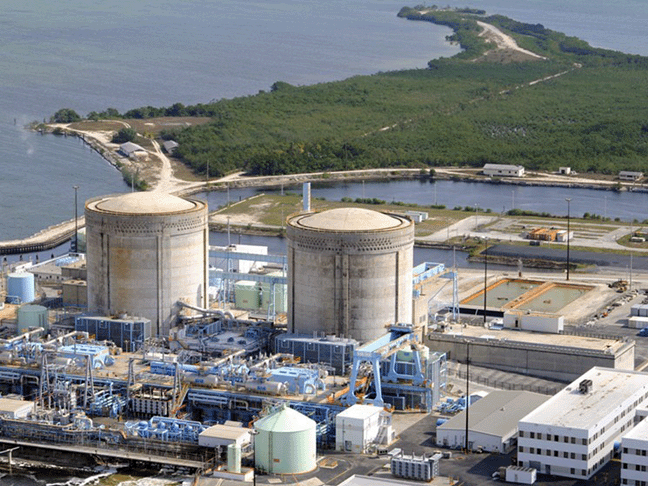
Since 2009 Juno Beach-based FPL has sought an operating license from the U.S. Nuclear Regulatory Commission for the proposed 2,200-megawatt Turkey Point 6 and 7 reactors which could cost as much as $21.8 billion. They might never be built, or no sooner than 2031, at the same facility where FPL already has two operating reactors overlooking Biscayne Bay south of Miami.
Still, customers have already paid close to $282 million in costs associated with the two reactors. And FPL wanted permission to continue charging customers with an exemption from having to file a feasibility study.
The Southern Alliance for Clean Energy, the Office of Public Counsel, the Florida Retail Federation and the Florida Industrial Power Users Group all urged the commission to deny FPL’s request for an exemption.
The PSC agreed, but the company can collect costs from customers if and when it does provide the required report as long as the report shows the project makes financial sense, the commission said. The utility could also seek to collect the costs some other way, such as through base rates…….
SACE said Tuesday it has other concerns, including that FPL has never committed to a binding price for the reactors or to construct them at all.
“FPL customers have already paid $300 million into the proposed Turkey Point expansion project that will almost certainly never be built. Two nuclear reactors of the same design in South Carolina were recently cancelled after the projected cost soared to over $25 billion dollars,” Smith said.
When New York state and Massachusetts retire three nuclear reactors between 2019 and 2021, the two states will lose a combined 2.7 gigawatts of carbon-free power. Both states want to replace that capacity with other forms of clean energy, in line with their ambitious goals to reduce greenhouse gas emissions and increase the share of renewables in their energy mix.
Some thousand miles north, Hydro-Quebec, owned by the Quebec government, is struggling with stagnate demand at home, and as it expands its hydropower generation capacity, the company seeks to sell power to New York and Massachusetts.
Hydro-Quebec faces strong competition from wind and solar proposals in the two U.S. states. In addition, hydropower is a reliable baseload option, but environmentalists say it is destructive to rivers and to river and nearby forest habitats.
The Pilgrim Nuclear Power Station in Plymouth, Mass., is planned to cease operations on May 31, 2019, while the two operating units at the Indian Point Energy Center will close in 2020-2021, with the decision driven by sustained low wholesale energy prices.
The closing of the three reactors would mean that NY and Massachusetts will lose a total of 2.7 gigawatts of carbon-free power.
This year, both NY state and Massachusetts issued requests for proposals for clean energy projects. Massachusetts seeks renewable energy generation and renewable energy credits (RECs) of 9,450,000 MWh annually and seeks proposals for long-term contracts of 15–20 years to provide the distribution companies with clean energy generation. The state has received more than 40 bids, including proposals from Hydro-Quebec-led developments. Hydro-Quebec says it is proposing six options —either 100-percent hydropower or a hydro-wind supply blend — offered over one of three proposed new transmission lines.
North Korean Nuclear Tests Close Chinese Ski Area, Outside, 17 Oct 17,
Border resort shuttered amid earthquake and volcano concerns after a series of underground detonations China announced an indefinite closure of the country’s only cat-access ski resort due to earthquakes that were caused by a series of underground nuclear tests conducted by North Korea.
Changbaishan Ski Resort is part of China’s Changbaishan National Nature Reserve, a nearly 800-square-mile preserve along North Korea’s northern border that sits within 70 miles of the nation’s nuclear test site at Punggye-ri. The underground nuclear detonations in late September registered a seismic magnitude of 6.3, and eight seconds later produced a burst of seismic energy measuring 4.1, according to the U.S. Geological Survey. The events triggered a landslide on a mountain within Changbaishan, prompting China to close a large section of the reserve—the only section with ski access.
“For the safety and convenience of travelers, we have temporarily closed the zone of Changbai Mountain. Officials are thoroughly investigating the safety of the tourist area,” reads a message from Chinese authorities, adding that the area will remain closed until “the potential risks disappear.”………
But the mountain range along the border of North Korea and China is sacred to more than just powder hounds. According to North Korean legend, its highest peak, Paektu Mountain, is the birthplace of the country’s former dictator Kim Jong-il. According to geological history, the range is also the skeleton of a violent volcanic eruption, an event that turned an ancient peak into the ring of mountains that appear today.
Aside from earthquakes and the subsequent landslides and avalanches, researchers worry that continued nuclear tests could recreate that explosive scenario, reactivating magma chambers and kicking off what would be a catastrophic modern-day volcanic eruption. A Newsweekarticle said that for a nuclear detonation to cause serious damage to a volcano, a preceding underground blast would need to measure at least 100 kilotons. The explosion in September was estimated to be around two and a half times that size. https://www.outsideonline.com/2251541/north-korea-nuclear-tests-are-affecting-skiing-china
Cabinet reshuffle about Zuma chasing nuclear deal: Malema, Times Live 17 October 2017 BY PENWELL DLAMINIThe leader of the Economic Freedom Fighters‚ Julius Malema‚ says the cabinet reshuffle announced by President Jacob Zuma on Tuesday is a tactical move to see the nuclear deal concluded.
“He is chasing the nuclear deal in the energy [department]….She [then minister of energy Tina Joemat-Pettersson] wanted minister Nene to sign some documents which were provided to her by the president. Nene said ‘I cannot sign the documents which have not been taken through the department. If you give me time to go through them‚ we can then sign.‘
“It took forever and [former finance minister Nhlanhla] Nene got removed because they thought he was reluctant on the thing. Peterson got removed because they thought she was not handling the nuclear deal properly‚” Malema charged at a media briefing on Tuesday.
“A confidante has been sent there [Department of Energy] to go and process the nuclear deal. [New minister of energy‚ David] Mahlobo will run the two departments. Both the intelligence and energy because [newly-appointed state security minister Bongani] Bongo is a nobody. He is just a young man who knows nothing. Bongo is put there because he admires Mahlobo. Bongo cannot undermine Mahlobo. He will listen to Mahlobo on what needs to happen.
“You must not be fooled. They are chasing the energy deal‚” Malema told reporters.
He was reacting to Zuma’s decision to remove Mmamoloko Kubayi as the minister of energy‚ replacing her with Mahlobo who was the minister of intelligence. The move‚ Malema said‚ was to have control on the energy department so that no one could block Zuma’s nuclear deal.
In April‚ the Western Cape High Court ruled that government’s decision to call for proposals for the procurement of 9.6 gigawatts of nuclear energy was unlawful and unconstitutional.
They voiced the opinion that Mahlobo’s abilities as a spy will be a handy tool to cast a veil of secrecy around critical deals that need to be hidden.
Concerns were raised that President Jacob Zuma’s Cabinet reshuffle, moving Mmamoloko Kubayi from the energy portfolio to communications and replacing her with the former state security minister, was a definite shift towards nuclear.
“This is all about the nuclear deal. Mahlobo has accompanied the president on visits to Russia, presumably to lay the ground for the Rosatom nuclear deal,” said Lawson Naidoo of the Council for the Advancement of the South African Constitution.
Mahlobo is seen as a close confidant of Zuma, with some labelling him as the president’s loyal “Prime Minister”.
Also significant is that Zuma was accompanied only by Mahlobo and Deputy International Relations Minister Nomaindia Mfeketo on his state visit to Russia in 2014, where he met with Putin at his residence in Novo-Ogariovo. No aides, advisers or wives went along, creating a veil of secrecy.
It has been widely speculated that Zuma and Putin struck a deal on nuclear cooperation at this meeting, but no evidence has ever emerged to confirm this.
The meeting only came to light later that week in 2014.
Democratic Alliance energy spokesperson Gordon Mackay said South Africans should be deeply concerned. “This is the state securitisation of the energy department. It started under Kubayi and will be completed under Mahlobo.”
He said Zuma was effectively taking control of the department, which has always been viewed as a department of former president Thabo Mbeki.
“It is the clearest indication that the state is dead set on pursuing nuclear.”
Mackay said Mahlobo is an enforcer, and a master at creating a murky atmosphere around deals that need to be pushed through and hidden.
The new energy minister is seen as close to Zuma and someone who can drive the nuclear deal, said Daniel Silke, director at the Political Futures Consultancy.
Liz McDaid, spokesperson for the Southern African Faith Communities’ Environment Institute, said since the institute’s court victory earlier this year in the high court, which ordered the government to restart the nuclear process, nothing has apparently happened on the surface to show progress with the deal.
“We suspected something was happening behind closed doors,” she said. “Last Friday’s nuclear site authorisation and now today’s Cabinet reshuffle has seen the Intelligence Minister become the Energy Minister. This is a desperate attempt to force through the nuclear deal.”
The Sunday Times last month added further fuel to the fire on Mahlobo’s Russian links, when the paper reported that Mahlobo had made the introductions between Russian gas company Rosgeo and controversial businessmen Kenny Kunene and Gayton McKenzie. Rosgeo signed a R5.3bn deal with PetroSA for gas exploration off the southern coast to feed the gas to liquids refinery at Mossel Bay at the recent Brics summit in Xiamen, China.
FBI uncovered Russian bribery plot before controversial nuclear deal http://nypost.com/2017/10/17/fbi-uncovered-russian-bribery-plot-before-controversial-nuclear-deal/By Bob Fredericks The FBI had evidence that Russian nuclear industry officials engaged in bribery, kickbacks, extortion and money laundering designed to grow Vladimir Putin’s energy business in the US before the Obama administration approved a deal in 2010 giving Moscow control of a large swath of American uranium, a new report said Tuesday.
The feds used a confidential US witness working inside the Russian nuclear industry to gather records, make secret recordings and intercept emails as early as 2009 that showed Moscow had compromised an American uranium trucking firm with bribes and kickbacks, The Hill reported.
“The Russians were compromising American contractors in the nuclear industry with kickbacks and extortion threats, all of which raised legitimate national security concerns. And none of that evidence got aired before the Obama administration made those decisions,” a person who worked on the case told The Hill.
Russian nuclear officials also sent millions of dollars to the US designed to benefit the Clinton Foundation while then-Secretary of State Hillary Clinton served on a government body that smoothed the way for the sale of the US uranium interests.
The nation’s top stock market regulator is investigating SCANA Corp.’s failed nuclear construction project, piling onto the growing stack of legal challenges and criminal probes now dogging South Carolina’s largest company.
The U.S. Securities and Exchange Commission, which oversees the stock market, has asked SCANA for documents tied to its effort to expand the V.C. Summer Nuclear Station north of Columbia. The company disclosed the investigation to its investors Tuesday.
Cayce-based SCANA, which owns South Carolina Electric & Gas, said the SEC’s subpoena was connected to “an investigation they are conducting relating to the new nuclear project.” The SEC declined to comment on the probe or its focus.
The state-owned power company Santee Cooper, meantime, hasn’t received a subpoena from the SEC, spokeswoman Mollie Gore said. Santee Cooper owned a minority stake in the project, which cost some $9 billion before it was abandoned in July.
The SEC inquiry is one of several investigations into the project, which was once heralded as the beginning of an American nuclear renaissance with a pair of new reactors in Fairfield County.
SCANA and Santee Cooper have already received a subpoena from a federal grand jury in Columbia, and the State Law Enforcement Division has opened a criminal inquiry into potential fraud surrounding the project. The state Legislature has formed two panels looking into what went wrong……..
The plunge has inspired at least three shareholders to sue SCANA, accusing the company and its executives of breaking securities laws by hiding the project’s problems from investors. The allegations have focused in part on the so-called Bechtel report, a highly critical audit that questioned the reactors’ viability in 2016.
And while legal challenges have piled up for SCANA, the SEC has already been involved on the edges of the V.C. Summer project.










 nuclear-news