America’s EPA now deliberately obscuring the truth on ionising radiation and health
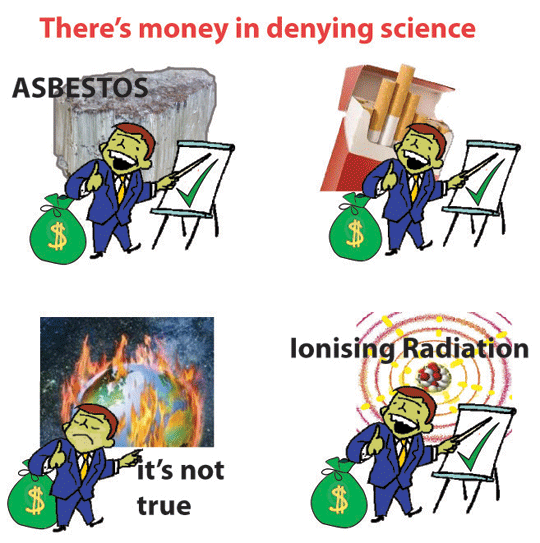
The EPA issued a public guidance in September, advising local officials to respond to a possible nuclear emergency by claiming that 5,000-10,000 millirems exposure “usually result[s] in no harmful health effects.” The watchdog group Public Employees for Environmental Responsibility (PEER) said past studies funded by the US government declared that level to be highly carcinogenic.
“National Research Council of the National Academy of Sciences, and EPA itself, have long estimated that 10,000 millirems could be expected to induce excess cancers in every 86th person exposed,” PEER said on Monday.
The non-profit criticized the agency for failing to cite which “radiation safety experts” it used to justify the declaration.
The EPA also didn’t say how long a human should be safe, when exposed to radiation at the 5,000-10,000 millirem range. It did note, however, that 75,000 millirem exposure “in a short amount of time (usually minutes too hours)” can cause acute radiation sickness.
“Although cancer has been associated with high doses of radiation received over short periods of time, the cancers usually do not appear for many years, even decades,” the guidance noted, ominously.
PEER Executive Director Jeff Ruch said the threshold cited by the agency could lead to a dangerous hands-off approach, should catastrophe strike.
“This signals that in the event of a Fukushima-type accident EPA will allow public consumption of radiation-contaminated drinking water for months,” Ruch said.
“Dr. Strangelove is alive and lurking somewhere in the corridors of EPA,” he added.
PEER noted that it is planning on suing the EPA to challenge the legality of the radiation exposure claims. The group said that the guidance violates the Safe Drinking Water Act.
The agency advice on radiation exposure–a supplement to a “Protective Action Guide”–was crafted, in its own words, “to help emergency planners prepare public communications prior to and during” radiological and nuclear emergencies.
In January, just before President Obama left office, the EPA issued the initial Protective Action Guide. It set the allowable threshold for the general population at 500 millirems, and the threshold for babies, children, and pregnant and nursing women at 100 millirems.
“Some commenters…believe the proposed PAG was too conservative and that EPA should consider establishing the PAG in the 2,000 to 10,000 [millirem] range,” the agency said in January, in the Federal Register.
PEER was critical of these limits, reacting to them by saying they also violated Safe Drinking Water Act rules.
“For decades, EPA had taken the position that ‘There is no known safe amount of radiation,’” the watchdog said on Monday.
No comments yet.
1 This Month


Tell the Ukrainian Government to Drop Prosecution of Peace Activist Yurii Sheliazhenko

Petition to revoke the licensing of the Near Surface Nuclear Disposal Facility (NSDF) at Chalk River. https://www.ourcommons.ca/petitions/en/Petition/Details?Petition=e-7247


of the week – STOP SMALL MODULAR REACTORS IN CANADA
To see nuclear-related stories in greater depth and intensity – go to https://nuclearinformation.wordpress.com
-
Archives
- March 2026 (204)
- February 2026 (268)
- January 2026 (308)
- December 2025 (358)
- November 2025 (359)
- October 2025 (376)
- September 2025 (258)
- August 2025 (319)
- July 2025 (230)
- June 2025 (348)
- May 2025 (261)
- April 2025 (305)
-
Categories
- 1
- 1 NUCLEAR ISSUES
- business and costs
- climate change
- culture and arts
- ENERGY
- environment
- health
- history
- indigenous issues
- Legal
- marketing of nuclear
- media
- opposition to nuclear
- PERSONAL STORIES
- politics
- politics international
- Religion and ethics
- safety
- secrets,lies and civil liberties
- spinbuster
- technology
- Uranium
- wastes
- weapons and war
- Women
- 2 WORLD
- ACTION
- AFRICA
- Atrocities
- AUSTRALIA
- Christina's notes
- Christina's themes
- culture and arts
- Events
- Fuk 2022
- Fuk 2023
- Fukushima 2017
- Fukushima 2018
- fukushima 2019
- Fukushima 2020
- Fukushima 2021
- general
- global warming
- Humour (God we need it)
- Nuclear
- RARE EARTHS
- Reference
- resources – print
- Resources -audiovicual
- Weekly Newsletter
- World
- World Nuclear
- YouTube
-
RSS
Entries RSS
Comments RSS
 nuclear-news
Leave a comment