Puerto’s electrical system could be restored with solar panels and Tesla batteries – Elon Musk

 Elon Musk says Tesla’s batteries could replace Puerto Rico’s electrical system https://www.businessinsider.com.au/elon-musk-tesla-batteries-solar-could-fix-puerto-rico-electrical-system-2017-10?r=US&IR=T DANIELLE MUOIO Tesla CEO Elon Musk said the company’s batteries and solar panels could help restore electricity to Puerto Rico if residents and the government decide they want to pursue that option.
From Nuclear Fusion Fraud to Physics Fortune
 The ITER Power Amplification Myth Oct. 6, 2017 – By Steven B. Krivit –
Short link: http://tinyurl.com/y9lvf79j
This is the third of three reports about the claims by representatives and proponents of the International Thermonuclear Experimental Reactor (ITER). “The Selling of ITER” published on Jan. 12, 2017. “Former ITER Spokesman Confirms Accuracy of New Energy Times Story” published on Jan. 19, 2017.
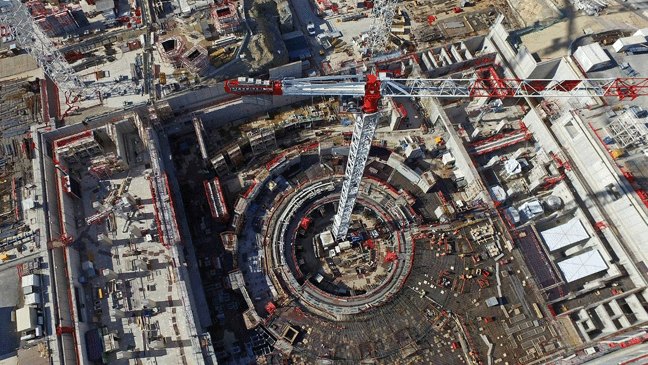
From Fusion Fraud to Physics Fortune
“………..The ITER project, supported by a widespread misunderstanding of its promised results, funded by billions in cash, resources and materials, will not deliver a practical demonstration of fusion power, but merely a scientific demonstration of a sustained fusion reaction. Yet on July 3, 2017, the Chinese Experimental Advanced Superconducting Tokamak reactor already did this, for 101 seconds. When built, ITER will merely do it for four times longer.
Oddly, the quest for practical nuclear fusion on Earth was born out of fraud. The ITER Web site recognizes this, with a page titled “Proyecto Huemul: From Fusion Fraud to Physics Fortune.”
The story began in 1948 in Argentina when Austrian scientist Ronald Richter proposed his idea for a fusion device to President Juan Perón. Perón agreed to fund the concept, and on March 24, 1951, Perón held a press conference at which he announced that his country had achieved practical, controlled nuclear fusion. By 1952, however, after independent investigators reported no evidence to support the claims, the project was shut down. The ITER page calls it “the scientific fraud of the century.”
Yet in 1951, before the Argentinian project was shut down, the project caught the attention of Lyman Spitzer, an astrophysicist at Princeton University. Spitzer, in turn, approached the U.S. Atomic Energy Commission and convinced it to fund his own fusion research concept. Thus, the U.S. controlled nuclear fusion era began at the Princeton Plasma Physics Laboratory, and the worldwide race for fusion energy began.
Since construction on ITER began in 2007, nuclear fusion news stories have been tagged with titillating headlines about unlimited energy. A CNN story headline is typical: “Is Nuclear Fusion About to Change Our World?” Every incremental step forward in temperature, pressure, or plasma confinement time has been a “breakthrough.” Each breakthrough, according to the news stories, has brought the dream of harnessing the power of the sun on Earth one step closer to reality. Rarely have the stories featured any critical assessment or analysis.
One journalist wrote that physicists at the Department of Energy’s Princeton Plasma Physics Laboratory had “demonstrated” how a new fusion reactor design could lead to the first commercially viable nuclear fusion power plant. The demonstration was merely on paper. The article featured a photo of a reactor. But it wasn’t the reactor described in the article. That reactor hadn’t been built yet.
As the comics below show, the very same Princeton Plasma Physics Laboratory — back in 1975 when the DOE was called the Atomic Energy Commission — told journalists it was a big step closer to virtually limitless pollution-free energy thanks to “breakthroughs” in plasma density and temperature.
Then there’s MIT scientist Earl Marmar, who told journalists this year that the technology exists to have fusion energy in 13 years if only it is funded aggressively enough.
Vision and hope are wonderful and necessary components of the human experience. But false hope and worthless promises — laced with misleading claims — do not represent the science accurately. They do not represent the integrity of all scientists involved in the research.
The false idea that the JET reactor produced 65% of the power it consumed has been deeply planted in the minds of the public and journalists. The same goes for the false idea that the ITER reactor will produce 10 times the power it consumes. These two myths serve to misrepresent the status of fusion energy research and, specifically, the ITER project……http://news.newenergytimes.net/2017/10/06/the-iter-power-amplification-myth/#more-44064
Catastrophic outcome if North Korea were to attack Seoul and Tokyo
Nuclear hit on Tokyo, Seoul ‘could kill 2 million’ http://www.straitstimes.com/asia/east-asia/nuclear-hit-on-tokyo-seoul-could-kill-2-million 6 Oct 17
New research shows disastrous outcomes for nearby US allies if North Korea strikes
SEOUL • As United States President Donald Trump threatens to destroy North Korea, even some of his closest aides have warned of the potentially disastrous effects of a war.
New research published on the 38 North website points to just how catastrophic the impact might be on the regime’s neighbours.
If North Korean leader Kim Jong Un were to launch a nuclear attack on Seoul and Tokyo – both within striking distance of his weapons – as many as 2.1 million people could die and another 7.7 million could be injured, according to the 38 North report.
The analysis by Mr Michael Zagurek Jr, a consultant specialising in databases and computer modelling, is based on North Korea’s current estimated weapons technology and bomb strength.
Mr Zagurek assumes that Mr Kim has a baseline arsenal of 20 to 25 warheads and the capacity to put them on ballistic missiles.
Concerns about a nuclear conflict in North Asia have increased as Mr Kim accelerates his programme of acquiring weapons capable of hitting continental US, and as Mr Trump threatens preemptive military action.
North Korean Foreign Minister Ri Yong Ho last month said the regime’s possible next steps include testing a hydrogen bomb over the Pacific Ocean.
According to Mr Zagurek, it is possible that another nuclear test, an intercontinental ballistic missile test, or a missile test that has the payload impact area too close to US bases in Guam might see Washington react with force.
US options could include attempting to shoot down the test missiles or possibly attacking the North’s missile testing, nuclear-related sites, missile deployment areas or the Kim regime itself. In turn, the North Korean leadership might perceive such an attack as an attempt to remove the Kim family from power and, as a result, could retaliate with nuclear weapons, he added.
North Korea’s older warheads have yields in the 15-25-kilotonne range, around the size of the bombs that devastated Hiroshima and Nagasaki in 1945.
Fatality estimates rise significantly if North Korea were able to strike with bombs similar to the one it tested on Sept 3, which had a likely yield of 108-205 kilotonnes, Mr Zagurek said.
Defense Secretary Mattis – staying in Iran deal is in U.S. national security interest
Europe plans to save Iran nuclear deal , despite Donald Trump
Europe’s governments look to bypass Trump to save Iranian nuclear deal
Despite pressure from UK and France, US president expected to declare Tehran in violation of agreement but Senate could yet block reimposition of sanctions, Guardian, Julian Borger, 4 Oct 17, European governments fear a concerted effort to persuade Donald Trump to continue to certify the Iran nuclear deal may have failed and are now looking for other ways to try to salvage the two year-old agreement.
European lobbying efforts are now focused on Congress which will have two months to decide – in the absence of Trump’s endorsement of the 2015 deal – whether to reimpose nuclear-related sanctions.
Fresh sanctions could in turn trigger Iranian withdrawal and a ramping up of its now mostly latent nuclear programme, taking the Middle East back to the brink of another major conflict.
Education on nuclear disarmament – New Zealand is the leader
New Zealand Educates Youth on Nuclear Disarmament, https://www3.nhk.or.jp/nhkworld/en/news/editors/5/nzeducatesyouthonnucleardisarmament/index.html – Hiromi Kurosaka, New Zealand is a staunch advocate of abolishing nuclear arms. Its policy coalesced in the 80s after strong opposition. And as a new generation grows up, the country is still committed to educating them about the horrors of nuclear weapons.
A commemoration of the victims of the atomic bombing of Hiroshima takes place annually in staunchly anti-nuclear New Zealand. The country adopted an anti-nuclear policy decades ago. Opposition had grown over the years as France repeatedly tested its nuclear weapons in the region’s waters. New Zealand’s policy bans the country from possessing nuclear arms or bringing them into its territory. Nuclear power isn’t used in the country either.
This year marks the 30th anniversary of the policy. A school focusing on teaching students the importance of disarmament invited survivors of the atomic bombing of Hiroshima to recount their painful experiences.
15-year-old Yasmin Clements-Levi, who heard the accounts of survivors for the first time, said “I’m really glad that I learned now, really exactly what they’ve gone through and how it affects them to this day.”
The school held a debate to help students think more deeply about the issue. Some of the students were against nuclear weapons. “It’s just horrible — the fact that so many people can die. It’s generally not worth it to have them in the world at all.” “If a terrorist group like ISIS were to get nukes, they could cause infinite destruction.”
Others maintained that they’re necessary. “If you talk about
1 This Month

of the week – Shut Down Drone Warfare!


Tell the Ukrainian Government to Drop Prosecution of Peace Activist Yurii Sheliazhenko

Petition to revoke the licensing of the Near Surface Nuclear Disposal Facility (NSDF) at Chalk River. https://www.ourcommons.ca/petitions/en/Petition/Details?Petition=e-7247
To see nuclear-related stories in greater depth and intensity – go to https://nuclearinformation.wordpress.com
-
Archives
- April 2026 (91)
- March 2026 (251)
- February 2026 (268)
- January 2026 (308)
- December 2025 (358)
- November 2025 (359)
- October 2025 (376)
- September 2025 (257)
- August 2025 (319)
- July 2025 (230)
- June 2025 (348)
- May 2025 (261)
-
Categories
- 1
- 1 NUCLEAR ISSUES
- business and costs
- climate change
- culture and arts
- ENERGY
- environment
- health
- history
- indigenous issues
- Legal
- marketing of nuclear
- media
- opposition to nuclear
- PERSONAL STORIES
- politics
- politics international
- Religion and ethics
- safety
- secrets,lies and civil liberties
- spinbuster
- technology
- Uranium
- wastes
- weapons and war
- Women
- 2 WORLD
- ACTION
- AFRICA
- Atrocities
- AUSTRALIA
- Christina's notes
- Christina's themes
- culture and arts
- Events
- Fuk 2022
- Fuk 2023
- Fukushima 2017
- Fukushima 2018
- fukushima 2019
- Fukushima 2020
- Fukushima 2021
- general
- global warming
- Humour (God we need it)
- Nuclear
- RARE EARTHS
- Reference
- resources – print
- Resources -audiovicual
- Weekly Newsletter
- World
- World Nuclear
- YouTube
-
RSS
Entries RSS
Comments RSS
 nuclear-news