Nuclear expansion expected to slow in the coming years, IAEA report says https://dailyenergyinsider.com/news/8285-nuclear-expansion-expected-slow-coming-years-iaea-report-says/October 05, 2017 by Alex Murtha While nuclear power’s global potential up to the year 2050 remains high, its expansion is expected to slow in the coming years, according to a recently published report on energy and electricity projections by the International Atomic Energy Agency (IAEA).
The report, titled Energy, Electricity and Nuclear Power Estimates for the Period up to 2050, also stated that interest in nuclear power remains particularly strong within the developing world. However, compared to the prior year’s projections for 2030, estimates were reduced by 45 gigawatts (GW) in both high and low cases.
In the short term, the impact of renewable energy sources on electricity prices, the low price of natural gas and country-specific nuclear policies following the 2011 Fukushima Daiichi Nuclear Power Plant disaster are all expect to affect nuclear growth prospects, the report said.
Compared to 2016 levels, high projections indicate an increase by 42 percent in 2030, by 83 percent in 2040 and by 123 percent in 2050. Yet, the low projections indicate a decline in capacity by 12 percent in 2030, 15 percent in 2040 before rebounding to current levels by 2050.
According to the IAEA, the wide range of the projections is also due to the considerable number of reactors scheduled to be retired by approximately 2030 and beyond, particularly in North America and Europe, along with whether or not new nuclear capacity would be built to replace retired reactors.
U.S. PREPARES NEW MISSILES FOR JAPAN AFTER NORTH KOREA THREATENS NUCLEAR WAR, newsweek BY TOM O’CONNORThe U.S. has moved closer to selling dozens of state-of-the-art missiles to Japan as part of President Donald Trump’s pledge to boost military support for Pacific allies opposed to nuclear-armed North Korea.
The State Department’s Defense Security Cooperation Agency said Wednesday it would back the Japanese government’s request for up to 56 AIM 120C-7 Advanced Medium Range Air-to-Air Missiles (AMRAAMs). The sale, which is estimated at $113 million and requires congressional approval, would also reportedly include various logistical, technical, engineering and weapons support services. It comes as Japan reconsiders its traditionally pacifist post-World War II stance on defense in the face of threats from North Korea, which has shot two missiles over Japanese territory in the past two months.
The proposed sale will provide Japan a critical air defense capability to assist in defending the Japanese homeland and U.S. personnel stationed there,” the agency said in a statement.
“Japan will have no difficulty absorbing these additional munitions into the Japan Air Self-Defense Force,” it added…….
Telegraph 3rd Oct 2017, The Government is likely to scrap the complex funding arrangements used to
prop up the development of Hinkley Point C after an energy minister
admitted the deal is unlikely to be used for future nuclear projects.
Richard Harrington, who joined the Business and Energy department as a
junior minister earlier this year, said nuclear “absolutely” had a role
to play in the future energy mix, but appeared to bow to Hinkley’s
critics by admitting the financing model was “unlikely” to be used
again. Speaking on the fringes of the Conservative Party conference, he
said he believed that a “third model” existed between the complex deal
agreed with EDF Energy on Hinkley, and the suggestion that Government
should be the main financier behind nuclear projects in order to drive
costs lower. http://www.telegraph.co.uk/business/2017/10/03/government-rethink-hinkley-point-funding-model-future-projects/
Les Echos 4th Oct 2017 [Machine Translation]Members of the board of directors of EDF and the
executive committee – met Tuesday in Hinkley Point, south-west England, for
a “delocalized strategic seminar” and to visit the site of the two EPRs.
Because of its location, project governance is much more complex than that
of the EPR project in Flamanville (Manche). Three teams are at work, with
about 700 people in Montrouge (France), 850 in Bristol (Great Britain) and
construction teams in Hinkley Point.
It is also necessary to integrate
Areva’s teams into Edvance, the new engineering structure resulting from
the restructuring of the nuclear industry. “There are many issues to be
discussed on the connection between EDF and NNB units in England,” said a
member of EDF’s board of directors before the summer. A site for Simone
Rossi, who will take over the management of EDF Energy on November 1, to
replace Vincent de Rivaz. https://www.lesechos.fr/industrie-services/energie-environnement/030655436090-edf-une-nouvelle-direction-pour-les-epr-anglais-2119323.php
Whitehaven News 3rd Oct 2017,Cumbria’s £10bn nuclear new build will not be delivered on schedule,
according to the man in charge of the company behind it. Tom Samson, the
chief executive of NuGen, which has plans for a power plant in Moorside,
near Sellafield, has said it will not be up and running by the 2025 target.
He has also said he expects a new investor in the project in the early part
of 2018 and confirmed the company has been speaking to the Government about
possible support. Mr Samson made these comments in an interview with
in-cumbria, where he also said he was “115 per cent” confident the scheme
would go ahead.
Doubts have surrounded the Moorside project – designed to
supply up to seven per cent of the UK’s electricity and create up to 10,000
jobs – all year because of issues affecting NuGen’s owner, Toshiba. Toshiba
has always insisted that it remains committed to the Cumbrian project
though it has long term plans to sell its stake. Korea Electric Power
Corporation (Kepco) and China General Nuclear Power Corporation (CGN) have
both expressed an interest in buying into NuGen.
Both Kepco and CGN have
their own reactor designs, which would need regulatory approval if they
were to be used by NuGen. Mr Samson said: “When we are in a partnership
with different technologies and shareholders it is inevitable that that
would change schedules. We will have a new plan which we will need to
create with any new owner and that will take us beyond 2025. “It is very
difficult to pin down a date but I would expect it will be operational
within the 2020s.” He added that there were several “credibly buyers” but
did not discuss which companies these were but did say: “There is a high
likelihood that there will be a new reactor technology.”
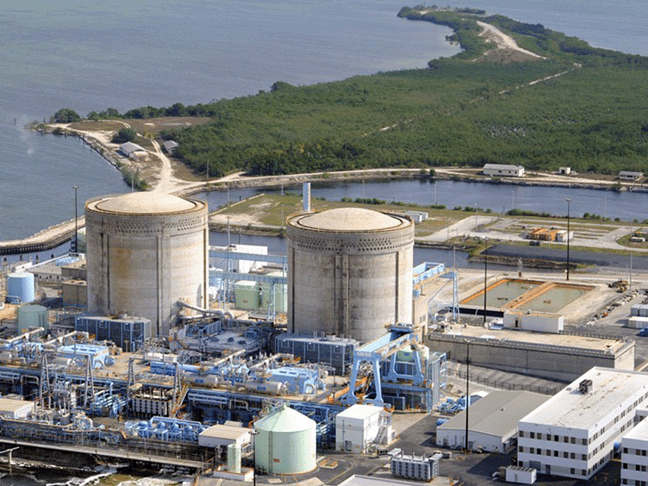
State Senator Says FPL Isn’t Preparing Miami’s Nuclear Plant for Sea-Level Rise, Miami New Times, JERRY IANNELLI | OCTOBER 5, 2017 The Turkey Point Nuclear Generating Station is built directly on the waterfront in Homestead — a location that has exposed the plant to serious natural disasters. The power plant survived Hurricane Andrew in 1992, but the storm’s 175 mph winds knocked out communication lines, disabled the emergency fire-safety system, and “severely cracked” an exhaust stack that could have destroyed the plant’s back-up power system if the stack had toppled, according to the Union of Concerned Scientists.
So while Florida Power & Light (FPL) proposes expanding Turkey Point and building two more reactors there, Miami state Sen. Jose Javier Rodriguez is asking for safer measures to prepare for sea-level rise and major hurricanes — or for FPL to drop the expansion plans altogether. This past August 23, Rodriguez sent the U.S. Nuclear Regulatory Commission (NRC), which regulates nuclear power plants, a letter demanding that FPL add greater sea-level-rise protections to its development plan.
Rodriguez made the letter public this week because the NRC had scheduled a hearing today to move forward with Turkey Point’s expansion plans; Hurricane Irma delayed the meeting, but it’s still expected to happen by the end of December. Rodriguez is asking the NRC to continue to delay ruling on the plan’s approval until FPL addresses the concerns of environmentalists and activists.
“They’re only taking into account one foot of sea-level rise in the future,” Rodriguez tells New Times. “Some projections — we’re hopeful those projections are wrong — but some projections are orders of magnitude higher than that.”…….
n his August letter to the NRC, Rodriguez laid out three specific concerns, which clean-energy activists opposed to FPL’s expansion plans have voiced repeatedly: First, Rodriguez said Turkey Point’s Combined Operating License application (COL) accounts for only a foot of sea-level rise by 2100 even though the National Oceanic and Atmospheric Administration warned last January that the seas could rise as much as 8.2 feet in that time period.
Second, Rodrigeuz said he was upset the plan covered only the new reactors — Units 6 and 7 — that FPL plans to build and does not propose any changes for the existing reactors. Those are the same reactors attached to cooling canals that leak low-level radioactive waste into Biscayne Bay and salt water into Miami’s drinking-water aquifer. Environmentalists have long complained that Turkey Point sits too close to protected parks and drinking-water sources.
Third, the lawmaker added he thought FPL’s applications did not properly account for what might happen to spent nuclear fuel rods that the plants produce. ….
“That also is obviously a huge concern all over the country,” Rodriguez says. “There really isn’t a plan for how these nuclear facilities store their waste.”
Anti-nuclear activists argue that if safely storing spent rods is this difficult, nuclear plants simply should not be built. Investigative comedian John Oliver earlier this yrar devoted a long segment on his HBO show Last Week Tonight to the nuclear-waste storage problem:
FPL recently won the right to store low-level radioactive waste from the expansion site underground in a rocky zone, but some environmental activists worry the waste might leak into Miami’s largest source of drinking water, the Biscayne Aquifer. Lawyers for the City of Miami asked the NRC to force FPL to rewrite its plan, but NRC regulators say FPL has done enough to mitigate those concerns.
Komo news, by NICHOLAS K. GERANIOS, Associated Press SPOKANE, Wash. (AP) 5 Oct 17, – Workers at the Hanford Nuclear Reservation have started injecting grout into a partially collapsed tunnel that contains radioactive wastes left over from the production of nuclear weapons, the U.S. Department of Energy said Wednesday.
The grout is intended to improve the stability of the 360-foot-long (110 meters) tube, which dates to 1956, and help prevent any radioactivity from escaping into the environment.
It will take an estimated 650 truckloads of grout to fill the tunnel adjacent to the closed Plutonium Uranium Extraction Plant, which produced most of the plutonium for the nation’s nuclear arsenal, the agency said. The complicated work should be completed by the end of the year……..
The roof of the tunnel, which was sealed in 1965, partially collapsed on May 9, forcing about 3,000 workers to shelter in place for several hours……
The site now contains the nation’s greatest volume of radioactive defense wastes. Cleanup of the site is expected to last until 2060 and cost $100 billion.
The grout will be injected into the tunnel at night. It is engineered to flow easily and will cover the contents, including eight contaminated railroad cars that carry waste.
The tunnel being filled with grout is one of two near the PUREX plant that contain contaminated rail cars and other radioactive waste.
The department concluded earlier this year that there is a high risk that the second, much larger, tunnel could also collapse.
The Energy Department has said that the two sealed tunnels “do not meet current structural codes and standards.”
The larger tunnel was built of metal and concrete in 1964. It is approximately 1,700 feet (510 meters) long and is covered with eight feet (2.5 meters) of soil to prevent radiation from escaping. Inside are 28 flat-bed rail cars containing nuclear waste, including giant storage vessels and other large equipment from plutonium production. That tunnel was sealed in 1996 and has not been entered since. http://komonews.com/news/local/650-truckloads-of-grout-to-fill-collapsed-radioactive-tunnel-at-hanford
ITV 4th Oct 2017,The Prime Minister has told ITV Border she understands concerns in Cumbria
over uncertainty about a new nuclear power station in the county. Theresa
May said her government remains committed to new nuclear but she didn’t
commit to funding the Moorside project. The Prime Minister’s refusal to
give financial backing to Moorside comes as the company in charge of
developing the project has admitted for the first time that the project
will be delayed. http://www.itv.com/news/border/update/2017-10-04/pm-refuses-to-give-financial-backing-to-moorside-project/
Consensus on Site 300 contamination Tracy Press October 4, 2017 By Michael Ellis Langley
A citizen watchdog group and the Environmental Protection Agency agree that continued funding is the only way to make sure a polluted test site near Tracy is fully cleaned up.
Tri-Valley Communities Against a Radioactive Environment, a private organization that monitors work at Lawrence Livermore National Laboratory, hosted a town hall Thursday evening with the EPA. The group is concerned about contamination of an 11-square-mile facility along Corral Hollow Road southwest of Tracy called Site 300. The site is managed by the Department of Energy and has been used for years for experiments to test America’s nuclear arsenal.
GR: Why does the fossil fuel industry keep this up? The influence on our lawmakers and regulators is a crime against all people everywhere. We must drive corporate lobbying and support for political campaigns out of our government.
“The Trump administration plans to scrap former president Barack Obama’s signature plan for reducing greenhouse-gas emissions from the nation’s power plants, arguing that the previous administration overstepped its legal authority, according to a 43-page proposal obtained by The Washington Post.
“The proposal, which is expected to be made public over the coming days, comes months after President Trump issued a directive instructing the Environmental Protection Agency to begin rewriting the controversial 2015 regulation, known as the Clean Power Plan, as part of a broader effort to obliterate his predecessor’s efforts to make combating climate change a top government priority.
“In a copy of the proposed repeal, first reported by Bloomberg News, the EPA does not…
¶ “A trio of storms could mean grid modernization in hard-hit areas” • Harvey, Irma and Maria struck Texas, Florida and Puerto Rico, respectively, with varying degrees of severity. Puerto Rico was especially hard hit, with 80% of transmission lines down. But in each location, there are opportunities to consider new ways to move forward. [Utility Dive]
Hurricane damage (Getty Images)
¶ “Rick Perry’s new coal subsidy could wreck America’s power markets” • The US DOE has set a new record for gall in the old practice of taxing the common good for private interests. In a fairly stunning move, it would impose a new tax on electricity consumers to support coal. It could roil America’s power markets for years to come. [The Hill]
World:
¶ The Institute for Energy Economics and Financial Analysis has released a report documenting the gathering momentum of the disruption…
(Natalie Renier, Woods Hole Oceanographic Institution) By Tara MacIsaac, Epoch Times Virginie Sanial, a scientist at Woods Hole Oceanographic Institution, samples groundwater beneath beaches in Japan. Virginie and her team found contaminated sands are releasing radionuclides into the ocean. (Matt Charette/Woods Hole Oceanographic Institution) Radioactive cesium from the Fukushima Daiichi nuclear power plant has been flowing into the ocean since […]








 nuclear-news