When did nuclear disarmament become such a dirty word for the Tories? Guardian, Emily ThornberryUnlike her Conservative predecessors Theresa May won’t commit to the principle of a nuclear-free world – just so she can attack Jeremy Corbyn’s position
On this day, 65 years ago, near a remote island off the Australian west coast, a bomb was exploded in the hull of the empty navy frigate HMS Plym, its blast two-thirds more powerful than the one that destroyed Hiroshima. At that moment, Britain officially became the world’s third nuclear power.
Both Winston Churchill, who authorised the test, and Clement Attlee, who initiated it, believed its true significance lay not in increasing Britain’s military capabilities, but in further deterring the threat of nuclear war between Russia and the west, and ultimately in eradicating that threat.
Since that day in October 1952, 17 general elections have been held in Britain, and – while debates have often raged about a unilateral versus multilateral approach – the principle that the British government should always be working towards global disarmament has never seemed in doubt.
Until now, that is. Theresa May’s manifesto earlier this year was only the third by a sitting government since Britain got the bomb that made no mention at all of nuclear proliferation and the importance of arms control. And – unlike the two others – she had no excuse.
The previous exceptions to the rule were in February 1974, when Ted Heath tried to reduce his snap election to the single question “Who governs Britain?”; and 1997, when a fag-end Tory administration was barely going through the motions against New Labour.
But in every other case, the prime minister and government of the day treated it as almost a moral responsibility to make clear their long-term commitment to disarmament, often alongside a statement of their short-term plans to retain and renew Britain’s nuclear arsenal…….
So the question for the prime minister and her party is: “When did disarmament become such a dirty word?” Why are Jeremy Corbyn and the Labour party now derided for advocating policies that Tory governments once considered perfectly commonplace?……..
Look at the situation today, especially this summer’s volatile and unresolved standoff between Kim Jong-un and Donald Trump, and it is clear that the threat of nuclear conflict is definitely no less severe than in previous decades, and is arguably at its highest level since the early 1980s.
For past governments of all parties in Britain, that was the cue to step up their efforts on nuclear diplomacy, and commit to progress on disarmament. But from May, Boris Johnson and Michael Fallon, we hear the opposite, and the explanation is as depressing as it is straightforward.
They know that Corbyn – along with me and others – is a long-standing proponent of disarmament. They know that this issue has caused tension in the Labour party over the past two years. And they therefore regard any discussion of nuclear weapons simply as a chance to misrepresent Labour as soft and divided on defence.
In that context, the silence of the last Tory manifesto makes total sense; any commitment to make progress on arms control would have made it impossible for May’s attack dogs to tear holes in Labour for saying the same.
So this most unprincipled of prime ministers chooses to ignore the issue of disarmament simply for short-term political gain, something no sitting government has done since that massive blast 65 years ago on HMS Plym………
at least up until now, every government since Churchill’s has believed that – whatever the arguments that nuclear weapons are a necessary short-term deterrent – the only long-term and absolute guarantee of safety is to eliminate them entirely from the planet.
It should hardly be a surprise therefore for Labour’s leader to state that as his ambition, just as it was for Churchill, Macmillan, Thatcher, Major and Cameron. Indeed, the fact that Theresa May continues to attack Jeremy Corbyn for holding that principle is not just a massive departure from the standards of her postwar predecessors, but one of the many reasons she is not fit to stand in their – or his – company.
These tablets also don’t eliminate all risks of nuclear disaster. Other radioactive substances, like cessium or plutonium, can be released in a nuclear disaster, and the iodine tablets will do nothing against that.
DUTCH GOVT. DISTRIBUTES IODINE TABLETS IN PROVINCES NEAR NUCLEAR PLANTS https://nltimes.nl/2017/10/03/dutch-govt-distributes-iodine-tablets-provinces-near-nuclear-plantsBy Janene Pieters on October 3, 2017 From this week the Dutch Ministry of Public Health is distributing iodine tablets in provinces located near nuclear plants. The pills are intended to protect against a certain type of radiation should there be a nuclear disaster. According to the Ministry, around 3 million people in large parts of the regions of Oost-Nederland, Noord-Nederland, Noord-Brabant, Zuid-Holland, Zeeland and Limburg will receive a packet of pills in the mail by the end of next week, the Volkskrant reports.
Iodine pills wil be sent to all children under the age of 18 who live within 100 kilometers of a nuclear plant. Within a radius of 20 kilometers from a plant, all people up to the age of 40 will get a packet of pills. Pregnant women can buy them from a pharmacy. If a nearby nuclear plant leaks radioactive material for any reason, the people living around it will receive a notification telling them to drink the iodine tablets.
The pills are intended to protect against a form of thyroid cancer, to which young people are particularly vulnerable during a nuclear disaster. The cancer develops when the thyroid gland absorbs radioactive iodine. By drinking the iodine tablets first, the thyroid absorbs all the iodine it can from the tablets and has no more room for radioactive iodine. Any iodine absorbed from the nuclear cloud will simply pass through the body.
While there are international guidelines for distributing iodine tablets around nuclear plants, each EU country can decide for itself how and whether they distribute the tablets. A few years ago Belgium decided to distribute iodine due to citizens’ concerns about the safety of nuclear power plants Doel and Tihange. In 2014, the Dutch government decided to “harmonize” the policy so that Dutch citizens can have the same protection as German and Belgian people living near nuclear power plants, according to the newspaper. This measure is taken as a precaution, and not in response to a threat of nuclear disaster.
These tablets also don’t eliminate all risks of nuclear disaster. Other radioactive substances, like cessium or plutonium, can be released in a nuclear disaster, and the iodine tablets will do nothing against that.
According to Wim Turkenburg, atomic physicist and energy professor at Utrecht University, the best thing to do after a nuclear disaster is to stay inside until the nuclear cloud dissipated. “Don’t go get your children from school, but leave them there”, he said to the Volkskrant. He also stressed that nuclear disasters are very rare, especially in the reactors located close to the Netherlands. “The nuclear plants here are more striclty checked than in Fukushima and Chernobyl.”
Japan nuclear stocks lukewarm after Tokyo governor denies parliament run Hudson Lockett, Ft.com 3 Oct 17 Japanese nuclear power companies were making only minor gains on Tuesday after the Tokyo governor who has called for phasing out nuclear energy by 2030 said she was “100 per cent” not running in the upcoming election. Kansai Electric and Kyushu Electric were up just 0.6 per cent, while Tokyo Electric was up just 0.2 per cent and Chugoku Electric Power was off 0.1 per cent Those same stocks had fallen around 5 per cent in response to Tokyo governor Yuriko Koike, whose Party of Hope will challenge prime minister Shinzo Abe’s Liberal Democratic Party in the upcoming snap election, declaring her support for phasing out nuclear energy by 2030……..https://www.ft.com/content/ca0433fb-f2ab-36bd-949d-f039d7c9da1b
Brexit Threatens U.K.’s Nuclear Renaissance Dream, Tories Told, Bloomberg, By Jess Shankleman, 3 Oct 17,
Rolls-Royce says government may annnounce nuclear winners soon
Tight migration policies after Brexit may hold back industry
Britain’s plan to spend billions of pounds on a fleet of new nuclear reactors could be stopped in their tracks if Prime Minister Theresa May ends the rights of skilled European migrants to work in the nation after it leaves the European Union.
That’s the warning delivered on Monday by Rolls-Royce Holdings Plc and other nuclear energy experts to Conservative Party members at their annual conference in Manchester, northwest England. The company also outlined plans to invest in new modular atomic power plants.
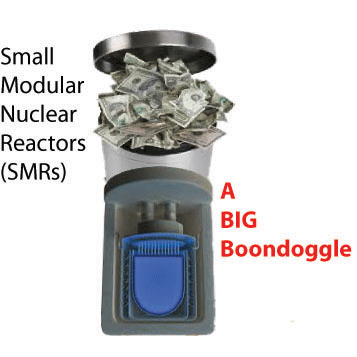
In the coming month, ministers are due to announce the results of a 250 million-pound ($213 million) competition for funding to research and develop small modular nuclear plants, said David Orr, Senior Vice President of Nuclear at the British manufacturing icon. Rolls-Royce is bidding to participate, he said…….
But the future of both the modular and traditional reactors like the ones being built by Electricite de France SA at Hinkley Point in western England is at risk from the U.K. exiting the EU, he said. That’s because the industry relies on engineers from overseas and because there is still a question mark over whether and how the U.K. could leave Euratom, the European Atomic Energy Community regulator that oversees the industry.
Shunning Fossil Fuels, 40 Catholic Groups Seek Climate Action, Scientific American
The coalition is the largest number of Catholic institutions to team up for a shift to green energy By Alister Doyle, Reuters on October 3, 2017 OSLO (Reuters) – Forty Roman Catholic groups said on Tuesday they were shunning investments in fossil fuels and urged others to follow suit.
The coalition was the largest number of Catholic institutions, in countries including Australia, South Africa, Britain and the United States, to team up for a shift to greener energies, the Global Catholic Climate Movement said.
Among those taking part was Assisi’s Sacro Convento and other Catholic institutions in the Italian town, birthplace of Saint Francis, who inspired Pope Francis.
The “joint divestment from fossil fuels is based on both their shared value of environmental protection and the financial wisdom of preparing for a carbon-neutral economy,” the Global Catholic Climate Movement said.
It did not estimate the value of their fossil fuel holdings. Several, contacted by Reuters, said they had few or none to sell and wanted mainly to rule out future investments and urge others to divest.
The Assisi municipality allied itself with the 40. “Many people say that Assisi is the city on the mountain – all people can see the choices, political and environmental, that Assisi takes,” mayor Stefania Proietti told Reuters.
She said the town was investing in cleaner energy, such as solar panels on rooftops, and electric vehicles……..
The Catholic Church claims 1.2 billion members.
Ben Caldecott, founding director of the Oxford sustainable finance programme at the University of Oxford, said: “Groups with moral authority, religious groups being a good example, are likely to have a disproportionate impact in terms of increasing stigma” of investing in fossil fuels.
The International Energy Agency projects that fossil fuels will account for more than half of world energy demand in 2040, even with a big green shift. Fossil fuel companies such as Exxon Mobil or Royal Dutch Shell say they are limiting emissions.
Radiation in uranium mines People working in nuclear power plants face considerable health hazards.http://www.millenniumpost.in/opinion/radiation-in-uranium-mines-264457?utm_source=web-social-share&utm_partner=mpost&utm_campaign=share&utm_medium=facebookArun Mitra | 2 Oct 2017, Nuclear energy is being projected as the panacea for the energy crisis in our country. It is true that we have acute shortage of electricity which is so essential for development. But there has been debate around the globe whether nuclear energy is the answer. There is evidence to prove that It is fraught with dangers right from digging of its ore – the uranium, to its transport to the nuclear power plants, hazards involved in its utilisation in nuclear facilities and lastly its waste management. There have been many accidents worldwide in the nuclear facilities which have been of extremely serious nature. The Three Mile island accident in 1979, the Chernobyl accident in 1986 and the Fukushima nuclear disaster in 2011. In India, too, several low-level accidents have occurred but they have gone unreported because there is no transparency in the nuclear energy industry and it is not covered under the RTI act.
A large number of workers are involved at every step of nuclear energy. Since nuclear energy is directly linked to radiations, it is important to examine if the workers or their families living in and around these facilities have any associated health problems. The Indian Doctors for Peace and Development (IDPD) had conducted a study on the health status of indigenous people around Jadugoda uranium mines situated in Jharkhand. The study was conducted under the leadership of Dr Shakeel Ur Rahman, who at present the General Secretary of IDPD.
All mining operations have related occupational health and safety hazards. Uranium mines present another hazard to workers and to members of the public. That is a radiation hazard. There are three types of exposure paths in the surrounding of uranium mine. Uranium mining and milling operations produce dust and gas (radon) having radioisotopes that are inhaled by miners and deliver internal radiation.
Through the ingestion of uranium series radioisotopes, transported in surface waters discharged from the mine delivering an internal radiation. The gamma-ray exposure by approaching tailing ponds or mine-tailings. The population living around the Jadugoda uranium mines was found to be suffering from following health effects:
Congenital Deformities: The investigation showed that babies from mothers, who lived near the uranium mining operation area, suffered a significant increase in congenital deformities. While 4.49 per cent mothers living in the study villages reported that children with congenital deformities were born to them, only 2.49 per cent mothers in reference villages fell under this category. The study when seen in this background reveals that people with disabilities in the study villages are significantly more than the all India average. Moreover, increased number of children in the study villages are dying due to congenital deformities. Out of mothers who have lost their children after birth, 9.25 per cent in the study villages reported congenital deformities as the cause of death of their children as compared to only 1.70 per cent mothers in the reference villages. The result shows that children born to mothers who lived near uranium mining operational area are more likely to die due to congenital deformities.
Primary Sterility: For the study purpose, the criteria of primary sterility were laid down to be a married couple not having conceived for at least three years after the marriage, and not using any method of contraception. The result shows that while 9.60 per cent of couples in study villages have not conceived even after three years of marriage, only 6.27 per cent of couples from reference villages fell under this category. The finding demonstrates that couples living near uranium mining operational area are approximately 1.58 times more vulnerable to primary sterility.
Cancer: On being asked the cause of last death in the household, 2.87 per cent households in the study villages attributed the cause of death to be cancer, whereas, 1.89 per cent households in reference village fell under this category. The study reveals that cancer as a cause of death among people living near uranium mining operational area is significantly high.
Life Expectancy: The study shows that increased numbers of people living near uranium mining operational area are dying before completing 62 years of age. The average life expectancy in the state of Jharkhand is 62 years. The study shows that 68.33 per cent the of deaths in the study villages were happening before attaining 62 years of age, whereas 53.94 per cent deaths were reported in reference villages under this category. The findings are discerning and the difference is significant. Other variables: The study tried to look at a few other health variables as well, like prevalence of spontaneous abortion among married women, stillbirths, and chronic lung diseases. The prevalence of all these health variables was definitely more in the study villages as compared to reference village, but the results were statistically not significant. (Dr. Arun Mitra is a leading ENT specialist based in Ludhiana. He is the Senior Vice-President of Indian Doctors for Peace and Development (IDPD) and is presently a member of the core committee of Alliance of Doctors for Ethical Health care in India. Views expressed are personal.)
Unearthed 29th Sept 2017, Doug Parr: Nuclear power is failing worldwide, it’s time for Hammond to
back away. Across the world investors are turning their backs on the
floundering nuclear industry – with good reason.
Do the UK government’s sums on Hinkley and climate change add up any more? It must be hard being a
civil servant. Think about the gyrations they must perform trying to
justify the UK nuclear power programme.
They cannot allow the mask ofcredibility to slip, otherwise government reasoning would be questioned,
ministerial reputations would be damaged, and uncomfortable discussions
about competence would need to be had. Like acrobats performing without a
safety net, civil servants have to hold tight and maintain a look of calm
poise, even with disaster looming. https://unearthed.greenpeace.org/2017/09/29/hinkley-nuclear-george-osborne-china-offshore-wind/
Will these rockets be powered by plutonium? And if so, what happens if there’s an accident, and one plunges into a city?
LANL engineer looks for partners for cheap space flight, LA Monitor, By Tris DeRoma, October 2, 2017
Joseph Archer wants to start a company to take ordinary citizens into space With all the millions of dollars spent on space tourism today, the Los Alamos National Laboratory radiological safety employee has a plan to do it more efficiently, and cheaper.
His first step is to get a group of investors together who are genuinely enthusiastic and interested in the idea…..The project will involve launching a one-ton payload into space within a year of the company’s formation. He estimates he could do it for an amount between $200,000-$600,000.
“As a group of retired professional and technical types, there is little doubt that we can accomplish such a modest objective,” he said in his statement……..
In his argument, he talks a lot about how the Germans were able to accomplish much with little when they built the V-2 rocket in World War II.
One Los Alamos resident, Alan Hack, said in a letter to the Los Alamos Monitor that there was a huge difference between the wartime German program and what’s happening today in civilian space travel.
“Comparing costs to manufacture the V-1 ignores that it was built by slave labor from the captured countries as the Nazi regime did not have enough German labor to meet the huge demands for war production. Your manned rocket cannot be as cheap as you estimate,” Hack said…..http://www.lamonitor.com/content/lanl-engineer-looks-partners-cheap-space-flight
LA Monitor By Tris DeRoma, October 2, 2017 Waste Isolation Pilot Plant officials assured the public Thursday that they’ve planned accordingly for a rock fall event in one of the facility’s underground storage rooms. The fall is expected in Room 6 in Panel 7.
According to equipment monitoring the situation, the rock fall should come from the ceiling, and could happen within four to six weeks. The room has been off limits for a year, and it only has radiologically contaminated equipment in it……http://www.lamonitor.com/content/wipp-officials-expect-rock-fall-within-month
CEZ Can’t Fund New Czech Reactors on Its Own, Minister Says, By Ladka Mortkowitz Bauerova
State support necessary for reactors to replace aging stock Czech utility CEZ AS can’t invest billions of dollars in new nuclear reactors without government assistance, in spite of what the nation’s prospective leader says, according to the government’s industry minister.
The Prague-based utility, while profitable, must protect the interest of minority shareholders by offering some form of state guarantee in any nuclear project, according to Industry and Trade Minister Jiri Havlicek. He rejected the view of billionaire Andrej Babis, whose ANO party is poised to win this month’s general election, that CEZ should finance new reactors on its own.
“Without the participation of the state –- whether in the form of taking over CEZ’s nuclear assets or some form of indirect state support –- there won’t be any new nuclear units,” Havlicek said in an interview…..
The Social Democrat-led government, which controls about 70 percent of CEZ, has repeatedly called for new nuclear capacity as aging coal-fired power plants and Soviet-era reactors are retired in the coming decades.
The Energy 202: Rick Perry manages to unite oil, gas, wind and solar — against him, WP By Dino GrandoniOctober 3
As he did nearly a year ago to win the presidency, Donald Trump has done the seemingly impossible and brought together disparate coalitions of unlikely interests. This week, it happened again when Trump managed to unite an unlikely band of fossil-fuel and renewable-energy advocates.
These 11 energy associations are working together. Together, that is, against the Trump administration’s latest energy policy directive.
On Monday, a coalition of 11 energy lobbying groups asked the Federal Energy Regulatory Commission to delay issuing and enforcing a new rule issued by the Energy Department. EnergySecretary Perry had asked for FERC to streamline the rulemaking process but the groups want time to weigh in during the traditional comment period.
The coalition attracted some strange bedfellows, including renewable-energy lobbyists such as the American Wind Energy Association and the Solar Energy Industries Association and oil and gas heavyweights such as the Natural Gas Supply Association and the American Petroleum Institute……..
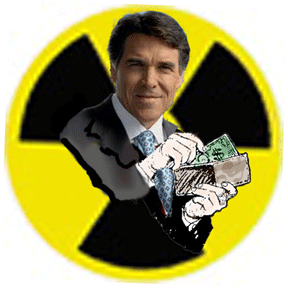
In a letter and proposed regulation, Perry asked FERC to consider issuing new rules to ensure that nuclear and coal-fired plants are compensated not only for the electricity they provide to homes and businesses, but for the reliability they add to the grid…….
What the groups have on their side: While technically housed under the Energy Department, FERC is an independent agency. In the case of Perry’s recommendations, the 5-member commission has the leeway to accept or reject them wholesale. By allowing no more than three commissioners to be from the same party, the commission is supposedly untethered from party influence.
Opposition mounts to radioactive waste near Ottawa River NEWS Oct 02, 2017 by Derek Dunn Arnprior Chronicle-Guide The number of groups and individuals opposed to a planned radioactive waste disposal facility near the Ottawa River continues to mount.
A recent letter to Prime Minister Justin Trudeau by 35 scientists, doctors, elected officials, and leaders of public interest groups and First Nations, urges him to “stand up for the health and safety of Canadians” by suspending what opponents call a giant surface mound about a kilometre from the river.
Multinational corporations have formed Canadian National Energy Alliance to build the disposal facility in Chalk River. It would house contaminated materials from more than 100 buildings on the nuclear laboratories site. It would also contain a small volume of mixed waste from offsite sources.
For 90 years there has been nuclear activity on the shores of the Ottawa, with no solution in place for permanently safeguarding the radioactive waste that is continuously generated. The five-storey high mound would contain mostly low-level waste, starting in 2020, taking up to 1 million cubic metres of waste by 2070.
However, groups like Ottawa Riverkeeper and Concerned Citizens of Renfrew County and Area, worry about leachate from the site making its way into the drinking water for 1 million people.
……McNab/Braeside Coun. Mark MacKenzie, a former Green Party of Canada president, has attended several meetings on the topic. He has also looked closely at the issues involved.
“I’ve got a lot of concerns about it,” MacKenzie said. “That it’s not deep underground tops the list.”
He said by calling it a “near surface” facility, the alliance is attempting to deceive.
The project also doesn’t conform to international standards, he added. And that while only one per cent of the waste is considered of medium level, it will persist for hundreds of thousands of years.
“Any percentage above ground that is supposed to be underground is too much.”
The landfill-grade liner proposed is also a concern, he said. It will eventually break down.
Then there are the players involved: SNC-Lavalin is in court for fraud and corruption; others are British and U.S., hence “not here for the long haul,” MacKenzie said. He said nuclear waste is a Government of Canada problem, not for private corporations.
Trump Admin. Pours $12 Billion Into Dying Nuclear Energy Project In Georgia, Triple Pundit. by Tina Casey on In a last-ditch attempt to save the struggling Vogtle nuclear energy project in Georgia, the U.S. Department of Energy has just proposed adding another $3.7 billion in loan guarantees to the $8.3 billion load it is already carrying, for a total of $12 billion. In a related move, the Energy Department also proposed a regulatory carve-out that would enable nuclear and coal power plants to continue operating, even if less costly alternatives are available.
That’s quite a bit of over-extension to aid a single industry, and it puts President Trump in a tight spot. After all, he is the chief representative of a political party that advocated long and hard against “picking energy winners and losers” during the Obama Administration.
Nuclear energy as a raison d’être
Before digging into this latest episode in the U.S. nuclear energy industry, it’s worth recalling that the Energy Department’s mission is deeply entwined with nuclear energy……
growth in China and India likely won’t be enough to save the global nuclear industry. A report by S&P Global Ratings estimates half of the 99 nuclear reactors currently operating in the United States could be taken offline in the next 17 years. That’s the equivalent of shutting all nuclear reactors in France or Japan — the second- and third-largest atomic powered countries, respectively, by installed capacity. The report thinks America could be nuclear-free by 2055.
Worse, changing political tides in Japan don’t look favorable for nuclear power.
While there’s much uncertainty about where Cameco will be in five years, the current trend doesn’t look very favorable.Investors beware.
Where Will Cameco Corporation Be in 5 Years? Most of the uranium miner’s supply contracts expire by 2021. What happens after that?, The Motley Fool Maxx Chatsko, Oct 3, 2017 The world’s largest uranium miner has been reeling in a long, drawn-out state of misery since the Fukushima nuclear disaster in 2011. Many industrialized nations have revisited their long-term power-generation strategies to include a future without atomic energy. The rise of emission-free wind and solar energy, which continues to outpace even the most optimistic projections, makes it even easier to envision a world with diminishing reliance on nuclear power.
None of that has stopped Cameco Corp (NYSE:CCJ) bulls or management from predicting a brighter future ahead. The company has slashed operations and kept a remarkably healthy balance sheet throughout uranium’s multiyear slide as a global commodity. While it appears to be making all of the right moves today, every day the company inches closer to an existential line in the sand: the year 2021.
That is the year most of its supply contracts expire. Given the current uncertainty surrounding nuclear power, investors shouldn’t be so sure the next round of renewals will be executed in a shareholder-friendly manner. That leads us to ask, where will Cameco Corp be in five years?
The coming contract cliff
Historically speaking, Cameco has managed its portfolio of long-term supply contracts very well. That has insulated the company from the recent downturn in uranium selling prices. For instance, while spot prices are at 12-year lows today, the uranium miner realized a 60% premium to that for every pound sold last year.
The reason is simple: Power companies were locked into higher prices when current contracts were signed. Although fortuitous today, these same forces may also prove problematic moving forward. Why? Uranium prices have trended down, while the uncertainty surrounding the future of nuclear power has trended up. The result: Power companies are hesitant to sign new contracts today out of fear they’ll be locked into higher-than-market prices in future periods……..
all of the projections on which Cameco bases its argument could prove disastrously incorrect. Unfortunately for shareholders, every new data point that comes in seems to hint that may be closer to reality……
growth in China and India likely won’t be enough to save the global nuclear industry. A report by S&P Global Ratings estimates half of the 99 nuclear reactors currently operating in the United States could be taken offline in the next 17 years. That’s the equivalent of shutting all nuclear reactors in France or Japan — the second- and third-largest atomic powered countries, respectively, by installed capacity. The report thinks America could be nuclear-free by 2055.
Worse, changing political tides in Japan don’t look favorable for nuclear power. Prime Minister Shinzo Abe recently dissolved the nation’s lower parliament in an effort to maintain his party’s majority after the general election scheduled for October 22. But in a surprise move, the two largest opposition parties merged into one. A major talking point of the “new” party: making Japan nuclear-free by 2030. Depending on the outcome of the election, the market may know the fate of atomic energy on the island nation well before 2021 — bad news for Cameco’s efforts to renew supply contracts.
Taken together, closing half of American nuclear reactors and all of those in Japan by about 2030 would remove roughly 104 nuclear reactors from operation. Add Germany’s eight nuclear reactors that will be shuttered by 2022, and the world could lose 25% of its nuclear power capacity in the next two decades. Planned additions from China, India, and the rest of the world wouldn’t come close to offsetting the losses……
given the global rise of wind, solar, and liquefied natural gas (LNG) — the last of which is increasingly important to Japan — the days of nuclear power certainly seem to be numbered. Forces both economic and political will be difficult for the industry to overcome.
If additional announcements are made for closures in America or Japan in the near future, it could jeopardize the company’s efforts to sign new long-term supply contracts to replace those that expire in 2021. While there’s much uncertainty about where Cameco will be in five years, the current trend doesn’t look very favorable. Investors beware. https://www.fool.com/investing/2017/10/03/where-will-cameco-corporation-be-in-5-years.aspx
Quoting unnamed sources news portal The Print reported that the damage could be the result of either a collision at sea or accidental scraping while entering the harbour. Officials in the the Navy refused to comment on the incident.
“Repair work on the submarine is likely to be complicated given that the sonar dome is made of titanium, a difficult metal that requires both specialised machinery and manpower to work on. However, the indigenous Arihant nuclear armed submarines are also being made in Visakhapatnam and that could help,” said the report.
INS Chakra, inducted in April 2012, is on ten year lease. The vessel is belongs to Akula-II class of Russian submarine.
The submarine, having displacement of 12,000 tonnes, is powered by a 190 MW reactor with top speed of over 30 knots.











 nuclear-news