America’s Risky Nuclear Buildup https://www.nytimes.com/2017/08/31/opinion/america-nuclear-buildup.html, By STUART ROLLOAUG. 31, 2017 “…….Pyongyang’s displays of its nuclear and missile technology are terrifying. But Washington’s development of new nuclear-weapon and missile technologies is also contributing to global instability. American nuclear advances threaten to start a new arms race and change the logic of mutually assured destruction, which has undergirded nuclear stability since the 1950s.
September 1, 2017
Posted by Christina Macpherson |
USA, weapons and war |
Leave a comment
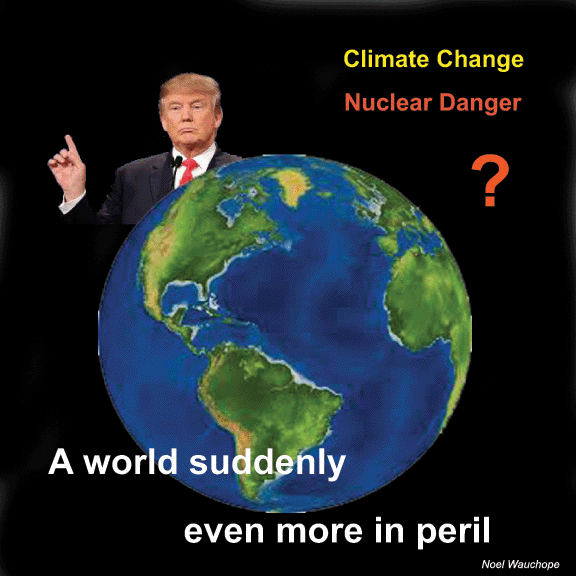
Donald Trump, nuclear war and climate change among gravest threats to humanity, say Nobel Prize winners Acclaimed chemist Peter Agre describes US President as ‘extraordinarily uninformed and bad-natured’ and likens him to ‘a villain in a Batman movie – everything he does is wicked or selfish’ The Independent, Sally Wardle 31 Aug 17, Nobel Prize winners consider nuclear war and US President Donald Trump as among the gravest threats to humanity, a survey has found.
More than a third (34%) said environmental issues including over-population and climate change posed the greatest risk to mankind, according to the poll by Times Higher Education and Lindau Nobel Laureate Meetings.
But amid rising tensions between the US and North Korea, almost a quarter (23%) said nuclear war was the most serious threat.
Of the 50 living Nobel Prize winners canvassed, 6% said the ignorance of political leaders was their greatest concern – with two naming Mr Trump as a particular problem.
Peter Agre, who won the Nobel Prize for chemistry in 2003, described the US President as “extraordinarily uninformed and bad-natured”.
He told Times Higher Education: “Trump could play a villain in a Batman movie – everything he does is wicked or selfish.”
Laureates for chemistry, physics, physiology, medicine and economics took part in the survey, with some highlighting more than one threat. Peace Prize and Literature Prize recipients were not canvassed……http://www.independent.co.uk/news/world/americas/donald-trump-grave-threat-humanity-nobel-prize-winners-nuclear-war-north-korea-climate-change-a7921676.html
September 1, 2017
Posted by Christina Macpherson |
2 WORLD, safety |
Leave a comment

 Contradicting Trump, U.N. Monitor Says Iran Complies With Nuclear Deal, NYT, By RICK GLADSTONE, AUG. 31, 2017 Iran is adhering to the limits placed on its nuclear activities under the 2015 agreement with six world powers, the United Nations monitor said Thursday in a quarterly report that could further complicate President Trump’s vow to find the Iranians in violation of the accord.
September 1, 2017
Posted by Christina Macpherson |
Iran, politics international |
Leave a comment
U.S. pressure or not, U.N. nuclear watchdog sees no need to check Iran military sites, http://www.reuters.com/article/us-iran-nuclear-inspections-idUSKCN1BB1JC , Francois Murphy, VIENNA , 31 Aug 17, – The United States is pushing U.N. nuclear inspectors to check military sites in Iran to verify it is not breaching its nuclear deal with world powers. But for this to happen, inspectors must believe such checks are necessary and so far they do not, officials say.
Last week, U.S. Ambassador to the United Nations Nikki Haley visited the International Atomic Energy Agency (IAEA), which is scrutinizing compliance with the 2015 agreement, as part of a review of the pact by the administration of President Donald Trump. He has called it “the worst deal ever negotiated”.
After her talks with officials of the U.N. nuclear watchdog, Haley said: “There are… numerous undeclared sites that have not been inspected. That is a problem.” Iran dismissed her demands as “merely a dream”.
The IAEA has the authority to request access to facilities in Iran, including military ones, if there are new and credible indications of banned nuclear activities there, according to officials from the agency and signatories to the deal.
But they said Washington has not provided such indications to back up its pressure on the IAEA to make such a request.
“We’re not going to visit a military site like Parchin just to send a political signal,” an IAEA official said, mentioning a military site often cited by opponents of the deal including Iran’s arch-adversary Israel and many U.S. Republicans. The deal was struck under Trump’s Democratic predecessor Barack Obama.
IAEA Director-General Yukiya Amano frequently describes his Vienna-based agency as a technical rather than a political one, underscoring the need for its work to be based on facts alone.
The accord restricts Iran’s atomic activities with a view to keeping the Islamic Republic a year’s work away from having enough enriched uranium or plutonium for a nuclear bomb, should it pull out of the accord and sprint towards making a weapon.
September 1, 2017
Posted by Christina Macpherson |
Iran, politics international |
Leave a comment
 WARNING: “Credible threat of severe accident at two nuclear reactors” due to
  Hurricane Harvey — “Clear potential for major disaster” — Plant “could be overwhelmed by raging flood waters” — Officials refuse to provide public with information http://enenews.com/warning-credible-threat-of-severe-accident-at-two-nuclear-reactors-due-to-hurricane-harvey-clear-potential-for-major-disaster-plant-could-be-overwhelmed-by-raging-flood-waters-of
|
By ENENews Reuters, Aug 29, 2017 (emphasis added): [W]atchdog groups called for the [South Texas Project nuclear] facility to shut due to Tropical Storm Harvey… The groups expressed concern about workers at the plant and the safety of the general public if Harvey caused an accident at the reactors… When asked if the plant would shut if flooding worsened, [spokesman Buddy Eller] said “We are going to do what’s right from a safety standpoint.”… Eller said 250 “storm crew” workers were running the plant… Personnel from the U.S. Nuclear Regulatory Commission (NRC) are also at the plant, assessing storm conditions.
teleSUR, Aug 29, 2017: Groups Warn of Nuclear Accident… In the midst of Tropical Storm Harvey’s drenching onslaught, energy watchdogs are sounding the alarm over the continued operation of two nuclear reactors in East Texas that are running at full capacity despite what they claim is the clear potential for a major disaster… [The nuclear plant] risks being flooded as water pours across the region, threatening the embankment wall shielding the power plant… Beyond Nuclear is one of three groups calling for an immediate shutdown of the twin reactors in case the embankment wall surrounding the plant is breached, which could lead to electrical fires and “cascading events” could result in an accident that threatens major core damage… Some fear the threat of a new Fukushima-style disaster.
Common Dreams, Aug 29, 2017: The South Texas Project nuclear power facility in Bay City, Texas could be under extreme threat from historic flood waters, groups warned… energy watchdogs groups are warning of “a credible threat of a severe accident” at two nuclear reactors… [They] are calling for the immediate shutdown of the South Texas Project (STP) which sits behind an embankment they say could be overwhelmed by the raging flood waters and torrential rains… Both the U.S. Nuclear Regulatory Commission and the STP operator have previously recognized a credible threat of a severe accident initiated by a breach of the embankment wall that surrounds the 7,000-acre reactor cooling water reservoir,” said [Beyond Nuclear’s] Paul Gunter… [Harvey] was declared the most intense rain event in U.S. history… [B]reach of the embankment wall surrounding the twin reactors would create “an external flood potentially impacting the electrical supply from the switchyard to the reactor safety systems.” In turn, the water has the potential to “cause high-energy electrical fires and other cascading events initiating a severe accident leading to core damage.” Even worse, they added, “any significant loss of cooling water inventory in the Main Cooling Reservoir would reduce cooling capacity to the still operating reactors that could result in a meltdown.” With the nearby Colorado River already cresting at extremely high levels and flowing at 70 times the normal rate, Karen Hadden, director of SEED Coalition, warned that the continue rainfall might create flooding that could reach the reactors… “Our 911 system is down, no emergency services are available, and yet the nuclear reactors are still running… This is an outrageous and irresponsible decision,” declared [Susan Dancer of the South Texas Association for Responsible Energy]. “This storm and flood is absolutely without precedent even before adding the possibility of a nuclear accident that could further imperil millions of people who are already battling for their lives.” As Harvey hovers over the coastal region, heavy rains are expected to persist for days…
Beyond Nuclear, Aug 29, 2017: The NRC and South Texas have refused to provide any public information on the status of the water level within in the reservoir…
See also: Nuclear Worker: “Imminent flood coming” near nuke plant from Hurricane Harvey… “Potentially catastrophic”… Running out of food… Working tirelessly to manage problems… Area turned “upside down” (VIDEO)
|
September 1, 2017
Posted by Christina Macpherson |
safety, USA |
Leave a comment
 Power company kills nuclear plant, plans $6 billion in solar, battery investment
Duke Energy Florida is just the latest utility to walk away from nuclear. Ars Technica MEGAN GEUSS – 8/31/2017, On Tuesday, power provider Duke Energy Florida announced a settlement with the state’s public service commission (PSC) to cease plans to build a nuclear plant in western Florida. The utility
INSTEAD INTENDS TO INVEST $6 BILLION
in solar panels, grid-tied batteries, grid modernization projects, and electric vehicle charging areas. The new plan involves the installation of 700MW of solar capacity over four years in the western Florida area.There’s excitement from the solar industry, but the announcement is more bad news for the nuclear industry. Earlier this year, nuclear reactor company Westinghouse declared bankruptcyas construction of its new AP1000 reactors suffered from contractor issues and a stringent regulatory environment. Two plants whose construction was already underway—the Summer plant in South Carolina and the Vogtle plant in Georgia—found their futures in question immediately.
At the moment, Summer’s owners are considering abandoning the plant, and Vogtle’s owners are weighing whether they will do the same or attempt to salvage the project.
Duke Energy Florida hadn’t started building the Levy nuclear plant, but it did have plans to order two AP1000 reactors from Westinghouse. Now that Westinghouse company is in dire financial straits, the Florida utility decided that its money is better spent elsewhere.
Just last week, Duke told its PSC that it would have to increase rates by more than eight percentdue to increased fuel costs. But with the new settlement that directs the utility toward solar and storage, customers will see that rate hike cut to 4.6 percent…….
overall, the changes will save residential customers future nuclear-related rate increases. Those customers will see a cost reduction of $2.50 per megawatt-hour (MWh) “through the removal of unrecovered Levy Nuclear Project costs,” the utility said.
The 700MW of solar won’t exactly cover the nameplate capacity of the Levy plant, which was supposed to deliver 2.2 gigawatts to the region. But the Tampa Bay Times wrote that Duke “is effectively giving up its long-held belief that nuclear power is a key component to its Florida future and, instead, making a dramatic shift toward more solar power.”……https://arstechnica.com/science/2017/08/florida-power-company-exchanging-nuclear-plans-for-solar-plans-cutting-rates/
 |
Click here to Reply or Forward
|
3.9 GB (26%) of 15 GB used
Last account activity: 30 minutes ago
Details
September 1, 2017
Posted by Christina Macpherson |
business and costs, renewable, USA |
Leave a comment
US state department to abolish climate change envoy Climate Home 29/08/2017, Critics say Rex Tillerson’s restructuring will further diminish US’ standing in international affairs, By Karl Mathiesen
Secretary of state Rex Tillerson has informed Congress that the US will no longer have a special envoy for climate change, the official that has led delegations to UN climate talks since 2009.
In a letter (below) addressed to Bob Corker (R-Tenn), the chairman of the Senate committee on foreign relations, Tillerson outlined a plan to abolish 36 out of 66 special envoy positions.
Some of the positions would be entirely scrapped, said Tillerson, or “if an issue no longer requires a special envoy or representative, then an appropriate bureau will manage any legacy responsibilities”. This was the case with climate change, which will now be managed under the Bureau of Oceans and International and Scientific Affairs (OES)……..
Under president Donald Trump, the US administration has announced plans to withdraw from the Paris climate agreement, although it remains a party to the accord until it can formally withdraw in 2020……..
In May, in response to budget proposals to cut 32% from his budget, Tillerson agreed to slim down the department. Other state department cuts under Trump include abolishing the Global Climate Change Initiative, which funds the UN climate process. http://www.climatechangenews.com/2017/08/29/us-state-department-abolish-climate-change-envoy/
September 1, 2017
Posted by Christina Macpherson |
climate change, politics international, USA |
Leave a comment
He also said Australia would be wise to make ourselves less of a target to an angry North Korea.
Speaking privately to the Associated Press, officials in Washington echo the warning that Mr Trump’s now former chief strategist Steve Bannon made in his last media interview before losing his job earlier this month: it is too late for a pre-emptive strike.
There’s no military solution, forget it,” Mr Bannon told the American Prospect in an August 16 interview.
“Until somebody solves the part of the equation that shows me ten million people in Seoul don’t die in the first 30 minutes from conventional weapons, I don’t know what you’re talking about, there’s no military solution here, they got us.”
North Korea nuclear war: Why chances of conflict are higher than ever A FORMER ambassador to South Korea reveals how war could start in North Korea. And all it will take is one tiny slip up. up. news.com.au 31 Aug 17 Debra Killalea @DebKillalea THE risk of conflict breaking out on the Korean Peninsula has never been greater as the margin for error shrinks.
That’s the damning assessment by a former Australian ambassador to South Korea who warned the world was running out of options for dealing with Kim Jong-un.
Speaking to news.com.au, former senior Australian diplomat Mack Williams said the Peninsula has faced crisis points before, including in the 1990s.
He warned this time was different, citing North Korea’s weapons stockpile and an unpredictable US leader as reasons the game has changed.
The ambassador to South Korea from 1994-1998 said the difference between now and then was that the North had upped the ante.
“North Korea has developed missiles and its nuclear technology is capable of causing damage.
“Its arsenal is also more difficult to take out.”
Mr Williams, who has a long career in Asian diplomacy, said while no one wanted war, the world had to accept it could happen, and all it would take was one simple error.
“What ante is left in this game?” he said.
“What can (US President Donald) Trump do? He could try and take out North Korea’s rockets but imagine if one hits China or even Russia.”………
“One wrong mistake would be apocalyptic for Japan,” he said.
“Now there are some who believe antimissile capabilities offer some protection.
“But there’s not enough defence against his (Kim’s) missiles.”
He said Tokyo appeared to have played the right card by not attempting to fire at the North Korean missile.
Mr Williams said if Japan shot it down, Kim could retaliate and if it missed then the country would be humiliated.
“On this occasion I believe they did the right thing by not doing anything.”
Writing in IT news, reviews, and analysis site, Ars Technica, writer Sean Gallagher writes the US and Japan took the best course of action.
Missing could have far-reaching political implications and potentially suggest that anti-ballistic missile systems are incapable of protection, he writes.
…… RISK GROWS
Mr Williams said regardless of how conflict broke out, whether it was a misfire or a deliberate act, Seoul would suffer first.
“Hundreds of thousands would be killed in just minutes,” he said.
“No matter how it starts and whether it’s Guam or Japan that’s the target, Seoul will be the first casualty.
“North Korea has a greater array of rockets across the border and America would need hundreds of smart bombs and boots on the ground.
“There would be no way to stop the military bombardment on Seoul.”
Mr Williams said while South Koreans were generally stoic many were becoming increasingly concerned given the DPRK’s missile build up.
“This isn’t South Korea of the 1950s, it’s a modern developed country and the moral obligation to protect them is huge.
“Otherwise all the sacrifices of the Korean War would be for nothing.”
Mr Williams said while the US would ultimately win any conflict and North Korea would be annihilated, the human cost would be huge.
Beijing doesn’t want to see North Korea collapse or a nuclear fight or fallout on its border.
“All hell would break loose,” he said.
He also said Australia would be wise to make ourselves less of a target to an angry North Korea.
‘THEY GOT US’
The US president’s language suggests he’s rethinking any military options that might allow him to knock out North Korea’s small but growing nuclear arsenal and ballistic missile range.
Speaking privately to the Associated Press, officials in Washington echo the warning that Mr Trump’s now former chief strategist Steve Bannon made in his last media interview before losing his job earlier this month: it is too late for a pre-emptive strike.
There’s no military solution, forget it,” Mr Bannon told the American Prospect in an August 16 interview.
“Until somebody solves the part of the equation that shows me ten million people in Seoul don’t die in the first 30 minutes from conventional weapons, I don’t know what you’re talking about, there’s no military solution here, they got us.”
debra.killalea@news.com.au
September 1, 2017
Posted by Christina Macpherson |
general |
1 Comment
 Donald Trump’s nuclear obsession with Iran is misplaced, The US president would be better advised to try defusing tensions with North Korea, Ft.com Roula Khalaf, 30 Aug 17,
Donald Trump had two nuclear tantrums this summer, though you may know about only one of them. He warned North Korea it would face “fire and fury like the world has never seen” if it made further threats to the US, and set much of the world fretting about nuclear war as a consequence. The former director of national intelligence James Clapper noted that there is nothing to stop Mr Trump from carrying out a first strike, which, as he rightly puts it, is “pretty damn scary”. Also scary is Mr Trump’s determination to reopen another nuclear dispute that was parked in 2015, thanks to deft diplomacy by his predecessor. He doesn’t rage as much about Iran as North Korea but Mr Trump hates the Iran nuclear deal, which rolled back Tehran’s enrichment programme in exchange for a lifting of international sanctions. Every time the state department confirms Iran is in compliance with it (Congress mandates this every 90 days), the president has a fit.
This summer, according to US media, during one such episode, Mr Trump ordered his lieutenants to come up with a reason why Iran is flouting the agreement next time they report back to him. For foreign policy watchers, this brought back memories of George W Bush’s obsession with Saddam Hussein and the resulting politicisation of intelligence on weapons of mass destruction to justify the invasion of Iraq. The consequences of that misguided adventure are still spilling Iraqi and American blood……
With the crisis intensifying in North Korea — which, unlike Iran, does have nuclear weapons — ensuring an Iranian nuclear programme stays inactive for a decade is rather reassuring. Though the circumstances and the nature of the regimes of North Korea and Iran are different, the same painstaking multilateral diplomacy that produced the deal with Tehran will be needed to resolve the stand-off with Pyongyang peacefully….
while it would have been preferable to force Iran into a total surrender, it was not possible. If there had been a better deal to be had, the six world powers involved in the talks would have negotiated it. Mr Trump fancies himself as a master negotiator, but he would meet his match if he sat down with the Iranians. The US administration is under the impression that undermining the nuclear agreement would force Iran into submission to its Sunni Arab neighbours. More likely, quite the opposite would happen. Mr Trump is obsessing about Iran for the wrong reasons. More useful would be to study the nuclear agreement for the lessons it might offer about dealing with North Korea.
roula.khalaf@ft.com https://www.ft.com/content/3534bbf6-8c96-11e7-9084-d0c17942ba93
September 1, 2017
Posted by Christina Macpherson |
Iran, politics international, USA |
Leave a comment
Houston: A Global WarningThe devastation of Hurricane Harvey marks a turning point and raises the terrible possibility that we’ve entered the age of climate chaos, Rolling Stone, By Jeff Goodell, 31 Aug 17, Let there be no doubt: the horrific damage wrought by Hurricane Harvey was an almost entirely man-made catastrophe, one fingerprinted by all-too-human neglect, corruption and denial. If we needed a reminder of the power of water to destroy an American city, Hurricane Harvey provided it. In Houston, a fast-growing metropolis of more than 2 million people, it wasn’t the wind that was so damaging, or a storm surge pushing in – it was just water everywhere, falling for days in biblical torrents and transforming highways into rivers, flowing into homes, killing dozens, sending tens of thousands of people fleeing for higher ground. It was a terrifying and deadly display of what happens when nature collides with urban life on a planet radically altered by climate change…….
given what scientists know now about how rising CO2 levels impact the climate, it’s wrong to dismiss Harvey as a purely “natural” event.
First, thanks to increasing carbon pollution, the waters in the Gulf of Mexico, over which Harvey formed, were about five degrees higher than average. “As the world warms, evaporation speeds up,” explained climate scientist Katherine Hayhoe. So on average, there is more water vapor in the air now to sweep up and later dump over land. Also, because hurricane winds are generated by the difference in temperature between the atmosphere and oceans, the warmer waters tend to intensify a hurricane’s gales.
Second, a warming climate fuels sea-level rise, which is the result of the thermal expansion of the oceans and the melting of glaciers. Higher seas mean bigger storm surges, which can be devastating (recall the destruction wrought by Hurricane Sandy). But when the seas are higher, it also means that it is more difficult to drain rainwater into the ocean. And that is what happened in Houston: The water had nowhere to go.
This was a disaster foretold. ……
we’ve allowed cities like Houston to become empires of denial. If you set out to design a metropolis that is poorly adapted to the future, you couldn’t do much better than Houston. Consider the rate at which it’s paved over the wetlands, nature’s sponges for absorbing water. Thirty percent of the surrounding coastal prairie wetlands was developed between 1992 and 2010, creating what amount to concrete catch basins that capture the water and funnel it toward destruction. In Houston, the bayou is just a place to drive your Lexus – this is a city that’s said to have 30 parking spots for every resident.
Houston proudly touts itself as “the City With No Limits,” playing up its Wild West heritage of endless land and opportunity. But it is also the largest U.S. city to have no zoning laws, meaning you can build whatever you want, wherever you want. While that makes developers happy, it’s not how you build a climate-resilient city. According to a Washington Post investigation, more than 7,000 residential buildings have been constructed in 100-year FEMA-designated flood plains since 2010. But given that FEMA’s flood maps haven’t been updated to reflect sea-level rise and other factors, the actual number of new buildings constructed in high-risk places is likely much larger. And this is true not just in Houston but in Miami, South Carolina and every other flood-prone region. Ten years ago, Houston officials banned development in areas with high risk of flooding. But developers sued, until the policy was weakened by the City Council. Government officials tried putting up flood gauges in low-lying areas to show how high the water could get during a hurricane, but pressure from real-estate agents got the signposts removed.
The feds bear some responsibility for the disaster-friendly design of Houston, too. Virtually all flood insurance in America is administered through the National Flood Insurance Program, which is supposed to prevent risky development by requiring better building standards and relocation of buildings that flood repeatedly. But since it was founded in 1968, the program has been contorted by developers, real-estate agents, and politicians lobbying for special treatment for their constituents. In places like Houston, the program helps enable development in high-risk areas by offering subsidized insurance rates that don’t reflect the real cost of living in flood-prone areas, as well as by offering repeat payouts for often-flooded homes. Even before Harvey, the program was already $25 billion in debt……….
we are likely to get a lot of rah-rah about rebuilding Houston bigger and better than before, some marginal improvements in building codes, and a lot of fighting in Congress over how much money to spend on recovery. President Trump will tout the heroics of the rescuers and the TV ratings of the storm – he is his own empire of denial. He not only pulled the U.S. out of the Paris climate deal, but just weeks before Harvey hit, he rolled back common-sense requirements for flood protection in federal projects.
Beyond the post-storm platitudes, it’s not hard to foresee what is coming. There will be another hurricane – next time it might hit Charleston or Miami or Norfolk, and it will destroy buildings and highways built in harm’s way and it will again cause billions of dollars worth of damage. Eventually, taxpayers in Kansas will get tired of bailing out people who live on the coast, and disaster-relief funds will dry up. As seas rise, mortgage companies will stop writing 30-year loans for homes by the sea. Bond ratings for cities will fall. Coastal roads will be washed away. Airports will be flooded. And the great coastal retreat will begin.
September 1, 2017
Posted by Christina Macpherson |
climate change, USA |
Leave a comment
As Harvey Raged, Workers Stayed at Nuclear Plant’s Controls, Bloomberg, By Mark Chediak
August 31, 2017,
-
Despite heavy rain, South Texas Project runs at full capacity
-
Biggest challenge is finding workers who can return to plant
As Hurricane Harvey bore down on them, workers remained at the controls of Texas’s biggest nuclear power plant,  keeping the lights on for 2 million customers even while some of their own homes were flooded.
Teams of employees have been stationed at the South Texas Project power plant since early Friday. While the site is 90 miles (145 kilometers) southwest of Houston and avoided the worst of the deadly storm, it had to cope with heavy rain and flooding on nearby roads that made it difficult for people to get around.
Plant technicians and engineers were organized into special storm-team crews, working rotating 12-hour shifts, washing clothes in the showers and sleeping on cots set up before Harvey hit. Throughout the storm, the concrete-domed twin reactors have continued operating at full capacity, providing electricity for Texans who can still get service amid a historic flood.
“Really, it’s a matter of getting the sleep you need so you are prepared and ready for the next shift,” said Bob Tatro, a 30-year veteran at the plant and a shift manager for a storm crew that’s kept the plant operating……..
Despite as many as 10 inches of rain on Monday, the nuclear plant near the Gulf of Mexico hasn’t been threatened by the rising waters in nearby tributaries, Eller said. Winds from Harvey never reached hurricane force at the site, which would have required the plant to shut down, he said. There was no flooding at the facility, which is near a wildlife nature preserve.
Workers have been making sure the site’s storm drains are clear and there is enough potable water, said Kurt Moorefield, a shift manager who has been at the plant since Friday.
‘Biggest Issue’
“The biggest issue is finding other employees who can safely make it back to the site,” Eller said. Some workers’ homes have flooded and the company was focused not only on keeping the plant running but helping to assist employees displaced by the storm, he said……..
About 250 operators, engineers, maintenance and other support staff have been stationed at the 2,700-megawatt plant since the storm hit. Additional workers were trickling in to provide help as the weather permitted, and the company was looking to transition back to normal staffing levels, Eller said……..https://www.bloomberg.com/news/articles/2017-08-30/as-harvey-raged-workers-slept-on-cots-to-keep-nuclear-power-on
September 1, 2017
Posted by Christina Macpherson |
climate change, USA |
Leave a comment
 Time for the energy sector to self-correct. EE, August 15th, 2017, by Prof. Hartmut Winkler, University of Johannesburg, May and June 2017 will go down as two of the most dreadful months in the history of the South African power utility Eskom. Its credibility in the eyes of the public has reached rock bottom after a series of well-publicised scandals.
Following the suspension of the then acting Eskom CEO, Matshela Koko, over a large contract allegedly benefitting his step-daughter, the nation was stunned by the reinstatement of the former CEO, Brian Molefe, who had previously left the utility under a cloud. The saga also forced the power utility to face the wrath of the parliamentary portfolio committee on Public Enterprises.
Highly damaging revelations followed from leaked emails, corroborating the findings of the Public Protector that Eskom’s leadership had allegedly irregularly assisted the Gupta family’s Oakbay Investments in securing the Optimum mine and the associated coal supply contract. The emails apparently also highlighted indefensibly close links between the Guptas and specific Eskom board members and executives. To top it off, the R4-billion Duvha boiler replacement was inexplicably awarded to a Chinese company, at a much higher cost than proposed by its competitors.
The scale of these alleged transgressions and the initial unwillingness or inability of government to deal with these matters has generated the impression that there are other agendas at play. It suggests that, like many other state-linked entities, Eskom has been taken over by persons furthering individual interests at the expense of the national good, a phenomenon now referred to as state capture.
This further raises the suspicion that the brazen taking of sides in the rollout of new generating capacity is also driven by other motives. Koko and Molefe have been outspokenly pro-nuclear and have blocked the long outstanding conclusion of power purchase agreements with successful bidders under the Renewable Energy Independent Power Producers Procurement Programme (REIPPPP). The power utility appears to have also promoted the distorted narrative that renewables are chiefly responsible for job losses at Mpumalanga coal mines.
The latest REIPPPP projects offer vastly reduced power purchase tariffs compared to the early rounds. Most renewables are now clearly cheaper than the cost of new coal and nuclear. Therefore Eskom’s opposition to REIPPPP on affordability grounds sounds decidedly hollow. The perception has therefore been created that Eskom is part of an effort to sabotage the renewable energy sector, which is the nuclear industry’s chief competitor in South Africa’s future energy landscape……..
While at this stage not directly compromised in the manner of Eskom, the nuclear industry too is in need of deep introspection. The sector has failed to condemn the irregularities and presidential interference in the nuclear procurement process to date, which saw Russian developer Rosatom allegedly placed in a dominant position over its competitors.
The Western Cape High Court ruling that the Russian nuclear agreement is invalid is viewed in some quarters as merely a speed hump rather than a call to return to the drawing board. NECSA board chair Kelvin Kemm’s defiant pronouncement in Moscow that the nuclear deal will be finalised before year end, probably to Rosatom’s advantage, is the worst thing the nuclear sector could do right now. Whatever the intention, such sabre rattling will merely harden the opposition from a public seemingly skeptical of all things nuclear.
There are respected people working in the nuclear field who genuinely believe that nuclear technology has a role in the future South African energy mix. These nuclear advocates have to now recognise that rehabilitating their sector requires the rebuilding of public trust, and honest attempts to allay concerns about costs, safety and potential corruption associated with new builds.
The renewable energy sector has been riding high on the back of positive international sentiment and the successful implementation of projects from the first three REIPPPP phases. That ride is however about to get much bumpier as the sector runs into opposition from unions and government.
While this opposition is to some degree based on misinformation, possibly planted deliberately, the renewable industry also needs to re-evaluate its tactics. Green hype and crude PR are no longer going to cut it, and current and past mistakes are about to be exploited ruthlessly. As with nuclear, sober engagement and diplomacy are now crucial to take the renewable energy sector forward to its rightful place in South Africa’s energy landscape. Send your comments to energize@ee.co.za http://www.ee.co.za/article/time-energy-sector-self-correct.html
September 1, 2017
Posted by Christina Macpherson |
secrets,lies and civil liberties, South Africa |
Leave a comment
The U.S. Backs Off Nuclear Power. Georgia Wants to Keep Building Reactors, NYT, By BRAD PLUMER, AUG. 31, 2017 WASHINGTON — Even as the rest of the United States backs away from nuclear power, utilities in Georgia are pressing ahead with plans to build two huge reactors in the next five years — the only nuclear units still under construction nationwide.
September 1, 2017
Posted by Christina Macpherson |
business and costs, USA |
Leave a comment
German region to hand out iodine over Belgium nuclear fears, https://www.washingtonpost.com/world/europe/german-region-to-hand-out-iodine-over-belgium-nuclear-fears/2017/08/31/2ff1bdd0-8e4c-11e7-9c53-6a169beb0953_story.html?utm_term=.b575ae8357bb By Associated Press August 31 BERLIN — A German border region is preparing to hand out potassium iodide tablets to residents who want them in case of an accident at a nuclear power plant in Belgium that has caused friction between the two countries.
Local officials in the Aachen area received permission from the regional government to distribute the tablets as a precaution amid longstanding concerns in Germany over the safety of the Tihange plant, less than 70 kilometers (43 miles) away. They’re meant to prevent thyroid cancer in case of radioactive contamination.
From Friday through Nov. 15, people under 46 can apply online for a coupon for the iodine tablets, which they can pick up free at pharmacies.
Germany plans to switch off all its nuclear reactors by 2022 and already has shut its oldest plants.
September 1, 2017
Posted by Christina Macpherson |
Germany, safety |
Leave a comment
Group: Water plan to remove Fukushima fuel ‘not viable’ http://www.asahi.com/ajw/articles/AJ201708310042.html, By KOHEI TOMIDA/ Staff Writer, August 31, 2017 The Asahi Shimbun A decommissioning organization on Aug. 31 formally recommended bypassing a safety measure to remove melted nuclear fuel from crippled reactors at the Fukushima No. 1 nuclear plant.
The Nuclear Damage Compensation and Decommissioning Facilitation Corp. (NDF) urged the central government and Tokyo Electric Power Co. to use the “airborne method” in which the melted fuel is removed even when the water level in the reactor containment vessel is kept low.
Proposals have been made to fill the containment vessels with water to restrain the spewing of radioactive materials during the fuel removal process.
But the NDF said that method is currently not viable because of the difficulties in patching up the holes in the containment vessels.
The government and TEPCO are expected to decide on a fuel removal method in September and confirm the specific steps next fiscal year.
The removal of equipment and other structural objects in and around the reactors must be completed before work can start on taking out melted fuel that remains in the pressure vessels.
The nuclear fuel that has seeped through the pressure vessels and landed at the bottom of the containment vessels will be the first to be removed.
Work will also have to be done to develop a robot arm that can remove fuel from the side of the containment vessel. Under the current schedule, removal of the melted fuel will start at one of the three, No. 1 to No. 3, reactors of the Fukushima No. 1 plant in 2021.
However, officials still do not know the exact location of the melted fuel in the reactors.
Hajimu Yamana, NDF president, pointed out there would likely be a need to combine various methods instead of pushing through with one specific procedure to meet the scheduled deadline.
September 1, 2017
Posted by Christina Macpherson |
Fukushima continuing |
Leave a comment








 nuclear-news