Denying Hurricane Harvey’s climate links only worsens future suffering, The variables in the climate change formula are mitigation, adaptation, and suffering. Denying the problem loads up on the suffering. Guardian, Dana Nuccitelli, 5 Sept 17, Human-caused climate change amplified the damages and suffering associated with Hurricane Harvey in several different ways. First, sea level rise caused by global warming increased the storm surge and therefore the coastal inundation and flooding from the storm. Second, the warmer atmosphere holds more water vapor, which intensifies extreme precipitation events like the record-shattering rainfall associated with Harvey. Third, warmer ocean waters essentially act as hurricane fuel, which may have made Harvey more intense than it would otherwise have been.
There are other possible human factors at play about which we have less certainty. ……
Other human activities also worsened Harvey’s impacts. For example, Houston suffers from urban sprawl, covering a larger area (nearly 600 square miles) than the cities of Chicago, San Francisco, Washington DC, Boston, Manhattan, and Santa Barbara combined. With urban sprawl and poor planning came expansive impervious surfaces – absorbent soil covered instead by concrete and asphalt, increasing flood risks. Houston’s lack of zoning laws combined with the National Flood Insurance Program (NFIP) also encouraged development in flood prone areas.
We’re subsidizing risky behavior
Private insurance companies don’t want to insure homes that face a significant risk of flooding, but with a lack of regulation and/or government insurance offered by NFIP, development in relatively high-risk flood areas can be profitable. That is, until a flood strikes. 85% of Houston homeowners don’t have flood insurance and will be unable to recover most of their losses from Hurricane Harvey. Others are covered by NFIP, which was already $24 billion in debt before Harvey. That’s because NFIP hasn’t been charging sufficiently high premiums, in large part because it has underestimated flood risks based on maps and projections that are sometimes decades out of date. And climate change is amplifying those flood risks…….
the government is effectively subsidizing the costs associated with living in high-risk flood areas. Between 1978 and 2005, NFIP paid out $5.5 billion (9.6% of paid claims) to just 30,000 properties (0.6% of the total covered by flood insurance) that each flooded an average of five times. Because the NFIP premiums are too low, taxpayers end up footing billions of dollars of those payouts.
The situation is analogous to climate change. Without a price on carbon pollution, industries and individuals can dump carbon in the atmosphere for free. But that carbon pollution has costs that we eventually pay, in the form of increased property damage due to amplified storms like Hurricane Harvey, for example. Or from higher food prices when farmers are struck by an intensified drought, or decreased worker productivity in heat waves, or valuable coastal property lost to encroaching sea levels, or homes lost to bigger wildfires and increased costs to fight them – the list of climate costs goes on and on.
Those costs are eventually paid by taxpayers, but we’re picking up the tab for the polluters. It’s effectively a subsidy for the fossil fuel industry to the tune of trillions of dollars every year, and as with artificially cheap flood insurance premiums, we’re subsidizing risky behavior that ultimately causes severe damages.
The Trump administration is in denial
Ten days before Hurricane Harvey hit, the Trump administration rolled back the Federal Flood Risk Mitigation Standard. The policy was implemented by the Obama administration, and required taxpayer-funded public infrastructure projects to plan for future flooding risks. Much infrastructure within and around Houston is now underwater, and accounting for future flooding risks when replacing it would be smart. But the Trump administration considered this policy a burdensome regulation, claiming that the infrastructure permitting process has too many “inefficiencies.” Apparently those “inefficiencies” include saving taxpayer money by reducing future flood losses.
Robin des Bois 30th Aug 2017, Within a few days, unless an accident occurs, the Pacific Egret will enter the North Korean missile influence area. The Pacific Egret carries 8 tons of MOX, a nuclear fuel made in France containing 8 to 10% of plutonium mixed with enriched uranium.
This civil bomb left the French port of Cherbourg on July 5, 2017. After having sailed down the Atlantic Ocean, passed off South Africa, crossed the Indian Ocean and the Pacific Ocean, the MOX is expected to be unloaded in the small private port of the Japanese nuclear power plant in Takahama, facing North Korea.
Once again, the French government, Areva and the Nuclear Safety Authority have taken the irresponsible risk of permitting and undertaking a nuclear expedition bound for an unsteady zone in all political, geological and climatic respects. http://www.robindesbois.org/en/moxquitue-n2/
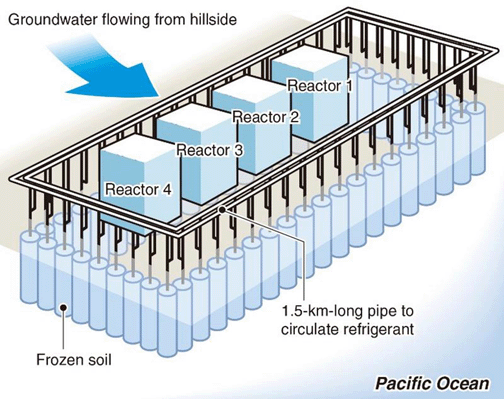
Tokyo Electric Power Company (TEPCO) has announced that the “ice wall” (formally known as the “Land-Side Impermeable Wall”) under construction at the crippled Fukushima Daiichi nuclear power plant in Japan has been
critically affected by rainfall from recent typhoons that have melted parts of the ice structure, allowing new pathways for highly contaminated waterto leak from the basements of the reactor buildings. http://enformable.com/2016/09/ice-wall-fukushima-daiichi-damaged-recent-typhoons-japan/
Allies seek to deploy aircraft carrier, strategic bomber in response to N.K. nuke test, Yonhap News, 2017-09- SEOUL, Sept. 4 — South Korea and the United States will seek to deploy a nuclear-powered aircraft carrier, strategic bombers and other powerful assets to the Korean Peninsula as a response to North Korea’s latest nuclear test, Seoul’s defense ministry said Monday.
In its report to the National Assembly’s defense committee, the ministry also said that its military will stage a unilateral live-fire drill, which involves Taurus air-to-surface guided missiles mounted on its F-15K fighter jets, this month. The missile with a range of 500 kilometers is capable of launching precision strikes on the North’s key nuclear and missile facilities.
“We will push for the option of deploying strategic assets such as the U.S. carrier strike group and strategic bombers after consultation with the U.S.,” the ministry said.
The show-of-force measures were unveiled a day after Pyongyang conducted what it claims to be a test of a hydrogen bomb mountable onto an intercontinental ballistic missile, sharply raising military tensions.
At the parliamentary session, Defense Minister Song Young-moo said that during his recent talks with U.S. Defense Secretary James Mattis, he demanded that the U.S. deploy its strategic assets to Korea on a “regular” basis. He made the demand, citing local politicians’ calls for the redeployment of U.S. tactical nukes.
S.Korea, US to lift warhead weight limit on South Korean missiles | 04 Sept 2017 | The US agreed to allow South Korea deploy heavier warheads on its missiles after the latest nuclear test by Pyongyang. The existing limit set in a missile pact between Washington and Seoul is 500 kg. The agreement to lift the weight limit was reached by US President Donald Trump and his South Korean counterpart Moon Jae-in in a phone call on Monday, the South Korean presidential office said in a statement. With tensions rising on the Korean peninsula, Donald Trump also gave “conceptual approval” for billions worth of US weapons to be sold to South Korea.
Florida officials begin ordering evacuations as Hurricane Irma intensifies to a Category 5 storm, WP
By Francisco Alvarado, Mark Berman and Sandhya Somashekhar September 5 KEY WEST, Fla. — Another monster storm is hurtling closer to the United States, this time threatening Florida, where officials announced mandatory evacuations Tuesday in advance of what forecasters say could be the most powerful hurricane to strike the Atlantic coast in more than a decade.
Even as millions across Texas picked up the pieces after Hurricane Harvey, which battered that region with record-setting rain last week and was blamed for at least 60 deaths, Hurricane Irma gathered strength in the ocean, registering as a Category 5 with winds in excess of 180 miles per hour.
Concern centered particularly on the Florida Keys, a chain of islands at the southern tip of the state that is a tourist hot spot and home to more than 80,000 residents. It is in the direct path of the storm as currently forecast, leading local officials there to announce that the area would be under mandatory evacuation orders beginning Wednesday.
ARTMS Products, Inc., a Vancouver-based medical technology company, is pleased to announce that it has entered into a strategic partnership with Alliance Medical to enable and demonstrate an alternative, non-reactor supply of technetium-99m (Tc-99m) within the United Kingdom. ARTMS will provide to Alliance the hardware, know-how, and proprietary consumables to gain regulatory marketing approval within the UK and subsequently implement commercial supply of accelerator-, or cyclotron-produced Tc-99m. This technology will enable a reduction in the reliance in the UK of foreign, subsidized, reactor-based medical isotope production; enhancing supply reliability and eliminating the use of enriched uranium as a source of life-saving medical isotopes.
Tc-99m is used in over 80% of all nuclear medicine imaging procedures in areas such as cardiology, oncology, and neurology. Typically sourced from an ageing fleet of global nuclear reactors, this important isotope has been subjected to significant supply disruptions in recent years. ARTMS’s technology to produce Tc-99m using medical cyclotrons is a viable alternative and forges a path to securing a safe, reliable, and environmentally sound supply of a critical medical isotope for the future. Continue reading →
Haley: Trump ‘has grounds’ to say Iran violating nuclear deal, Politico, By NAHAL TOOSI, 09/05/2017
Donald Trump’s U.N. ambassador says the president “has grounds” to declare that Iran is not complying with the 2015 nuclear deal, stoking doubts about whether Trump intends tokeep an international agreement and core legacy achievement for former President Barack Obama.
Nikki Haley, speaking Tuesday in Washington, said she did not know what Trump plans to do next month when he is due to certify to Congress whether Tehran is complying with the agreement. But she appeared to lay the groundwork for Trump to declare that Iran is in violation of the deal……..http://www.politico.com/story/2017/09/05/trump-iran-violate-nuclear-deal-nikki-haley-242331
But what about those 3% of papers that reach contrary conclusions? Some skeptics have suggested that the authors of studies indicating that climate change is not real, not harmful, or not man-made are bravely standing up for the truth, like maverick thinkers of the past. (Galileo is often invoked, though his fellow scientists mostly agreed with his conclusions—it was church leaders who tried to suppress them.)
Not so, according to a review published in the journal of Theoretical and Applied Climatology. The researchers tried to replicate the results of those 3% of papers—a common way to test scientific studies—and found biased, faulty results.
Katharine Hayhoe, an atmospheric scientist at Texas Tech University, worked with a team of researchers to look at the 38 papers published in peer-reviewed journals in the last decade that denied anthropogenic global warming.
“Every single one of those analyses had an error—in their assumptions, methodology, or analysis—that, when corrected, brought their results into line with the scientific consensus,” Hayhoe wrote in a Facebook post.
One of Hayhoe’s co-authors, Rasmus Benestad, an atmospheric scientist at the Norwegian Meteorological Institute, built the program using the computer language R—which conveniently works on all computer platforms—to replicate each of the papers’ results and to try to understand how they reached their conclusions. Benestad’s program found that none of the papers had results that were replicable, at least not with generally accepted science.
Broadly, there were three main errors in the papers denying climate change. Many had cherry-picked the results that conveniently supported their conclusion, while ignoring other context or records. Then there were some that applied inappropriate “curve-fitting”—in which they would step farther and farther away from data until the points matched the curve of their choosing.
And of course, sometimes the papers just ignored physics altogether. “In many cases, shortcomings are due to insufficient model evaluation, leading to results that are not universally valid but rather are an artifact of a particular experimental setup,” the authors write.
Those who assert that these papers are correct while the other 97% are wrong are holding up science where the researchers had already decided what results they sought, the authors of the review say. Good science is objective—it doesn’t care what anyone wants the answers to be.
The review serves as an answer to the charge that the minority view on climate change has been consistently suppressed, wrote Hayhoe. “It’s a lot easier for someone to claim they’ve been suppressed than to admit that maybe they can’t find the scientific evidence to support their political ideology… They weren’t suppressed. They’re out there, where anyone can find them.” Indeed, the review raises the question of how these papers came to be published in the first place, when they used flawed methodology, which the rigorous peer-review process is designed to weed out.
In an article for the Guardian, one of the researchers, Dana Nuccitelli points out another red flag with the climate-change-denying papers: “There is no cohesive, consistent alternative theory to human-caused global warming,” he writes. “Some blame global warming on the sun, others on orbital cycles of other planets, others on ocean cycles, and so on. There is a 97% expert consensus on a cohesive theory that’s overwhelmingly supported by the scientific evidence, but the 2–3% of papers that reject that consensus are all over the map, even contradicting each other.”
The Galileo example is also instructive, Nuccitelli points out. The “father of observational science,” championed the astronomical model that the earth and other planets in our solar system revolve around the sun—a view that was eventually accepted almost universally as the truth. “If any of the contrarians were a modern-day Galileo, he would present a theory that’s supported by the scientific evidence and that’s not based on methodological errors,” he writes. “Such a sound theory would convince scientific experts, and a consensus would begin to form.”
WP. By Ben GuarinoSeptember 5 President Trump recently announced his pick for NASA administrator: Rep. Jim Bridenstine (R-Okla.), a former pilot whose goals for our solar system include installing humans on the moon and cleaning up space junk. He also has expressed skepticism about human-caused climate change.
NASA has lacked a permanent administrator since January. The previous one, former astronaut and retired Marine Corps aviator Charles Bolden, resigned the day that Trump took office. NASA’s associate administrator, Robert Lightfoot Jr., stepped in as the temporary head of the agency. Lightfoot holds the record for longest tenure as an acting NASA administrator.
The announcement, on Friday evening before Labor Day weekend, came after months of speculation that the 42-year-old representative from Oklahoma would get the nod. Last year, Bridenstine — a strong supporter of Trump during the presidential race — informally told the Trump campaign he was interested in a leadership role at NASA or the Air Force, The Washington Post reported three days after the November election…….
a bigger question is his stance on earth and climate science. From the House floor in 2013, Bridenstine said that “global temperatures stopped rising 10 years ago,” which is incorrect. In a 2016 interview with Aerospace America, he said that the climate “has always changed,” though remained open to “studying it.”……
Before his election to the House of Representatives, Bridenstine served as a Navy pilot and directed the Tulsa Air and Space Museum. He has not worked as a scientist or engineer, though he was involved with a rocket-powered aircraft league. (The Rocket Racing League — think NASCAR, but with rocket planes — failed to hold any races. “It was before its time,” Bridenstine said to Space News in 2013.)
If confirmed, Bridenstine would be the first politician to serve as NASA administrator. He is a member of the conservative House Freedom Caucus, which has frequently come into conflict with Republican leaders. Those opposed to his nomination, particularly Sens. Marco Rubio (R) and Bill Nelson (D) of Florida, have pointed to his political career as a critical flaw.
Catherine McKenna Criticizes ‘Ridiculous’ Tory Climate Change Language”The conservatives are still saying that the environment and the economy can be separated!” Huff Post 09/04/2017 OTTAWA — Canada’s push to get climate change action included in a revamped North American Free Trade Agreement is turning into a heated domestic dispute just as it makes its debut at the official negotiating table.
The NAFTA schedule obtained by The Canadian Press showed the environment was on the schedule for seven hours of NAFTA talks in Mexico City Monday, and another seven hours on Tuesday.
It could be one of the more contentious chapters, as significant differences of opinion about the environment exist between the Liberal government of Prime Minister Justin Trudeau and U.S. President Donald Trump.
Those differences largely exist domestically as well and were being played out in social media over the Labour Day weekend. Environment Minister Catherine McKenna launched an angry missive at Conservative Foreign Affairs critic Erin O’Toole on Sunday, for suggesting the environment was a mere “trinket” better left to the sidelines in order to protect Canada’s economic well-being…….
“We are currently witnessing the largest forest fire in British Columbia’s history, the Atlantic Ocean recording record temperatures, and the second flood of the century in 12 months in Windsor,” McKenna wrote. “And the conservatives are still saying that the environment and the economy can be separated! Climate change is real and environmental protection is essential. It is time for the conservatives to understand the message.”…….
Canada would like a new NAFTA to specifically reference climate change and prioritize measures to help combat it…..That the environment is a Canadian priority for NAFTA was underscored last week when McKenna created a NAFTA advisory council on the environment made up of two former premiers, a former provincial finance minister and representatives from environment and industry associations. http://www.huffingtonpost.ca/2017/09/04/catherine-mckenna-erin-otoole-environment_a_23196523/
There are many things that we would want them to tell us about the future, but there’s one thing that it would be vital for us to tell them: to stay away from nuclear waste storage facilities. No matter how deep the materials are buried underground or how secure the facilities are, there’s still a chance that some curious person will seek them out.
According to the United States Nuclear Regulatory Commission, radioactive waste can vary in how long it takes to decay and turn into “harmless materials.” While some radioactive elements decay quickly, others take many millennia. For example, Plutonium-239 “has a half-life of 24,000 years,” meaning that half of its radioactivity will decay in that time. Exposure to radioactive materials can kill cells or cause cell mutations, leading to cancer.
Since we can’t time travel to warn future generations about these dangers, we have to find another way to make sure they receive this message. We need to attempt to make a warning that can last for tens of thousands of years.
At first, the solution may seem simple. We could just put up signs saying “Keep Out” or “Danger.” But even if the signs were extremely durable and could last long enough, people wouldn’t be able to understand English (or any other contemporary language) to read them that far into the future. Languages are constantly changing and evolving, and the words that we use today would be incomprehensible to everyone by then. Even scholars of ancient languages would have difficulty with languages from so long ago.
We also can’t rely on the government to maintain or guard these facilities forever. The United States is currently only 241 years old. It’s extremely unlikely that it would still be the same country 24,000 years from now.
Experts have proposed using symbols or pictures instead of words to get around the language issue. These pictures would portray terrified faces, or those in extreme pain, to warn people to stay away. Other, more fanciful ideas include that will change color when near nuclear waste or creating myths that are passed down through generations by telling stories about the dangers of these facilities so that even if people don’t know or understand what they hold, they will still stay away out of superstition.
Of course, there’s also the concern that these elaborate warnings will only serve to draw more attention to nuclear waste storage facilities, and make people curious about what’s inside them. They could have the opposite effect of making people explore the facilities. But an attempt to warn people is better than no attempt at all.
Several writers who have discussed this issue came to the opposite conclusion: that we should do nothing. Juliet Lapidos, writing for Slate, believes that “ultimately the option of doing nothing—of leaving the site devoid of markers—seems like the most elegant solution of all.” A benefit of this “relaxed approach,” Lapidos writes, is that it’s cheaper.
In Forbes, James Conca writes that it’s “a foolish idea to alert the future that nuclear waste is buried deep underground in a permanent geologic repository” or “to waste resources on such an uncertain outcome.”
It seems remarkably shortsighted to avoid warning future generations about nuclear waste so we can save money. The value of saving human lives, or even the potential to save human lives, outweighs the cost.
This conundrum may be a difficult one, but that doesn’t mean we shouldn’t at least attempt to solve it. It may have seemed impossible that humans would ever land on the moon, but that didn’t stop people from trying (and succeeding).
People may wonder why they should care about those living thousands of years from now. However, a person who may encounter radioactive materials could be your great-great-great (etc.) grandchild. If you could prevent your distant descendants from dying from exposure to nuclear waste, would you?
But even if there wasn’t a familial connection, humans have a responsibility to try to preserve humanity, or at least not to destroy it. By creating nuclear weapons and using nuclear energy, we made a mess. Now, we need to clean it up to avoid catastrophic repercussions for future generations.
Jessica Primavera is a Collegian contributor and can be reached at jprimavera@umass.edu.
Global race for AI will ‘most likely cause’ WWIII as computers launch 1st strike – Musk https://www.rt.com/usa/401957-ww3-ai-musk-strike/#.Wa2SHDrLvSE.facebook 4 Sep, 2017 Competition for superiority in Artificial Intelligence at national level will “most likely” cause World War Three, billionaire entrepreneur Elon Musk has said, warning that an AI may deem first use its best chance of winning.
“China, Russia, soon all countries with strong computer science. Competition for AI superiority at national level most likely cause of WW3,” Musk tweeted.The SpaceX founder says he doubts that North Korea can launch its own nuclear strike. He believes that Pyongyang “launching a nuclear missile would be suicide for their leadership, as South Korea, [the U.S.] and China would invade and end the regime immediately.”
Musk’s comments come days after Russian President Vladimir Putin stated that “the future belongs to artificial intelligence” and whoever masters it first will rule the world.
“Artificial intelligence is the future, not only for Russia, but for all humankind. It comes with colossal opportunities, but also threats that are difficult to predict. Whoever becomes the leader in this sphere will become the ruler of the world,” Putin said.
An avid anti-AI crusader, Musk appears to be more frightened by artificial intelligence, a rising phenomenon he is willing to put under control.
“If you’re not concerned about AI safety, you should be. Vastly more risk than North Korea,” Musk said in August this year.
The entrepreneur has long warned about the perils AI might bring to humankind. He maintains there is a great probability that artificial intelligence, free of any regulation and oversight, is able to go rogue and turn on humans in the end.
“AI is a fundamental risk to the existence of human civilization in a way that car accidents, airplane crashes, faulty drugs or bad food were not. They were harmful to a set of individuals in society of course, but they were not harmful to society as a whole,” Musk said in mid-July during a public event.
North Korea: What can earthquake science tell us about the nuclear test?, ABC, 4 Sept 17, The Conversation By Neil Wilkins, University of Bristol “……History of forensic seismology The use of what’s called “forensic seismology” to detect and identify nuclear tests dates back almost to the birth of nuclear weapons themselves.
In 1946, the US conducted the first underwater test of a nuclear bomb at Bikini Atoll in the Pacific Ocean.
The shock waves created by the huge explosion were picked up at seismometers all over the world, and scientists realised that seismology could be used to monitor these kinds of tests.
In 1963, at the height of the Cold War, nuclear testing moved underground. The seismic waves from underground tests are more difficult to detect, because the shaking felt over such long distances is very small — only around one-millionth of a centimetre.
A seismic array is better able to pick out the small vibrations from a particular source than a single seismometer, and can also be used to work out with greater accuracy where the waves originally come from.
To enforce this treaty, the Vienna-based CTBT Organisation is establishing an International Monitoring System with over 50 seismic monitoring stations to detect nuclear tests anywhere on Earth.
This system doesn’t just use seismometers.
Infrasound instruments listen for very low frequency sound waves, inaudible to the human ear, generated by potential nuclear explosions in the atmosphere; hydroacoustic instruments listen for sound waves travelling long distances through the oceans generated by underwater explosions, and radionuclide detectors “sniff out” radioactive gases released from a nuclear test site.
What do seismic monitors look for?
Any sort of earthquake or explosion, whether natural or man-made, produces different sorts of shock waves which travel through the Earth and can be detected by seismometers, which can measure very small ground movements…..
Distinguishing between earthquakes and explosions
There are a number of ways to do this. One is to measure the depth at which the earthquake occurred.
Even with modern drilling technology, it is only possible to place a nuclear device a few kilometres below the ground; if an earthquake occurs at a depth of more than 10 kilometres, we can be certain it is not a nuclear explosion.
Studies of the numerous nuclear tests that took place during the Cold War show that explosions generate larger P waves than S waves when compared with earthquakes.
Explosions also generate proportionally smaller Surface waves than P waves.
Seismologists can therefore compare the size of the different types of wave to try to determine whether the waves came from an explosion or a natural earthquake.
For cases like North Korea, which has carried out a sequence of nuclear tests since 2006, we can directly compare the shape of the waves recorded from each test.
The Houston flooding disaster demands that we talk about climate change, Post Gazette, SCILLA WAHRHAFTIG, 5 Sept 17, Why are media not talking about climate change and how it is impacting the disaster in Houston? ….Houston with its oil refineries is especially vulnerable to disasters like the one that has just occurred. When they shut down the oil refineries, tons of toxic chemicals were released into the air. Almost no one is talking about the environmental hazards on the people of Houston.
Failure to talk about the environmental hazards of climate change means that we will continue to make the mistakes of the past and not engage in long-term planning. We can expect that occurrences such as Katrina, Houston and Fukushima will be part of our lives. We have a president and an administration who are denying climate change, which is already having an impact on our work toward natural alternatives to oil and gas. We need media that are willing to write about climate change and the realities of the environmental catastrophes the world and the United States are experiencing. http://www.post-gazette.com/opinion/letters/2017/09/05/The-Houston-flooding-disaster-demands-that-we-talk-about-climate-change/stories/201709050032






 nuclear-news