Climate change and coral reefs – for some reefs, their end is nigh
Farewelling coral reefs The Saturday Paper, Karen Middleton, 16 Sept 17 We hear much about trying to contain temperature rises to 2 degrees above pre-industrial levels. Why is that the magic number?
Ove Hoegh-Guldberg The 2-degree guardrail came out of the 2009 Copenhagen meeting. When you looked at how ecosystems were responding, you got into an unmanageable area at 2 degrees above the pre-industrial period, which was where the CO2 concentration had been stable for a long time. The trajectory we’re on today could raise temperatures by as much as 5 or 6 degrees on history.
One of the problems with 2 degrees is that generally people have the idea that it’s a guardrail. You go up to the edge of 2 degrees and look over it and see where you don’t want to go and it’s all very safe here. But it’s more like a slippery slope. Things get progressively worse until they become unmanageable. At the latest Conference of the Parties, the UNFCC [United Nations Framework Convention on Climate Change ] governing framework started to say, “well actually we want to keep things well below 2 degrees, and hopefully aim for 1.5 in the long term”.
KM And where are we now?
OHG We’re about a degree above the pre-industrial period.
KM So we’ve got half a degree’s leeway left.
OHG: To keep to that half a degree would be a massive decarbonisation of almost everything we do – energy, transport, food production and so on. Key to this is not just the amount of temperature change; it’s the system’s stability. If we don’t take care of fossil fuels we very quickly get into a situation where things change. Anything like that puts a lot of stress on biology but also on our economic systems. If you’re constantly having increasing temperatures and challenges then you’re not going to be able to build an economic system that will last 50 or 100 years……..
KM You predicted 20 years ago that we were going to be in a diabolical situation. Are you saying, “I told you so?”
OHG I wish I’d been wrong. A very simple model that I put together with people from the European Union showed what temperature was likely to do and we knew the temperature at which coral reefs got into trouble and they crossed each other around mid-century. I remember thinking at the time, “I hope this one’s wrong.” In the last couple of years we’ve had back-to-back bleaching events. Reefs have disappeared from many places – the Caribbean has been particularly hit hard. Corals have gone from maybe 50 to 60 per cent of the bottom of the ocean to less than 5 per cent in many places.
KM Is this irreversible?
OHG Under normal, non-climate-change circumstances, reefs might lose corals due to cyclones for example. And if they’re given 10 to 20 years, they’ll bounce back. But what’s been happening with these bleaching events, which are similar to cyclones in killing coral en masse, is they’re now coming faster and faster. There’s not enough time for reefs to bounce back……..
you have to say, “Where are those reefs that have the best chance of surviving a climate increase of 0.5 degrees?” The ocean isn’t heating up at the same rate in all places. There are some places where the currents have stalled, where it’s getting a lot hotter a lot quicker, like the equatorial Pacific, versus the coral triangle, which is this South-East Asian paradise for corals. The number of species there is something like three times that of Australia. So you start to go, “Oh, well if we’re going to preserve something we wouldn’t do it at the equator where it’s getting really, really hot – we should be going to South-East Asia.”
You do run into what appears to be triage, and I don’t think that’s the right word. I think it’s about another strategy being added onto the great things that are already going on in conservation. We will be releasing a list later this year and you have to ask the question: “What if the Great Barrier Reef’s not on it?” And it’s an interesting one………
KM How do you assess the current status of the Great Barrier Reef? How bad was the bleaching?
OHG The reef’s health has been rocky for some time. In 1998 we had 50 per cent of the reef bleached but only 10 per cent died. That’s 10 per cent of 40,000 square kilometres of coral – it’s still a large amount. Then it happened again in 2002 and then we had a bit of a break and then it came roaring back in 2016 and 2017, where not only much of the reef bleached but we lost almost 50 per cent of the corals over the last two years. If we continue to have warm summers like we had in ’16 and this year, the next one could wipe out the remaining coral. Now, I don’t want to sound doomsday, but that’s where we’re at right now. It’s still a wonderful place to visit. But if we continue on this trajectory it won’t be, very soon – within our lifetime. I think that this is the wake-up call that we need. If losing the Great Barrier Reef isn’t serious stuff, what is? https://www.thesaturdaypaper.com.au/news/environment/2017/09/16/farewelling-coral-reefs/15054840005215
The problem of plutonium: justification for its reprocessing is now dead
Forty years later, Japan’s breeder program, the original justification for its reprocessing program, is virtually dead.
Forty years of impasse: The United States, Japan, and the plutonium problem http://www.tandfonline.com/doi/full/10.1080/00963402.2017.1364007 Masafumi Takubo &Frank von Hippel, 23 Aug 2017, Recently, records have been published from the internal discussions in the Carter administration (1977–80) on the feasibility of convincing Japan to halt its plutonium-separation program as the United States was in the process of doing domestically. Japan was deeply committed to its program, however, and President Carter was not willing to escalate to a point where the alliance relationship could be threatened. Forty years later, the economic, environmental, and nonproliferation arguments against Japan’s program have only been strengthened while Japan’s concern about being dependent on imports of uranium appears vastly overblown. Nevertheless, Japan’s example, as the only non-weapon state that still separates plutonium, continues to legitimize the launch of similar programs in other countries, some of which may be interested in obtaining a nuclear weapon option.
Foreign civilian plutonium programs had become a high-level political issue in the United States after India used plutonium, nominally separated to provide startup fuel for a breeder reactor program in its first nuclear weapon test in 1974 (Perkovich 1999). The United States reversed its policy of encouraging the development of plutonium breeder reactors worldwide to avoid an anticipated shortage of uranium. The breeder reactors would convert abundant non-chain-reacting uranium 238 into chain-reacting plutonium and then use the plutonium as fuel, while conventional reactors are fueled primarily by chain-reacting uranium 235, which makes up only 0.7 percent of natural uranium.
The Ford administration (1974–77) blocked France’s plan to sell spent fuel reprocessing plants to South Korea and Pakistan but did not succeed in persuading Japan to abandon its nearly complete Tokai pilot reprocessing plant. Therefore, when the Carter administration took office in January 1977, it inherited the difficult plutonium discussion with Japan.
The earliest document in the newly released trove is a 19-page memo dated 24 January 1977, in which career State Department official Louis Nosenzo briefs the incoming Carter political appointees on the issue.2 His arguments are strikingly similar to those being made some 40 years later by United States and international nongovernmental organizations such as the International Panel on Fissile Materials (IPFM 2015) and by US government officials – most recently, members of the Obama administration.3
These arguments are, in brief, that the separation and use of plutonium as a fuel is not economically competitive with simply storing the spent fuel until its radioactive heat generation has declined and a deep underground repository has been constructed for its final disposal. In this “once-through” fuel cycle, the plutonium remains mixed with the radioactive fission products in the intact spent fuel and therefore is relatively inaccessible for use in weapons.
The earliest document in the newly released trove is a 19-page memo dated 24 January 1977, in which career State Department official Louis Nosenzo briefs the incoming Carter political appointees on the issue.2 His arguments are strikingly similar to those being made some 40 years later by United States and international nongovernmental organizations such as the International Panel on Fissile Materials (IPFM 2015) and by US government officials – most recently, members of the Obama administration.3
These arguments are, in brief, that the separation and use of plutonium as a fuel is not economically competitive with simply storing the spent fuel until its radioactive heat generation has declined and a deep underground repository has been constructed for its final disposal. In this “once-through” fuel cycle, the plutonium remains mixed with the radioactive fission products in the intact spent fuel and therefore is relatively inaccessible for use in weapons.
Presumably with tongue in cheek, he opined that “[s]pace limitations are a real problem only for countries like Luxemburg.” (Luxemburg, about equal in area to St. Louis, Missouri, did not and still does not have a nuclear program.) Subsequently, it was pointed out that the volume of an underground repository for highly radioactive waste is determined not by the volume of the waste but by its heat output; the waste has to be spread out to limit the temperature increase of the surrounding buffer clay and rock (IPFM 2015). Reprocessing waste would contain all the heat-generating fission products in the original spent fuel, and the heat generated by the plutonium in one ton of spent MOX fuel would be about the same as the heat generated by the plutonium in the approximately seven tons of spent low-enriched uranium fuel from which the plutonium used to manufacture the fresh MOX fuel had been recovered.
With regard to the issue of the need for plutonium to provide startup fuel for breeder reactors, Nosenzo noted that “experimental breeders currently utilize uranium [highly enriched in the chain-reacting isotope uranium 235] rather than plutonium for start-up and this will probably also be true of commercial breeder start-up operations.”4
“[T]here is a strong need for a US position paper presenting the above rationale with supporting analysis,” Nosenzo wrote. “This would be of value, for example, with other governments in the nuclear suppliers context and more generally … for use by sympathetic foreign ministries attempting to cope effectively with their ministries of energy, of technology and of economics.”
The last point reflected the reality that the promotion of breeder reactors was central to the plans of powerful trade ministries around the world, including Japan’s Ministry of International Trade and Industry (now the Ministry of Economy, Trade and Industry), and that foreign ministries sometimes use independent analyses to push back against positions of other ministries that seem extreme to them. A few years ago, an official of South Korea’s Foreign Ministry, for example, privately described the Korea Atomic Energy Research Institute, the driving force behind South Korea’s demand for the same “right” to reprocess as Japan, as “our Taliban.”
Japan planned to start operation of its Tokai reprocessing plant later that spring, and it appeared clear to Nosenzo that it would be impossible to prevent the operation of the almost completed plant. Another memo cited Prime Minister Fukuda as publicly calling reprocessing a matter of “life and death” for Japan.5 Japan’s government had committed itself to achieving what Glenn Seaborg, chairman of the US Atomic Energy Commission from 1961–71, had relentlessly promoted as a “plutonium economy,” in which the world would be powered by the element he had codiscovered.
Why would the Fukuda administration have seen the separation and use of plutonium as so critical? We believe that the Prime Minister had been convinced by Japan’s plutonium advocates that the country’s dependence on imported uranium would create an economic vulnerability such as the country had experienced during the 1973 Arab oil embargo, still a recent and painful memory. Indeed, according to a popular view in Japan, further back, in 1941, it was a US embargo on oil exports to Japan that had triggered Japan’s attack on Pearl Harbor. The plutonium advocates argued that breeder reactors would eliminate resource-poor Japan’s vulnerability to a uranium cutoff by turning already imported uranium into a virtually inexhaustible supply of plutonium fuel for its reactors.
During the past 40 years, however, uranium has been abundant, cheap, and available from a variety of countries. Furthermore, as some foreign observers have suggested, if Japan was really concerned about possible disruptions of supply, it could have acquired a 50-year strategic reserve of uranium at a much lower cost than its plutonium program (Leventhal and Dolley 1994). Indeed, because of the low cost of uranium, globally, utilities have accumulated an inventory sufficient for about seven years. Although it took several years for Congress to accept the Carter administration’s proposal to end the US reprocessing and breeder reactor development programs, Congress did support the administration’s effort to discourage plutonium programs abroad. The Nuclear Nonproliferation Act of 1978 required that nuclear cooperation agreements with other countries be renegotiated so that any spent fuel that had either originally been produced in the United States or had been irradiated in a reactor containing components or design information subject to US export controls could not be reprocessed without prior consent from the US government. Internally, however, the administration was divided over whether the United States could force its allies to accept such US control over their nuclear programs.
One of the final memos in the National Security Archives file, written in May 1980, toward the end of the Carter administration by Jerry Oplinger, a staffer on the National Security Council, criticized a proposal by Gerard Smith, President Carter’s ambassador at large for nuclear nonproliferation. Smith proposed that the administration provide blanket advance consent for spent fuel reprocessing in Western Europe and Japan.7 Oplinger characterized Smith’s proposal as “surrender” and argued that, even though the danger of further proliferation in Europe or by Japan was low, their examples could be used by other countries as a justification for launching their own plutonium programs.
The Carter administration did not surrender to the Japanese and the West European reprocessing lobbies but, in 1988, in exchange for added requirements for safeguards and physical protection of plutonium, the Reagan administration signed a renegotiated US–Japan agreement on nuclear cooperation with full, advance, programmatic consent to reprocessing by Japan for 30 years. In the original 1968 agreement, the United States had been given the right to review each Japanese shipment of spent fuel to the British and French reprocessing plants on a case-by-case basis and to make a joint determination on reprocessing in Japan. This right had allowed the United States to question whether Japan needed more separated plutonium. As a result of the 1988 agreement, by the time of the 2011 Fukushima accident, Japan had built up a stock of some 44 tons of separated plutonium, an amount sufficient for more than 5000 Nagasaki-type bombs (Japan Atomic Energy Commission 2012), and the largest amount of MOX fuel it had loaded in a single year (2010) contained about one ton of plutonium (IPFM 2015).
The initial period of the 1988 agreement will expire in 2018, after which either party may terminate it by giving six months written notice. This provides an opportunity for the US government to reraise the issue of reprocessing with Japan.
Unlike the 1968 agreement with Japan, the 1958 US–EURATOM agreement did not have a requirement of prior US consent for reprocessing of European spent fuel in West Europe. The Europeans refused to renegotiate this agreement, and, starting with President Carter, successive US presidents extended the US–EURATOM agreement by executive order year by year (Bulletin of the Atomic Scientists 1994). Finally, in 1995, the Clinton administration negotiated language in a new agreement that the European reprocessors accepted as a commitment to noninterference (Behrens and Donnelly 1996). By that time, the nonnuclear weapon states in Europe – notably Germany and Italy – had lost interest in breeder reactors and the only reprocessing plants listed in the agreement were those of United Kingdom and France. Reprocessing proponents in Japan often say that Japan is the only non-weapon state trusted by the international community to reprocess. In reality, Japan is the only non-weapon state that has not abandoned reprocessing because of its poor economics.
As Oplinger pointed out, Japan played a central role in sustaining large-scale reprocessing in Europe as well as at home. In addition to planning to build their own large reprocessing plant, Japan’s nuclear utilities provided capital, in the form of prepaid reprocessing contracts, for building large new merchant reprocessing plants in France and the United Kingdom. France also played a leading role in promoting reprocessing and in designing Japan’s reprocessing plant.
Oplinger insisted that the planned reprocessing programs in Europe and Japan would produce huge excesses of separated plutonium beyond the requirements of planned breeder programs: “Any one of these three projected plants would more than swamp the projected plutonium needs of all the breeder R&D programs in the world. Three of them would produce a vast surplus … amounting to several hundred tons by the year 2000.”
He attached a graph projecting that by the year 2000, the three plants would produce a surplus of 370 tons of separated plutonium beyond the requirements of breeder research and development. The actual stock of separated civilian plutonium in Europe and Japan in 2000 was huge – using the IAEA’s metric of 8 kilograms per bomb, enough for 20,000 Nagasaki bombs – but about half the amount projected in Oplinger’s memo (IPFM 2015). This was due in part to operating problems with the UK reprocessing plant and delays in the operation of Japan’s large reprocessing plant. On the demand side, breeder use was much less than had been projected, but, in an attempt to deal with the surplus stocks, quite a bit of plutonium was fabricated into MOX and irradiated in Europe’s conventional reactors.
Forty years later, Japan’s breeder program, the original justification for its reprocessing program, is virtually dead. Japan officially abandoned its Monju prototype breeder reactor in 2016 after two decades of failed efforts to restore it to operation after a 1995 leak of its sodium secondary coolant and a resulting fire. Japan’s government now talks of joining France in building a new Advanced Sodium Technological Reactor for Industrial Demonstration (ASTRID) in France, and France’s nuclear establishment has welcomed the idea of Japan sharing the cost.8
The mission for ASTRID-type fast-neutron reactors would be to fission the plutonium and other long-lived transuranic elements in spent low-enriched uranium fuel and MOX fuel, for which Japan will have to build a new reprocessing plant. According to France’s 2006 radioactive waste law, ASTRID was supposed to be commissioned by the end of 2020.9 Its budget has been secured only for the design period extending to 2019, however. In an October 2016 briefing in Tokyo, the manager of the ASTRID program showed the project’s schedule with a “consolidation phase” beginning in 2020 (Devictor 2016). The next day, the official in charge of nuclear issues at France’s embassy in Tokyo stated that ASTRID would not start up before 2033 (Félix 2016). Thus, in 10 years, the schedule had slipped by 13 years. It has been obvious for four decades that breeder reactors and plutonium use as a reactor fuel will be uneconomic. The latest estimate of the total project cost for Japan’s Rokkasho Reprocessing Plant, including construction, operation for 40 years, and decommissioning, is now 13.9 trillion yen ($125 billion), with the construction cost alone reaching 2.95 trillion yen ($27 billion), including 0.75 trillion yen for upgrades due to new safety regulations introduced after the Fukushima accident. The total project cost of the MOX fuel fabrication facility, including some 42 years of operation and decommissioning, is now estimated at 2.3 trillion yen ($21 billion) (Nuclear Reprocessing Organization of Japan 2017
). In the United States, after it became clear in 1977 that reprocessing and breeder reactors made no economic sense and could create a proliferation nightmare, it took only about five years for the government and utilities to agree to abandon both programs, despite the fact that industry had spent about $1.3 billion in 2017 dollars on construction of a reprocessing plant in South Carolina (GAO 1984), and the government had spent $4.2 billion on the Clinch River Demonstration Breeder Reactor project (Peach How could Japan’s government have allowed reprocessing advocates to drive its electric-power utilities to pursue its hugely costly plutonium program over 40 years?
For context, it must be remembered that the United States, a nuclear superpower, has been much more concerned about nuclear proliferation and terrorism than Japan. Tetsuya Endo, a former diplomat involved in the negotiations of the 1988 agreement, depicted the difference in the attitude of the two governments as follows:
Whereas the criterion of the United States, in particular that of the US government … is security (nuclear proliferation is one aspect of it), that of the Japan side is nuclear energy. … [I]t can be summarized as security vs. energy supply and the direction of interests are rather out of alignment. (Endo 2014)As we have seen, in the United States, after India’s 1974 nuclear test, both the Ford and Carter administrations considered the spread of reprocessing a very serious security issue. Indeed, a ship that entered a Japanese port on 16 October 1976 to transport spent fuel to the United Kingdom could not leave for nine days due to the Ford administration’s objections (Ibara 1984
). In Japan, the US concerns about nuclear proliferation and terrorism have been generally considered interference in Japan’s energy policy by a country that possesses one of the worlds’ largest nuclear arsenals. Even the eyes of parliament members opposed to reprocessing, antinuclear weapon activists and the media sometimes got blurred by this nationalistic sentiment.
Nevertheless, reprocessing is enormously costly and the willingness of Japan’s government to force its nuclear utilities to accept the cost requires explanation.
One explanation, offered by the Japan Atomic Energy Commission (JAEC) (Japan Atomic Energy Commission 2005), involves the political challenge of negotiating arrangements for storing spent fuel indefinitely at reactor sites. The government and utilities had promised the host communities and prefectures that spent fuel would be removed from the sites. The reprocessing policy provided destinations – first Europe and the Tokai pilot plant, and then the Rokkasho Reprocessing Plant. The JAEC argued that, since it would take years to negotiate indefinite onsite storage of spent fuel, nuclear power plants with no place to put spent fuel in the meantime would be shut down one after another, which would result in an economic loss even greater than the cost of reprocessing.
Japan’s nuclear utilities have had to increase on-site storage of spent fuel in any case due to delays in the startup of the Rokkasho Reprocessing Plant, which was originally to start commercial operations in 1997. Indeed, the utilities have adopted the dangerous US practice of dense-packing their spent-fuel cooling pools with used fuel assemblies. Storing spent fuel in dry casks, onsite or offsite, cooled by natural convection of air would be much safer (von Hippel and Schoeppner 2016). In the United States, spent fuel is transferred to onsite dry cask storage after the dense-packed pools become completely full. It’s better to make this transfer as soon as the spent fuel gets cool enough. Such a shift to a policy of accelerated dry cask storage would require stronger nuclear safety regulation in both countries (Lyman, Schoeppner, and von Hippel 2017
Second, there is the bureaucratic explanation. The bureaucracy has more power over policy in Japan than in the United States. In Japan, when a new prime minister is elected in the Diet, only the ministers change whereas, in the United States with a two-party system, policy making is shared by Congress and the executive branch to a greater extent, and a new president routinely replaces more than 4000 officials at the top of the bureaucracy.10 (This works both for the better and worse as can be observed in the current US administration.) Also, in Japan, unlike the United States, the bureaucracy is closed. There are virtually no mixed careers, with people working both inside and outside the bureaucracy (Tanaka 2009).
Third, the provision of electric power has been a heavily regulated regional monopoly in Japan. Utilities therefore have been able to pass the extra costs of reprocessing on to consumers without eroding their own profits. This monopoly structure also has given utilities enormous power both locally and nationally, making it possible for them to influence both election results and the policy-making process. Thus, even if the original reprocessing policy was made by bureaucrats, it is now very difficult to change because of this complicated web of influence.
Japan has been gradually shifting toward deregulation, especially since the Fukushima accident, but a law has been passed to protect reprocessing by requiring the utilities to pay in advance, at the time of irradiation, for reprocessing the spent fuel and fabricating the recovered plutonium into MOX fuel (Suzuki and Takubo 2016). The fact that nuclear utilities didn’t fight openly against this law, which will make them pay extra costs in the deregulated market, suggests that they expect the government to come up with a system of spreading the cost to consumers purchasing electricity generated by nonnuclear power producers, for example with a charge for electricity transmission and distribution, which will continue to be regulated.
Plutonium separation programs also persist in France, India, and Russia. China, too, has had a reprocessing policy for decades, although a small industrial reprocessing plant is only at the site-preparation stage and a site has not yet been found for a proposed large reprocessing plant that is to be bought from France. Central bureaucracies have great power in these countries, as they do in Japan. France’s government-owned utility has made clear that, where it has the choice – as it has had in the United Kingdom, whose nuclear power plants it also operates – it will opt out of reprocessing. This is one of the reasons why reprocessing will end in the United Kingdom over the next few years as the preexisting contracts are fulfilled (IPFM 2015
).
A final explanation put forward from time to time for the persistence of reprocessing in Japan is that Japan’s security establishment wants to keep open a nuclear weapon option. There already are about 10 tons of separated plutonium in Japan, however (with an additional 37 tons of Japanese plutonium in France and the United Kingdom), and the design capacity of the Rokkasho Reprocessing Plant to separate eight tons of plutonium, enough to make 1000 nuclear warheads per year, is far greater than Japan could possibly need for a nuclear weapon option. Also, Japan already has a centrifuge enrichment plant much larger than that planned by Iran. Iran’s program precipitated an international crisis because of proliferation concerns. Japan’s plant, like Iran’s, is designed to produce low-enriched uranium for nuclear power plants, but the cascades could be quickly reorganized to produce enough weapon-grade uranium for 10 bombs per year from natural uranium. Japan plans to expand this enrichment capacity more than 10-fold.11 It is therefore hard to imagine that the hugely costly Rokkasho reprocessing project is continuing because security officials are secretly pushing for it.
The idea that Japan is maintaining a nuclear weapon option has negative effects for Japan’s security, however, raising suspicions among its neighbors and legitimizing arguments in South Korea that it should acquire its own nuclear weapon option. It also undermines nuclear disarmament. According to the New York Times, when President Obama considered adopting a no-first-use policy before leaving office, Secretary of State John Kerry “argued that Japan would be unnerved by any diminution of the American nuclear umbrella, and perhaps be tempted to obtain their own weapon” (Sanger and Broad 2016). It’s about time for both the security officials and antinuclear weapon movements to examine this concern more seriously.
Given the terrible economics of reprocessing, its end in Japan and France should only be a matter of time. As the 40-year-long impasse over Japan’s program demonstrates, however, the inevitable can take a very long time, while the costs and dangers continue to accumulate. The world has been fortunate that the stubborn refusals of Japan and France to abandon their failing reprocessing programs have not resulted in a proliferation of plutonium programs, or the theft and use of their plutonium by terrorists. The South Korean election of President Moon Jae-in – who holds antinuclear-power views – may result in a decrease in pressure from Seoul for the “right” to reprocess.
The combined effects of the “invisible hand” of economics and US policy therefore have thus far been remarkably successful in blocking the spread of reprocessing to non-weapon states other than Japan. China’s growing influence in the international nuclear-energy industry and its planned reprocessing program, including the construction of a large French-designed reprocessing plant, could soon, however, pose a new challenge to this nonproliferation success story. Decisions by France and Japan to take their completely failed reprocessing programs off costly government-provided life support might convince China to rethink its policy.
Britain’s Tories stick with nuclear ideology, although wind power is cheaper
Wind power is cheaper than nuclear – so can we finally ditch the pro-nuclear ideology? http://www.newstatesman.com/politics/staggers/2017/09/wind-power-cheaper-nuclear-so-can-we-finally-ditch-pro-nuclear-ideology
Tory MPs back Hinkley Point yet block wind turbine developments. This week’s auction of government subsidies for energy show clearly that not only have the Tories been undermining our chances of transitioning to a renewable energy future, they are also forcing up our energy bills.
Two big offshore wind farms came in at £57.50 per megawatt hour and a third at £74.75. These “strike prices” compare with a guaranteed price for electricity from Hinkley of £92.50. This is the price the government agreed in order to persuade the French and Chinese to build the new nuclear plant. So effectively, consumers and businesses will be forced to pay a premium of 60 per cent for the privilege of receiving electricity from Hinkley; a premium that will increase further as the price of renewables falls further over the next six years, up until Hinkley comes on grid – if it ever does.
No one doubts that Hinkley is an economic disaster, but it has been kept alive by a dubious subsidy regime. As a “mature technology”, nuclear should never receive a subsidy, which is why there are ongoing legal challenges on this point. By contrast, the dramatic fall in the cost of offshore wind, and other renewable technologies, prove the value of subsidising “infant industries” until they are mature enough to survive and thrive subsidy-free.
But it’s not just dodgy economics that have kept the Hinkley white elephant staggering on. It is also a warped anti-renewables, pro-nuclear ideology, something highly evident in my own constituency of the South West.
It would appear there were no applications for subsidies to build offshore wind in the South West. Why would there be when our region is stalked by Tory dinosaurs who will fight their planning proposals; destroying opportunities for local people, pushing up their energy bills, and denying us the clean energy future we deserve in the process?
Since I became an MEP, there have been two exciting large scale offshore wind proposals in the South West. The Navitus off-shore wind development in Dorset could have secured enough energy to power 700,000 homes, while the Atlantic Array off the North Devon coast, was forecast to power 900,000 homes. Both were ditched in no small part due to dogmatic opposition to wind power.
In both examples, some of the most active opponents were local Tory MPs. In the case of Navitus Bay, where local Tories allegedly opposed the development on the grounds of its potential impact on the Jurassic Coast World Heritage Site, Private Eye pointed out that local MP and vociferous opponent of Navitus, Conor Burns. received regular payments from an engineering firm connected with the oil and gas industry (it is listed in his register of interests). Navitus was proposed in an area off the Dorset coast thought to be suitable for oil and gas drilling. Conor Burns has never spoken out against plans to drill for oil and gas in the area.
As for Atlantic Array, the campaign group Slay the Array was led by none other than Steve Crowther, interim leader of Ukip. His party’s policies for the 2017 general election included the repeal of the 2008 Climate Change Act. Interestingly, they promised to support renewables when they could be delivered at competitive prices. Given that is now clearly the case, perhaps Mr Crowther would like to reconsider his staunch ideological opposition to Atlantic Array?
Lest we think it is just the Tories and Ukip standing in the way of a genuine transformation to cheaper, greener energy, Labour too has refused to ditch nuclear. The party is still trumpeting the thousands of jobs new nuclear, including Hinkley, can deliver. This view is deeply flawed. Evidence suggests that renewables create around three times as many jobs as nuclear for every £1m invested.
It is not only operating and servicing renewable energy projects that create jobs. There is also huge potential for job creation through the manufacture of components to support the renewables sector. Siemens in Hull provides a good example of what is possible. The company has invested £310m in wind turbine production and installation facilities, creating more than a thousand jobs.
Back in 2015, I commissioneda report which demonstrated the potential we have in the South West to generate in excess of 100 per cent of our energy from renewables. The report concluded that we could create 122,000 jobs across the region and add over £4bn a year to the economy. This is not unique to the South West; other areas of the UK could also be energy self-sufficient and reap the economic rewards. And the report was of course written before offshore wind was so much cheaper than nuclear.
Now is the time to end our affair with the dangerous and expensive technologies of the past and usher in a new green industrial revolution. There is an opportunity for political unity against Hinkley and in favour of renewables.
Abe says Japan won’t accept North Korea as nuclear power
Japan won’t accept North Korea as nuclear power, Abe says, Nikkei Asian Review, 14 Sept
Prime minister vows to fortify defense, but rejects pursuit of strike capability, TOKYO — As North Korea rapidly develops its nuclear weapons capability and China grows as the top economic and military power in the region, Japanese Prime Minister Shinzo Abe vowed to stop Pyongyang’s nuclear program and to strengthen Japan’s defense capabilities in an interview with The Nikkei and the Nikkei Asian Review……..
Seattle a target for Kim’s nuclear missiles, says local politician
By Michael Havis For Mailonline, eattle is a target for Kim’s nuclear missiles warns local politician who says Washington State must be ready for North Korean attack
State senator Mark Miloscia said danger to Washington State was now ‘starting to become imminent’
The senator warned that the threat was now growing with each weapons test
He has urged American lawmakers to back a bid for an emergency response plan
US could not rely on safeguards that prevented hostilities with Soviets, he said
Rdioactive particles detected in soils from Northern Japan
Science Direct (accessed) 11th Sept 2017, Arnie Gundersen & Marco Kaltofen: Radioactively-hot particles detected in dusts and soils from Northern Japan by combination of gamma spectrometry,
autoradiography, and SEM/EDS analysis and implications in radiation risk
assessment. After the March 11, 2011, nuclear reactor meltdowns at
Fukushima Dai-ichi, 180 samples of Japanese particulate matter (dusts and
surface soils) and 235 similar U.S. and Canadian samples were collected and
analyzed sequentially by gamma spectrometry, autoradiography, and scanning
electron microscopy with energy dispersive X-ray analysis.
http://www.sciencedirect.com/science/article/pii/S0048969717317953
Investigation of radiation contaminated Dalgety Beach
Dundee Courier 8th Oct 2017, Radiation remediation work at Dalgety Bay has edged closer with the start
of ground surveys at the contaminated beach. Investigations into ground
conditions began on Monday,before the long-awaited clean-up of dumped
radioactive debris from the Second World War, which is due to begin in
spring 2019.
The Ministry of Defence confirmed this week engineers are now
on site, having secured access. Stephen Ritchie, of the MoD’s Defence
Infrastructure Organisation, said: “Work started on site on Monday on a
ground investigation survey which has been the subject of ongoing
negotiations with the landowner.“That’s likely to take six weeks,
depending on the weather.” Updating south and west Fife councillors on
progress, Mr Ritchie also said it was hoped planning consent would be
issued soon for the remediation works.
https://www.thecourier.co.uk/fp/news/local/fife/504987/surveys-begin-of-radium-contaminated-fife-beach-ahead-of-mod-clean-up/
Activist posts billboard warning about Seabrook nuclear plant
Comley and his non-profit group We The People have put a massive electronic sign up along Route 1 in Salisbury warning President Donald Trump that the region has no clear evacuation plan in the event of a nuclear catastrophe at the plant.
“CAUTION PRESIDENT TRUMP; SEABROOK NUCLEAR ZONE NO EVACUATION POSSIBLE; INVESTIGATE THE NUCLEAR REGULATORY COMMISSION,” the sign reads.
It also includes a quote from Albert Einstein: “To the Village Square We Must Take the Facts Of Atomic Energy, From There Must Come America’s Voice.”…….Comley ran for president as a Republican in the New Hampshire primary in 2016, garnering just 31 votes statewide, and he says he’s running for president again in 2020. http://ipswich.wickedlocal.com/news/201
UK government being strongly lobbied by makers of Small Modular Nuclear Reactors
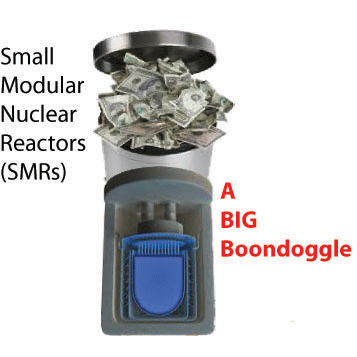 City AM 10th Sept 2017 ,A consortium developing small modular reactors is expected to urge the
government to push forward with a plan to develop so-called baby reactors
to secure the UK’s energy needs after the decommissioning of older
nuclear power stations. The government launched a competition to find the
best value SMR reactor design for the UK in 2016, and this week a
consortium led by Rolls-Royce will publish a report in Westminster which
claims it can generate electricity at £60 per megawatt hour, which is
two-thirds the price of recent large-scale nuclear plants.
http://www.cityam.com/271732/mps-review-baby-nuclear-reactor-plans-cheaper-source-secure
Elon Musk thinks that World War 3 will be started by Artificial Intelligence attack
Elon Musk: World War 3 Will Be Started by a Preemptive AI Nuclear Attack http://theantimedia.org/elon-musk-world-war-3-ai-nuclear-attack/ by Jake Anderson, (ANTIMEDIA) — Stating in a tweet this week that artificial intelligence would be the most likely cause of World War 3, entrepreneur and tech mogul Elon Musk added a new chapter to his crusade against unregulated AI. Coming on the heels of Vladimir Putin’s pronouncement that the best innovator in AI technology would be the next global leader — as well as Musk’s own statement that AI is more dangerous than North Korea — the new tweet comes amid a peak of global tensions regarding nuclear ICBMs.
Musk has positioned himself as a neo-Luddite in the AI race but has also made the controversial claim that the best way for us to safeguard human civilization against runaway AI is to essentially merge our minds symbiotically with AI technology. This is why his company, OpenAI, is working on the creation of a “neural lace” that will act as a transhumanist brain-machine interface (BMI) capable of merging the human mind with AI in a cloud-type environment.
Is Musk’s posturing a brilliant marketing move meant to permanently nestle his brand into the next generation of tech development? Or does he legitimately fear a preemptive nuclear strike by an advanced artificial intelligence that sees the human race — not killer robots — as the greatest threat to life on Earth?
Danger of nuclear wastes parked on the edge of the Pacific
And unlike in the past, it may have several choices for where to send the waste. Although there still are no federally licensed nuclear waste dumps, despite the billions of dollars ratepayers have paid to fund them, as of this year there are two proposals for temporary storage sites that could conceivably be ready for business by the early 2020s……..
Granted, when it comes to waste that’s going to remain radioactive for tens of thousands of years, there are no great solutions. But there are certainly better ones than continuing to hold more than 70,000 tons of nuclear fuel at about 120 operating and decommissioned nuclear plants across the country in facilities never intended for long-term storage, then hoping for the best.http://www.latimes.com/opinion/editorials/la-ed-nuclear-waste-storage-20170911-story.html
September 15 Energy News

Opinion:
¶ “Is Oil Industry Threatened By More Than Electric Vehicles?” • Execs at a number of top fossil fuel companies have suggested that even after demand for oil and natural gas peaks, demand for petrochemical feedstocks for plastics, fertilizers, and other chemicals will stay strong. But plastics pose serious problems that have to be addressed. [CleanTechnica]
 Oil and agriculture
World:
¶ Emerging markets including India and China could be the best bets for investors hoping to fight climate change and boost returns, according to a report by Morgan Stanley’s Institute for Sustainable Investing and The Economist Intelligence Unit. If the planet is allowed to heat up by 5° C (9° F), it may mean $7 trillion in losses for investors. [Livemint]
¶ Renewable microgrids are cropping up all around the world as developing and developed countries alike turn to them for their increased resiliency and…
View original post 751 more words
US NRC Response on Crystal River Nuclear Power Station Spent Fuel Pool Near Tampa; Our Response, and More


Our question re the closed Crystal River Nuclear Power Station and Hurricane Irma. (Screenshots of the original correspondance and of NRC documents on the cracked spent fuel pool at Crystal River found at the bottom of this blog post.)
“… despite claims to the contrary, there remains some risk due to the nuclear waste at the Crystal River nuclear site north of Tampa. Are you checking that site? Will you? How many workers does Duke have on site? Do you have any? Any status available re the crack in the spent fuel pool at Crystal River noted by you 5 to 8 years ago? Has anyone examined what happens if the roof comes off of the spent fuel pool and the huge amounts coal dust piled up nearby for the Crystal River coal plant fly into the spent fuel pool? I haven’t found anything.”
At least Mr. Neil…
View original post 1,354 more words
US NRC Teleconference Meeting Re Turkey Pt.; St. Lucie; Seabrook; Point Beach; and Duane Arnold Nuclear Power Stations – Register By 3 PM EDT Sept. 18th

The meeting is September 20th (Wednesday), in the afternoon, in Rockville Maryland. People can participate via teleconference. Register by Monday, September 18th, 3 pm EDT. Turkey Point and St. Lucie are in Florida; Seabrook is in New Hampshire, Point Beach is in Wisconsin on Lake Michigan, and Duane Arnold in Iowa.
“Meeting info
Purpose
The purpose of the meeting is for Florida Power & Light Company (FPL) and NextEra Energy to discuss with the U.S. Nuclear Regulatory Commission (NRC) staff their plans for an upcoming submittal on closing out Generic Safety Issue (GSI)-191 and Generic Letter (GL) 2004-02.
Meeting Feedback
Meeting Dates and Times
09/20/17
1:00PM – 4:00PM
Meeting Location
NRC One White Flint North
11555 Rockville Pike
OWFN-O8-B4
Rockville MD
Contact
Justin Poole
301-415-2048
Booma Venkataraman
301-415-2934
Participation Level
Category 1
NRC Participants
Justin Poole, Office of Nuclear Reactor Regulation
Booma Venkataraman, Office of Nuclear Reactor Regulation
External…
View original post 197 more words
President Moon says No to nuclear weapons in South Korea
No nuclear weapons in South Korea, says President Moon, By Paula Hancocks and James Griffiths, CNN September 14, 2017
Story highlights
1 This Month
Chernobyl: The Lost Tapes – A good documentary on Chernobyl on SBS available On Demand for the next 3 weeks– https://www.sbs.com.au/ondemand/tv-program/chernobyl-the-lost-tapes/2352741955560

of the week–London Campaign for Nuclear Disarmament

Tell the Ukrainian Government to Drop Prosecution of Peace Activist Yurii Sheliazhenko
To see nuclear-related stories in greater depth and intensity – go to https://nuclearinformation.wordpress.com
-
Archives
- April 2026 (139)
- March 2026 (251)
- February 2026 (268)
- January 2026 (308)
- December 2025 (358)
- November 2025 (359)
- October 2025 (376)
- September 2025 (257)
- August 2025 (319)
- July 2025 (230)
- June 2025 (348)
- May 2025 (261)
-
Categories
- 1
- 1 NUCLEAR ISSUES
- business and costs
- climate change
- culture and arts
- ENERGY
- environment
- health
- history
- indigenous issues
- Legal
- marketing of nuclear
- media
- opposition to nuclear
- PERSONAL STORIES
- politics
- politics international
- Religion and ethics
- safety
- secrets,lies and civil liberties
- spinbuster
- technology
- Uranium
- wastes
- weapons and war
- Women
- 2 WORLD
- ACTION
- AFRICA
- Atrocities
- AUSTRALIA
- Christina's notes
- Christina's themes
- culture and arts
- Events
- Fuk 2022
- Fuk 2023
- Fukushima 2017
- Fukushima 2018
- fukushima 2019
- Fukushima 2020
- Fukushima 2021
- general
- global warming
- Humour (God we need it)
- Nuclear
- RARE EARTHS
- Reference
- resources – print
- Resources -audiovicual
- Weekly Newsletter
- World
- World Nuclear
- YouTube
-
RSS
Entries RSS
Comments RSS
 nuclear-news