Nuclear lobby pins its hopes on China to develop costly and dubious Generation IV nuclear reactors
the theories behind many of the proposed systems aren’t new and often date back to the 1950s and ’60s. Some experimental plants have been built, such as the fast breeder reactors in the U.K. and U.S. Most suffered from crippling cost or design problems or were abandoned after nuclear accidents.
“Most if not all of these so-called advanced reactor designs have been around for decades,”
“Different designs have different problems. I don’t think anyone can be or should be confident that these problems can be resolved merely by throwing money and hiring engineers and scientists.”
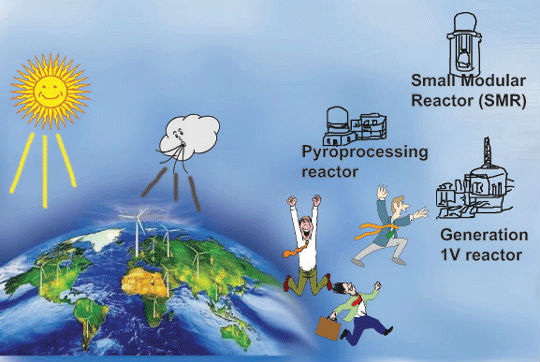
Nuclear Experts Head to China to Test Experimental Reactors, Bloomberg By
“The outlook for nuclear power is brighter there than anywhere else in the world,” said M. V. Ramana, a professor at the Liu Institute for Global Issues at the University of British Columbia. “It is not so difficult for a company developing a nuclear reactor design to find a partner.”
The systems proposed belong to the so-called fourth generation of reactors. The current generation under construction include enhanced safety features following the Fukushima disaster in Japan in 2011, but still typically use traditional fuel rods, cooled by water under pressure. Both Areva SA and Westinghouse Electric Co. are slated to turn on their current-generation nuclear reactors in the next year in China — well ahead of any other nation, despite delays.
Recycled Fuel
Some Generation IV designs aim to cut construction costs by using coolants that work at atmospheric pressure — reducing the need for massive containment structures. Many recycle their fuel, reducing the need for uranium, and in some cases are fail-safe without intervention if something goes wrong…….
Coolants include liquid sodium, gases and molten metal. Some use thorium instead of uranium to power the reaction.
Still, the theories behind many of the proposed systems aren’t new and often date back to the 1950s and ’60s. Some experimental plants have been built, such as the fast breeder reactors in the U.K. and U.S. Most suffered from crippling cost or design problems or were abandoned after nuclear accidents.
“Most if not all of these so-called advanced reactor designs have been around for decades,” said Ramana at the Liu Institute. “Different designs have different problems. I don’t think anyone can be or should be confident that these problems can be resolved merely by throwing money and hiring engineers and scientists.”
Computer Models
TerraPower’s traveling-wave design is based on research by Saveli Feinberg, a physicist who first proposed it in the 1950s. Levesque says that advancements in computing in the last decade have revolutionized the ability to develop these technologies. “You couldn’t get it near the concept without the computer modeling,” he said.
Yet computers alone won’t prove the technology without a working plant.
“What they really need is to construct research reactors,” said Allison Macfarlane, former head of the U.S. Nuclear Regulatory Commission. “And that is really expensive.”………
Areva is not currently working with Chinese teams to develop a fourth generation reactor, spokesman Mathias Schuch said in an email. Westinghouse didn’t respond to requests for comment on next-generation reactors………
“Nuclear can be a difficult industry and it needs to be heavily regulated,” Macfarlane said. “You can make rather a big expensive mess if you don’t get it right. Only one accident will seriously affect the entire industry. There are very few industries like that.”
Developers say the industry is over-regulated. Michael F. Keller, president of Hybrid Power Technologies LLC said the NRC is a “bureaucratic straight jacket” that creates a massive financial burden on the deployment of advanced reactors. “As advanced reactors are generally passively fail-safe, there is no rational reason to apply the grossly overly-complex regulations currently in use,” he said.
The DOE said in a email that it is promoting development of a framework that will increase regulatory certainty for advanced reactors in coordination with the NRC and industry………https://www.bloomberg.com/news/articles/2017-09-21/nuclear-scientists-head-to-china-to-test-experimental-reactors
No comments yet.
1 This Month

of the week – Shut Down Drone Warfare!


Tell the Ukrainian Government to Drop Prosecution of Peace Activist Yurii Sheliazhenko

Petition to revoke the licensing of the Near Surface Nuclear Disposal Facility (NSDF) at Chalk River. https://www.ourcommons.ca/petitions/en/Petition/Details?Petition=e-7247
To see nuclear-related stories in greater depth and intensity – go to https://nuclearinformation.wordpress.com
-
Archives
- March 2026 (230)
- February 2026 (268)
- January 2026 (308)
- December 2025 (358)
- November 2025 (359)
- October 2025 (376)
- September 2025 (257)
- August 2025 (319)
- July 2025 (230)
- June 2025 (348)
- May 2025 (261)
- April 2025 (305)
-
Categories
- 1
- 1 NUCLEAR ISSUES
- business and costs
- climate change
- culture and arts
- ENERGY
- environment
- health
- history
- indigenous issues
- Legal
- marketing of nuclear
- media
- opposition to nuclear
- PERSONAL STORIES
- politics
- politics international
- Religion and ethics
- safety
- secrets,lies and civil liberties
- spinbuster
- technology
- Uranium
- wastes
- weapons and war
- Women
- 2 WORLD
- ACTION
- AFRICA
- Atrocities
- AUSTRALIA
- Christina's notes
- Christina's themes
- culture and arts
- Events
- Fuk 2022
- Fuk 2023
- Fukushima 2017
- Fukushima 2018
- fukushima 2019
- Fukushima 2020
- Fukushima 2021
- general
- global warming
- Humour (God we need it)
- Nuclear
- RARE EARTHS
- Reference
- resources – print
- Resources -audiovicual
- Weekly Newsletter
- World
- World Nuclear
- YouTube
-
RSS
Entries RSS
Comments RSS
 nuclear-news
Leave a comment