Even for New Mexico, it’s better to spend $trillion on positive things, not nuclear weapons
 World is crying out for clean energy, not nuclear weapons http://www.santafenewmexican.com/opinion/my_view/world-is-crying-out-for-clean-energy-not-nuclear-weapons/article_c3c64f7a-6d53-58c5-9ddb-f67dd0fea5e5.html, By Greg Mello , 17 Sept 17
Nikki Haley suggest handing the North Korea issue over to the Pentagon
 North Korea: UN has ‘exhausted’ its options and America may hand issue to Pentagon, Nikki Haley says, ABC News 18 Sept 17 The US ambassador to the United Nations says the UN Security Council has run out of options to contain North Korea’s nuclear program, adding Washington may have to turn the matter over to the Pentagon.
Key points:
- Ms Haley says if North Korea continues it “will be destroyed”
- Donald Trump calls Kim Jong-un “rocket man” and praises sanctions effects
- Security adviser HR McMaster says preparing a military option is becoming necessary
“We have pretty much exhausted all the things that we can do at the Security Council at this point,” Nikki Haley told CNN, adding that she was perfectly happy to hand the North Korea issue over to Defence Secretary James Mattis.
As world leaders head to the United Nations headquarters in New York for the annual General Assembly meeting this week, Ms Haley’s comments indicated the US was not backing down from its threat of military action against North Korea.
On Thursday, North Korea launched a missile over Japan into the Pacific Ocean in defiance of new UN Security Council sanctions banning its textile exports and capping imports of crude oil.
China has urged the US to refrain from making threats to North Korea, but when asked about President Donald Trump’s warning last month that the North Korean threat to the US will be met with “fire and fury”, Ms Haley said “it was not an empty threat”.
“If North Korea keeps on with this reckless behaviour, if the United States has to defend itself or defend its allies in any way, North Korea will be destroyed,” she said………
Military options available to Mr Trump range from a sea blockade aimed at enforcing sanctions to cruise missile strikes on nuclear and missile facilities to a broader campaign aimed at overthrowing leader Kim Jong-un.
Mr Mattis has warned the consequences of any military action would be “tragic on an unbelievable scale” and bring severe risk to US ally South Korea…….. http://www.abc.net.au/news/2017-09-18/un-has-exhausted-options-on-north-korea-haley-says/8955238
A Rethink On North Korean Nuclear Crisis – some analysts say that it’s time for this
 Some Analysts Say Time May Be Right For A Rethink On North Korean Nuclear Crisis, NPR, September 17, 2017, ANTHONY KUHN
North Korea test-launched another missile Friday that arced over northern Japan and into the Pacific, showing its progress toward being able to strike the U.S. and signaling its defiance of U.N. sanctions imposed after its sixth, and most recent, nuclear testearlier this month.
“The world will never accept a nuclear-armed North Korea,” U.S. Ambassador Nikki Haley told the U.N., after the sanctions passed the Security Council on Monday. She added: “If the North Korean regime does not halt its nuclear program, we will act to stop it ourselves.”
But some analysts believe that this approach to the North Korean nuclear crises is dangerously deluded.
A decade or so ago, it still may have been possible to use sanctions or the threat of military force to compel North Korea to give up its nuclear programs, argues Zhao Chu, an independent, Shanghai-based analyst, former soldier and former editor of World Outlook, a foreign affairs magazine.
But Zhao warns that the situation has now fundamentally changed, and that trying to fly through a window of opportunity that has already closed is a very bad idea. Pyongyang can hardly be expected to give up the nuclear ace in the hole that it worked so long to acquire.
Then again, perhaps the window of opportunity for military action was never open, argues Lyle Goldstein, an associate professor in the Strategic Research Department at the U.S. Naval War College in Newport, Rhode Island. This is because the South Korean capital, “Seoul was always so vulnerable” to North Korean conventional artillery attacks, which could cause mass casualties.
Analysts say North Korea looked at the fate of other authoritarian regimes, particularly Libya under Moammar Gadhafi and Iraq under Saddam Hussein, and concluded that their lack of nuclear weapons left them vulnerable to being toppled by the U.S. and its allies.
Pyongyang now believes — correctly or not — that, by acquiring the ability to carry out a nuclear strike against the U.S., it has taken a crucial step toward assuring its own survival.
“You could credit the Kim regime with taking regime change off the table,” says the U.S. Naval War College’s Goldstein.
Another way of looking at it is that North Korea has now gained a valuable bargaining chip. And while it is unlikely to give it away for nothing, it may be willing to trade it for some sort of security guarantee, or some form of payment, whether in food or energy.
A grimmer possibility, of course, is that it might just sell it to raise much-needed cash.
Here, Goldstein sees an opportunity to strike a bargain with North Korea to resolve the crisis. He says that years of using all sticks and no carrots have not yielded the required results, and it’s time for some creative thinking.
Goldstein rejects the idea that the only way to improve North Korea is through regime change. “There are plenty of obnoxious regimes around the world,” he says, “and more than a few are allies of the United States.”…..
“I think we should take a pragmatic attitude and tolerate a nuclear North Korea,” Zhao concludes. “Why did the U.S. and China tolerate India and Pakistan going nuclear? Because they had no better options.”
All that’s left to do, Zhao says, is to try to prevent North Korea from proliferating nuclear technology, help it to avoid nuclear accidents, and set up unofficial dialogues to get scholars, if not officials, discussing possible solutions.
Indeed, China’s government realizes that North Korea’s nuclear disarmament is no longer an option in the near term, Zhao argues. It has therefore signaled in its public statements that for now, its top priority is to prevent the outbreak of war on the Korean Peninsula, or as the government puts it, to prevent “chaos on our doorstep.” http://www.npr.org/sections/parallels/2017/09/17/551214870/some-say-its-time-to-rethink-responses-to-north-korea-nuclear-crisis
USA’s ex-national security adviser was doing secret nuclear deal with Russia and Middle East nations
 MIKE FLYNN’S NUCLEAR SIDE-HUSTLE GETS EVEN SHADIER
Two weeks before the inauguration, Flynn reportedly met the king of Jordan while pushing a deal to build nuclear reactors . . . in Jordan. Vanity Fair , BY BESS LEVIN SEPTEMBER 15, 2017 Remember Mike Flynn? The ex-national security adviser who was forced to resign after he forgot to mention some conversations he’d had with Russian ambassador Sergey Kislyak? Whose unfair persecution at the hands of James Comey was allegedly one of the reasons Donald Trump fired his own F.B.I. director? Who received $600,000 in a lobbying deal from a Turkish man with business ties to Russia, and who subsequently BLOCKED A PLAN TO ATTACK ISIS that the Turkish government opposed, all without ever registering a foreign agent or disclosing his lobbying deals? He’s back in the news today, and if you were hoping it was for something fun like Flynn announcing that he is joining the next season of Dancing with the Stars, you will be disappointed.
BuzzFeed News reports that two weeks before Donald Trump was inaugurated, Flynn and soon-to-be White House advisers Steve Bannon and Jared Kusher had a secret morning meeting with Jordan’s King Abdullah II, during the same period in which Flynn was pushing “a multibillion-dollar deal to build nuclear reactors in Jordan and other Middle East nations.” (Like 100 other foreign contacts he initially failed to disclose, Kushner’s initial security clearance form failed to mention this particular meeting.) According to BuzzFeed, topics discussed included “Israeli-Palestinian relations, intelligence sharing between America and Jordan on Syria, ISIS,” and a nuclear project called the Marshal Plan, a $200 billion project which initially involved U.S. companies building reactors in Jordan and other Middle East nations, with security handled by a Russian state-owned firm called Rosoboron, which, incidentally, is currently facing the possibility of U.S. sanctions.
People close to the three Trump advisers say that the nuclear deal was not discussed. But a federal official with access to a document created by a law enforcement agency about the meeting said that the nuclear proposal, known as the Marshall Plan, was one of the topics the group talked about.
According to Politico, Flynn was paid at least $25,000 in his capacity as a consultant on the plan by one of the American companies involved. According to the Wall Street Journal, Flynn’s disclosure forms “indicate that [his] year-and-a-half work on the project ended in December 2016, but Mr. Flynn in fact remained involved in the project once he joined the Trump administration in January, discussing the plan and directing his National Security Council staff to meet with the companies involved, the former staffers said.” (Flynn’s lawyer declined to comment to the Journal, as did the White House.)
If this all sounds like the type of thing that’s going to keep you up at night, you’re not alone. “Any proposal to introduce dozens of nuclear reactors to the Middle East, particularly Saudi Arabia, raises many proliferation red flags,” the Arms Control Association’s Daryl Kimball told BuzzFeed. “The Saudis do not need nuclear power and them gaining access could lead to dangerous consequences down the road.” Giving a country nuclear energy capacity, as the Marshall Plan would, “is like giving a country a nuclear weapons starter kit,” the nonprofit Center for Arms Control and Non-Proliferation’s Alexandra Bell said…..https://www.vanityfair.com/news/2017/09/mike-flynns-nuclear-side-hustle-gets-even-shadier
Pressure grows on Theresa May to sign UN nuclear weapons ban treaty

 Theresa May under growing pressure to sign UN anti-nuclear treaty
Campaigners urge the Prime Minister to back global treaty calling for the total ban of nuclear weapons, Inde[endent Lizzy Buchan Political Correspondent, 17 Sept 17 Pressure is mounting on Theresa May to sign up to a UN treaty calling for the eventual elimination of nuclear weapons.
More than 120 nations endorsed the global treaty at a summit in July, which warns that a complete ban is the only way to prevent the “catastrophic humanitarian consequences” of the use of nuclear weapons.
Britain and other nuclear nations opposed the move, but critics have called on the Prime Minister to change course this week when the treaty will be opened for signatures at the UN’s annual general assembly.It comes amid escalating tensions between the US and North Korea, after a string of nuclear tests from the pariah state and war-like rhetoric from Donald Trump.
Anti-nuclear campaigners called on Britain to take the lead on disarmament, or risk offering a “blank cheque” to other nations seeking to boost their nuclear arsenal.
The UK and other nuclear powers support a non-proliferaton treaty, which prevents the spread of nuclear weapons – but the pact has previously attracted criticism for being ineffective.
Green Party co-leader Caroline Lucas said the Government had “utterly failed” in its commitment to nuclear disarmament, and urged the Prime Minister to back the UN treaty, in which signatories agree not to develop, test, buy or possess nuclear weapons………
Andrew Smith, of the Campaign Against Arms Trade, said: “For far too long, UK foreign policy has been guided by an unbending commitment to militarism and interventionism. Trident has been right at the heart of it.
“Despite this, there is a growing international consensus against nuclear weapons.
“It’s time for Trident-owning countries like the UK to take a lead, and take a crucial step towards a nuclear-free world.
“To continue doing otherwise will only provide an excuse and a blank cheque for every other country that seeks nuclear proliferation.”
Downing Street was unavailable for comment. http://www.independent.co.uk/news/uk/politics/theresa-may-nuclear-treaty-un-pressure-weapons-a7949346.html
New study results in creation of new classification of climate change threats
 New climate risk classification created to account for potential ‘existential’ threats https://www.eurekalert.org/pub_releases/2017-09/uoc–ncr091417.php Researchers identify a one-in-20 chance of temperature increase causing catastrophic damage or worse by 2050
UNIVERSITY OF CALIFORNIA – SAN DIEGO A new study evaluating models of future climate scenarios has led to the creation of the new risk categories “catastrophic” and “unknown” to characterize the range of threats posed by rapid global warming. Researchers propose that unknown risks imply existential threats to the survival of humanity.
These categories describe two low-probability but statistically significant scenarios that could play out by century’s end, in a new study by Veerabhadran Ramanathan, a distinguished professor of climate and atmospheric sciences at Scripps Institution of Oceanography at the University of California San Diego, and his former Scripps graduate student Yangyang Xu, now an assistant professor at Texas A&M University.
The risk assessment stems from the objective stated in the 2015 Paris Agreement regarding climate change that society keep average global temperatures “well below” a 2°C (3.6°F) increase from what they were before the Industrial Revolution.
Even if that objective is met, a global temperature increase of 1.5°C (2.7°F) is still categorized as “dangerous,” meaning it could create substantial damage to human and natural systems. A temperature increase greater than 3°C (5.4°F) could lead to what the researchers term “catastrophic” effects, and an increase greater than 5°C (9°F) could lead to “unknown” consequences which they describe as beyond catastrophic including potentially existential threats. The specter of existential threats is raised to reflect the grave risks to human health and species extinction from warming beyond 5° C, which has not been experienced for at least the past 20 million years.
The scientists term warming probability of five percent or less as a “low-probability high-impact” scenario and assess such scenarios in the analysis “Well Below 2°C: Mitigation strategies for avoiding dangerous to catastrophic climate changes,” which will appear in the journal Proceedings of the National Academy of Sciences on Sept. 14.
Ramanathan and Xu also describe three strategies for preventing the gravest threats from taking place.
“When we say five percent-probability high-impact event, people may dismiss it as small but it is equivalent to a one-in-20 chance the plane you are about to board will crash,” said Ramanathan. “We would never get on that plane with a one-in-20 chance of it coming down but we are willing to send our children and grandchildren on that plane.”
The researchers defined the risk categories based on guidelines established by the Intergovernmental Panel on Climate Change (IPCC) and previous independent studies. “Dangerous” global warming includes consequences such as increased risk of extreme weather and climate events ranging from more intense heat waves, hurricanes, and floods, to prolonged droughts. Planetary warming between 3°C and 5°C could trigger what scientists term “tipping points” such as the collapse of the West Antarctic Ice Sheet and subsequent global sea-level rise, and the dieback of the Amazon rainforest. In human systems, catastrophic climate change is marked by deadly heat waves becoming commonplace, exposing over 7 billion people to heat related mortalities and famine becoming widespread. Furthermore, the changes will be too rapid for most to adapt to, particularly the less affluent, said Ramanathan.
Risk assessments of global temperature rise greater than 5°C have not been undertaken by the IPCC. Ramanathan and Xu named this category “unknown??” with the question marks acknowledging the “subjective nature of our deduction.” The existential threats could include species extinctions and major threats to human water and food supplies in addition to the health risks posed by exposing over 7 billion people worldwide to deadly heat.
With these scenarios in mind, the researchers identified what measures can be taken to slow the rate of global warming to avoid the worst consequences, particularly the low-probability high-impact events. Aggressive measures to curtail the use of fossil fuels and emissions of so-called short-lived climate pollutants such as soot, methane and HFCs would need to be accompanied by active efforts to extract CO2 from the air and sequester it before it can be emitted. It would take all three efforts to meet the Paris Agreement goal to which countries agreed at a landmark United Nations climate conference in Nov 2015.
Xu and Ramanathan point out that the goal is attainable. Global CO2 emissions had grown at a rate of 2.9 percent per year between 2000 and 2011, but had slowed to a near-zero growth rate by 2015. They credited drops in CO2 emissions from the United States and China as the primary drivers of the trend. Increases in production of renewable energy, especially wind and solar power, have also bent the curve of emissions trends downward. Other studies have estimated that there was by 2015 enough renewable energy capacity to meet nearly 24 percent of global electricity demand.
Short-lived climate pollutants are so called because even though they warm the planet more efficiently than carbon dioxide, they only remain in the atmosphere for a period of weeks to roughly a decade whereas carbon dioxide molecules remain in the atmosphere for a century or more. The authors also note that most of the technologies needed to drastically curb emissions of short-lived climate pollutants already exist and are in use in much of the developed world. They range from cleaner diesel engines to methane-capture infrastructure.
“While these are encouraging signs, aggressive policies will still be required to achieve carbon neutrality and climate stability,” the authors wrote.
The release of the study coincides with the start of Climate Week NYC in New York, a summit of business and government leaders to highlight global climate action. Ramanathan and colleagues will deliver a complementary report detailing the “three-lever” mitigation strategy of emissions control and carbon sequestration on Sept. 18 at the United Nations. That report was produced by the Committee to Prevent Extreme Climate Change, chaired by Ramanathan, Nobel Prize winner Mario Molina of UC San Diego, and Durwood Zaelke, who leads an advocacy organization, the Institute for Governance and Sustainable Development, with 30 experts from around the world including China and India.
China urges USA to find ways other than threats, to deal with North Korea
US must stop North Korea threats, says China, as Kim Jong-un aims for military ‘equilibrium’
Chinese ambassador says America needs to do ‘much more’ to achieve cooperation as Kim Jong-un speaks of goal of equalling US military might, Guardian, Tom Phillips , 16 Sept The United States must stop threatening North Korea’s leader if a peaceful solution to the nuclear crisis is to be found, China’s ambassador to Washington has said, as Kim Jong-un reiterated his country’s aim to reach military “equilibrium” with the US.
Cui Tiankai told reporters in Washington: “They [the US] should refrain from issuing more threats. They should do more to find effective ways to resume dialogue and negotiation.”
“Honestly, I think the United States should be doing … much more than now, so that there’s real effective international cooperation on this issue.”
North Korea’s state news agency, KCNA on Saturday quoted Kim as saying: “Our final goal is to establish the equilibrium of real force with the US and make the US rulers dare not talk about military option.”
The US warned on Friday it could revert to military options if the latest sanctions fail to curb North Korean missile and nuclear tests, after Pyongyang fired a missile over Japan for the second time in two weeks.
Earlier, the US secretary of state, Rex Tillerson urged Russia and China to “indicate their intolerance for these reckless missile launches by taking direct actions of their own”.
The Chinese ambassador was speaking after Pyongyang fired a missile over Japan for the second time in two weeks a move the UN security council said it “strongly condemned”.
Speaking in Beijing, a foreign ministry spokeswoman said China opposed the launch but also urged the US to change its tactics towards Pyongyang. “China is not to blame for the escalation of tensions. China does not hold the key to resolving the Korean peninsula nuclear issue, either. Those who tied the knots are responsible for untying [them].”……..https://www.theguardian.com/world/2017/sep/16/us-must-stop-north-korea-threats-says-china-kim-jong-un-military-equilibri
No – nuclear industry is NOT “emissions free”
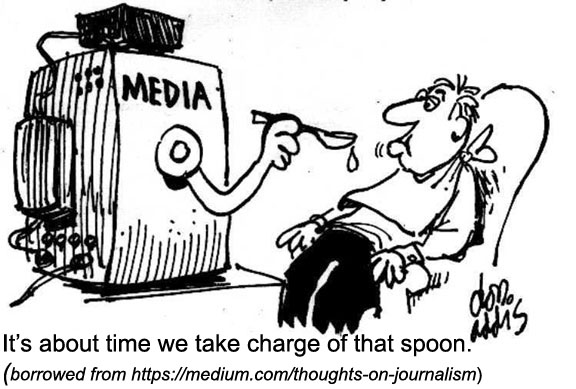 Beware nuclear industry’s fake news on being emissions free
David Lowry on nuclear not being zero-carbon technology Guardian, 18 Sept 17 Your incisive editorial makes many strong points, not least highlighting the exigencies of potential security compromises and terrorism vulnerabilities of the planned new nuclear reactor at Hinkley Point. But there is a fatal flaw in the argument you set out. The editorial asserts: “Nuclear power has a trump card: it is a zero-carbon technology which delivers a continuous, uninterrupted supply.”
This is demonstrably untrue. On the latter point, you only have to consult the published operating record of reactors to see this is an unsustainable claim. All reactors have lengthy planned outages (shutdowns) for operational reasons; some have significant unplanned outages due to operational failures; and in the extreme case of post-accident safety prudence, such as in Japan, their 54 reactors were all closed for years after the 2011 Fukushima disaster – and became hugely expensive “stranded assets”.
On alleged zero-carbon status of nuclear plants, you repeat a similarly erroneous assertion made in your editorial of 1 October 2005 (Pre-empting debate), where you wrote: “The big advantage of nuclear generation is that it does not produce environmentally degrading emissions in the way that fossil fuel generation does.”

You printed my response to this assertion (There is nothing green about Blair’s nuclear dream, 20 October 2005) in which I set out the various ways the carbon footprint of nuclear power is substantial, if the whole “cradle-to-grave” nuclear fuel chain (uranium mining, milling, enrichment, fuel production, in-reactor fuel irradiation, storage and final long-term management) is properly calculated. I pointed out that the nuclear industry’s proponents, such as those gathered at last week’s World Nuclear Association jamboree in London, are fond of spreading fake news such as describing nuclear energy as “non-carbon emitting”. It is about time this dangerous falsehood was confined to the dustbin of history.
Dr David Lowry
Senior research fellow, Institute for Resource and Security Studies, Cambridge, Massachusetts, USA https://www.theguardian.com/environment/2017/sep/17/beware-nuclear-industrys-fake-news-on-being-emissions-free
An international Treaty that works! The Montreal Protocol and the healing of the ozone layer.
Each year, during the southern spring, a hole appears in the ozone layer above Antarctica. This is due to the extremely cold temperatures in the winter stratosphere (above 10km altitude) that allow byproducts of CFCsand related gases to be converted into forms that destroy ozone when the sunlight returns in spring.

As ozone-destroying gases are phased out, the annual ozone hole is generally getting smaller – a rare success story for international environmentalism.
Back in 2012, our Saving the Ozone series marked the Montreal Protocol’s silver jubilee and reflected on its success. But how has the ozone hole fared in the five years since?
The Antarctic ozone hole has continued to appear each spring, as it has since the late 1970s. This is expected, as levels of the ozone-destroying halocarbon gases controlled by the Montreal Protocol are still relatively high. The figure below shows that concentrations of these human-made substances over Antarctica have fallen by 14% since their peak in about 2000.
It typically takes a few decades for these gases to cycle between the lower atmosphere and the stratosphere, and then ultimately to disappear. The most recent official assessment, released in 2014, predicted that it will take 30-40 years for the Antarctic ozone hole to shrink to the size it was in 1980………
Reassuringly, a recent study showed that the size of the ozone hole each September has shrunk overall since the turn of the century, and that more than half of this shrinking trend is consistent with reductions in ozone-depleting substances. However, another study warns that careful analysis is needed to account for a variety of natural factors that could confound our detection of ozone recovery……..
While annual monitoring continues, which includes measurements under the Australian Antarctic Program, a more comprehensive assessment of the ozone layer’s prospects is set to arrive late next year. Scientists across the globe, coordinated by the UN Environment Program and the World Meteorological Organisation, are busy preparing the next report required under the Montreal Protocol, called the Scientific Assessment of Ozone Depletion: 2018.
This peer-reviewed report will examine the recent state of the ozone layer and the atmospheric concentration of ozone-depleting chemicals, how the ozone layer is projected to change, and links between ozone change and climate.
In the meantime we’ll watch the 2017 hole as it peaks then shrinks over the remainder of the year, as well as the ozone holes of future years, which will tend to grow less and less large as the ozone layer heals. https://theconversation.com/after-30-years-of-the-montreal-protocol-the-ozone-layer-is-gradually-healing-84051
Trump, Netanyahu – hatred of Obama fuels their opposition to Iran nuclear agreement


 Obama-complex Fuels Trump and Netanyahu’s Fight Against Iran Nuclear Deal, Haaretz, Chemi Shalev Sep 17, 2017
 Britain’s Liberal Democrats faltering in their support for nuclear power
 Nuclear power plants may not keep Britain’s lights on, say Lib Dems
Party raises concerns over nuclear costs as Vince Cable says record low wind power prices should lead to ‘radical reappraisal’, Guardian, Adam Vaughan and Jessica Elgot, 16 Sept 17, New nuclear power stations may not be the best option for keeping Britain’s lights on and meeting the country’s carbon targets, the Liberal Democrats have said.
The party said there were legitimate concerns over nuclear’s cost and the risks it would not be delivered on time, just days after windfarms secured state support far more cheaply than the Hinkley Point C atomic power station.
However, the party, which voted in support of nuclear four years ago after decades of opposition, said the technology should still be considered an option in the UK’s future energy mix.
“Nuclear power should be kept open as an option – but there is a risk that it may not be able to keep the lights on and that it may not be the lowest-cost option,” said the Lib Dems in a new report, authored by the former coalition minister Lynne Featherstone.
Vince Cable, the party’s leader, said this week that the breakthrough low subsidy prices for offshore windfarms should prompt a “radical reappraisal” of how Britain is powered.
African countries – easy targets for the global nuclear merchants – warning to South Africa

 The truth about nuclear power in SA https://www.iol.co.za/sunday-tribune/news/the-truth-about-nuclear-power-in-sa-11245644 17 SEPTEMBER 2017, NABEELAH SHAIKH, nabeelah.shaikh@inl.co.za, DURBAN: Two international anti-nuclear activists visited Durban on Saturday to educate the community on the harmful effects of nuclear energy. They highlighted why South Africans must continue to oppose its proliferation in our country.
Russian activist Vladimir Slivyak and American activist Chris Williams claim African countries are “easy targets” for nuclear reactor companies who have wanted to sell the idea of nuclear energy, as more Western countries oppose it.
Slivyak, a member of the Russian environmental organisation Ecodefense, has been an environmental and energy activist since 1989. Williams, a long time sustainable energy policy activist, is currently the Vermont USA organiser for the Citizens Awareness Network.
These activists have already been to Joburg and Port Elizabeth where they visited rural communities near a proposed nuclear site to educate them about what nuclear energy was and what it would mean for them if it were introduced.
In Durban yesterday, Slivyak and Williams spoke at an event at St Paul’s Church. Recently Earthlife Africa Johannesburg and the Southern African Faith Communities’ Environment Institute challenged the government’s nuclear deals with Russia, the US and South Korea.
In April, judgment was delivered in the Cape Town High Court and these deals were set aside and declared unlawful and unconstitutional. In a press briefing yesterday morning Slivyak and Williams emphasised the need for South Africa to distance itself from nuclear energy and said renewable energy was the way of the future.
“South Africa has enough sun as well as wind. There are other alternatives like solar and wind energy which is now becoming the way of the future. When these international nuclear companies try to sell you the idea of nuclear energy, they don’t tell you that in the long run, it’s actually going to cost you a whole lot more than you expect,” said Williams.
He said the financial markets internationally were also moving away from nuclear energy to renewable energy because it was cost effective and the safer alternative.
In Germany, they’ve already taken a decision to close 23 nuclear reactor plants in the next five to six years. They’ve made a commitment to source all their power through sustainable energy and other countries should follow in this path. We are here to spread the word in terms of what’s happening on the international front and countries can make informed decisions based on this,” said Slivyak.
Earthlife Africa Durban, who hosted the anti-nuclear activists, said it was concerned that the South African government still planned to pursue the nuclear deal.
“It is at the heart of the state capture and the cabinet reshuffle. If it goes ahead the R1 trillion deal will bankrupt the country. It is a risky and dangerous source of power as witnessed by the many nuclear disasters, most notably Fukushima in Japan”.
“Earthlife Africa Durban and the South Durban Community Environmental Alliance supports a renewable energy future and an end to coal and nuclear power stations. We call on the people of South Africa to oppose the government’s shady nuclear deals and to support a safe, clean and green future with renewable energy,” said Earthlife Durban spokeswoman, Alice Thompson.
Report that North Korea may be secretly building nuclear submarine
North Korea secretly building nuclear submarine: report Washington Times, – The Washington Times – Sunday, September 17, 2017 North Korea is clandestinely building a nuclear-powered submarine, according to a Japanese newspaper report highlighting the potential new threat from Pyongyang, whose increased naval activities during recent months already had U.S. military and intelligence officials on edge.
The report by Japan’s Sekai Nippo — citing an “informed” but unnamed “source familiar with the North Korean situation” — said the size of the nuclear-powered submarine under construction is unclear, but that the Kim Jong Un regime in Pyongyang hopes to have it deployed within three years.
The claim could not be independently verified by The Washington Times and U.S. intelligence sources could not immediately be reached for comment. If true, however, the claim could indicate a dramatic naval evolution by North Korea, which analysts say presently has a fleet of between 50 and 60 diesel-electric submarines that are louder and easier to detect than nuclear-powered vessels…….http://www.washingtontimes.com/news/2017/sep/17/report-north-korea-secretly-building-nuclear-subma/
Let’s name hurricanes after climate change deniers
We should name hurricanes after the climate change deniers, SMH, Peter FitzSimons , 17 Sept 17
In the wake of Hurricane Irma devastating Florida this week, an idea floated on Twitter deserves a wider airing. Why not name the monster hurricanes, the ones that are off the scale, after noted climate change denialists? They could start with Rush Limbaugh, who spent the days before Irma hit ranting that the coverage of the approaching hurricane was all part of a “liberal conspiracy”, only to quietly leave town the day before the eye of the hurricane arrived.
But, seriously, does it not make a certain amount of sense? The legacy of those who continue to deny the reality of climate change – continuing with brain dead assertions like “the climate changes all the time, it’s called the weather” – is a world ever more prone to such things as hurricanes. As The Economist noted this week, “There are now 400 extreme weather events every year, four times as many as in 1970.”……http://www.smh.com.au/comment/we-should-name-hurricanes-after-the-climate-change-deniers-20170915-gyi7f2.html
1 This Month


Tell the Ukrainian Government to Drop Prosecution of Peace Activist Yurii Sheliazhenko

Petition to revoke the licensing of the Near Surface Nuclear Disposal Facility (NSDF) at Chalk River. https://www.ourcommons.ca/petitions/en/Petition/Details?Petition=e-7247


of the week – STOP SMALL MODULAR REACTORS IN CANADA
To see nuclear-related stories in greater depth and intensity – go to https://nuclearinformation.wordpress.com
-
Archives
- March 2026 (212)
- February 2026 (268)
- January 2026 (308)
- December 2025 (358)
- November 2025 (359)
- October 2025 (376)
- September 2025 (258)
- August 2025 (319)
- July 2025 (230)
- June 2025 (348)
- May 2025 (261)
- April 2025 (305)
-
Categories
- 1
- 1 NUCLEAR ISSUES
- business and costs
- climate change
- culture and arts
- ENERGY
- environment
- health
- history
- indigenous issues
- Legal
- marketing of nuclear
- media
- opposition to nuclear
- PERSONAL STORIES
- politics
- politics international
- Religion and ethics
- safety
- secrets,lies and civil liberties
- spinbuster
- technology
- Uranium
- wastes
- weapons and war
- Women
- 2 WORLD
- ACTION
- AFRICA
- Atrocities
- AUSTRALIA
- Christina's notes
- Christina's themes
- culture and arts
- Events
- Fuk 2022
- Fuk 2023
- Fukushima 2017
- Fukushima 2018
- fukushima 2019
- Fukushima 2020
- Fukushima 2021
- general
- global warming
- Humour (God we need it)
- Nuclear
- RARE EARTHS
- Reference
- resources – print
- Resources -audiovicual
- Weekly Newsletter
- World
- World Nuclear
- YouTube
-
RSS
Entries RSS
Comments RSS
 nuclear-news