
nuclear-news

The News That Matters about the Nuclear Industry Fukushima Chernobyl Mayak Three Mile Island Atomic Testing Radiation Isotope

Flood death toll in India, Bangladesh and Nepal – 1200 and rising

Floods in India, Bangladesh and Nepal kill 1,200 and leave millions homeless http://www.independent.co.uk/news/world/asia/india-floods-bangladesh-nepal-deaths-millions-homeless-latest-news-updates-a7919006.html

Authorities say monsoon flooding is one of the worst in region in years, Chloe Farand , 30 Aug 17, At least 1,200 people have been killed and millions have been left homeless following devastating floods that have hit India, Bangladesh and Nepal, in one of the worst flooding disasters to have affected the region in years.

International aid agencies said thousands of villages have been cut off by flooding with people being deprived of food and clean water for days.

South Asia suffers from frequent flooding during the monsoon season, which lasts from June to September, but authorities have said this year’s floods have been much worse.

  • In the eastern Indian state of Bihar, the death toll has risen to more than 500, the Straits Times reported, quoting disaster management officials.The paper said the ongoing floods had so far affected 17 mllion people in India, with thousands sheltered in relief camps.

    Anirudh Kumar, a disaster management official in Patna, the capital of Bihar, a poor state known for its mass migration from rural areas to cities, said this year’s farming had collapsed because of the floods, which will lead to a further rise in unemployment in the region.

  • In the northern state of Uttar Pradresh, reports said more than 100 people had died and 2.5 million have been affected.In Mumbai, authorities struggled to evacuate people living in the financial capital’s low-lying areas as transport links were paralysed and downpours led to water rising up to five feet in some parts of the city.

    Weather officials are forecasting heavy rains to continue over the next 24 hours and have urged people to stay indoors.  In neighbouring Bangladesh, at least 134 have died in monsoon flooding which is believed to have submerged at least a third of the country.

    More than 600,000 hectares of farmland have been partially damaged and in excess of 10,000 hectares have been completely washed away, according to the disaster minister.

    Bangladesh’s economy is dependent on farming and the country lost around a million tonnes of rice in flash floods in April.

    “Farmers are left with nothing, not event with clean drinking water,” said Matthew Marek, the head of disaster response in Bangladesh for the International Federation of Red Cross and Red Crescent.

  • In Nepal, 150 people have been killed and 90,000 homes have been destroyed in what the UN has called the worst flooding incident in the country in a decade.According to the Red Cross, at least 7.1 million people have been affected in Bangladesh – more than the population of Scotland – and around 1.4 million people have been affected in Nepal.

    The disaster comes as headlines have focused on the floods in Houston, Texas, which authorities have described as “unprecedented”.  Officials in Texas have said the death toll now stands at 15 in the wake of Hurricane and Tropical Storm Harvey, with thousands forced to flee their homes.

    The rise in extreme weather events such as hurricanes and floods have been identified by climate scientists as the hallmark of man-made climate change.

    The US has seen two of its worst storms ever, Hurricane Harvey and Hurricane Katrina, in just over a decade.

    India’s Prime Minister, Narendra Modi, has said climate change and new weather patterns are having “a big negative impact”.

August 30, 2017 Posted by | climate change | Leave a comment

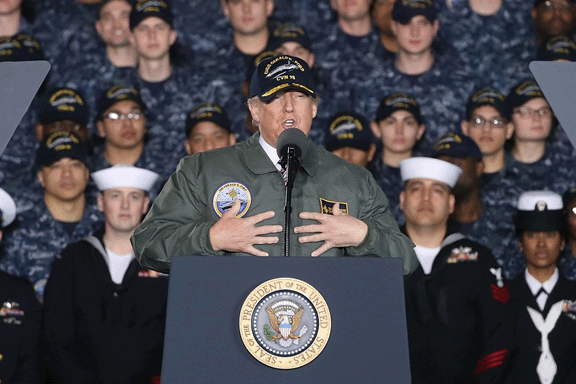
Trump – “all options on the table”, after North Korea’s missile test, flying over Japan

All options on the table after missile: Trump Sky News ,  30 August 2017 US president Donald Trump has said ‘all options are on the table’ after North Korea launched a ballistic missile over Japan.

Mr Trump spoke as China said tensions on the Korean peninsula were now at ‘tipping point’.

North Korea fired a midrange ballistic missile that flew over Japan on Tuesday, a test considered one of the most provocative ever from the reclusive state.

It came as US and South Korean forces conduct annual military exercises on the peninsula. Chinese foreign ministry spokeswoman Hua Chunying reiterated Beijing’s call for peace talks, saying ‘pressure and sanctions’ against North Korea ‘cannot fundamentally solve the issue’, and said the country needed to exercise restraint.

‘The UN Security Council has put through several resolutions and sanctions have all along been put in place but everyone can see whether they’ve had actual results,’ she added.

‘On the one hand, sanctions have continued to be put in place via resolutions and on the other hand North Korea’s nuclear and missile launch process is still continuing.’……http://www.skynews.com.au/news/top-stories/2017/08/30/all-options-on-the-table-after-missile–trump.html

August 30, 2017 Posted by | North Korea, politics international, USA | Leave a comment

Houston flooding and the danger to South Texas’ nuclear reactors

As Historic Flooding Grips Texas, Groups Demand Nuclear Plant Be Shut Down https://www.commondreams.org/news/2017/08/29/historic-flooding-grips-texas-groups-demand-nuclear-plant-be-shut-down#

This storm and flood is absolutely without precedent even before adding the possibility of a nuclear accident that could further imperil millions of people who are already battling for their lives.”

byJon Queally, staff writer, 29 Aug 17, As record-breaking rainfall and unprecedented flooding continue to batter the greater Houston area and along the Gulf coast on Tuesday, energy watchdogs groups are warning of “a credible threat of a severe accident” at two nuclear reactors still operating at full capacity in nearby Bay City, Texas.

Three groups—Beyond Nuclear, South Texas Association for Responsible Energy, and the SEED Coalition—are calling for the immediate shutdown of the South Texas Project (STP) which sits behind an embankment they say could be overwhelmed by the raging flood waters and torrential rains caused by Hurricane Harvey.

“Both the U.S. Nuclear Regulatory Commission and the STP operator have previously recognized a credible threat of a severe accident initiated by a breach of the embankment wall that surrounds the 7,000-acre reactor cooling water reservoir,” said Paul Gunter, director of the Beyond Nuclear’s Reactor Oversight Project, in a statement by the coalition on Tuesday.

The groups warn that as Harvey—which on Tuesday was declared the most intense rain event  in U.S. history—continues to dump water on the area, a breach of the embankment wall surrounding the twin reactors would create “an external flood potentially impacting the electrical supply from the switchyard to the reactor safety systems.” In turn, the water has the potential to “cause high-energy electrical fires and other cascading events initiating a severe accident leading to core damage.” Even worse, they added, “any significant loss of cooling water inventory in the Main Cooling Reservoir would reduce cooling capacity to the still operating reactors that could result in a meltdown.”

With the nearby Colorado River already cresting at extremely high levels and flowing at 70 times the normal rate, Karen Hadden, director of SEED Coalition, warned that the continue rainfall might create flooding that could reach the reactors. “There is plenty of reserve capacity on our electric grid,” she said, “so we don’t have to run the reactors in order to keep the lights on. With anticipated flooding of the Colorado River, the nuclear reactors should be shut down now to ensure safety.”

Last week, the STP operators said that safety for their workers and local residents was their top concern, but that they would keep the plant operating despite the approaching storm.

Susan Dancer, president of the South Texas Association for Responsible Energy, said that as residents in Bay City—herself included—were being forced to leave their homes under manadatory evacaution orders, it makes no sense to keep the nuclear plant online.

“Our 911 system is down, no emergency services are available, and yet the nuclear reactors are still running. Where is the concern for employees and their families? Where is the concern for public safety? This is an outrageous and irresponsible decision,” declared Dancer. “This storm and flood is absolutely without precedent even before adding the possibility of a nuclear accident that could further imperil millions of people who are already battling for their lives.”

As Harvey hovers over the coastal region, heavy rains are expected to persist for days even as the storm system creeps toward to Louisiana in the east.

But no matter how remote the possibility, said Gunter, “it’s simply prudent that the operator put this reactor into its safest condition, cold shutdown.”

August 30, 2017 Posted by | climate change, safety, USA | Leave a comment

America’s Military Now Run by Military Industrial Complex Lobbyists?

Fill the Swamp: Trump to Put Military Industrial Complex Lobbyist in Charge of the Army, Last Wednesday, it was reported that Donald Trump was moving to nominate Raytheon lobbyist Mark Esper for secretary of the Army. Raytheon is one of the “big five” defense contractors, and the president’s decision comes at a time when concerns are being raised over the idea of defense industry executives being placed in senior positions at the Pentagon.Daily Liberator, By:  James Holbrooks, 29 Aug 17 

This article first appeared at ANTIMEDIA……

The Washington Examiner, which broke the news in an exclusive after speaking with unnamed D.C. sources, reported that Pentagon officials “privately expressed confidence that Esper, with his military, Pentagon and Capitol Hill experience, will win quick Senate confirmation.”

That would be a change of pace. Esper’s nomination is Trump’s third attempt to fill the position of Army secretary.

A ROCKY ROAD

Trump’s first choice, New York billionaire and owner of the Florida Panthers hockey team, Vincent Viola, withdrew back in February over concerns about financial conflicts of interest……..

Assuming Mark Esper hangs in there and keeps his name in the running for Army secretary, he’ll need to pass vetting by the Senate Armed Services Committee (SASC). That hearing isn’t expected to take place until September. But it was within that committee, back in June, that SASC chairman John McCain first voiced concern over members of the defense industry taking key positions at the Pentagon.

THE CHAIRMAN MAKES NOISE

In a hearing Defense News called “surprisingly contentious,” McCain threatened to block the SASC confirmation of Patrick Shanahan for deputy defense secretary, the number two spot at the Pentagon below defense secretary James Mattis. One of the reasons, the Arizona senator made clear, was Shanahan’s ties to industry contractors.

Shanahan had been with Boeing since 1986 before accepting Trump’s nomination. He was a member of the Boeing Executive Council and had even earned the nickname “Mr. Fix-it” within the corporation for his ability to turn around troubled projects.

At the hearing, McCain cited Shanahan’s industry past, saying he was “not overjoyed” that the would-be deputy secretary spent so much time at one of the big five defense contractors. He also said Shanahan’s ilk serving at the Pentagon was “not what our Founding Fathers had in mind.”

McCain, a Republican, went further weeks later, bluntly stating in a hallway interview in Congress that he “did not want people from the top five corporations” to fill positions at the Pentagon. Party politics aside, at least some lawmakers across the aisle appear to share his concern.

Senator Jack Reed, a Democrat who sits on the SASC, told Defense News in early July that “real concern about the concentration of these people” exists because decision-making processes may be “influenced by [their]prior employment.”

Similarly, Senator Richard Durbin, another Democrat, said the Trump administration has “turned a blind eye to the whole question of conflicts of interest from start to finish.”

Despite such criticisms, the SASC gave Shanahan the green light, and the Senate officially confirmed him last Tuesday. This means that right now, the two most powerful men at the Pentagon have significant past connections to the defense industry.

For those unaware, for years Secretary of Defense James Mattis was a board member of one of the big five contractors, General Dynamics, and up until the point of his nomination had nearly $600,000 in vested stock options with the corporation, according to Securities and Exchange Commission (SEC) filings.

LUCKY BREAK

In a convenient bit of timing, John McCain was absent at Shanahan’s full Senate confirmation on July 18, as he was recovering from surgery to remove a blood clot, which ultimately revealed a brain tumor. The same could be said for Ellen Lord, who went through SASC vetting relatively unscathed on the very same day and now awaits the committee’s nod to move on to a full Senate vote.

Lord has been CEO of Textron Systems, a global aerospace and defense conglomerate, since 2012. As with what happened to Shanahan, Lord likely would have faced a harsh grilling from McCain. Commenting on Lord’s smooth sail through her SASC hearing, Defense News wrote:

“That may have been due to the absence of Sen. John McCain, the Arizona Republican who chairs SASC. McCain, recuperating at home from a recent surgery, previously told Defense News he is concerned about the number of defense industry figures entering key Pentagon roles.”

The same good fortune was bestowed upon a former Lockheed Martin vice president on Thursday. Ryan McCarthy passed his SASC vetting for undersecretary of the Army, and if the Senate eventually confirms both him and Mark Esper, it would mean the top two Army positions at the Pentagon would be filled by defense industry executives.

It was speculated that former Lockheed Martin attorney David Ehrhart would come under heavy scrutiny at his SASC hearing for Air Force General Counsel, the department’s chief legal officer. The same would have surely gone for John Rood, Trump’s expected pick for undersecretary of defense for policy and current head of international sales at Lockheed.

But with the SASC confirming defense industry figures in McCain’s absence, it now appears the Arizona senator’s leeriness was the only substantive thing holding up the show.

DOWN A DARK PATH

Like Senator Richard Durbin and others in Congress who don’t like the emerging trend under Donald Trump, most in the mainstream media will only go so far as to highlight the myriad conflicts of interest between the Trump administration and the corporate world.

Right now, for example, Secretary of State Rex Tillerson is catching fire for being the CEO of ExxonMobil when it violated sanctions on Russia back in 2014. The U.S. Treasury Department just hit Exxon with a $2 million fine for that move, and Exxon promptly filed a lawsuit against the government in response………http://www.thedailyliberator.com/fill-swamp-trump-put-military-industrial-complex-lobbyist-charge-army/

August 30, 2017 Posted by | business and costs, politics, secrets,lies and civil liberties, weapons and war | Leave a comment

It might be best to learn to live with a nuclear North Korea

Can the world live with a nuclear North Korea?, BBC, 30 August 2017,  This is, by any standards, the most provocative of North Korea’s recent missile tests.

Launching a rocket over Japanese territory – with at least the possibility that it could break up and deposit debris on Japanese soil – shows that Pyongyang is intent on maintaining its brinkmanship – this was only the third missile test to over-fly Japan within the past two decades. However, this may perhaps be brinkmanship only to a point.

It is noteworthy that North Korea did not make good on its threat to direct a missile towards the US Pacific territory of Guam – something that might well have precipitated a US military response.

But equally clearly it shows that the Trump administration’s assertions earlier this month – after a round of escalating threats between Washington and Pyongyang – that the North Korean regime was now pausing for thought, were premature.

So here we are again, facing the question of what to do about North Korea as it moves rapidly forward with its linked ballistic missile and nuclear weapons programmes.

Or, to put the question another way, if these programmes cannot be stopped, and Pyongyang eventually gets the ability to target the continental USA with a nuclear-armed missile, can the US and the world live with a nuclear-armed North Korea?

There are five declared nuclear weapons states: Britain, France, the US, China and Russia.

They mostly developed their nuclear weapons arsenals in the aftermath of World War Two, which had seen a frightening demonstration of the power of “the Bomb” with its use by the Americans against two Japanese cities. China was a relative latecomer to the nuclear “club”, joining in the mid-1960s.

Since then, efforts to prevent the spread or proliferation of nuclear weapons have been remarkably successful. The Non-Proliferation Treaty – which entered into force in 1970 – made the clear distinction between the declared nuclear weapons states and everyone else.

The deal was that the declared nuclear states would seek to cut – and eventually eliminate – their arsenals, while the rest would get the benefits of peaceful nuclear technology by agreeing never to seek nuclear weapons.

Either through the Non-Proliferation Treaty, by military threat – as in the case of Iraq and Libya – or by additional agreements – such as the understanding with Iran – very few countries have sought to develop nuclear arsenals.

Some, who had relatively advanced weapons programmes, like South Africa, abandoned them altogether.

Three countries who never signed up to the NPT deal did develop nuclear weapons arsenals: Israel, India and Pakistan.

But, while their programmes remain for some controversial, they are only seen as a threat in a regional context, though Pakistan’s nuclear security and its proliferation activities in the past have rung alarm bells more widely.

So what would it mean if North Korea joined this trio?

Indeed, for practical purposes, it already is a nuclear-armed state. It is its capacity to strike US cities that is still in doubt………

  • A clear diplomatic pathway

Diplomacy under the Trump administration has got a bad rap. Look at his opposition to the nuclear agreement with Iran.

But just imagine if there was a similar deal in place with Pyongyang. That is not really a feasible proposition but the point remains that in a substantially deteriorating situation even an agreement that slows or delays North Korea’s progress might be better than nothing.

Former US diplomats have cautioned that past diplomatic engagement with “the hermit kingdom” is often unfairly written off.

True, the deal that froze North Korea’s nuclear activities in the mid-1990s eventually collapsed. But Pyongyang’s nuclear progress was frozen for several years. Another agreement in 2000, freezing North Korea’s long-range missile programme, similarly collapsed.

But the key takeaway here is that the record shows it was US actions as much as North Korea’s that ended these deals.


The North Korean regime, many analysts argue, is not quite as crazy as it seems. There is a logic behind its behaviour and there are things that it wants. A peace deal on the Korean peninsula; economic development; a commitment by the US not to seek regime change; these are all the potential currency for diplomatic exchanges in the future.

This, as ever, is a problem with few good alternatives on offer. The goal needs to be to avoid the very worst outcomes and to favour the least bad. Diplomacy, coercion, sanctions, deterrence, all have a part to play.

The question remains whether this US administration is capable of rising to the challenge and whether the North Korean regime is prepared genuinely to bargain if it were to receive tangible gains. http://www.bbc.com/news/world-asia-41083375

August 30, 2017 Posted by | North Korea, politics international | Leave a comment

As North Korea tensions escalate, USA tests most dangerous nuclear weapon ever produced’

World War 3? US tests ‘most dangerous nuclear weapon ever produced’ amid North Korea row, THE United States has carried out a second test of a nuclear bomb, described as the most dangerous nuclear weapon ever produced, as tensions with North Korea escalate. Express UK By JON ROGERS, Aug 29, 2017 US authorities confirmed the test was successful and the B61-12 gravity bomb is expected to go into production within three years.

B61-12 gravity bombs, without a nuclear warhead, were dropped from F-15E fighter jets at Tonopah Test Range in Nevada on August 8, the National Nuclear Security Administration said.

The tests were intended to check the bomb’s “non-nuclear functions and the aircraft’s capability to deliver the weapon.”

A statement from the NNSA said: “B61-12 gravity bombs, without a nuclear warhead, were dropped from F-15E fighter jets at Tonopah Test Range in Nevada on August 8. The tests were intended to check the bomb’s ‘non-nuclear functions and the aircraft’s capability to deliver the weapon.”

These tests are part of a series over the next three years to qualify the B61-12 for service. The first qualification flight test occurred in March.

The new weapon is scheduled for production in March 2020 and will replace the B61.

Military experts believe the weapon’s accuracy and variable power reduces the risk of collateral damage and potential widespread civilian casualties.

The B61-12 bomb features a tail kit from aircraft manufacturer Boeing which will enable a precision-guided trajectory………

The timing of the latest test comes amid heightened tensions between the US and North Korea whose latest missile launch occurred yesterday as the country sent a rocket over the north of Japan and sparking international condemnation.

Brian Becker, director of the anti-war Answer coalition told RT: “In order to placate his critics, in the media and in politics, Trump has given a blank check to his generals.

“So they are having a grand time right now, and they are testing all the weapons they’ve been wanting to test, but not been able to.” http://www.express.co.uk/news/world/847385/World-War-3-latest-US-nuclear-bomb-test-North-Korea-B61-12

August 30, 2017 Posted by | USA, weapons and war | Leave a comment

USA coastal properties to lose value because of climate change?

How climate change could turn US real estate prices upside down
Floridians have long recognised climate’s threat to their homes. Amid the disaster wrought by Harvey, home buyers may look to higher ground,
Guardian, Richard Luscombe in Miami, Florida, 30 Aug 17, If Florida gleaned anything from Hurricane Andrew, the intensely powerful storm that tore a deadly trail of destruction across Miami-Dade County almost exactly 25 years to the day that Hurricane Harvey barrelled into the Texas coastline, it was that living in areas exposed to the wrath of Mother Nature can come at a substantial cost.

At the time the most expensive natural disaster ever to hit the US, Andrew caused an estimated $15bn in insured losses in the state and changed the way insurance companies assessed their exposure to risk for weather-related events.

Many of the lessons that Florida has learned since 1992 have parallels in the unfolding disaster in Texas, experts say, and what was already a trend toward factoring in environmental threats and climate change to land and property values looks certain to become the standard nationwide as Houston begins to mop up from the misery of Harvey.

“The question is whether people are going to be basing their real estate decisions on climate change futures,” said Hugh Gladwin, professor of anthropology at Florida International University, who says his research suggests higher-standing areas of Miami are becoming increasingly gentrified as a result of sea level rise.

“In any coastal area there’s extra value in property, [but] climate change, insofar as it increases risks for those properties from any specific set of hazards – like flooding and storm surge – will decrease value.”

Miami Beach in particular has become a poster child for the effects of climate change, with some studies making grim predictions of a 5ft sea level rise by the end of the century and others suggesting that up to $23bn of existing property statewide could be underwater by 2050.

To counter those effects and preserve property values, Miami Beach has embarked on an ambitious and costly defensive programme that includes raising roads and installing powerful new pumps to shift the ever more regular floodwaters.

Even so, there are indications that investors are already looking to higher ground elsewhere in the city, such as the traditionally poor, black neighbourhoods of Little Haiti and Liberty City. “The older urban core was settled on the coastal ridge and anything below that was flooded. The coastal ridge we’re talking about is clearly gentrifying,” Gladwin said.

Or, as the journal Scientific American put it in its own investigation in May: “Real estate investment may no longer be just about the next hot neighbourhood, it may also now be about the next dry neighbourhood.”…….

Albert Slap, president and co-founder of Coastal Risk Consulting: “You have thousands of properties in Norfolk, Annapolis, Atlantic City, Savannah, Charleston and Miami Beach where part of the property goes underwater with seawater for days at a time. When you have fish swimming in your driveway, it’s not an amenity, like a swimming pool. It means you’re driving through saltwater to get your kids to school, get to the supermarket, whatever you’re going to do.

“Will there be a massive decline in the property values of the flooded areas in Houston? Common sense would say yes. And if that’s combined with new legislation that’s going to require full disclosure, then wow.” https://www.theguardian.com/environment/2017/aug/29/hurricane-harvey-climate-change-real-estate-florida

August 30, 2017 Posted by | climate change, USA | Leave a comment



