According to a report by the UNEP, the World Food Programme and the National Environmental Protection Agency (NEPA), the biggest climate hazards to Afghan livelihoods are drought and floods, caused by irregular snowmelt or rainfall.
global warming should be taken as seriously as fighting insurgents. “Terrorism is not going to be lingering here for ever,” he says. “But climate change is an ongoing death sentence.”
 How climate change is a ‘death sentence’ in Afghanistan’s highlands, Global
  warming should be taken as seriously as fighting insurgents, say those witnessing the savage impact first-hand, Guardian, Sune Engel Rasmussen , 28 Aug 17 ,
The central highlands of Afghanistan are a world away from the congested chaos of the country’s cities. Hills roll across colossal, uninhabited spaces fringed by snow-flecked mountains, set against blistering blue skies.
In this spectacular, harsh landscape, one can pinpoint more or less where human settlement becomes impossible: at an altitude of 3,000 metres (9,840ft).
This is where Aziza’s family lives, in the village of Borghason. In a good year, they just about survive by cultivating wheat and potatoes for food and a small income. However, when the rains fail, as they increasingly do, the family is plunged into debt, unable to reimburse merchants for that year’s seeds. “Last year, we had to borrow money from the bazaar,” Aziza says.
Things are about to get tougher. The precariousness of life in Bamiyan, one of Afghanistan’s poorest provinces, leaves villages like Borghason at the mercy of climate change.
On a recent visit, the Guardian trekked from freshwater lakes surrounded by jagged massifs at 4,500 metres down to villages at the receiving end of erratic weather, a common result of global warming. Warmer temperatures melt the mountain snow earlier, resulting in an increased flow of water before farmers need it.
These are irregularities that farmers living at the margins of economic sustainability cannot afford. “People are surviving,” says Andrew Scanlon, country director for the UN Environment Programme (UNEP). “[But] their ability to bounce back is almost zilch.”
Farmers say unanimously that temperatures have risen over the past decades. Rain is scarcer and more unpredictable. “People know about climate change even if they don’t call it that,” says Fatima Akbari, the UNEP’s country assistant. “They know all about change in water and weather.”
Despite 15 years as one of the world’s biggest receivers of international aid, much of it to agriculture, Afghanistan remains woefully underdeveloped and largely defenceless against jolts from nature. Western donors primarily poured money into short-sighted programmes such as heavy engineering and cash-for-work schemes, designed for “quick impact”, Scanlon says.
“Soldiers and engineers were on six-month contracts and needed to quickly win hearts and minds,” he adds. Governments and engineers got accustomed to short time frames. Meanwhile, little was done to build long-term resilience. Winning hearts and minds was meant to win the war, yet climate change endangers that elusive victory.
Although research on the topic in Afghanistan is limited to small-scale anthropological analyses, studies from Iraq and elsewhere link global warming and security. According to the UNEP, about 80% of conflicts in Afghanistan are related to resources like land and water – and to food insecurity, an immediate consequence of global warming.
According to a report by the UNEP, the World Food Programme and the National Environmental Protection Agency (NEPA), the biggest climate hazards to Afghan livelihoods are drought and floods, caused by irregular snowmelt or rainfall.
Bamiyan is the epicentre. The mountains in Shah Foladi, one of four recognised national parks, feed both the Kabul basin and the Helmand river, which runs south for 700 miles (1,126km). In Helmand, water has instigated conflict for decades and been central to foreign intervention since the early cold war, when the US got involved in irrigation projects.
Despite fighting a worsening war against insurgents, the Afghan government seems, to an extent, aware of the need to address the risks of global warming. “In the region, Afghanistan is the most vulnerable country facing the ravages of climate change,” says Prince Mostapha Zaher, grandson of the former king Mohammad Zahir Shah and director general of the NEPA…….
Women are particularly affected by erratic weather. In Borghason, when the rains fail, farmers switch crops from barley to wheat, which is less ideal as livestock feed, says Chaman, an older woman in the village. As a result, women – who are tasked with fetching water and tending livestock – have longer distances to hike.
Villages in Bamiyan exemplify how climate change can hamper the ability of families to sustain themselves. According to Prince Zaher, they show why global warming should be taken as seriously as fighting insurgents. “Terrorism is not going to be lingering here for ever,” he says. “But climate change is an ongoing death sentence.” https://www.theguardian.com/world/2017/aug/28/how-climate-change-is-death-sentence-afghanistan-highlands-global-warming
August 28, 2017
Posted by Christina Macpherson |
Afghanistan, climate change |
Leave a comment
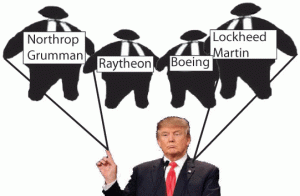 Trump Forges Ahead on Costly Nuclear Overhaul, Sweeping Aside Doubts, By DAVID E. SANGER and WILLIAM J. BROADNYT, AUG. 27, 2017
 During his
speech last week about Afghanistan, President Trump slipped in a line that had little to do with fighting the Taliban: “Vast amounts” are being spent on “our nuclear arsenal and missile defense,” he said, as the administration builds up the military.
August 28, 2017
Posted by Christina Macpherson |
politics, USA, weapons and war |
Leave a comment
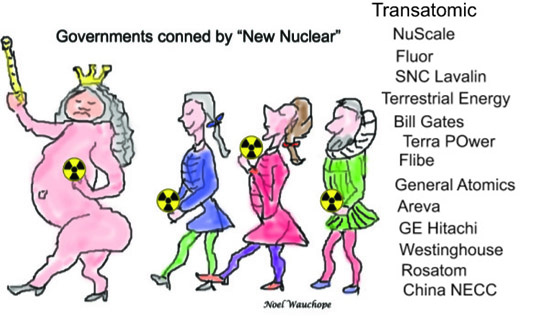
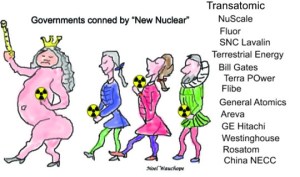 James Hansen’s Generation IV nuclear fallacies and fantasies, REneweconomy, Jim Green, 28 Aug 2017, http://reneweconomy.com.au/james-hansens-generation-iv-nuclear-fallacies-fantasies-70309/
The two young co-founders of nuclear engineering start-up Transatomic Power were embarrassed earlier this year when their claims about their molten salt reactor design were debunked, forcing some major retractions.
The claims of MIT nuclear engineering graduates Leslie Dewan and Mark Massie were trumpeted in MIT’s Technology Review under the headline, ‘What if we could build a nuclear reactor that costs half as much, consumes nuclear waste, and will never melt down?’
MIT physics professor Kord Smith debunked a number of Transatomic’s key claims. Smith says he asked Transatomic to run a test which, he says, confirmed that “their claims were completely untrue.”
Kennedy Maize wrote about Transatomic’s troubles in Power Magazine: “[T]his was another case of technology hubris, an all-to-common malady in energy, where hyperbolic claims are frequent and technology journalists all too credulous.” Pro-nuclear commentator Dan Yurman said that “other start-ups with audacious claims are likely to receive similar levels of scrutiny” and that it “may have the effect of putting other nuclear energy entrepreneurs on notice that they too may get the same enhanced levels of analysis of their claims.”
Well, yes, others making false claims about Generation IV reactor concepts might receive similar levels of scrutiny … or they might not. Arguably the greatest sin of the Transatomic founders was not that they inadvertently made false claims, but that they are young, and in Dewan’s case, female. Ageing men seem to have a free pass to peddle as much misinformation as they like without the public shaming that the Transatomic founders have been subjected to. A case in point is climate scientist James Hansen ‒ you’d struggle to find any critical commentary of his nuclear misinformation outside the environmental and anti-nuclear literature.
Hansen states that 115 new reactor start-ups would be required each year to 2050 to replace fossil fuel electricity generation ‒ a total of about 4,000 reactors. Let’s assume that Generation IV reactors do the heavy lifting, and let’s generously assume that mass production of Generation IV reactors begins in 2030. That would necessitate about 200 reactor start-ups per year from 2030 to 2050 ‒ or four every week. Good luck with that.
Moreover, the assumption that mass production of Generation IV reactors might begin in or around 2030 is unrealistic. A report by a French government authority, the Institute for Radiological Protection and Nuclear Safety, states: “There is still much R&D to be done to develop the Generation IV nuclear reactors, as well as for the fuel cycle and the associated waste management which depends on the system chosen.”
Likewise, a US Government Accountability Office report on the status of small modular reactors (SMRs) and other ‘advanced’ reactor concepts in the US concluded: “Both light water SMRs and advanced reactors face additional challenges related to the time, cost, and uncertainty associated with developing, certifying or licensing, and deploying new reactor technology, with advanced reactor designs generally facing greater challenges than light water SMR designs. It is a multi-decade process …”
An analysis recently published in the peer-reviewed literature found that the US government has wasted billions of dollars on Generation IV R&D with little to show for it. Lead researcher Dr Ahmed Abdulla, from the University of California, said that “despite repeated commitments to non-light water reactors, and substantial investments … (more than $2 billion of public money), no such design is remotely ready for deployment today.”…… http://reneweconomy.com.au/james-hansens-generation-iv-nuclear-fallacies-fantasies-70309/
August 28, 2017
Posted by Christina Macpherson |
Reference, reprocessing, spinbuster |
Leave a comment
Cyclones and climate change: connecting the dots,https://au.news.yahoo.com/a/36857982/cyclones-and-climate-change-connecting-the-dots/, by Marlowe HOOD, 27 Aug 17, Paris (AFP) – Scientists freely acknowledge they don’t know everything about how global warming affects hurricanes like the one pummelling southeast Texas.
But what they do know is enough to keep them up at night. The amplifying impact of sea level rise, warming oceans, and hotter air — all incontrovertible consequences of climate change — is basic physics, they say. Likewise accelerated shifts in intensity, such as the sudden strengthening that turned Harvey from a Category 2 to a Category 4 hurricane — on a scale of 5 — just as it made landfall Friday.
What’s missing is a detailed track record of hurricanes past, the kind of decades-long log of measurements that climate scientists need to discern the fingerprint of human influence. Starting in the 1970s, satellite data allowed for a better tally, but even that wasn’t enough.
“It is awfully difficult to see climate change in historical data so far because hurricanes are fairly rare,” Kerry Emmanuel, a professor of atmospheric science at MIT in Boston, told AFP. Experts, in other words, do not disagree on the potential of manmade global warming to magnify the destructive power of the tropical storms known variously around the world as cyclones, hurricanes and typhoons. Rather, they are confounded — for now — by a lack of information.
“Just because the data don’t allow for unambiguous detection yet, doesn’t mean that the changes haven’t been occurring,” noted James Kossin, a scientist at the US National Oceanic and Atmospheric Administration’s Center for Weather and Climate in Madison, Wisconsin.
Kossin figured out that cyclones have drifted poleward in their respective hemispheres over the last three decades, a finding hailed by other hurricane gurus as the most unambiguous evidence so far that global warming has already had a direct impact.
– Like a tsunami – When it comes to cyclones and climate change, there are many points of near “universal agreement,” said Emanuel.
One is the consequence of rising seas. “The most lethal aspect of hurricanes — wherever they occur in the world — is storm surge,” he said in an interview. “It is physically the same phenomenon as a tsunami, except that it is excited by wind rather than a sea floor shaken by an earthquake.”
If Hurricane Sandy — which caused $50 billion in damage — had happened a century earlier, it probably would not have flooded lower Manhattan because sea level was about 30 centimetres (a foot) lower, he pointed out.
Global warming is likely to add roughly a metre (three feet) to the global watermark by century’s end, according to recently revised estimates. “The surge from these storms will be more devastating — higher and more penetrating,” said James Elsner, an atmospheric scientists and hurricane expert at Florida State University.
A second point of consensus is that hurricanes will hold more water, raising the threat of lethal and destructive flooding. “We calculate that one degree Celsius (1.8 degrees Fahrenheit) of warming translates into a seven percent increase in humidity in the atmosphere,” said French scientist Valerie Masson-Delmotte, co-chair of the UN?s Intergovernmental Panel on Climate Change (IPCC).
The US National Hurricane Center predicts that Harvey could dump more than 40 inches (100 centimetres) by the time skies clear. Hurricane Mitch — the second deadliest Atlantic hurricane on record — left some 19,000 dead in Central America, “all from fresh-water flooding,” noted Emanuel.
“The irony is that hurricanes are known for wind, yet wind is third on the list of lethal aspects,” after storm surges and flooding caused by rain.
‘Fewer but stronger’ –
Earlier this year, Emanuel published a study pointing to yet another worrying climate “signal” emerging from the noise of raw data.
Scientists have made great progress in anticipating the path a storm will follow, extending their predictive powers from a day or two to about a week.
At the same time they have made scant headway in forecasting hurricane strength.
“The thing that keeps forecasters up at night is the prospect that a storm will rapidly gain strength just before it hits land,” Emanuel said, citing Harvey as an example.
In 2015, Hurricane Patricia in the Pacific Ocean intensified more rapidly — “It just went ‘Boom!’” — than any storm on record.
“Global warming can accentuate that sudden acceleration in intensity,” Emanuel said. A finding oft cited as evidence that the jury is still out on whether climate change will boost cyclones is that scientists don’t know if there will be more or fewer such storms in the future.
But even if there are fewer, which seems likely, that misses the point, the experts interviewed agreed.
Since 1971, tropical cyclones have claimed about 470,000 lives and caused some $700 billion in damages globally, according to the Centre for Research on the Epidemiology of Disasters.
But most of that death and destruction is attributable to a relative handful of storms. Just three, for example, have caused well over half of all storm-related deaths in the US since 1900.
So even if the number of mostly smaller storms diminishes, that’s not what counts.
“The idea of ‘fewer but stronger’ seems to be the fingerprint of climate change on tropical cyclones,” Elsner concluded.
August 28, 2017
Posted by Christina Macpherson |
climate change, USA |
Leave a comment

 NORTH KOREA KEEPS SAYING IT MIGHT GIVE UP ITS NUCLEAR WEAPONS — BUT MOST NEWS OUTLETS WON’T TELL YOU THAT, The Intercept Jon Schwarz, August 26 2017 “…….here’s what you don’t know, unless you’re an obsessive North Korea-watcher:
Also starting on July 4, North Korea has been saying over and over again that it might put its nuclear weapons and missiles on the negotiating table if the United States would end its own threatening posture.
This fact has been completely obscured by U.S. and other western media. For the most part, newspapers and television have simply ignored North Korea’s position. When they haven’t ignored it, they’ve usually mispresented it as its opposite – i.e., claiming that North Korea is saying that it will never surrender its nuclear weapons under any circumstances. And on the rare occasions when North Korea’s statements are mentioned accurately, they’re never given the prominence they deserve.
North Korea’s proclamations have been closely tracked by Robert Carlin, currently a visiting scholar at Stanford University’s Center for International Security and Cooperation and formerly head of the Northeast Asia Division in the State Department’s intelligence arm. Carlin has visited North Korea over 30 times.
Via email, Carlin described how it is difficult but critical to accurately decode North Korean communications. “Observers dismiss as unimportant what the North Koreans say,” Carlin writes, and “therefore don’t read it carefully, except of course if it is colorful, fiery language that makes for lovely headlines. Some of what the North says is simply propaganda and can be read with one eye closed. Other things are written and edited very carefully, and need to be read very carefully. And then, having been read, they need to be compared with past statements, and put in context.”
With that in mind, here’s Kim Jong-un’s statement on July 4:
[T]he DPRK would neither put its nukes and ballistic rockets on the table of negotiations in any case nor flinch even an inch from the road of bolstering the nuclear force chosen by itself unless the U.S. hostile policy and nuclear threat to the DPRK are definitely terminated. [emphasis added]
That formulation again appeared in an August 7 government statement after the United Nations Security Council passed new sanctions on North Korea. The same day, North Korean Foreign Minister Ri Yong Ho also said it during a speech at the Association of Southeast Asian Nations regional forum in the Philippines.
And on August 22 at the UN Conference on Disarmament in Switzerland, North Korean diplomat Ju Yong Chol made exactly the same point, stating, “As long as the U.S. hostile policy and nuclear threat remains unchallenged, the DPRK will never place its self-defensive nuclear deterrence on the negotiating table.”
In the past North Korea has pledged to renounce its nuclear weapons program. During the so-called Six-Party Talks in 2005, all the nations involved, including North Korea, affirmed that the North Korea was “committed to abandoning all nuclear weapons and existing nuclear programs.” Meanwhile, the United States and North Korea agreed to “respect each other’s sovereignty, exist peacefully together, and take steps to normalize their relations.”
Then the situation soured. Carlin writes that more recently “the routine formula in lower level media commentaries was that the nuclear deterrent was ‘not a mere bargaining chip to put on the table for negotiations with the United States.’”
So all of this seems quite clear and straightforward. North Korea is again telling the world that it is willing to consider renouncing its nuclear weapons program. Obviously Kim’s regime may not be telling the truth, especially given the fact that it has violated prior agreements. But the United States has flagrantly violated those agreements as well. The only way to find out whether there’s a path to North Korean disarmament is to honestly engage with them about it.
There are huge roadblocks to that happening, and one of the biggest is the failure of western media simply to inform their audience of the basics of what’s happening.
Since July 4, the New York Times and Washington Post have published hundreds of articles about North Korea. Both papers have informed their readers that Kim has called Americans “bastards.” But they’ve each only published one story quoting Kim’s key caveat, that North Korea will consider giving up its nukes if “the U.S. hostile policy and nuclear threat to the DPRK are definitely terminated.” And in both cases the Post and Times simply reprinted an AP story — in which Kim’s words appear in the 23rd paragraph – rather than running pieces of their own………
Coverage in other publications has tended to be, if anything, shoddier, with television coverage worst of all. The BBC World Service soberly explained on August 15 that “North Korea says its nuclear program can never be on the negotiating table and that’s where the stand-off is.” Other outlets have generally maintained a discreet silence about North Korea’s position.
Taken in total, the media’s performance on North Korea so far is an extremely ominous development. We know because of the Iraq War that newspapers and TV can provide a key assist in launching catastrophic U.S. wars. As things stand now, it’s by no means impossible that they will do it again. https://theintercept.com/2017/08/25/north-korea-keeps-saying-it-might-give-up-its-nuclear-weapons-but-most-news-outlets-wont-tell-you-that/
August 28, 2017
Posted by Christina Macpherson |
North Korea, politics international, weapons and war |
Leave a comment
North Korea vows to ‘sharpen its nuclear sword’ in WORLD WAR 3 threat to USA, Express UK 27 Aug 17 NORTH Korea has sparked fears of all-out war with the USA after threatening to “sharpen its nuclear sword” as tensions continue to escalate., By JOEY MILLAR, Aug 27, 2017 North Korea has issued yet another sabre-rattling statement to its Western enemies, warning the US it would show “no mercy” in any conflict.
August 28, 2017
Posted by Christina Macpherson |
North Korea, politics international, weapons and war |
Leave a comment


 UK Running ‘Secret’ Program to Develop Nuclear Weapons https://sputniknews.com/europe/201606071040916158-uk-trident-nuclear-proliferation/
A new report claims Britain’s Atomic Weapons Establishment (AWE) is ‘secretly’ working on a program to upgrade the current UK Trident warhead to give it more destructive power, despite the country’s long-term commitment to reduce nuclear proliferation.
According to the Nuclear Information Service (NIS) — an independent body which works to promote public awareness and foster debate on nuclear disarmament — AWE is currently working on a program to upgrade the current UK Trident warhead to the ‘Mark 4A’ modified warhead, which will have increased accuracy and destructive power and an extended lifetime.
Parliament has never been formally notified of the Mark 4A modification program and the costs and timetable for the program have never been disclosed. Nevertheless, the policy of successive UK governments has been to achieve a world without nuclear weapons, so it is incontrovertible that at some point in the future nuclear weapons production and maintenance at AWE must cease,” its latest report says. Transparency?
In May 2010, the government announced that it would reduce the overall size of the UK’s nuclear weapons stockpile to 225.
A government statement, updated in May 2015, stated: “Following a further review, in October 2010 the Prime Minister announced that by the mid-2020s the overall size of the UK nuclear weapons stockpile will reduce to no more than 180 warheads.
No more than 120 will be operationallyavailable.”
However, critics say that a reduction in the number of warheads, but with increased “destructive power,” is hardly in the spirit of non-nuclear proliferation.
Parliament should debate whether to replace the UK Trident warhead, given the questions over its necessity, cost, proliferation implications, and impact on the UK’s nuclear disarmament obligations,” the NIS report says.
Professor Martin Rees (Lord Rees of Ludlow), Astronomer Royal and a former President of the Royal Society, in the foreword to the report says:
“[There is] a need for AWE, a highly expensive institution, to be more politically accountable and more transparent. Parallel US institutions like Los Alamos are in a less ‘closed’ world; to a greater extent than at AWE their staff attend mainstream scientific conferences and contribute research on non-classified topics.”
According to the report, the program involves close collaboration with the US nuclear weapons laboratories through a joint US/UK Joint Re-entry System Working Group, and key components for the modified warhead are purchased from the US.
August 28, 2017
Posted by Christina Macpherson |
UK, weapons and war |
Leave a comment

 If Report Says Iran Is Abiding by Nuclear Deal, Will Trump Heed It?, NYT, By GARDINER HARRIS AUG. 27, 2017 WASHINGTON — Within days, international monitors will send an inspection report on Iran’s nuclear facilities to governments around the world, touching off a chain of events that could lead to another clash between President Trump and congressional Republicans, or even his own top advisers.
August 28, 2017
Posted by Christina Macpherson |
Iran, politics international, USA |
Leave a comment
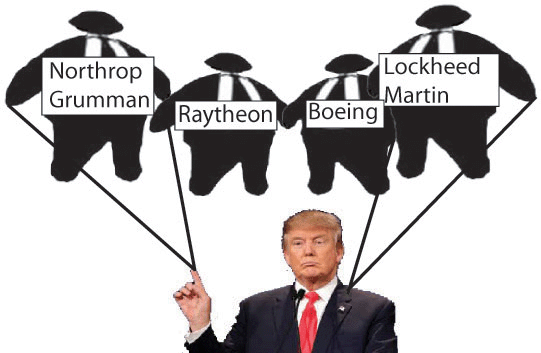
Armed Services Dem accuses Trump admin of rushing nuclear contracts, The Hill, BY ELLEN MITCHELL – 08/27/17 House Armed Services Committee ranking member Adam Smith (D-Wash.) on Sunday accused the Trump administration of rushing two major nuclear weapons programs.
“This week, the Air Force awarded four contracts worth nearly $2.5 billion to begin developing two new nuclear weapons. Yet this administration has not even completed its Nuclear Posture Review,” Smith said in a statement.
“We are rushing on autopilot to fund these programs.” The Pentagon in April officially began the nuclear posture review, which was ordered by President Trump in January. It’s the first review of the U.S. nuclear weapons policy since 2010, and won’t be done for several more months.
The Pentagon, however, has not waited for the review’s completion in moving ahead with two new nuclear weapons programs.
Last week the Defense Department awarded contracts for the Ground Based Strategic Deterrent, which will replace the current Minuteman III intercontinental ballistic missiles, and the Long Range Standoff (LRSO) weapon, the next nuclear-capable cruise missile to be fired from aircraft…..http://thehill.com/policy/defense/348197-armed-services-dem-accuses-trump-admin-of-rushing-nuclear-contracts
August 28, 2017
Posted by Christina Macpherson |
business and costs, politics, weapons and war |
Leave a comment








 nuclear-news