U.S. Senator wants report on costs and safety of Los Alamos National Laboratory
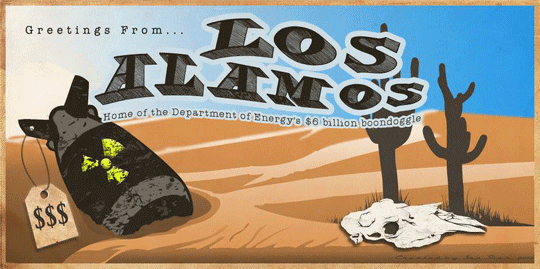 Senator seeks answers on LANL’s nuclear safety, By Rebecca Moss | The New Mexican, Aug 23, 2017,
A U.S. senator has asked the National Nuclear Security Administration to report to Congress by Thursday on the costs and safety of Los Alamos National Laboratory’s weapons production program and, in particular, the potential for critical accidents.
In early August, U.S. Sen. Claire McCaskill, D-Mo., a ranking member of the Senate’s Homeland Security and Governmental Affairs Committee, sent a letter to Frank Klotz, administrator of the NNSA, saying she had serious concerns about poor federal oversight and management of the laboratory and requesting a report.
The inquiry was triggered by a series of investigative reports by the Washington, D.C.-based Center for Public Integrity, which were published in The New Mexican and other newspapers earlier this summer. The series highlighted a number of serious incidents at Los Alamos’ plutonium facility, events that could have led to significant radiological releases and worker deaths. Poor management has resulted in unsafe working conditions, injured workers and federal violations at the plutonium facility and other sites, and senior officials rarely were penalized for the problems, the stories said……
Los Alamos was the only nuclear site that failed its annual review for nuclear criticality safety in fiscal year 2016, a program designed to prevent severe nuclear accidents. The lab was graded as “adequate but needs improvement” the previous year, according to a federal report.
In her Aug. 3 letter to Klotz, McCaskill said, “Private firms contracted to operate and maintain these facilities have not been held accountable in a meaningful way for the safety lapses that occurred under their watch.”….
I have previously noted my concerns regarding DOE’s poor oversight and management of its contracts and its inability to properly exercise effective oversight of its budget,” McCaskill said in the letter.
She asked the National Nuclear Security Administration to report on the current state of operations and safety testing at Los Alamos’ plutonium facility, known as PF-4, and whether safety standards have been met. She also asked the agency to provide costs associated with closing the facility, how much of the agency’s budget for fiscal year 2018 will go to improving safety standards, and if any penalties will be imposed on the lab or its management contractors.
“Does NNSA feel it is meeting its duty to prevent dangerous nuclear accident?” she asked.
U.S. Sen. Tom Udall, D-N.M., said in an email that McCaskill’s letter “raises some very serious and important questions, and I hope the NNSA answers these questions in a timely manner.”…….
Greg Mello, director of the Los Alamos Study Group, a nuclear disarmament-focused nonoprofit, said in a statement that McCaskill’s letter is “only the tip of the iceberg” of problems at Los Alamos.
“Bad management is a feature,” he said. “It is partly why people work at these facilities (LANL in particular) in the first place — low professional standards, high salaries, and lack of accountability.”
Increasing doubts about the future of nuclear energy
Doubts Surface About Nuclear Energy After S.C. Project Is Halted, WFAE 90.7, By DAVID BORAKS • AUG 22, 2017 “…….On July 31, Santee Cooper and South Carolina Electric & Gas announced they were abandoning construction of two new reactors at the V.C. Summer plant north of Columbia. The immediate reasons were simple: The project was four years behind schedule and at least $5 billion over budget.
CEO Kevin Marsh of SCANA, the parent company of South Carolina Electric & Gas, said it no longer made financial sense, especially after Santee Cooper pulled out.
“What really led us to this decision on the abandonment was looking at the costs going forward. And, of course in our case, without a partner, it made that cost just too much for our customers to bear,” Marsh told analysts earlier this month.
But there were other factors. One was this spring’s bankruptcy of the lead contractor and reactor designer, Westinghouse Electric. Fallout from its troubles is now hitting other projects, including one in Georgia.
Also, demand for electricity isn’t growing as fast as it once was – in part, because of energy efficiency. And then there’s the boom in other forms of energy that weren’t in the picture two decades ago when planning for these plants began, according to Kit Konolige, senior utilities industry analyst with Bloomberg Intelligence…..
Nuclear power is on the decline in most places, with the exception of China and India. California’s lone remaining nuclear plant will close in 2025. And Germany is phasing out nuclear by 2022, after shutting nearly half its reactors after Fukushima.
Troubles at projects like those in South Carolina, and a reliance on existing nuclear plants, make nuclear’s future a critical question for Duke Energy. …..
Last year, the company won federal licenses for two new nuclear plants in South Carolina and Florida, using the same Westinghouse reactor designs as the now halted South Carolina project. They could cost more than $11 billion each and take a decade to build. The question is whether it makes business sense, says Duke spokesman Rick Rhodes.
“We have what’s called a combined construction and operating license for those two projects. However, we’ve not made a decision to build either of those plants. As I said, we are watching closely what’s going on in the industry,” Rhodes said.
The decision will depend on what happens to Westinghouse, how much the plants will cost and how fast electricity demand grows, he said.
Bloomberg’s Konolige doesn’t see nuclear power regaining any momentum.
“Personally, I think it will be very difficult to justify building new nuclear plants. From a shareholder’s viewpoint, they just represent a tremendous amount of uncertainty over a long period of time. And obviously a great expenditure of capital,” he said.
Capital that companies like Duke may decide is better spent elsewhere. http://wfae.org/post/doubts-surface-about-nuclear-energy-after-sc-project-halted
It would take a miracle to salvage South Carolina’s abandoned nuclear power projects
Kallanish Energy 24th Aug 2017, When South Carolina senators asked Tuesday what it would take to salvage
the V.C. Summer Nuclear project, utility executives involved replied a new
partner who could put at least $3 billion into the over-budget,
behind-schedule project.
The state’s customer advocate was a bit more cynical – and perhaps more truthful. “You are going to need probably
more than one partner. I don’t know if you can get one partner and I
don’t think one partner can do it,” said Dukes Scott, executive
director of the South Carolina Office of Regulatory Staff, the Charlotte
Business Journal newspaper reported.
“You are going to need a partner for (state-owned) Santee Cooper and you are going to need a partner for (South
Carolina Electric & Gas, SCE&G) … and we need a third and fourth partner
to come in to finish this plant.” Scott reminded the senators of the
decision involving energy giant Duke Energy made in the early 1980s to
abandon plans for the Cherokee Nuclear plant in Gaffney, S.C. He said he
was asked at that time what it would take to save Cherokee. “My answer
was a miracle,” he said, the Business Journal reported. “What I just
described is close to that.” http://www.kallanishenergy.com/2017/08/24/enators-told-saving-nuclear-project-could-take-a-miracle/
1 This Month


Tell the Ukrainian Government to Drop Prosecution of Peace Activist Yurii Sheliazhenko

Petition to revoke the licensing of the Near Surface Nuclear Disposal Facility (NSDF) at Chalk River. https://www.ourcommons.ca/petitions/en/Petition/Details?Petition=e-7247


of the week – STOP SMALL MODULAR REACTORS IN CANADA
To see nuclear-related stories in greater depth and intensity – go to https://nuclearinformation.wordpress.com
-
Archives
- March 2026 (204)
- February 2026 (268)
- January 2026 (308)
- December 2025 (358)
- November 2025 (359)
- October 2025 (376)
- September 2025 (258)
- August 2025 (319)
- July 2025 (230)
- June 2025 (348)
- May 2025 (261)
- April 2025 (305)
-
Categories
- 1
- 1 NUCLEAR ISSUES
- business and costs
- climate change
- culture and arts
- ENERGY
- environment
- health
- history
- indigenous issues
- Legal
- marketing of nuclear
- media
- opposition to nuclear
- PERSONAL STORIES
- politics
- politics international
- Religion and ethics
- safety
- secrets,lies and civil liberties
- spinbuster
- technology
- Uranium
- wastes
- weapons and war
- Women
- 2 WORLD
- ACTION
- AFRICA
- Atrocities
- AUSTRALIA
- Christina's notes
- Christina's themes
- culture and arts
- Events
- Fuk 2022
- Fuk 2023
- Fukushima 2017
- Fukushima 2018
- fukushima 2019
- Fukushima 2020
- Fukushima 2021
- general
- global warming
- Humour (God we need it)
- Nuclear
- RARE EARTHS
- Reference
- resources – print
- Resources -audiovicual
- Weekly Newsletter
- World
- World Nuclear
- YouTube
-
RSS
Entries RSS
Comments RSS
 nuclear-news