Bold legal tactics in Japan, against the nuclear industry
 BNEF 18th Aug 2017, In the basement of a three-story house in a leafy neighborhood in Tokyo,
about 40 lawyers crowded together, plotting against Japan’s massive
nuclear power industry. The host was 73-year-old Hiroyuki Kawai, one of
Japan’s most colorful litigators. The end game? To close all of the
country’s 42 reactors for good, a result that would be a major blow to
the future of atomic energy across the world.
For the staunch anti-nuclear activist, the risk of a meltdown outweighs the benefits of the relatively
clean source of power. Kawai is propelling the anti-nuclear movement
forward with a 22 trillion yen ($171 billion) shareholder lawsuit against
the company, among the largest in damages ever sought.
He wants to pressure the government and businesses to distance themselves from atomic power, and
while his court cases have yielded mixed results, his bold tactics are
garnering attention around the world. https://about.bnef.com/blog/how-a-harley-riding-ex-ally-of-villains-is-leading-a-nuke-revolt/
Concern over dangers of nuclear bombs transport across Britain
 Herald 20th Aug 2017, Scotland is “wholly unprepared” to deal with an accident or an attack on
the nuclear bomb convoys that regularly travel across the country,
according to a new report. Local authorities are accused of breaching their
legal duty to safeguard the public by failing to assess and warn of the
dangers.
Scottish Ministers are under fire for failing to make councils
comply. Campaigners are demanding an urgent review of measures to protect
people from radioactive contamination from convoy crashes. They say that an
accident could spread plutonium and other toxic materials over miles.
Anti-nuclear groups have previously attacked the UK government for failing
to ensure the safety of nuclear weapons transports. But now they are
targeting Scottish central and local government for not doing enough.
According to the nuclear-free group of local authorities (NFLA), the report
showed there was “confusion” over the response to convoy accidents.
One problem was that councils weren’t informed of convoy movements, it argued.
“There needs to be a wider rethink about such convoys and greater
cooperation with all emergency responders, including councils, so that the
risks to the public can be fully unpacked and considered,” said NFLA
Scotland representative, Audrey Doig, an SNP councillor from Renfrewshire.
http://www.heraldscotland.com/news/15483954.No_safety_assessments_carried_out_for_nuclear_convoys_in_Scotland/
The value of wind and solar power to America’s health and environment
if you add up those central estimates, wind and solar saved Americans around $88 billion in health and environmental costs over eight years. Not bad.
 Wind and solar power are saving Americans an astounding amount of money
Not getting sick and dying from pollution is worth quite a bit, it turns out. VOX, by Aug 18, 2017 Wind and solar power are subsidized by just about every major country in the world, either directly or indirectly through tax breaks, mandates, and regulations.
The main rationale for these subsidies is that wind and solar produce, to use the economic term of art, “positive externalities” — benefits to society that are not captured in their market price. Specifically, wind and solar power reduce pollution, which reduces sickness, missed work days, and early deaths. Every wind farm or solar field displaces some other form of power generation (usually coal or natural gas) that would have polluted more.
Subsidies for renewables are meant to remedy this market failure, to make the market value of renewables more accurately reflect their total social value.
This raises an obvious question: Are renewable energy subsidies doing the job? That is to say, are they accurately reflecting the size and nature of the positive externalities?
That turns out to be a devilishly difficult question to answer. Quantifying renewable energy’s health and environmental benefits is super, super complicated. Happily, researchers at the Lawrence Berkeley Lab have just produced the most comprehensive attempt to date. It contains all kinds of food for thought, both in its numbers and its uncertainties.
(Quick side note: Just about every country in the world also subsidizes fossil fuels. Globally, fossil fuels receive far more subsidies than renewables, despite the lack of any policy rationale whatsoever for such subsidies. But we’ll put that aside for now.)
Here’s how much wind and solar saved in health and environmental costs
The researchers studied the health and environmental benefits of wind and solar in the US between 2007 (when the market was virtually nothing) and 2015 (after years of explosive market growth).
Specifically, they examined how much wind and solar reduced emissions of four main pollutants — sulfur dioxide (SO2), nitrogen oxides (NOx), fine particulate matter (PM2.5), and carbon dioxide (CO2) — over that span of years. The goal was to understand not only the size of the health and environmental benefits, but their geographical distribution and how they have changed over time.
To cut to the chase, let’s review the top-line conclusions:
- From 2007 to 2015, wind and solar in the US reduced SO2, NOx, and PM2.5 by 1.0, 0.6, and 0.05 million tons respectively;
- reduction of those local air pollutants helped avoid 7,000 premature deaths (the central estimate in a range from 3,000 to 12,700);
- those avoided deaths, along with other public health impacts, are worth a cumulative $56 billion (the central estimate in a range from $30 to $113 billion);
- wind and solar also reduced CO2 emissions, to the tune of $32 billion in avoided climate costs (the central estimate in a range from $5 to $107 billion).
So, if you add up those central estimates, wind and solar saved Americans around $88 billion in health and environmental costs over eight years. Not bad.
That number is worth reflecting on, but first let’s talk a second about how they came up with it.
Uncertainties abound in measuring positive externalities
Tallying up these benefits is difficult for all sorts of reasons………
In all those steps, there are uncertainties and ranges, some having to do with the limitations of models, some having to do with the limitations of our understanding of the impacts of pollution, some having to do with difficult-to-quantify intangibles like the value of a human life.
These uncertainties explain the wide range of estimates involved: premature mortalities range from 3,000 to 12,700; local pollution impacts from $30 to $113 billion; CO2 climate impacts from $5 to $107 billion. (It’s worth saying that there are good reasons to think most SCC estimates are lowballing — certainly $5 billion is ludicrous.)……..
Wind and solar benefits vary over time and from place to place
If you dig into the paper, you find that the most interesting data has to do with the variations in benefits across regions and over time.
It’s complex, but in a nutshell, the health and environmental benefits of wind and solar vary depending on what other sources are being displaced, and how much, and when…….
Wind and solar effects also varied widely by region, because some regions have cleaner power sectors than others. In California, wind and solar are mostly displacing natural gas. In the upper Midwest and mid-Atlantic regions, which rely more heavily on coal, wind and solar have greater impact……. https://www.vox.com/energy-and-environment/2017/8/18/16160456/wind-solar-power-saving-money
Britain is well able to have low-carbon energy without nuclear power
Tom Burke’s Blog 16th Aug 2017, There is a very broad National consensus about what we want our energy
policy to do, what the goal of British Energy Policy should be. It should
be affordable, it should be secure and it should be low-carbon, in
delivering the service that people want. I don’t know anybody who
doesn’t agree that that trilemma is what we are trying to do.
And there is no doubt at all that it can be delivered in the UK, in a way that does
not involve nuclear power, and if we were to do that it would be cheaper
and more secure than doing it in the way that we are currently trying to do
it.
We don’t have a problem with technology, we actually have more
technology than we can begin to use, and we certainly don’t have a
problem with the economics of using low-carbon technologies, or a variety
of low-carbon technologies.
All the problems we have with getting to the goal, are political problems. They are problems about getting the politics
right, not about getting the technologies or the economics right. As we
look at that project in the context of what’s going on in the world, as
we look around at what is happening in the world, it is very clear that all
over the world we are now engaged in a transition, in the so-called energy
transition, as we move to a low-carbon economy to make sure that climate
change doesn’t destroy civilisation.
And as we make that transition, we must make sure that it is a “just transition”. It’s not just as shift
of technology it is also a shift of people’s livelihoods and communities,
and we must take those communities and those livelihood with us as we make
that transition. http://tomburke.co.uk/2017/08/16/no-need-for-nuclear-the-renewables-are-here-conway-hall-london-17-june-2017/
SCE&G customers ripped off in SCANA nuclear power boondoggle
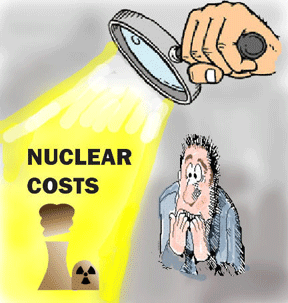
 The State 19th Aug 2017, SCE&G customers have already paid $1.4 billion for the SCANA nuclear power
plants boondoggle. That comes out to an average of $2,000 paid by each of
the 700,000 customers from the nine rate hikes to date.
With $27 of the average person’s power bill going to the now-abandoned project, if SCE&G
does not change this rate, that will cost the average customer an
additional $19,440 over the next 60 years — giving SCE&G a total of $13.6
billion to recover the balance of $4.9 billion it spent on the failed
project.
For the total of $21,440 that customers would pay on average for
this abandoned project, they could have purchased solar panels, thereby
reducing power consumption and obviating a need for increased generating
capacity while lowering their utility bills considerably. http://www.thestate.com/opinion/letters-to-the-editor/article167996422.html
USA research recommends wind and solar power for Africa
Environmental Research Web 19th Aug 2017, The International Renewable Energy Agency says that Africa has the
potential and the ability to utilise its renewable resources to fuel the
majority of its future growth. It adds ‘doing so would be economically
competitive with other solutions, would unlock economies of scale, and
would offer substantial benefits in terms of equitable development, local
value creation, energy security, and environmental sustainability’.
Simply deploying solar PV locally, off grid, with panels put on individual
homes, schools and the like, although helpful, is not enough to make more
than a limited dent on problem of providing full access to energy.
At present, 57% of Africa’s mostly rural population does not have access to
electricity. Grids, including local mini grids, are also needed New cheaper
power inputs also also needed- but they are on the way.
A new assessment by the U.S. Department of Energy’s Lawrence Berkeley National Laboratory
(Berkeley Lab) has found that wind and solar can be economically and
environmentally competitive options in Africa and can contribute
significantly to the rising demand, which could triple as African economies
develop. http://blog.environmentalresearchweb.org/2017/08/19/powering-africa/
Iran fully compliant with its obligations under the nuclear agreement
Russian ambassador: Iran in full compliance with nuclear deal http://www.tehrantimes.com/news/416051/Russian-ambassador-Iran-in-full-compliance-with-nuclear-deal August 19, 2017 TEHRAN – Russian Ambassador to Tehran Levan Dzhagaryan has said that Iran has acted fully in compliance with its commitments under the nuclear agreement, noting that the U.S. should not complain in this regard.
“We will insist on our stance when talking with the Americans,” Dzhagaryan said in an interview with ISNA, stressing that the nuclear agreement must be fully implemented.
He said Russia is deeply concerned about U.S. President Donald Trump’s bashing of the nuclear deal, officially known as the Joint Comprehensive Plan of Action.
“The European countries are also very concerned and oppose [such rhetoric],” the Russian diplomat said, adding, “This is not a deal between Iran and America, but rather a multilateral agreement.”
“As you know, Russia has put a lot of effort into reaching the JCPOA,” the diplomat remarked.
Dzhagaryan also expressed the hope that China, along with U.S. allies including France, Germany, and especially Britain would persuade Washington to soften its tone on the nuclear accord.
On the recent U.S. sanctions that targeted Russia, Iran and North Korea, the diplomat said he regards all of them as “illegal”.
“However, we urge North Korea not to carry out missile tests, as it will be used as a pretext by the Americans to expand their military presence in the region,” he pointed out.
He also pointed to the economic benefits following the nuclear agreement, saying although he is satisfied with the level of Tehran-Moscow political ties, he cannot be content with the level of economic transactions between the two countries.
Russia has long supported the full implementation of the JCPOA and belives the full implementation of the deal would benefit all countries, Russia’s top diplomat in Iran asserted.
On Friday, the Russian Foreign Ministry spokeswoman Maria Zakharova reiterated her country’s stance, saying the Kremlin keeps on supporting the international pact.
Talking to reporters, she invited all the other signatories to the deal to stick to it.
Russian has all the time declared its stance regarding the international deal clearly and Moscow was actively involved in conclusion of the JCPOA, she said.
Zakharova stressed that Russia played an important role in preventing the Iran nuclear issue to be drawn into a military conflict.
In certain tense conditions, she said, the U.S. would say Iran’s nuclear program needed military solution.
But Russia insisted clearly on its stance on solving the nuclear issue through negotiations and it will never change its standing regarding the deal, said Zakharova.
Right wing in South Korea calling for nuclear weapons
Time for nuclear balancing act?, Korea HeraldBy Yeo Jun-suk, 20 Aug 17 Calls grow in Seoul to deploy tactical atomic weapons to counter NK nuclear threats, Aug 20, 2017 Despite under a constant threat of war from the communist North Korea, South Korea has remained a nuclear weapons-free zone since 1991. But with Pyongyang nearing the finish line in its atomic weapons program, politicians and security experts in Seoul are calling for “a balancing act” to adapt to the new security environment on the Korean Peninsula: A North Korean nuclear weapon can only be deterred by a nuclear weapon — by either South Korea’s own or the US, they said.
“We can’t fight against the North with bare hands,” said Rep. Jeong Yong-ki, a spokesman for the main opposition Liberty Party Korea. “It’s time for us to be in a tit-for-tat over North Korea’s nuclear weapons.”
The conservative party, who favors hardline approaches toward the North, adopted as its party platform last week a call for redeploying US tactical nuclear weapons that were withdrawn from the peninsula in 1991.The minor conservative Bareun Party, while also advocating nuclear deterrence, floated an idea of US “sharing” its nuclear weapons with South Korea.
As opposed to the Liberty Party’s proposal of bringing US nuclear weapons back here, the idea calls for the US granting South Korea a right to use US nuclear assets operating outside the peninsula, such as nuclear-powered submarines or fighter jets carrying nuclear bombs, when the need arises.
“Our idea allows us to have nuclear deterrence without deploying nukes here,” while avoiding possible backlashes from neighboring countries, said Rep. Ha Tae-kyung of Bareun Party.
The need for a nuclear deterrent was echoed even from a former security advisor to President Moon Jae-in, a liberal favoring re-engagement with the North and nuclear disarmament of both Koreas. …….http://www.koreaherald.com/view.php?ud=20170820000215
Despite the financial fiasco, nuclear executives busily planning for more bonuses
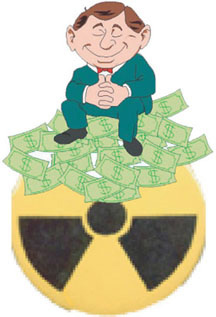 Even after nuclear catastrophe, SCANA execs eye bonuses, Post and Courier, BY STEVE BAILEY, 20Aug 17
Did South Carolina agency do enough to protect utility customers from nuclear financial fiasco?
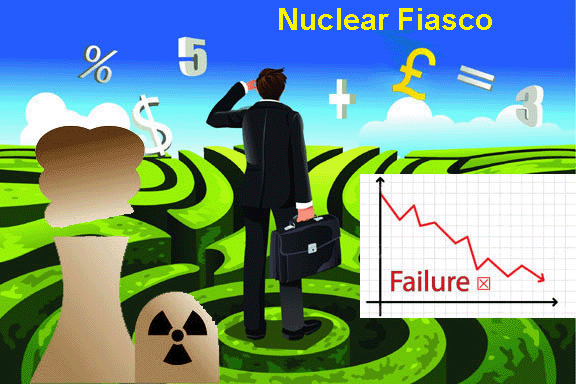 After paying for abandoned nuke project, do SC consumers need a stronger advocate?, The State, BY SAMMY FRETWELL sfretwell@thestate.com AUGUST 19, 2017 COLUMBIA, SC
A state agency whose job is to look out for utility customers finds itself explaining whether it did enough to protect ratepayers from rising power bills that resulted from a bungled nuclear expansion project.
The S.C. Department of Regulatory Staff, a 71-person agency with a $13.3 million budget, is drawing scrutiny for what critics say was a tepid defense of SCE&G ratepayers who were charged about $2 billion for the costs of two new reactors. SCE&G abandoned the unfinished reactor construction project July 31 after hitting customers with nine rate increases to pay for the work.
Regulatory staff officials say they did plenty to help ratepayers. But state law also requires the department to weigh the interests of utilities against those of customers. The Office of Regulatory Staff initially supported SCE&G’s plan to charge customers through a series of rate increases…….http://www.thestate.com/news/article168181267.html
Waste of money and time with no nuclear reactors happening
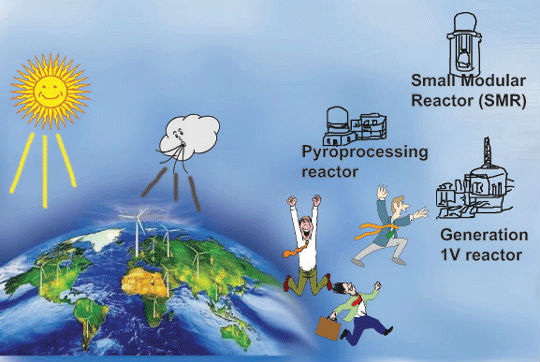 Money and time wasted and no new reactor designs to show for it http://www.beyondnuclear.org/home/2017/8/15/money-and-time-wasted-and-no-new-reactor-designs-to-show-for.html
The majority of pro-nuclear boosters appear finally to have swallowed a dose of reality — and have ceased clinging to the idea that “new nuclear power plants” and even “new reactor designs” will be the energy answer of the near future. The error- and omission-filled pro-new-nuclear propaganda piece, Pandora’s Promise, was out of date almost as soon as it was released. Even its producers and stars have jumped ship and instead now clamor to keep old, economically failing and technically deteriorating nuclear plants going, just to justify a continued existence.
In a telling piece of research — A retrospective analysis of funding and focus in US advanced fission innovation — by Abdulla et al, a look was taken at how US spending has affected nuclear power development and new reactor design. Unsurprisingly, the authors noted that:
“despite spending $2 billion since the late 1990s—no advanced design is ready for deployment. Even if the program had been well designed, it still would have been insufficient to demonstrate even one non-light water technology. It has violated much of the wisdom about the effective execution of innovative programs: annual funding varies fourfold, priorities are ephemeral, incumbent technologies and fuels are prized over innovation, and infrastructure spending consumes half the budget. Absent substantial changes, the possibility of US-designed advanced reactors playing a role in decarbonization by mid-century is low.” [emphasis added.]
As the authors also explained in their conclusion:
“In this paper, we do not seek to present a comprehensive diagnosis of the problems facing nuclear energy innovation in the US. Rather, we have reconstructed NE’s budget history and evaluated how close the office has come to achieving its advanced reactor mission. Our research shows that, as currently structured, NE has neither the funding levels nor the programmatic focus that it needs to deliver on its mission of developing and demonstrating one or two advanced reactor designs by mid-century. This comes despite multiple strategy roadmaps and billions of dollars of appropriations.”
The only reasonable conclusion to draw is that enough money and time has already been wasted on a failed technology that has zero role to play in our energy present or future.
Opposition to dangerous air flights carrying radioactive wastes
 Campaigners aim to raise awareness of Moray nuclear flights at meeting, The Press and Journal, Aberdeen, by August 20, 2017 Anti-nuclear campaigners will meet in Moray to press for alternatives to transporting radioactive waste through the region.
Former TVA chairman David Freeman calls for solar power
 Look to solar energy, Post and Courier, S. David Freeman, Former TVA chairman, 20 Aug 17
Perhaps we should thank the Lord that the nuclear meltdown by Santee Cooper was just financial. Based on their performance in trying to build the two reactors, one must be somewhat concerned whether, if they completed them, they would operate reliably and safely.
There is a lesson to be learned from this experience but surely the first thought should not be to spend good money because a bad judgment was made. The lesson to be learned is that the world of electricity has changed and solar power is cheaper than nuclear power.
Santee Cooper should accept this basic fact and go back to its original mission of low-cost electricity, which today means solar and wind backed by storage and used efficiently.
Selling Santee Cooper to get the money to complete the nukes would be like a gambler who had lost a lot of money and took out a mortgage on his house to “win” back his loses. For the sake of the consumer who will pay — don’t do it.http://www.postandcourier.com/opinion/letters_to_editor/letter-look-to-solar-energy/article_d56e8544-81e6-11e7-9f4f-a7d76bb5420d.html
Nuclear lobby none too happy about Trump’s lack of action to further nuclear power
Trump administration’s nuclear energy plans hanging on by a thread, – The Washington Times August 20, 2017
The next generation of U.S. nuclear power, which the Trump administration views as a key part of the nation’s energy supply, is hanging on by a thread as two key projects have run into serious trouble and are raising doubts about the viability of new nuclear facilities moving forward.
Utilities in South Carolina late last month stopped construction at V.C. Summer, scrapping plans to build two reactors near Columbia and ending a 10-year project that was expected to provide something of a blueprint for future cutting-edge nuclear plants.
At the same time, Georgia’s Vogtle nuclear project also has hit roadblocks, with costs expected to reach at least $25 billion. Original projections were about $14 billion, and the facility already is years behind schedule.
Vogtle supporters reportedly have asked the Trump administration for financial help in finishing the project, and some analysts say federal intervention looks to be the only way new nuclear reactors can be completed in the current economic climate.
No nuclear reactors have been built in the U.S. in more than 30 years, though the fuel source still provides more than 20 percent of the nation’s electricity. Both Summer and Vogtle were envisioned as much more efficient, safer plants than those built decades ago, but specialists say the first-of-their-kind nature of the facilities has led to massive cost overruns and construction delays.
Both Summer and Vogtle were envisioned as much more efficient, safer plants than those built decades ago, but specialists say the first-of-their-kind nature of the facilities has led to massive cost overruns and construction delays.
“What we call the first of a kind is a lot more expensive,” Mr. Schwartz said. “We need to buy down the cost of the first-of-a-kind plants to levels that are commercially viable The only source of that buy-down, really, is the United States government.”
There seems to be some support in Congress for, at the very least, extending existing programs aimed at helping Summer and Vogtle.
Sen. Lindsey Graham, South Carolina Republican, said last week that Congress should extend production tax credits for new nuclear facilities. The House already has passed such legislation, and Mr. Graham said the Senate should do the same to ensure billions of dollars aren’t wasted on nuclear plants that never materialize…….http://www.washingtontimes.com/news/2017/aug/20/trump-administrations-nuclear-energy-plans-hanging/
Continuing questioning about Trump’s mental stability
Schiff: Jury’s out on Trump’s mental stability, Politico.com , By KYLE CHENEY, 08/20/2017
Rep. Adam Schiff, the top Democrat on the House Intelligence Committee, said Sunday that he and his colleagues are increasingly concerned about President Donald Trump’s mental fitness.
“There are some serious issues,” Schiff said on CNN’s “State of the Union,” adding that “the pressures of the job may only get worse.”
The California lawmaker’s comments came after he was asked by host Jake Tapper to respond to Democratic Rep. Jackie Speier’s call Tuesday to invoke the 25th Amendment, which empowers the vice president and Cabinet to remove a president who is incapable of serving. That remedy, Schiff noted, was primarily envisioned for a president who has “some kind of physical incapacitation or serious mental illness, a breakdown.”
“We’re still far from concluding that that’s the case, even though we find, many of us, his conduct anathema,” Schiff said. He added, “I don’t think we’re at a point of thinking about the 25th Amendment.”……
Schiff emphasized that colleagues on both sides of the aisle have recently questioned Trump’s stability, most notably Sen. Bob Corker (R-Tenn.), who said Thursday that Trump “has not yet been able to demonstrate the stability nor some of the competence that he needs to demonstrate in order to be successful.”
“I certainly think that there’s an issue with the president’s capability,” Schiff said, describing “some aspect of his character” that’s “incapable of introspection.” “I think it’s a question people are asking.” http://www.politico.com/story/2017/08/20/schiff-trump-mental-health-241835
1 This Month


18 March Webinar @ 1 PM EST: An Assessment of SMR Projects: The Case of Canada
register for the zoom:
https://us02web.zoom.us/webinar/register/WN_o8BIIOUvQ2ONJR1nta65DQ#/registration


of the week – STOP SMALL MODULAR REACTORS IN CANADA
To see nuclear-related stories in greater depth and intensity – go to https://nuclearinformation.wordpress.com
-
Archives
- March 2026 (146)
- February 2026 (268)
- January 2026 (308)
- December 2025 (358)
- November 2025 (359)
- October 2025 (376)
- September 2025 (258)
- August 2025 (319)
- July 2025 (230)
- June 2025 (348)
- May 2025 (261)
- April 2025 (305)
-
Categories
- 1
- 1 NUCLEAR ISSUES
- business and costs
- climate change
- culture and arts
- ENERGY
- environment
- health
- history
- indigenous issues
- Legal
- marketing of nuclear
- media
- opposition to nuclear
- PERSONAL STORIES
- politics
- politics international
- Religion and ethics
- safety
- secrets,lies and civil liberties
- spinbuster
- technology
- Uranium
- wastes
- weapons and war
- Women
- 2 WORLD
- ACTION
- AFRICA
- Atrocities
- AUSTRALIA
- Christina's notes
- Christina's themes
- culture and arts
- Events
- Fuk 2022
- Fuk 2023
- Fukushima 2017
- Fukushima 2018
- fukushima 2019
- Fukushima 2020
- Fukushima 2021
- general
- global warming
- Humour (God we need it)
- Nuclear
- RARE EARTHS
- Reference
- resources – print
- Resources -audiovicual
- Weekly Newsletter
- World
- World Nuclear
- YouTube
-
RSS
Entries RSS
Comments RSS
 nuclear-news
