Jordan soon to be plunged into nuclear debt by Russia?
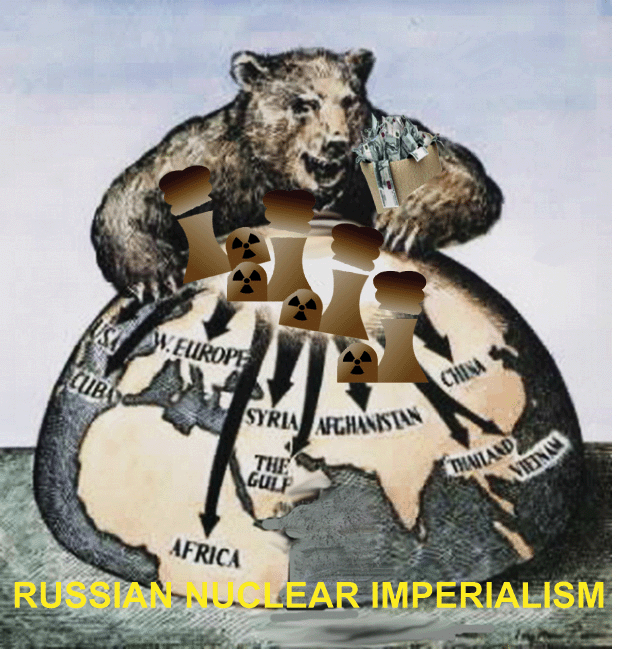 Jordan in talks with Russia on financing solutions for nuclear reactor 2017-08-17 AMMAN, (Xinhua) — Jordan on Wednesday said talks were still ongoing with Russia to secure the best financing solutions to build the country’s first nuclear power plant.
The Jordan Atomic Energy Commission said in a statement that the two countries were still committed to the project to build a nuclear power plant in Jordan with two reactors each having a capacity of 1,000 megawatts.
Russia’s Rosatom, the state atomic energy corporation, has been keen on implementing the project since its inception and is involved in the project with all its technical and financial aspects, the commission said, quoted by the Jordan Times.
The commission’s statement came following some local reports claiming that the Russian company was looking into withdrawing from the project and it has already submitted a request to Jordan in this regard…….
Jordan will secure 1.5 billion U.S. dollars and Russia will do the same for building the plant, which is estimated to cost 10 billion dollars. The rest will be financed by banks and funds.
In March 2015, Jordan signed an inter-governmental agreement with Russia to build and operate the nuclear power plant. Russia’s Rosatom will own 49 percent of the project. http://news.xinhuanet.com/english/2017-08/17/c_136531761.htm
Florida ratepayers could be up for $millions for two nuclear reactors that may never be built.
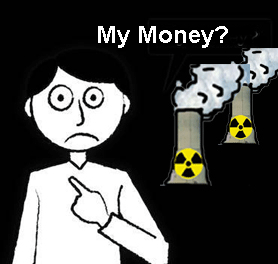
 FPL nuclear project uncertain, but charges could grow by $90 million, Susan Salisbury, Palm Beach Post Staff Writer Florida Power & Light Co. ratepayers must wait two months before finding out if they will be required to pay many millions of dollars for costs associated with two nuclear reactors that may never be built.
Federal judge rules that USA govt could be liable for uranium cleanup on Navajo land
Gov’t Is Owner In Navajo Land Uranium Cleanup Suit: Judge, By Kat Sieniuc. Law360, New York (August 16, 2017, ) — An Arizona federal judge on Tuesday ruled that the federal government qualifies under environmental cleanup law as an owner of more than a dozen old uranium sites on Navajo Nation land and could be liable for cleaning up the area.
U.S. District Judge David G. Campbell partially granted El Paso Natural Gas Company LLC’s bid for a quick win against the United States and U.S. the Department of the Interior, as well as the Bureau of Indian Affairs and the U.S. Department of Energy, among other…https://www.law360.com/articles/954711/gov-t-is-owner-in-navajo-land-uranium-cleanup-suit-judge
The weapons industry is polluting our environment – Potomac River as an example
 How War Pollutes the Potomac River, DAVID SWANSON AND PAT ELDER FOR BUZZFLASH AT TRUTHOUT, 17 AUG 17, The Pentagon’s impact on the river on whose bank it sits is not simply the diffuse impact of global warming and rising oceans contributed to by the U.S. military’s massive oil consumption. The U.S. military also directly poisons the Potomac River in more ways than almost anyone would imagine.
Let’s take a cruise down the Potomac from its source in the mountains of West Virginia to its mouth at the Chesapeake Bay. The journey down this mighty waterway details six EPA Superfund sites created by the Pentagon’s reckless disregard for the fragile ecosystem of the Potomac River watershed.
The U.S. Navy’s Allegany Ballistics Laboratory in Rocket Center, West Virginia, 130 miles north of Washington, is a critical source of contamination in the Potomac River. The on-site disposal of explosive metals and solvent wastes contaminates soil and groundwater with hazardous chemicals. The groundwater and soil along the river are laced with explosives, dioxins, volatile organic compounds, acids, laboratory and industrial wastes, bottom sludge from solvent recovery, metal plating pretreatment sludge, paints, and thinners. The site also has a beryllium landfill. An active burning area is still used for waste disposal, sprinkling chemical dust over the river. It’s not good.
Traveling the river 90 miles further south brings us to Fort Detrick in Frederick, Maryland, the Army’s “proving ground” for the nation’s biological warfare program. Anthrax, Phosgene, and radioactive carbon, sulfur, and phosphorous are buried here. The groundwater is laced with deadly trichloroethylene, a human carcinogen, and tetrachloroethene, suspected of causing tumors in laboratory animals. The Army tested ghastly and heinous agents here, like Bacillus globigii, Serratia marcescens, and Escherichia coli. Although the DOD says it ceased biological weapons testing for offensive purposes in 1971, the claim is like the military’s placement of “defensive” missile systems near an enemy’s border.
Fort Detrick also has a history of dumping high levels of phosphorus into its drain system that ultimately washes into the lower Monocacy River, a tributary of the Potomac. In fact, the Maryland Department of Environment has cited the Army for exceeding allowable permit levels. Too much phosphorus in the water causes algae to grow faster than the Potomac ecosystem can handle. It is deadly. The Army is a leading polluter of the Potomac River watershed……..
The Potomac is far from unique. Sixty-nine percent of U.S. Superfund environmental disaster sites are the result of war preparations.
Preparations for war cost over 10 times the money that actual wars do, and cause at least 10 times the deaths. Routine U.S. military war preparations cause deaths by diverting resources from human needs and directly through massive environmental destruction spread all over the world including in the United States, and including in the Potomac.
So-called foreign intervention in civil wars around the world is, according to comprehensive studies, 100 times more likely — not where there is suffering, not where there is cruelty, not where there is a threat to the world, but where the country at war has large reserves of oil or the intervener has a high demand for oil.
The U.S. military is the top consumer of petroleum around, burning more of it than most entire countries, and burning much of it in routine preparations for more wars. There are military planes that can cause more damage with jet fuel in 10 minutes than you can with gasoline driving your car for a year.
All such calculations omit the environmental destruction done by private weapons makers and by their weapons. The U.S. is the leading exporter of war weapons to the rest of the world.
All such calculations also omit much of the damage and all of the details of the human suffering. The U.S. military burns toxic waste in the open, near its own troops in places like Iraq, near the homes of the people who live in the countries it has invaded, and within the United States in many — often poor and minority — communities such as Colfax, Louisiana, and at Dahlgren on the Potomac.
Much of the damage is essentially permanent, such as the poison of depleted uranium, used in places like Syria and Iraq. But this is true in locations all around the United States as well. Near St. Louis, Missouri, an underground fire is moving ever closer to an underground pile of radioactive waste.
And then there is the Potomac River. It flows south between the Lincoln and Jefferson Memorials in Washington, D.C. on the east, and Arlington, Virginia, on the west, where the Pentagon Lagoon brings the water up to the headquarters of world militarism.
Not only does the home of war making sit near rising waters — rising first and foremost because of the effects of war making, but those particular waters — the waters of the Potomac and of the Chesapeake Bay into which it flows, and the tides of which raise and lower the waters of the Pentagon Lagoon each day — are heavily polluted by war preparations.
This is why we are planning and invite you to join in a kayactivist flotilla to the Pentagon on September 16th. We need to bring the demand of No More Oil for Wars to the doorstep of our leading destroyer of the environment.
David Swanson is an author, activist, journalist, and radio host. He is director of WorldBeyondWar.org and campaign coordinator for RootsAction.org. Swanson’s books include War Is A Lie. He blogs at DavidSwanson.org and WarIsACrime.org. He hosts Talk Nation Radio. He is a 2015, 2016, 2017 Nobel Peace Prize Nominee. Follow him on Twitter: @davidcnswanson and FaceBook. http://truth-out.org/buzzflash/commentary/how-war-pollutes-the-potomac-river
TSAR BOMBA – Most Horrific Man-made Explosion in History
 The monster atomic bomb that was too big to use, In 1961, the Soviet Union tested a nuclear bomb so powerful that it would have been too big to use in war. And it had far-reaching effects of a very different kind. By Stephen Dowling, BBC, 16 August 2017, On the morning of 30 October 1961, a Soviet Tu-95 bomber took off from Olenya airfield in the Kola Peninsula in the far north of Russia……
nothing the Soviet Union had tested would compare to this.
TSAR BOMBA – Most Horrific Man-made Explosion in History – USSR Hydrogen Bomb
The Tu-95 carried an enormous bomb underneath it, a device too large to fit inside the aircraft’s internal bomb-bay, where such munitions would usually be carried. The bomb was 8m long (26ft), had a diameter of nearly 2.6m (7ft) and weighed more than 27 tonnes. It was, physically, very similar in shape to the ‘Little Boy’ and ‘Fat Man’ bombs which had devastated the Japanese cities of Hiroshima and Nagasaki a decade-and-a-half earlier. The bomb had become known by a myriad of neutral technical designations – Project 27000, Product Code 202, RDS-220, and Kuzinka Mat (Kuzka’s Mother). Now it is better known as Tsar Bomba – the ‘Tsar’s bomb’……
It was more than a metal monstrosity too big to fit inside even the largest aircraft – it was a city destroyer, a weapon of last resort…… In order to give the two planes a chance to survive – and this was calculated as no more than a 50% chance – Tsar Bomba was deployed by a giant parachute weighing nearly a tonne. The bomb would slowly drift down to a predetermined height – 13,000ft (3,940m) – and then detonate. By then, the two bombers would be nearly 50km (30 miles) away. It should be far enough away for them to survive.
The bomb’s mushroom cloud soared to 64km (40 miles) high, with its cap spreading outwards until it stretched nearly 100km (63 miles) from end to end. It must have been, from a very far distance perhaps, an awe-inspiring sight.
On Novaya Zemlya, the effects were catastrophic. In the village of Severny, some 55km (34 miles) from Ground Zero, all houses were completely destroyed (this is the equivalent to Gatwick airport being destroyed by a bomb that had fallen on Central London). In Soviet districts hundreds of miles from the blast zone, damage of all kinds – houses collapsing, roofs falling in, damage to doors, windows shattering – were reported. Radio communications were disrupted for more than an hour.……
Tsar Bomba unleashed almost unbelievable energy – now widely agreed to be in the order of 57 megatons, or 57 million tons of TNT. That is more than 1,500 times that of the Hiroshima and Nagasaki bombs combined, and 10 times more powerful than all the munitions expended during World War Two. Sensors registered the bomb’s blast wave orbiting the Earth not once, not twice, but three times……
One of the architects of this formidable device was a Soviet physicist called Andrei Sakharov – a man who would later become world famous for his attempts to rid the world of the very weapons he had helped create. He was a veteran of the Soviet atomic bomb programme from the very beginning, and had been part of the team that had built some of the USSR’s earliest atom bombs…….
With such immense power, there would be no guarantee that the giant bomb wouldn’t swamp the north of the USSR with a vast cloud of radioactive fallout.
That was of particular concern to Sakharov, says Frank von Hippel, a physicist and head of Public and International Affairs at Princeton University.
“He was really apprehensive about the amount of radioactivity it would create,” he says, “and the genetic effects that could have on future generations
“It was the beginning of his journey from being a bomb designer to becoming a dissident.”…….
The Soviets had built a weapon so powerful that they were unwilling to even test it at its full capacity. And that was only one of the problems with this devastating device.
The Tu-95 bombers built to carry the Soviet Union’s nuclear weapons were designed to carry much lighter weapons. The Tsar Bomba was so big that it couldn’t be placed on a missile, and so heavy that the planes designed to carry it wouldn’t have been able to take them all the way to their targets with enough fuel. And, if the bomb was as powerful as intended, the aircraft would have been on a one-way mission anyway…..
Tsar Bomba had other effects. Such was the concern over the test – which was 20% of the size of every atmospheric test combined before it, von Hippel says – that it hastened the end of atmospheric testing in 1963. Von Hippel says that Sakharov was particularly worried by the amount of radioactive carbon 14 that was being emitted into the atmosphere – an isotope with a particularly long half-life. “This has been partly mitigated by all the fossil fuel carbon in the atmosphere which has diluted it,” he says.
Sakharov worried that a bomb bigger than the one tested would not be repelled by its own blastwave – like Tsar Bomba had been – and would cause global fallout, spreading toxic dirt across the planet.
Sakharov become an ardent supporter of the 1963 Partial Test Ban, and an outspoken critic of nuclear proliferation and, in the late 1960s, anti-missile defences that he feared would spur another nuclear arms race. He became increasingly ostracised by the state, a dissident against oppression who would in 1975 be awarded the Nobel Peace Prize, and referred to as “the conscience of mankind”, says von Hippel.
Tsar Bomba, it seems, may have had fallout of a very different kind. http://www.bbc.com/future/story/20170816-the-monster-atomic-bomb-that-was-too-big-to-use
Will potassium iodide protect you from nuclear fallout?
 Verify: Will potassium iodide protect you from nuclear fallout?http://www.abc10.com/news/local/verify/verify-will-potassium-iodide-protect-you-from-nuclear-fallout/464777998 In 1999, the World Health Organization released guidelines on the use of potassium iodide, citing the exposure of children to radiation after the Chernobyl disaster.
Controls on low-level nuclear waste disposal relaxed
Restrictions and liability cover requirements for low-level nuclear waste disposal and for
transport of nuclear materials are to be eased.
http://www.endsreport.com/article/57117/controls-on-low-level-nuclear-waste-disposal-relaxed
Effects of the nuclear industry – environmental risks in 31 countries
 Town & Country Planning Association (accessed) 17th Aug 2017, Prof Andrew Blowers: In the first of a series of articles on the local and social legacies of nuclear energy, Andrew Blowers looks at where and why
these legacies have come to pass.
The nuclear industry has left its visible and invisible footprint in landscapes of risk encountered in the 31
countries in which nuclear energy has been developed.
In several countries the mark is, as yet, small, related to one or two operating nuclear
reactors. At the other extreme there are those countries with
long-established nuclear industries, some involved in both the civil and
military sectors, where nuclear operations, including electricity
generation, reprocessing and experimental processes, are intermixed with
redundant facilities, nuclear wastes, and radioactive discharges onto land
and into water and emissions into the atmosphere. https://www.tcpa.org.uk/journal
French nuclear regulator ASN makes EDF review all nuclear components made by Areva’s foundry Creusot Forge
Times of India 16th Aug 2017, Utility EDF must review all components of its nuclear reactors that were
made by Areva’s foundry Creusot Forge by the end of 2018, French nuclear
regulator ASN said in a statement on Wednesday. The ASN did not say that
EDF would have to halt its reactors for the review, but the company would
have to provide the required documentation for each reactor two months
before it could restart the reactors following refueling. A spokeswoman for
EDF told Reuters the company does not expect any impact on power generation
and that the ASN’s timing had been integrated in its reactor maintenance
schedule.
Energy sector impacted by Britain’s withdrawal from the European Union
IPPR 16th Aug 2017, The implications of the UK’s withdrawal from the European Union are
particularly significant for the energy sector. This uncertainty
surrounding Brexit negotiations in turn raises specific regional concerns.
The North as a whole boasts 48 per cent of the UK’s renewable power,
including 71 per cent of England’s biomass generation, 41 per cent of UK
wind power and 40 per cent of UK installed nuclear capacity. Concerns over
the retention of mechanisms and legislation that support the energy sector
are therefore particularly pressing for businesses and other energy
stakeholders in the North.
https://www.ippr.org/research/publications/impact-of-brexit-on-energy-in-the-north
1 This Month

of the week – Shut Down Drone Warfare!


Tell the Ukrainian Government to Drop Prosecution of Peace Activist Yurii Sheliazhenko

Petition to revoke the licensing of the Near Surface Nuclear Disposal Facility (NSDF) at Chalk River. https://www.ourcommons.ca/petitions/en/Petition/Details?Petition=e-7247
To see nuclear-related stories in greater depth and intensity – go to https://nuclearinformation.wordpress.com
-
Archives
- March 2026 (230)
- February 2026 (268)
- January 2026 (308)
- December 2025 (358)
- November 2025 (359)
- October 2025 (376)
- September 2025 (257)
- August 2025 (319)
- July 2025 (230)
- June 2025 (348)
- May 2025 (261)
- April 2025 (305)
-
Categories
- 1
- 1 NUCLEAR ISSUES
- business and costs
- climate change
- culture and arts
- ENERGY
- environment
- health
- history
- indigenous issues
- Legal
- marketing of nuclear
- media
- opposition to nuclear
- PERSONAL STORIES
- politics
- politics international
- Religion and ethics
- safety
- secrets,lies and civil liberties
- spinbuster
- technology
- Uranium
- wastes
- weapons and war
- Women
- 2 WORLD
- ACTION
- AFRICA
- Atrocities
- AUSTRALIA
- Christina's notes
- Christina's themes
- culture and arts
- Events
- Fuk 2022
- Fuk 2023
- Fukushima 2017
- Fukushima 2018
- fukushima 2019
- Fukushima 2020
- Fukushima 2021
- general
- global warming
- Humour (God we need it)
- Nuclear
- RARE EARTHS
- Reference
- resources – print
- Resources -audiovicual
- Weekly Newsletter
- World
- World Nuclear
- YouTube
-
RSS
Entries RSS
Comments RSS
 nuclear-news