Global Warming Policy Foundation concedes that the Tory peer’s supposedly official figures were wrong and produced by a right-wing think tank, Ian Johnston Environment Correspondent @montaukian 15 aug17, A claim by Britain’s leading climate science sceptic, Nigel Lawson, that the world’s average temperature has fallen in the past 10 years was based on an “erroneous” temperature chart, his think tank, the Global Warming Policy Foundation, has admitted.
The former Tory Chancellor was interviewed on BBC Radio 4’s Today programme about the release of former US Vice-President Al Gore’s new film, The Inconvenient Sequel: Truth to Power, which describes how climate change is already having significant effects on the planet but also that the plunging cost of renewable energy means there is a solution.
The film points out the world’s average temperature had hit the highest on record for three years in a row – 2014, 2015 and 2016 – and an increase in extreme weather events.
His first film in 2006, An Inconvenient Truth, predicted that site of the 9/11 memorial would face an increased risk of being flooded as sea levels rise. At the time, this prompted some ridicule, but this actually happened during Hurricane Sandy in 2012.
Lord Lawson claimed in the interview that the Intergovernmental Panel on Climate Change (IPCC) had “confirmed that there has been no increase in extreme weather events”.
And he then added: “As for the temperature itself, it is striking, he [Gore] made his previous film 10 years ago, and according – again – to the official figures, during this past 10 years, if anything, mean global temperature, average world temperature, has slightly declined.”
However the Global Warming Policy Foundation (GWPF) has now revealed the source of these supposedly “official” figures was a meteorologist who works for a libertarian think tank, the Cato Institute, founded by US billionaire and leading climate sceptic, Charles Koch.
And the GWPF also admitted the figures were wrong.
“It has been brought to our attention that a temperature chart prepared by US meteorologist Ryan Maue and published by Joe Bastardi and which was referred to in the Today programme appearance of Lord Lawson is erroneous,” the think tank tweeted.
“This has been acknowledged in recent days by those responsible for the dataset. We are therefore happy to correct the record.”
And, just as Al Gore said, the temperature has reached the highest recorded level in the last three successive years.
The GWPF added that it stood by Lord Lawson’s claims that the IPCC agreed there had been no increase in extreme weather.
It is difficult to attribute any single storm or heatwave to the effect of global warming.
However, the latest IPCC report says: “It is likely that the frequency of heat waves has increased in large parts of Europe, Asia and Australia.
“There are likely more land regions where the number of heavy precipitation events has increased than where it has decreased. The frequency or intensity of heavy precipitation events has likely increased in North America and Europe.”
Pennsylvania Gov. Tom Wolf is reminding Luzerne County residents to stock up on potassium iodide pills in case of an emergency at the Talen Energy nuclear power plant. Aug. 15, 2017 SALEM, Pa. (AP) — Pennsylvania Gov. Tom Wolf is reminding Luzerne County residents to stock up on potassium iodide pills in case of an emergency at the Talen Energy nuclear power plant.
The Democratic governor’s administration will be handing out free potassium iodide on Aug. 24 as part of an annual effort to replace expired tablets. The Wilkes-Barre Citizens’ Voice reports (http://bit.ly/2w6uokN ) the medication blocks the uptake of radioactive iodide.
In Luzerne County, there are 19 municipalities that are within or partially within the 10-mile radius of the plant. Wolf says residents who live within 10 miles of any of the state’s five nuclear power plants should also have up-to-date potassium iodide supplies.
The state Department of Health also has supplies year-round at certain offices.
Florida PSC looks at paying for nuclear projects today, Tampa Bay Times, By Malena Carollo, Times Staff Writer, August 15, 2017 TALLAHASSEE — The Florida Public Service Commission is holding its annual hearing at 1:30 p.m. today to discuss whether — and how much — Floridians will pay for its utilities’ nuclear power projects.
Among the projects up for discussion is Duke Energy Florida’s now-defunct Crystal River nuclear power plant — which ratepayers are still paying for. Duke said in May that it is attempting to recover $50 million in costs related to decommissioning the Crystal River facility.
The plant was closed in 2013, a year after Duke acquired the plant’s operator, Progress Energy. A DIY steam generator replacement that Progress Energy attempted in 2009 went awry, eventually rendering the plant unusable. Customers are paying for the decomissioning — a process that takes decades.
Because utilities are allowed to keep a portion of the funds spent on a nuclear project, Duke walked away with about $100 million following upgrades to the Crystal River plant.
What will not be discussed at this meeting is cost recovery for another nuclear power project Duke had proposed in Levy County.
When Duke bought Progress Energy, it also took over the construction of two nuclear reactors slated to be built in Levy. Duke ended up shutting down the $25-billion project because of high costs, which left Duke customers on the hook for a $1 billion bill.
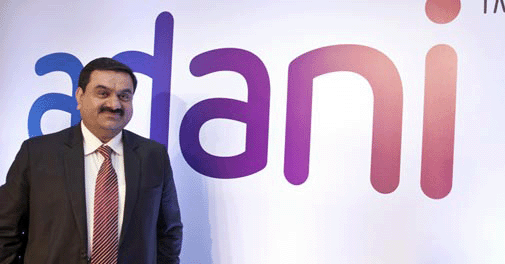
If true, one effect of the alleged scheme would have been to move vast sums of money from the Adani Group’s domestic accounts into offshore bank accounts where it could no longer be taxed or accounted for.
Adani mining giant faces financial fraud claims as it bids for Australian coal loan, Exclusive: Allegations by Indian customs of huge sums being siphoned off to tax havens from projects are contained in legal documents but denied by company, Guardian, Michael Safi in Delhi, 16 Aug 17, A global mining giant seeking public funds to develop one of the world’s largest coal mines in Australia has been accused of fraudulently siphoning hundreds of millions of dollars of borrowed money into overseas tax havens.
Indian conglomerate the Adani Group is expecting a legal decision in the “near future” in connection with allegations it inflated invoices for an electricity project in India to shift huge sums of money into offshore bank accounts.
The directorate of revenue intelligence (DRI) file, compiled in 2014, maps out a complex money trail from India through South Korea and Dubai, and eventually to an offshore company in Mauritius allegedly controlled by Vinod Shantilal Adani, the older brother of the billionaire Adani Group chief executive, Gautam Adani.
Vinod Adani is the director of four companies proposing to build a railway line and expand a coal port attached to Queensland’s vast Carmichael mine project.
The proposed mine, which would be Australia’s largest, has been the source of years of intense controversy, legal challenges and protests over its possible environmental impact.
Expanding the coal port to accommodate the mine will require dredging an estimated 1.1m cubic metres of spoil near the Great Barrier Reef marine park. Coal from the mine will also produce annual emissions equivalent to those of Malaysia or Austria according to one study.
One of the few remaining hurdles for the Adani Group is to raise finance to build the mine as well as a railway line to transport coal from the site to a port at Abbot Point on the Queensland coast.
To finance the railway Adani hopes to persuade the Northern Australia Infrastructure Facility (Naif), an Australian government-backed investment fund, to loan the Adani Group or a related entity about US$700m (A$900m) in public money.
While it awaits the decision on the loan, in Delhi the company is also expecting the judgment of a legal authority appointed under Indian financial crime laws in connection to allegations it siphoned borrowed money overseas.
The Adani Group fully denies the accusations, which it has challenged in submissions to the authority.
The investigation
News of the investigation was first reported in India three years ago, but the full customs intelligence document reveals forensic details of the workings of the alleged fraud which have not been publicly revealed.
The 97-page file accuses the Adani Group of ordering hundreds of millions of dollars’ worth of equipment for an electricity project in western India’s Maharashtra state using a front company in Dubai.
The Dubai company allegedly sold the exact same equipment back to Adani Group-controlled businesses in India at massively inflated prices, in some instances said to be eight times the sale price.
According to the allegations in the file, the effect of these transactions was that the Adani Group spent an average 400% more for the materials. That money was allegedly paid to a company Indian authorities allege was owned through a series of shell companies leading to a Mauritius trust controlled by Vinod Adani.
If true, one effect of the alleged scheme would have been to move vast sums of money from the Adani Group’s domestic accounts into offshore bank accounts where it could no longer be taxed or accounted for.
Because tariffs for using electricity transmission networks are determined partly by what they cost to build, if the DRI’s accusations are correct, the overvaluation of capital goods would have been likely to have led to higher power prices for Indian consumers……
The Australian loan
The Adani Group, or a linked entity, has reportedly been granted “conditional approval” for the US$700m (AU$900m) concessional loan from Naif, the Australian government investment fund.
But due to secrecy around the operation of the investment fund, it is not clear whether the loan application discloses the existence of the DRI notice or the ongoing legal proceedings, or whether the applicant is required to do so under the Naif’s anti-money laundering provisions……
The Guardian is publishing excerpts from the DRI file in the interests of ensuring Naif, as well as the public, have access to as much relevant information as possible in assessing whether Adani or linked companies would be suitable recipients of public money.
In a separate case last year, six Adani subsidiaries were listed among 40 other companies being investigated for allegedly running a similar price-inflation scheme. The companies are accused of inflating the price of coal imports from Indonesia to hide profits in overseas tax havens.
The DRI and the ED did not respond to a request to clarify the status of the investigations.
Are Court Victories for Nuclear Credits a Win for Renewables? Maybe Not, https://www.greentechmedia.com/articles/read/nuclear-credit-court-victories-renewables-maybe-notNRG’s Abe Silverman argues that zero-emissions credits for nuclear power plants are bad public policy and need to go, by Abe Silverman August 15, 2017,On July 31, 2017, Greentech Media published an article entitled “Court Victories for New York, Illinois Nuclear Subsidies Are a Big Win for Renewables,” and declared that the court proceedings represented “a significant win for the nation’s largest nuclear fleet owner Exelon.” While recent developments are certainly good for Exelon shareholders, they are bad for consumers and the environment.
First, no matter how you slice it, these nuclear bailouts are bad public policy. Rather than supporting renewables, they starve green policy initiatives of cash and instead funnel billions of hard-earned consumer dollars to Exelon Corporation’s bottom line. This is no win for renewables.
Second, both the New York and Illinois judges ruled that private parties, including other power generators and ratepayer advocates, lacked “standing” to challenge these handouts in federal court. Depriving private parties of the right to sue in federal court is a breathtaking limit on the right of ratepayers — on whose backs these nuclear bailouts will be paid — to challenge these decisions. In other words, these judicial decisions have every electric consumer in Illinois and New York paying for nuclear power rather than renewable energy, while denying those citizens any say in the process.
Third, the impact of nuclear “zero-emissions credits,” or ZECs, on the market is simply too big for federal regulators to ignore. The Federal Energy Regulatory Commission, the consumer protection agency charged with ensuring that wholesale electricity prices are “just and reasonable,” has generally taken a hands-off approach to state programs that incent renewables development. But if nuclear subsidies are identical to state renewables programs, then FERC may have to regulate both.
On ZECs, it is important to note that the American Wind Energy Association joined the competitive generators in describing how renewable and nuclear bailout programs are vastly different. ZEC may rhyme with REC, but under the ZEC programs, only specific nuclear facilities qualify for the subsidy — wind and solar operators need not apply. Why should ratepayers be forced to “rent” obsolete and uneconomic nuclear plants that they’ve already paid for, rather than build new, modern generation?
Finally, while the New York federal judge dismissed the complaint, this case is far from over. The two District Court decisions represent only the first skirmish in a war that could easily end up at the Supreme Court. In fact, the Illinois appeals court has already set an aggressive schedule for filings and hearings, with the first brief due from the plaintiffs — including consumer advocates — at the end of August.
Hopefully, the judges will carefully reflect on the dangers of supporting these nuclear bailout programs by asserting that they’re the same as renewables programs. This false equivalence directly and significantly harms consumers by burdening them with billions of unnecessary costs and actually hurts the efforts of the states and sustainably focused generators and consumers to build new renewables. Abe Silverman is vice president and deputy general counsel of regulatory affairs at NRG.
“…. the coalition’s involvement has raised concerns about the use of limited county resources in such a speculative venture. Nor is it clear how the thorium proposal squares with the coalition’s legal mission, which is to “build essential regional infrastructure elements,” such as pipelines, roads, transmission and rail needed to deliver extracted minerals and power to markets……
The coalition’s financing and procurement practices have recently come under intense scrutiny by Utah Treasurer David Damschen, who believes the group could be flouting accountability standards.
As a new member of the state Community Impact Board (CIB), which gives out federal mineral royalties to rural counties, Damschen has raised numerous concerns about the coalition’s management of CIB grants— its sole source of revenue. At recent meetings, the state treasurer has openly wondered whether the coalition steers contracts to insiders instead of the best qualified people and spends public money in ways that provide minimal public benefit…….
Thorium technology has years of costly research and development ahead before it’s ready to produce power and isotopes, according to Mike Simpson, a University of Utah metallurgical engineering professor.
“It‘s not accurate to say it’s proven to work. Aspects of it have been proven, but everything that has to be tied together hasn’t happened,” said Simpson, adding he would provide advice to the coalition for free. ”They still need another 10 years to perfect this….
many technical hurdles remain and these rural counties are not positioned to help address these challenges other than siting assistance for a reactor, Simpson added. Salt Lake Tribune
Lifeline to Ga. nuclear project stuck in the Senate,Tamar Hallerman – The Atlanta Journal-Constitution, 14 Aug 17, A last-ditch effort to send hundreds of millions of dollars in tax breaks to Georgia’s struggling Plant Vogtle nuclear project appears to be stuck in the U.S. Senate as lawmakers grapple with the prospect of a broader tax overhaul.
Boosters of the estimated $25 billion project, the only one of its kind left in the U.S., think the federal bill could throw an economic lifeline to the companies behind the venture as they decide whether to move ahead with construction or abandon work amid major cost overruns and deep delays.
Under current law, newly constructed nuclear reactors can receive federal tax credits for producing electricity only if they are put in service before 2021. The bill before Congress would lift the deadline……
Georgia backers of the project recently visited Washington to ask for more aid from the Trump administration, Bloomberg reported last week, potentially by increasing or speeding up the disbursement of $8.3 billion in federal loan guarantees……
Nuclear power also has its critics on Capitol Hill, who see it as a waste of taxpayer funding.
US AND KOREAN NUCLEAR PLANT CANCELLATIONS: IMPLICATIONS FOR UK NEW NUCLEAR BUILD, Prospec t Law August 10, 2017 The US currently has 100 nuclear power plants in operation supplying about 20% of its power needs. A further four were under construction, two each in Georgia and South Carolina, until the owners of the South Carolina plants recently announced the cancellation of construction of its two Westinghouse AP1000 units, Summer 2 and 3.
Summer 2 and 3 had been under construction since 2013, with original operational dates of late 2019 and late 2020. However, due to construction delays and cost overruns, these were later revised to December 2022 for Summer 2 and March 2024 for Summer 3. The finances were a key factor in the decision to cancel construction, with the original estimate of $11.5 bn having more than doubling to $25 bn. The reasons behind this are no doubt complex, but as the US has not constructed a new reactor since the 1970s, the loss of nuclear expertise must be a factor.
Summer 2 and 3 were intended to showcase advanced nuclear technology and pave the way, along with the Georgia plants – also Westinghouse AP1000s, for a nuclear renaissance in the US. A further four AP1000s and 12 SMRs (Small Modular Reactors) are currently proposed and several more are in the early stages of planning. The fate of these and the two Georgia plants remains to be seen…….
The Westinghouse bankruptcy has also complicated the picture in the US, with its AP1000 design being used for the South Carolina and Georgia projects and its role being reduced to a vendor supporting the EPC. Their situation has also had an effect in the UK, with Toshiba’s stake in Nu-Gen now being considered by KEPCO. Rather than utilise the Westinghouse design, which was approved by the UK nuclear regulator, ONR, in March this year, KEPCO wants to use its own technology, which will cause a delay in construction of the Moorside plant while the necessary regulatory design assessment is undertaken.
The South Korean nuclear industry is also in difficulty, with the new anti-nuclear government suspending construction of the Shin Kori 5 and 6 nuclear plants for several months while it undertakes a public consultation on their future. This decision has generated much debate in the country and is seen as a threat to its nuclear exports, and KEPCO’s future Nu-Gen.
What Is the Future of US Nuclear Power Industry? VOA 15, Aug 17As America’s nuclear power industry continues to suffer major economic difficulties, some are questioning whether it can – or should – survive.
The latest setback came July 31, when state power companies in South Carolina halted construction of two reactors. After spending about $9 billion, the companies decided that increasing costs and repeated building delays did not make the project worth finishing…..
Industry groups had hoped the South Carolina reactors would mark a new beginning for U.S. nuclear power and show the benefits of the latest technology….o…nly two new nuclear reactors are currently being built in the United States – both of them in Georgia. The reactors were the first large nuclear plants to be started in the United States in more than 30 years. And the future of those reactors is uncertain.
The project – currently about half-finished – has also suffered major cost overruns and delays. For now, the company’s parent, Japan-based Toshiba, has promised to provide at least $3.7 billion to finish the project……
opponents say they’ve been hearing the same arguments in support of nuclear power for decades.
Paul Gunter is a longtime anti-nuclear activist. He co-founded the Clamshell Alliancein 1976. The group was formed to oppose the Seabrook Station nuclear plant in New Hampshire. He and hundreds of other protesters were arrested during non-violent demonstrations against the project. Gunter says his main opposition was that the licensing approval process was corrupt.
“For example, you couldn’t raise the issue of, what are you going to do with all the nuclear waste from Seabrook? And that question was not allowed in the licensing proceeding.”
Seabrook Station was eventually completed at a cost of about $7 billion and began operations in 1990. The Clamshell Alliance helped shape America’s anti-nuclear movement for many years to come.
Another defining moment came after the Three Mile Island plant accident in Pennsylvania in 1979 – the worst nuclear disaster in U.S. history. A series of mechanical and human mistakes sent one of the reactors into a partial meltdown, sending large amounts of radiation into the surrounding area.
Gunter says even before that accident, there were clear signs the nuclear industry would not be economically sustainable. Today, he says neither state utility providers nor large energy companies are willing to put up money for risky nuclear projects.
“So the only way that you can revive nuclear power is going to be through socializing its financing through the rate payer and the taxpayer. But at this point, we’re seeing the rate payer become the irate payer – when you waste billions and billions of dollars and decades on a predictable outcome.”…








 nuclear-news