Americans all too easily accept the idea of a pre-emptive nuclear strike?
The Real Nuclear Option, Americans are disturbingly unbothered by the idea of striking first with nuclear weapons, Slate ,By Fred Kaplan, 15 Aug 17, As President Trump rails against North Korea, threatening to rain down “fire and fury like the world has never seen” if it so much as tests another long-range missile, the world can’t help but wonder: Would he really do this? Would he order a nuclear strike, the ultimate fire and fury, against a country that hadn’t attacked us first?
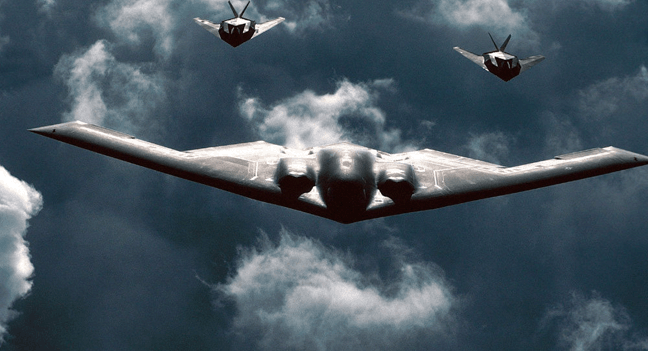
Many are doubtful. His top security advisers would oppose such a move. So would the American people who, though they have no formal say in the matter, would impose constraints on a president’s actions—or so goes the conventional wisdom. Some scholars have written of a “nuclear taboo” ingrained in our sensibilities since the bombing of Hiroshima. Others detect a growing revulsion against the killing of noncombatants even with conventional weapons.
However, a new study suggests that these comforting notions are mistaken.
In the latest issue of the journal International Security, Scott Sagan and Benjamin Valentino, respectively professors at Stanford University and Dartmouth College, conclude that the American public is “unlikely to serve as a serious constraint on any president who might consider using nuclear weapons in the crucible of war.” In fact, under pressures similar to those facing President Harry Truman at the end of World War II, a clear majority of the public would support the first use of nuclear weapons now, just as it did back then.
Some opinion polls appear at first glance to show otherwise. A majority of Americans now say that Truman was wrong to drop atomic bombs on Hiroshima and Nagasaki. But Sagan and Valentino regard those polls as “a misleading guide” to understanding Americans’ “real views” on the use of nuclear weapons and the killing of civilians.
The problem with the Hiroshima polls is that Americans today lack the mindset of Americans in the time of World War II. Japan is now a leading U.S. ally. Few among the living remember the shock of Pearl Harbor or the horrors of the war in the Pacific and the desperate desire to stop the slaughter of American troops by any means necessary. So, the two professors—Sagan an eminent scholar of nuclear strategy, Valentino an expert on public opinion and the use of force—came up with a clever way of gauging how Americans would react in a similar situation today.
They commissioned the polling firm YouGov to conduct a survey in which those polled were shown a mock news story. In this story, the United States imposes sanctions on Iran for violating the Iran nuclear deal. Iran then attacks an American aircraft carrier in the Persian Gulf, killing 2,403 U.S. military personnel (the same number as those killed at Pearl Harbor, though this parallel isn’t drawn explicitly). The U.S. responds with airstrikes on Iranian military facilities. Iran refuses to surrender. The U.S. invades Iran but gets bogged down after 10,000 American troops are killed.
Those polled were then given a choice. Should we persist with the ground invasion all the way to Tehran, knowing that 20,000 American soldiers would be killed? Or should we drop a nuclear bomb on Mashhad, Iran’s second-largest city, “to pressure the Iranian government to surrender”—an attack that would kill 100,000 Iranian civilians (an arbitrarily chosen number).
The results were unsettling, though not so surprising. More than half of the respondents, 55 percent, favored dropping a nuclear bomb rather than proceeding with the invasion. An even higher number, 59 percent, said they would approve the president’s action after the fact if he chose to drop the bomb.
Then the pollster changed one key premise: What if the nuking of Mashhad killed 2 million Iranian citizens—which would you prefer: dropping the nuclear bomb or proceeding with the ground invasion, which would kill 20,000 U.S. soldiers?
Those favoring the nuclear option did drop, but not by much—from 55 percent (under the scenario with 100,000 killed) to 47 percent (under the scenario with 2 million killed). More sobering, the same number as before—59 percent—said they would approve the president’s action, after the fact, if he decided to drop the bomb.
In other words, to 47 percent—nearly half—of those polled, killing 2 million Iranian civilians is preferable to killing 20,000 American military personnel, a ratio of 100:1….. http://www.slate.com/articles/news_and_politics/war_stories/2017/08/sagan_and_valentino_study_shows_americans_would_likely_support_nuclear_first.html
August 16, 2017 -
Posted by Christina Macpherson |
politics, USA, weapons and war
No comments yet.




 nuclear-news
Leave a comment