Donald Trump’s longterm obsession with nuclear war
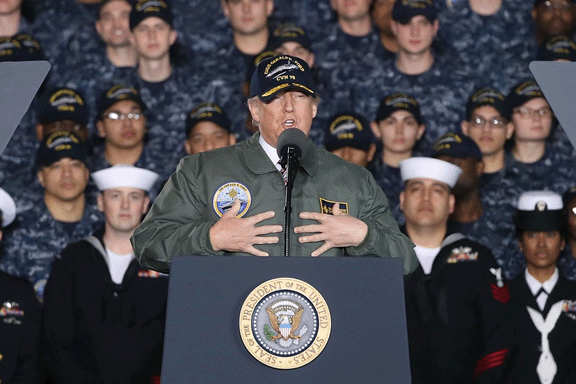 Trump Has Been Thinking About Nuclear War for Decades. Here’s Why That’s Scary. He seems to think it’s inevitable. Mother Jones, AUG. 11, 2017 “……In a 1984 interview with the Washington Post, Trump, then merely a 38-year-old celebrity developer, shared his fantasies: He was hoping to build the “greatest hotel in the world” and construct the world’s “tallest” building in New York City—and one day become the United States’ chief negotiator with the Soviet Union for nuclear weapons. In between boasts of how rich and famous he was, Trump declared that he could negotiate a great nuclear arms deal with Moscow and said he wanted to head the US arms negotiating squad. “He says he has never acted on his nuclear concern,” the newspaper reported. “But he says that his good friend Roy Cohn, the flamboyant Republican lawyer, has told him this interview is a perfect time to start.”
Comparing crafting an arms accord with cooking up a real estate deal, Trump insisted he had innate talent for this mission. “Some people have an ability to negotiate,” he said. “It’s an art you’re basically born with. You either have it or you don’t.” Trump claimed he would know exactly what to demand of the Russians—though that would have to remain a secret for the time being. He was undaunted by his lack of experience in the technical field of nuclear weaponry: “It would take an hour-and-a-half to learn everything there is to learn about missiles…I think I know most of it anyway. …….
he continued to think and talk about nuclear weapons—often voicing a fatalistic approach, as if he believed nuclear conflagration was unavoidable. During a 1990 interview with Playboy, Trump was asked to describe his “longer-term views of the future.” Trump answered, “I think of the future, but I refuse to paint it. Anything can happen. But I often think of nuclear war.”…….
Trump pushed on with his notion that nuclear annihilation could be on the horizon:……..
It’s clear: Trump has been fretting about nuclear destruction for many years. But for all his concern, he seemingly has not done much to educate himself on the weighty subject. During the presidential campaign, he uttered several troubling comments about nuclear arms. At a Republican primary debate, he botched a question about the nuclear triad—a sign he did not understand the most basic information about the structure of the US nuclear command. As a candidate, Trump noted that he would support allowing Japan, South Korea, and Saudi Arabia to obtain nuclear weapons—that is, he was advocating nuclear proliferation—and that he would be open to using the ultimate weapons against ISIS and in other conflicts. He asserted that when it came to national security, he had “a very good brain.”
These days, his cavalier talk of “fire and fury” in response to Kim Jong-un’s reckless remarks about Pyongyang’s nuclear weapons show that Trump doesn’t bother to consider the difficult and vexing nuances of nuclear diplomacy. (Attack North Korea, and North Korea could well destroy Seoul with or without nuclear weapons.) Since the days of the Cold War, Trump has repeatedly signaled that he fears that nuclear war may be inescapable but that he also believes nuclear policy is an easy matter to master. At least for him. Each of these notions is frightening. Together, they can be terrifying. http://www.motherjones.com/politics/2017/08/trump-has-been-thinking-about-nuclear-war-for-decades-heres-why-thats-scary/
Cumbria being bribed to accept nuclear wastes and the now despised Moorside project
Radiation Free Lakeland 10th Aug 2017, The Whitehaven News reports today on the worst kept secret that Toshiba is financially torpedoing. Still not to worry eh, there are still slush funds
aplenty to greenwash the increasingly despised Moorside plan.
Apart from NuGen (100% Toshiba) the other two sponsors are the Copeland Community Fund
( this fund doles out the £millions Cumbria is bribed with to continue to
accept nuclear wastes) and United Utilities (in cahoots with the nuclear
industryand currently under fire for polluting West Cumbria’s water
supply).
The nuclear fanatics are calling for the government to “step
in” and “save Moorside”- are they joking? Successive governments have
never stepped away from throwing public money at the expanding nuclear
nightmare.
https://mariannewildart.wordpress.com/2017/08/10/nugens-parent-company-loses-millions-no-worries-though-plenty-of-slush-funds-for-greenwashing-moorside/
Uncertainties swirl around Britain’s Moorside nuclear project – NuGen looks like becoming very OldGen
 Beyond Nuclear 10th Aug 2017, The fact that the alleged nuclear revival has evaporated into the ether is
being trumpeted as breaking news. But there was never a nuclear revival —
only “plans” and “aspirations” built on quicksand.
The collapse of the South Carolina nuclear new build project at V.C. Summer had been seen
coming since it’s first glimmer on paper — by groups such as Southern
Alliance For Clean Energy, relegated, as are many of us, to anti-nuclear
Cassandras.
The same reactor design — the untested AP 1000 — is planned
for a site next to the Sellafield reprocessing facility in the UK. But with
the implosion of Toshiba under the weight of the Westinghouse financial
collapse, that project is under serious threat.
The site is owned and operated by the rashly named consortium, NuGen. But as the sign at the site
indicates, there is nothing happening there right now as NuGen partners
scamper for the exits and the South Koreans — who have forsaken nuclear
power at home — mull sticking it on others overseas.
If the South Koreans switch out the AP 1000 for their own reactor design at the Moorside NuGen
site, it will become very old Gen indeed, with likely many more years of
delay. By that time, nuclear energy will have become 100% redundant, as
renewables, combined with energy efficiency, will have completely taken
over.
As Martin Forwood of Cumbrians Opposed to a Radioactive Environment
commented in a recent press release: “The latest news of the plug being
pulled on the half-built AP1000 reactors in the US and the fall from grace
on the Tokyo Stock Exchange of NuGen’s sole investor Toshiba will further
add to the increasing uncertainties swirling around in the Moorside
mists”.
New technical document to investigate radioactive materials – IAEA
IAEA 10th Aug 2017, When nuclear or radioactive material is encountered out of regulatory
control, it is crucial that nuclear forensic investigators learn about the
material’s origin and history. To do so, they look at details in the
characteristics of the material – known as nuclear forensic signatures
– as these reveal important clues about this information.
To help experts make reliable conclusions about nuclear forensic signatures, the IAEA in
August 2017 published a new technical document that highlight novel
analytical techniques used by experts around the world.
https://www.iaea.org/newscenter/news/new-iaea-document-helps-nuclear-security-experts-investigate-the-origin-and-history-of-nuclear-or-radioactive-material
Grand solar power plan for Tunisia, to connect to the European grid
Daily Planet 9th Aug 2017, A UK-based solar developer has this week applied to the Tunisian government
for authorisation to build a 4.5 gigawatt plant in the country, making it a
solar plant large enough to provide carbon-free electricity to over five
million European homes or over seven million electric vehicles.
TuNur is looking to build the new solar complex in the Tunisian Sahara, supplying
energy to both Tunisia and Europe. Three high voltage submarine cable
systems are planned, allowing for the transport of power to Europe with low
loss.
The first will link Tunisia with Malta, which is already connected to
the European grid, and would reinforce the island’s position as a central
Mediterranean energy hub. The second cable, which would come ashore north
of Rome has been under development for several years and is being evaluated
as a “project of common interest” by the European Community.
The project is the latest in a number of solar projects based in North Africa,
and follows the Noor project in Morocco, which launched in 2016. Noor 1, is
the first section, providing 160 megawatts of a total 580 megawatt
capacity. https://dailyplanet.climate-kic.org/tunisian-solar-power-plant-power-five-million-homes-europe/
Lithium wastes problem, as drive for electric cars continues
Guardian 10th Aug 2017,The drive to replace polluting petrol and diesel cars with a new breed of
electric vehicles has gathered momentum in recent weeks. But there is an
unanswered environmental question at the heart of the electric car
movement: what on earth to do with their half-tonne lithium-ion batteries
when they wear out?
British and French governments last month committed to
outlaw the sale of petrol- and diesel-powered cars by 2040, and carmaker
Volvo pledged to only sell electric or hybrid vehicles from 2019. The
number of electric cars in the world passed the 2m mark last year and the
International Energy Agency estimates there will be 140m electric cars
globally by 2030 if countries meet Paris climate agreement targets.
This electric vehicle boom could leave 11m tonnes of spent lithium-ion batteries
in need of recycling between now and 2030, according to Ajay Kochhar, CEO
of Canadian battery recycling startup Li-Cycle. However, in the EU as few
as 5% (pdf) of lithium-ion batteries are recycled.
This has an environmental cost. Not only do the batteries carry a risk of giving off
toxic gases if damaged, but core ingredients such as lithium and cobalt are
finite and extraction can lead to water pollution and depletion among other
environmental consequences.
There are, however, grounds for optimism. Thus far, the poor rates of lithium-ion battery recycling can be explained by the fact that most are contained within consumer electronics, which
commonly end up neglected in a drawer or chucked into landfill. This won’t
happen with electric vehicles, predicts Marc Grynberg, chief executive of
Belgian battery and recycling giant Umicore. “Car producers will be accountable for the collection and recycling of spent lithium-ionbatteries,” he says. “Given their sheer size, batteries cannot be stored at
home and landfilling is not an option.” https://www.theguardian.com/sustainable-business/2017/aug/10/electric-cars-big-battery-waste-problem-lithium-recycling
Climate change action subverted by Norway’s search for oil and gas in the Arctic
Guardian 10th Aug 2017, Norway’s plan to ramp up oil and gas production in the Arctic threatens
global efforts to tackle climate change, according to a new study.
The research says 12 gigatonnes of carbon could be added by exploration sites
in the Barents Sea and elsewhere over the next 50 years, which is 1.5 times
more than the Norwegian fields currently being tapped or under
construction.
The authors of the report from Oil Change International – an
NGO backed by Friends of the Earth, WWF and Greenpeace – say this
undermines the 2015 Paris agreement to cut worldwide emissions in order to
keep the planet’s temperature rise to between 1.5C and 2C.
The report highlights the “cognitive dissonance” between Norway’s progressive domestic
measures to comply with the Paris agreement on emissions cuts and its role
as Europe’s biggest exporter of fossil fuels.
https://www.theguardian.com/environment/2017/aug/10/norways-push-for-arctic-oil-and-gas-threatens-paris-climate-goals-study
BBC gives platform for climate sceptic to spout anti science
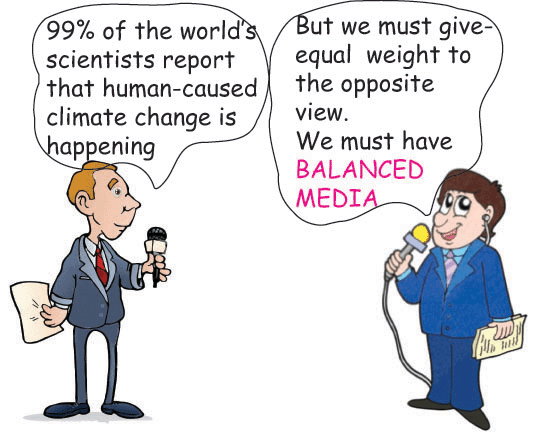 Carbon Brief 10th Aug 2017, Factcheck: Lord Lawson’s inaccurate claims about climate change on BBC
Radio 4. The Today programme, BBC Radio 4’s flagship current affairs
breakfast show, featured a prominent five-minute interview this morning
with the climate sceptic Conservative peer Lord Lawson.
Lawson was asked by the presenter Justin Webb to respond to Webb’s earlier interview with Al
Gore. The former US vice president is in the UK promoting his new
documentary, The Inconvenient Sequel: Truth to Power, a follow-up to his
Oscar-winning film released a decade ago.
Lawson, who has a history ofcontroversial appearances on the Today programme, made a number of
inaccurate claims throughout his interview. It has already attracted
widespread criticism from scientists. Carbon Brief has transcribed and
annotated the interview to highlight and contextualise the errors. https://www.carbonbrief.org/factcheck-lord-lawson-inaccurate-claims-about-climate-change-bbc-radio-four
Debate on whether it would be constitutional for Trump to make a nuclear strike against North Korea
A Trump nuclear strike against North Korea: constitutional or not? http://www.politifact.com/truth-o-meter/article/2017/aug/10/nuclear-strike-against-north-korea-constitutional-/
But some members of Congress argue that the current process by which the president can order a nuclear strike is illegal.
“Our view is the current nuclear launch approval process is unconstitutional,” U.S. Rep. Ted Lieu, D-Calif, said on CNN on Aug. 8, 2017. Lieu has filed a proposal to require congressional approval before the president could launch a first nuclear strike.
“Right now one person can launch thousands of nuclear weapons, and that’s the president. No one can stop him. Under the law, the secretary of defense has to follow his order. There’s no judicial oversight, no congressional oversight,” Lieu said.
Lieu, a colonel in the Air Force reserves, is generally correct about the president’s power to initiate a nuclear strike. The constitutionality, however, is a more complex question. We won’t rate Lieu’s claims on the Truth-O-Meter, but we did think it was important to provide context to his statement and the law.
The current nuclear launch approval process was enshrined after the atomic bombings of Hiroshima and Nagasaki in Japan to end World War II. President Harry Truman signed the Atomic Energy Act of 1946 to give the president full responsibility over the nation’s nuclear arsenal.
(As an aside, Lieu’s argument wouldn’t apply in cases when Congress formally declares war, since the president has a longstanding right as commander-in-chief to decide how to wage war.)
So the current nuclear launch approval process doesn’t include the same checks and balances as other executive branch decisions. The launch process allows the president to use nuclear weapons with a single verbal order. Some experts believethe president doesn’t need to consult with the defense secretary. The president’s order cannot be overridden.
The U.S. Supreme Court has never weighed in on the question of whether the current nuclear launch approval process is legal. Not surprisingly, we heard mixed opinions from legal scholars.
The Constitution allows the president to use significant military force without congressional approval if it’s in self-defense. But would it be constitutional for the president to respond to a conventional bombing with a nuclear strike? What about a state-sponsored act of terror?
These questions have no definitive answer.
The murkiness is due in some part to the framers not foreseeing the capability for mass destruction that nuclear weapons guarantee, said Samuel Issacharoff, a constitutional law professor at New York University. But, he said, the narrow design of a founding document doesn’t necessarily make a president’s unilateral military action — nuclear or non-nuclear — unconstitutional.
“The best one can say is that the constitutional scheme may be poorly designed
for modern circumstances,” he said.
The Constitution does give Congress the authority to declare war, which it hasn’t done since World War II. But presidents before Trump — and including Trump with his April airstrikes in Syria — have initiated war or war actions without express congressional permission.
In 1973, Congress passed the War Powers Resolution requiring that in the absence of a war declaration by Congress, the president report to Congress within 48 hours of introducing armed forces into hostilities and remove forces within 60 days if Congress does not approve.
A simple reading, then, could give Trump a 48-hour window of unilateral power.
But the War Powers Resolution hasn’t stopped longer military interventions. President Bill Clinton sent U.S. troops into the former Yugoslav republic of Kosovo in 1999, and they remained in place despite the failure to receive congressional authorization.
There’s a final wrinkle to all of this: Some experts say that Trump could circumvent the need for Congress to declare war against North Korea, because the United States is already at war with North Korea.
The Korean War (1950-3) ended with an armistice, but the two parties never signed the peace treaty scheduled in Geneva in 1954 formally ending the war.
“In the absence of some new legal instrument that makes fighting the war improper, you can say that the president has whatever authority he had before,” said Saikrishna Prakash, a law professor at the University of Virginia.
But there’s a caveat to that, too. Congress approved funding to fight the Korean War, but never formally declared war. That was done by the United Nations.
Trump administration’s mixed messages on North Korea
,BBC 12 Aug 17, At a time when nuclear war with North Korea seems a possible – if distant – threat, you’d think everyone would want the US administration to be on the same page.
But in recent weeks, statements from President Trump and his top officials appear to directly contradict each other.
President Trump’s latest outburst – that the US military was “locked and loaded”ready to deal with North Korea – came just hours after his Defence Secretary Jim Mattis attempted to cool tensions by saying that diplomatic efforts were succeeding.
Here are some of the other mixed messages we’ve heard since North Korea’s intercontinental ballistic missile (ICBM) test on 28 July…….http://www.bbc.com/news/world-us-canada-40903061
Russia not happy with U.S. casting doubt on Iran nuclear deal
Russia says ‘a pity’ U.S. casts doubt on Iran nuclear deal, https://www.reuters.com/article/us-iran-nuclear-russia-usa-idUSKBN1AR1AU MOSCOW (Reuters) 11 Aug 17 – Russian Foreign Minister Sergei Lavrov said on Friday it is a pity that the administration of U.S. President Donald Trump was casting doubt on the 2015 deal to curtail Iran’s nuclear weapons program. “Unfortunately now our American partners call this …(treaty) into question,” Lavrov told a meeting with students broadcast live by state television.
“In the Trump administration they continue calling these agreements wrong and erroneous, and it’s a pity that such a successful treaty is now somewhat being cast into doubt.”
Trump said on Thursday said he did not believe that Iran was living up to the spirit of the deal
U.S,. Court extends freeze in litigation over the Clean Power Plan – a blow to climate action
Obama’s climate regulations could save the United States billions — but they face a precarious future under the Trump administration.
That all changed, however, when President Donald Trump assumed office in January. Trump, who does not accept the scientific consensus on climate change, railed against the rule through his presidential campaign, pledging to undo the regulation as part of his vast rollback of Obama-era environmental policies. In late March, the Trump Justice Department asked the U.S. Court of Appeals for the District of Columbia not to render a decision in the case, arguing that it would be premature to rule on a regulation that the administration was in the process of undoing. The court agreed, at least in part, with the Trump administration, issuing a 60-day freeze in litigation in late-April.
Tuesday’s decision extends that stay for another two months, dashing hopes that the court could revive the rule either by ruling in favor of the regulation or remanding it to the EPA for modifications, rather than complete repeal and rewrite.
But in a concurring opinion, two judges included a stark rebuff to the idea that the EPA could rely on the court to delay the regulation — reminding the agency that the EPA’s 2009 endangerment finding, which relied on volumes of scientific evidence to classify carbon emissions as a public health threat, compels the agency to act to limit greenhouse gas emissions.
Combined with the existing stay of the rule from the Supreme Court, the two judges — both nominated by Democratic presidents — argued that the court’s extension of the pause in litigation amounted to “relieving EPA of its obligation to comply with that statutory duty for the indefinite future.”
“We are in a race against time to protect our communities and families from the clear and present danger of climate pollution,” Tomás Carbonell, directory of regulator policy and senior attorney for Environmental Defense Fund, which is one of the groups defending the Clean Power Plan, said in a statement. “EDF, along with millions of concerned Americans, will keep working to ensure EPA complies with its legal obligations and acts to protect our nation from climate pollution.”
The court’s decision came just days after legal experts from Columbia University’s Sabin Center for Climate Change Law released new analysis looking at the economic benefits of Obama-era climate and environmental regulations, including the Clean Power Plan. According to the analysis, the total benefits of maintaining several Obama-era regulations on greenhouse gas emissions could reach almost $370 billion by 2030. The analysis found that some of the highest benefits came from implementing the Clean Power Plan, which could by itself could create $46 billion in economic benefits by 2030. Those benefits came from the estimated reduction in emissions, as well as greater efficiency and lower health costs as a result of declines in pollution. The analysis also estimated that the Clean Power Plan could create as many as 59,700 new jobs by 2020.
China’s economic advantage in control of rare earths
Control of rare earths gives China a fresh economic advantage, Las Vegas Sun, By Llewellyn King, Aug. 10, 2017 “……China controls the world’s production and distribution of rare earths. It produces more than 92 percent of them and holds the world in its hand when it comes to the future of almost anything in high technology.
Rare earths are great multipliers and the heaviest are the most valuable. They make the things we take for granted, from the small motors in automobiles to the wind turbines that are revolutionizing the production of electricity. For example, rare earths increase a conventional magnet’s power by at least fivefold. Strategically, they are the new oil.
Rare earths are also at work in smartphones and computers. Fighter jets and smart weapons, like cruise missiles, rely on them. In national defense, there is no substitute and no other supply source available…….
If President Donald Trump — apparently encouraged by his trade adviser Peter Navarro, and his policy adviser Steve Bannon — is contemplating a trade war with China, rare earths are China’s most potent weapon.
A trade war moves the rare-earths threat from existential to immediate.
In a strange regulatory twist the United States — and most of the world — won’t be able to open rare-earths mines without legislation and an international treaty modification. Rare earths are often found in conjunction with thorium, a mildly radioactive metal and a large regulatory problem.
The Nuclear Regulatory Commission and the International Atomic Energy Agency have defined thorium as a nuclear “source material” that requires special disposition. Until these classifications, thorium was disposed of along with other mine tailings. Now it has to be separated and collected. ….
Meanwhile, future disruptions from China won’t necessarily be in the markets; they could be in the obscure but vital commodities known as rare earths: China’s not-quite-secret weapon. https://lasvegassun.com/news/2017/aug/10/control-of-rare-earths-gives-china-a-fresh-economi/
Under Trump administration, dramatic drop in EPA fines against polluters
EPA fines collected against polluters dropped 60% under Trump, report says, By Miranda Green, CNN August 10, 2017 Washington (CNN) The amount of money the Environmental Protection Agency is penalizing polluters they’ve sued for breaching federal regulations has plummeted by 60% under President Donald Trump, a report released Thursday has found.
How the US military co-opted a famous journalist to make the nuclear industry look good
In 2004, the progressive journalists Amy and David Goodman called for the prize to be revoked, charging that Laurence had knowingly covered up the effects of radiation sickness on the Hiroshima and Nagasaki survivors by “parroting the government line” that such reports were Japanese propaganda.
Laurence’s role within the Manhattan Project was a clear conflict of interest
We will probably never know the true extent to which William Laurence was co-opted, compromised, or corrupted by his military and governmental connections and involvements.
 ‘Atomic Bill’ and the Birth of the Bomb A star New York Times reporter was hired by the Manhattan Project to be its chronicler and cheerleader. The ethical debate continues to this day. Undark, 08.09.2017 / BY
T 5:51 A.M. on Monday, May 21, 1956, the famed New York Times science correspondent William Leonard “Atomic Bill” Laurence watched a new universe burst into existence……Called Cherokee, it was a hydrogen bomb that moments before had been dropped about four miles off target from a B-52 bomber flying 10 miles over the northern Pacific, near the island of Namu in the Bikini Atoll
“….Laurence was also, at least in his own era, one of the most important science writers in America, one whose influence, if not his lyrical and vivid prose style, persists to this day. The Princeton historian Michael D. Gordin, author of “Five Days in August” and “Red Cloud at Dawn,” notes Laurence’s seminal impact on popular perceptions of the Bomb: “[His] science-driven utopianism, stressing some of the potential positive outcomes of nuclear power and minimizing the threat to Americans … [was] strongly influential in those early years, and shaped some of the discourse even of those opposed to the positions he articulated.” Much of Laurence’s writing, Gordin goes on, “became just part of the way people talked about nuclear weapons for decades.”
For Laurence, science represented humanity’s salvation, whether through medical advances or the power of the atom. If he believed that science was “the religion of the future,” as Spencer Weart wrote in his book “Nuclear Fear,” then Laurence definitely saw himself as an evangelist…….
OR YEARS, Laurence had wavered, torn between his firsthand knowledge of the annihilating power of nuclear weapons and his hope that the civilian and military atom would bring about a fabled new age of wonder for humankind. The great dangers and the great promise were two separate paths, and it was up to us to choose the right one.
But now those two sides of the atom, the dark and the light, nuclear oblivion and nuclear plenty, finally reconciled themselves in Laurence’s mind. He knew he had been wrong. They weren’t separate. They were one and the same. In the face of the awesome power of hydrogen fusion, no distinctions were necessary, or even possible. Beyond the dark cloud of nuclear destruction lay the super-bright sun of nuclear promise. And he would be the one who, through his words, would help the world see that light……..
In recent years, rising concerns over journalistic ethics, embedded reporters, and conflicts of interest have led critics to view Laurence’s role in the Manhattan Project as a classic example of the latter. Here was a reporter for America’s newspaper of record, tapped to serve not the interests of objective journalism but those of the military. …..
Laurence won his second Pulitzer Prize in 1946 for his Manhattan Project reporting, specifically his eyewitness account of the Nagasaki bombing mission. In 2004, the progressive journalists Amy and David Goodman called for the prize to be revoked, charging that Laurence had knowingly covered up the effects of radiation sickness on the Hiroshima and Nagasaki survivors by “parroting the government line” that such reports were Japanese propaganda. That same year, Beverly Ann Deepe Keever, a University of Hawaii journalism professor, took The Times itself to task, claiming in her book “News Zero: The New York Times and the Bomb” that beginning with Laurence and continuing throughout the Atomic Age, the paper had “omitted or obscured the defining — and harmful — effect” of radiation and radioactivity and had “aided the U.S. government at critical moments in implementing an information policy that covered up or minimized the scope and impacts of radiation and radioactivity.”
However, there’s an important perspective that such accusations overlook. Laurence’s role within the Manhattan Project was a clear conflict of interest by today’s standards……
While I was away with the atomic project for four months, I was off the Times payroll,” he explained in his Columbia oral history interview. “My salary came from the Army. … All the facts, all the news I got, I got from the Army and not from my connection with the Times.” ….
Despite Laurence’s claims, the question of just who was paying him while he was lost in “Atomland-on-Mars,” as he called it, remains unclear. His temporary boss, Gen. Leslie Groves — the military head of the Manhattan Project and the man who plucked Laurence away from the Times after personally selecting him for his atomic job — later wrote in his own memoir that “it seemed desirable for security reasons, as well as easier for the employer [i.e., The Times], to have Laurence continue on the payroll of the New York Times, but with his expenses to be covered by the MED” — the Manhattan Engineering District, i.e. Manhattan Project……..
His glowing paeans to the limitless future of atomic energy and the relative “safety” of the supposedly “clean” hydrogen weapons then under development — along with a thinly veiled disdain toward the growing grassroots campaign to ban atomic testing — only helped to enhance his image as a journalist who not only accepted but actively supported the Bomb as a part of 20th-century civilization. …
There’s no doubt that Groves and the military were consciously attempting to downplay the dangers of radiation….
We will probably never know the true extent to which William Laurence was co-opted, compromised, or corrupted by his military and governmental connections and involvements. It appears that in many ways, he was never really certain himself, and allowed himself to fall into a rabbit hole of murky motivations, ethical conflicts, and questionable alliances for the sake of what he viewed as his journalistic duty and dedication to the truth. What is clear, however, is that he allowed his awe, his sense of wonder, to overwhelm his consciousness, numbing his original visceral dread of atomic weapons and his detailed knowledge of their power. After struggling for decades with the insoluble conflict between the atom’s potential for both unparalleled good and unspeakable evil, he resolved the struggle in his own soul by surrendering to a comforting anodyne, a conviction that nuclear weapons were ultimately a “world-covering, protective umbrella” to shield humanity until the dawn of a golden era of peace.
Blinded by the fireball light of Cherokee that shone so brilliantly and then faded, Laurence anesthetized the dread he had felt and warned of long before any of his colleagues by simply fooling himself. Those of us who are his inheritors must guard against falling into the same trap. https://undark.org/article/atomic-bill-laurence-manhattan-project/
1 This Month

of the week – Shut Down Drone Warfare!


Tell the Ukrainian Government to Drop Prosecution of Peace Activist Yurii Sheliazhenko

Petition to revoke the licensing of the Near Surface Nuclear Disposal Facility (NSDF) at Chalk River. https://www.ourcommons.ca/petitions/en/Petition/Details?Petition=e-7247
To see nuclear-related stories in greater depth and intensity – go to https://nuclearinformation.wordpress.com
-
Archives
- April 2026 (91)
- March 2026 (251)
- February 2026 (268)
- January 2026 (308)
- December 2025 (358)
- November 2025 (359)
- October 2025 (376)
- September 2025 (257)
- August 2025 (319)
- July 2025 (230)
- June 2025 (348)
- May 2025 (261)
-
Categories
- 1
- 1 NUCLEAR ISSUES
- business and costs
- climate change
- culture and arts
- ENERGY
- environment
- health
- history
- indigenous issues
- Legal
- marketing of nuclear
- media
- opposition to nuclear
- PERSONAL STORIES
- politics
- politics international
- Religion and ethics
- safety
- secrets,lies and civil liberties
- spinbuster
- technology
- Uranium
- wastes
- weapons and war
- Women
- 2 WORLD
- ACTION
- AFRICA
- Atrocities
- AUSTRALIA
- Christina's notes
- Christina's themes
- culture and arts
- Events
- Fuk 2022
- Fuk 2023
- Fukushima 2017
- Fukushima 2018
- fukushima 2019
- Fukushima 2020
- Fukushima 2021
- general
- global warming
- Humour (God we need it)
- Nuclear
- RARE EARTHS
- Reference
- resources – print
- Resources -audiovicual
- Weekly Newsletter
- World
- World Nuclear
- YouTube
-
RSS
Entries RSS
Comments RSS
 nuclear-news