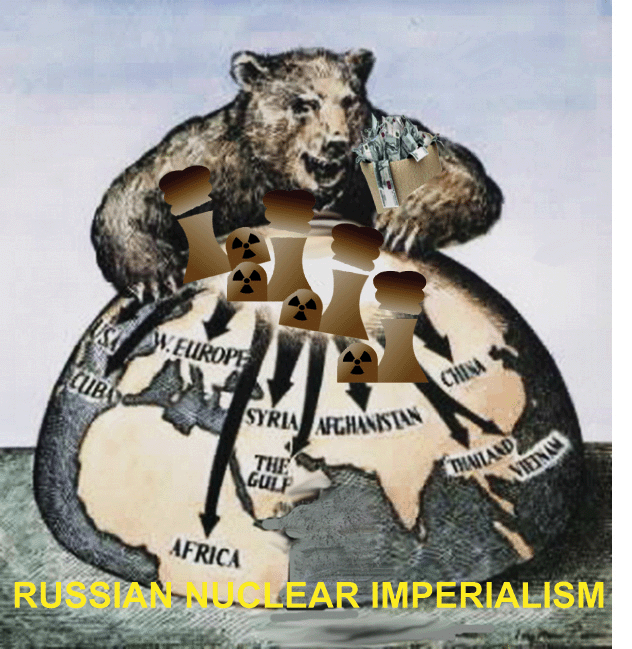
Poland speaks out harshly against Belarusian nuclear plantPoland has lent its voice to a growing chorus of countries that won’t buy power from the Belarusian Nuclear Power Plant that Moscow is building in Ostrovets because it considers the project to be unsafe, RIA Novosti reported, Bellona, August 9, 2017 by Charles Digges, “………Since the early 2000s, many in the West see Russia’s ambitions to built nuclear plants abroad as attempt to cast Moscow’s apron strings into the European Union.
By fully financing reactor builds, they say, the Kremlin is offering a Faustian bargain: energy independence in exchange for long-term debt and Moscow friendly politics.
The Moscow-leaning government of Viktor Orban in Hungary is a good example. Budapest relies on a Soviet-built nuclear power plant for 50 percent of its electricity, and recently signed a €12 billion deal for a second Russia-built plant. Budapest is now also less likely to pester Moscow over sensitive issues like Russia’s covert war in Ukraine.
That’s because Moscow has a habit of settling political disputes by shutting off the power and heat in places where it has built infrastructure. Disputes between Russia and Ukraine, which remain bitter, led to cuts in Europe’s gas supply from Russia during the winter in 2006 and 2009.
Lithuania’s law against the Ostrovet’s plant is Vilnius’s attempt to opt out of being a hostage to Moscow’s new zero-sum nuclear energy policy, and Poland seems to agree.
These boycotts against buying nuclear power have been enormously effective in shutting down other unpopular nuclear builds in the region.
A Russian nuclear plant in the Kaliningrad enclave was quietly shelved in 2011 when Poland declared it wouldn’t help out with financing.
Lithuania’s own plans for a nuclear power plant took a more tortured route. Since 2009, the country has been trying, unsuccessfully, to kindle investment interest in its own Visaginas nuclear power plant to replace the Soviet-built Ignalina station.
Nuclear not the answer, as consumers pay for abandoned reactors, REneweconomy, By Giles Parkinson on 9 August 2017 “…….The so-called “nuclear renaissance” in the United States has had another major setback, with another two reactors under construction in South Carolina abandoned after costs spiralled out of control, leaving consumers holding the bill for plants that will never be completed.
The plug was pulled on the V.C. Summer nuclear project last week after $US9 billion had already already spent, and after it became clear that the original $US11.5 billion bill for the whole project would more than double to at least $US25 billion ($31 billion).
South Carolina consumers will be left holding the bill, and 20 per cent of their electricity rates will go to pay for something that will never be completed.
Critics say the decision heralds the demise of new nuclear in the US, and expect the Vogtle nuclear reactor project in Georgia to also collapse as its costs also surge.
The Vogtle reactors, also funded by consumers and taxpayer loans, are the only two reactors under construction in the US, out of the 31 once hailed as a sign of the industry’s renaissance in the US.
Given the farce around the massive Hinkley Point project in the UK, which is running more than $2 billion over-budget after just the first year of a planned 10-year construction period, and the cost over-runs for next generation reactors in France and Finland, it seems clear that nuclear has done its dash in western economies.
Hinkley is now tipped to cost £19.6 billion, a rise of £1.5 billion, and it faces delays.
On top of that, the Independent reported last month that government figures now show the total bill to households could total £50 billion ($A83 billion), more than eight times greater than the National Audit Office’s initial 2013 estimate that a public investment of £6 billion would be required………
The nuclear industry is putting pressure on the Trump administration to approve a bail-out of existing nuclear generators, which they say cannot compete against wind, solar and gas.
A Department of Energy advisory committee last year recommended that nuclear receive an additional production create of $US27/MWh which would result in a bill to taxpayers of more than $US228 billion.
To put that in perspective, a newly released study by the Berkley Renewable Energy Laboratory puts the average cost of new wind farms at just $20/MWh. Solar is not far behind – and both cheaper than the subsidies needed by nuclear to keep ageing plants operating.
“Nuclear power is failing despite the fact that it is already heavily subsidised,” said Tim Judson, of the Nuclear Information and Resource Service.
“With renewable energy now surpassing nuclear by widening margins, it’s clear that subsidizing nuclear is an expensive way to slow down the growth of clean, safe, affordable, job-creating energy sources.””
Consumers are the biggest victims from the latest attempts to revive the nuclear industry, because the utilities that proposed them made sure that it was the consumers, not the investors, that took the risk.
Peter Bradford, a former Nuclear Regulatory Commission (NRC) Commissioner, and past chair of the New York and Maine state utility regulatory commissions, said using ratepayers to finance construction of nuclear reactors in advance are debacles waiting to happen.
““The primary lessons for Georgia, Virginia, and other states, from the South Carolina cancellations (as well as Levy County in Florida and Kemper in Mississippi) is that laws and regulatory decisions placing economic risks on customers instead of the investors and lenders who should properly bear them are a disastrous mistake,” he says.
“Freed of responsibility for the consequences of their mistakes, utility executives too often plunge into ill-advised schemes to pad their rate bases (and individual compensation) when they should be managing competitive processes designed to select the most cost-effective alternative.””
He warned that taxpayers could still end up on the hook for billions of dollars if the Vogtle project goes belly up.
Unlike VC Summer, Vogtle managed to win themselves more than $US8 billion in taxpayer-backed loan guarantees. Critics say it is clearer than ever that the writing is on the wall for taxpayers.
Bradford says it is clear that the any remaining illusions about a resurgence of nuclear power in the United States are now dead.
““In fact, there never was an actual ‘nuclear renaissance’, just the 31 paper applications on file at the Nuclear Regulatory Commission by early 2009.
“Now nearly all but two are cancelled, leaving a trail of economic waste in their wake. The intent of the renaissance dream was to show that new reactor designs and an expedited licensing process from which the public was largely excluded would produce reactors that could be completed ‘on time and on budget’ as well as at competitive costs.
“The expectation was that private financing, without subsidy from customers and taxpayers, would then become available to nuclear power. That dream is now in ruins.
“Throughout the history of the church, people have always found ways to use God and scripture to justify empire, to justify oppression and exploitation,” Kyle Meyaard-Schaap, an organizer with a pro-environmental Christian group called Young Evangelicals for Climate Action (YECA), told me. “It’s a convenient theology to hold, especially when we are called to drastic, difficult action.”
How Fossil Fuel Money Made Climate Change Denial the Word of God Brendan O’Connor, Splinter , 8 Aug 17 In 2005,at its annual meeting in Washington, D.C., the National Association of Evangelicals was on the verge of doing something novel: affirming science. Specifically, the 30-million-member group, which represents 51 Christian denominations, was debating how to advance a new platform called “For the Health of a Nation.” The position paper—written the year before An Inconvenient Truth kick-started sense of public urgency around climate change—included a call for evangelicals to protect God’s creation, and to embrace the government’s help in doing so. The NAE’s board had already adopted it unanimously before presenting it to the membership for debate.
At the time, many in the evangelical movement were uncomfortable with its close ties to the Republican anti-environmental regulation agenda. That year, a group called the Evangelical Alliance of Scientists and Ethicists protested the GOP-led effort to rewrite the Endangered Species Act, and the NAE’s vice president of governmental affairs Richard Cizik pushed for the organization to endorse John McCain and Joe Lieberman’s cap-and-trade bill. “For the Health of a Nation,” which Cizik also pushed, was an opportunity to draw a bright line between their support of right-wing social positions on abortion and civil rights and a growing sentiment that God’s creation needed protection from industry……..
At the behest of a group called the Interfaith Stewardship Alliance, the board buckled, releasing a statement in February 2006 “recognizing the ongoing debate” on global warming and “the lack of consensus among the evangelical community on the issue.” Just days later, an outside group of 86 evangelical leaders, under the aegis of the Evangelical Climate Initiative, issued a “Call to Action” declaring that climate change was real and that “millions of people could die from it in this century.”
For his trouble, Cizik was targeted by a collection of hard right Christians, who petitioned the NAE board to muzzle him or force him to resign. “Cizik and others are using the global warming controversy to shift the emphasis away from the great moral issues of our time, notably the sanctity of human life, the integrity of marriage, and the teaching of sexual abstinence and morality to our children,” their letter read. It also implied that Cizik, who had worked for the NAE for nearly three decades, supported abortion, giving condoms to children, and infanticide…….
The NAE did eventually endorse climate action in 2015. But it was too late. By that time, a corps of right-wing Christians, funded by fossil-fuel interests, had hijacked the public and political machinery of the evangelical movement. They are now in the White House, where the anti-environmental agenda is dominated by Christian fundamentalists like EPA Commissioner Scott Pruitt while the more moderate views offormer ExxonMobil CEO Rex Tillerson are ignored. This is the story of how they did it.
At a town hall in Michigan last May, Republican Rep. Tim Walberg assured his constituents that, while the climate may be changing, they don’t need to be concerned. “As a Christian, I believe that there is a creator in God who is much bigger than us,” he told them. “And I’m confident that, if there’s a real problem, He can take care of it.”
This idea—that whatever happens in God’s creation happens with His blessing—has deep roots in the American evangelical community, especially among the elite fundamentalists who walk the halls of power in Washington, D.C. For years, an evangelical minister named Ralph Drollinger has held weekly Bible studies for members of Congress, preaching that social welfare programs are un-Christian and agitating for military action against Iran. (In December 2015, he expressed his desire to shape Donald Trump into a benevolent, Christian dictator.) Drollinger also teaches that climate change caused by humans is impossible in light of God’s covenant with Noah after the Flood: “To think that man can alter the earth’s ecosystem—when God remains omniscient, omnipresent and omnipotent in the current affairs of mankind—is to more than subtly espouse an ultra-hubristic, secular worldview relative to the supremacy and importance of man,” he wrote recently.
Conservative groups, funded by fossil fuel magnates, spend approximately one billion dollars every year interfering with public understanding of what is actually happening to our world. Most of that money—most of the fraction of it that can be tracked, anyway—goes to think tanks that produce policy papers and legislative proposals favorable to donors’ interests, super PACs that support politicians friendly to industry or oppose those who are not, or mercenary lobbyists and consultants, in some instances employing the same people who fought to suppress the science on smoking. In terms of impact, however, few investments can rival the return that the conservative donor class has gotten from the small cohort of evangelical theologians and scholars whose work has provided scriptural justifications for apocalyptic geopoliticsand economic rapaciousness.
“Throughout the history of the church, people have always found ways to use God and scripture to justify empire, to justify oppression and exploitation,” Kyle Meyaard-Schaap, an organizer with a pro-environmental Christian group called Young Evangelicals for Climate Action (YECA), told me. “It’s a convenient theology to hold, especially when we are called to drastic, difficult action.”
Many of these soothsayers are gathered together in an organization called the Cornwall Alliance—formerly known as the Interfaith Stewardship Alliance, the same group that mobilized against Cizik’s environmental proposal—a network with ties to politicians and secular think tanks across the conservative landscape. In 2013, Cornwall published an anti-environmentalist manifesto called Resisting the Green Dragon. “False prophets promise salvation if only we will destroy the means of maintaining our civilization. No more carbon, they say, or the world will end and blessings will cease,”it warns. “Pagans of all stripes now offer their rival views of salvation, all of which lead to death.” Members of the Cornwall Alliance and their ilk are not simply theoreticians but enforcers, stifling dissent in the wider American evangelical community, smothering environmentalist tendencies before they gain a following………
For almost 20 years, Beisner and members of the Cornwall Alliance have worked with establishment conservatives to bolster opposition to climate change: The Heartland Institute identifies him as a policy advisor on its web site, and he speaks regularly at the institute’s annual conference on climate change (though in an interview he curiously denied ever actually giving any policy advice to Heartland). The Heritage Foundation hosted the 2015 premierof Where the Grass is Greener, a documentary produced by the Cornwall Alliance. In May, Beisner and senior executives from Heartland, Heritage, and a slew of other billionaire-funded political entities like Americans for Prosperity and the Competitive Enterprise Institute sent a letter to Donald Trump urging him to withdraw from the Paris climate agreement and asking him to stop funding United Nations global warming programs.
Together, Cornwall, Heartland, and Heritage have been able to set the terms of the conservative conversation—evangelical or otherwise—about the climate. They determine what science is acceptable, which proposed solutions can be considered, and what the consequences of inaction might look like. “There’s a very strong connection between those institutions and the evangelical Right,” Rev. Hescox told me. “Their denial of the science—and really portraying this as a big government issue—is why there was so much pushback among evangelicals.”
The Cornwall Alliance, joined by scientists associated with organizations partly funded by ExxonMobil, continued hammering away at Christian groups that supported action on climate change. In 2008, it launched the bizarrely named “We Get It!” campaign, which targeted the Evangelical Climate Initiative and was endorsed by a slew of conservative organizations, including the Family Research Council and David Barton’s WallBuilders…..
Given that it is a relatively small operation with relatively low overhead, the money that the Cornwall Alliance receives is a vanishingly small fraction of the hundreds of millions spent by the Koch, the Mercer, or the DeVos families. (The Kochs are oil, coal, and gas scions; Robert Mercer is a hedge fund manager who, with his daughter Rebekah, fueled Trump’s rise; Education Secretary Betsy DeVos and her husband Dick are long-time Republican donors).
Their money flows through a multitude of nonprofits, front groups, and donor-advised funds. (A donor-advised fund is a kind of money-laundering service for philanthropists who don’t want anyone to know where their money is going: They make a contribution to the fund, and then tell the fund where to send the money; as a nonprofit, the fund has to disclose all of the grants that it makes, but it does not need to disclose its own donors, nor what direction those donors attached to their money.) Donors Trust, the “dark money ATM” of the conservative movement, contributed $1,001,500 to the James Partnership between 2009 and 2015; in most years, this constituted around half of the Partnership’s total revenue………
…….billions are paying off. Not only have the people who funded Cornwall successfully stopped the government from pursuing policies that might make the lives of people who are living with the consequences of climate change a little bit better, but under the Trump administration their lackeys are actively working to dismantle what little progress has been made. When Drollinger teaches that God’s covenant with Noah means that the consequences of climate change not only will not but in fact cannot be as devastating as scientists believe, he echoes a lengthy essay published by the Cornwall Alliance in 2009 that lays out the same argument. Typical of the organization’s style, it appears to the casual observer like any policy paper drawn up at one of D.C.’s many think tanks and nonprofits; in reality, the document blends quotations from scripture with pseudo-scientific data—citing, for example, the Mercer-funded Oregon Institute of Science and Medicine. During Pruitt’s confirmation hearing, Republican Sen. John Barrasso favorably cited Beisner and the Cornwall Alliance’s support for the Oklahoma attorney general……http://splinternews.com/how-fossil-fuel-money-made-climate-denial-the-word-of-g-1797466298
To Stop Global Warming, Should Humanity Dim the Sky? The world’s top geoengineering researchers met off the record to discuss the possibility in Maine last month. ROBINSON MEYER, The Atlantic AUG 7, 2017 Late last month, about 100 researchers from around the world gathered at Logan International Airport in Boston. A fleet of buses appeared to whisk them to a remote and luxurious ski resort in northeastern Maine.…….They had gathered to discuss how to provide humanity one last line of defense against catastrophic global warming: solar geoengineering.
The idea behind solar geoengineering is simple. For the last four decades, humanity has struggled to reduce the amount of greenhouse gas entering the atmosphere. We have decommissioned nuclear plants, introduced millions of new gasoline-burning cars to the roadway, and dawdled through treaty after treaty. Meanwhile, the concentration of carbon dioxide in the atmosphere has only risen.
It sure seems like we’ll need some more time to get our act together. So maybe we should toy with another variable: While we try to reduce the planet’s heat-trapping gas, maybe we can also try to reduce the amount of heat entering the atmosphere in the first place.
Interest in the technique has spiked recently. An administration hostile to climate mitigation has taken power in the United States, and some countries risk falling short of the promises they made under the Paris Agreement. It seems suddenly plausible that the industrialized world will not succeed in staving off two degrees of temperature rise.
Governments and private donors have opened their pockets in advance of that failure. This summer, China’s national Ministry of Science and Technology announced it will fund a 15-person, $3 million geoengineering research programat Beijing Normal University. It will join several government-funded teams working on the same problem in Germany as well.
This fall, Harvard University will also launch its own solar geoengineering research with $7.5 million in funding from private sources. Its leaders hope to eventually amass a budget of $20 million.
So the conference, organized by Gordon Research Conferences, was well-timed. It is thought to be the largest gathering of geoengineering scientists ever assembled, and its participants included almost every senior researcher in the field. It was held under the Chatham House rule, which proscribed attendees from disclosing who said what, but its agenda and attendees list are available online…….
There are several ways of holding off that warmth. They all involve bouncing sunlight back into space before it penetrates too far into the lower atmosphere. Over the past decade, scientists have discussed some different ways to do this: by brightening clouds over the ocean; by pushing cirrus clouds to form in the high atmosphere; or by spraying a reflective gas into the sky at high altitudes, mimicking the effect of a large volcanic eruption.
Last month’s meeting arrived at the consensus that this final technique—called stratospheric aerosol injection—is the best bet going forward. Researchers don’t see a technological impediment to developing seeding tools, seeing the few remaining problems as within the capability of any large aerospace company. There are plenty of natural precedents for stratospheric aerosols, too—volcanoes have gone off hundreds of time during human history—and they see it as the most reversible and easy to model.
“When you put particles in the stratosphere, it’s simpler to calculate what the effect would be on the energy budget and on the temperature,” said Storelvmo. “Anything that involves clouds generally becomes much more complicated.”
It also benefits from some built-in economies of scale. “With the physics [of stratospheric injection], you can have huge multipliers. You put one particle in the stratosphere and it can deflect trillions of photons,” said Ken Caldeira, a senior scientist at the Carnegie Institution for Science and a presenter at last month’s meeting.
This neat efficiency separates solar geoengineering from its sibling, “carbon geoengineering,” which aims to directly scrub the atmosphere of carbon dioxide and other heat-trapping gases. If perfected, carbon geoengineering could permanently solve the problem of global warming, but researchers consider the technological advances needed to accomplish it far-off, and the meeting didn’t address it……
Yet this makes the most feasible form of geoengineering (dimming the sun) only a stopgap—albeit a tentatively effective one. “Most of the climate models project that solar geoengineering could offset most climate change for most people most of the time. But in climate models, if something goes wrong, you can run the model again. In the real world you don’t have that option,” Caldeira said.
So much of the meeting was devoted to the natural follow-up question: What could go wrong?
The most glaring concerns are about how stratospheric aerosol injection could affect the water cycle, “whether it could induce droughts or floods or things like that,” said Storelvmo. Many researchers describe that as the riskiest aspect of solar geoengineering right now……
It’s also unclear how much solar geoengineering will be required to hold off the worst symptoms of climate change. Because the equator receives stronger, more frequent sunlight than the poles, stratospheric aerosols would chill the tropics more than they would the higher latitudes. This could trap wannabe geoengineers in a dosage dilemma.“If you’re interested in stopping ice sheets from melting, you can’t just make global temperature constant. You have to overcool it to reach the high latitudes,” said Robock.
A similar mechanism could create even nastier water-cycle problems. Stratospheric aerosols may cool the continents more than they cool the oceans, equalizing the normal pressure difference between land and sea—and, in turn, killing the seasonal monsoons of Asia and Africa. Food prices worldwide would skyrocket……
Other sessions at the conference focused on other unknowns about solar geoengineering beyond weather. Little research has been conducted into how ecosystems would respond to prolonged global dimming. Some researchers also worry that spraying sulfur dioxide into the high stratosphere could damage the ozone layer, though recent research has suggested this risk is smaller than once thought…….
By Kim Sung-hwan, staff reporter New report finds that nuclear power phaseout could save nearly $17 billion in maintenance costs
The cost of managing the “spent nuclear fuel” irradiated in nuclear plants has steadily increased and now exceeds 64 trillion won (US$57.2 billion), a new report confirms. If the government implements its policy of a nuclear phaseout, it could reduce this maintenance cost by as much as 19 trillion won (US$16.9 billion), according to the report.
A report on the current maintenance cost for spent nuclear fuel that Minjoo Party lawmaker Lee Hun, a member of the National Assembly’s Industry, Trade, Resources and SME Committee, received from the Ministry of Trade, Industry and Energy on July 25 states that as of 2016 the cost needed to maintain the spent nuclear fuel for 36 nuclear reactors (including one that is permanently shuttered, 24 that are operational, five that are under construction and six whose construction is planned) is 64.13 trillion won. “The Radioactive Waste Maintenance Cost Calculation Committee, which determines the cost of spent nuclear fuel, calculated that the project cost as of 2016 was 64.13 trillion won, but the government has been publishing the project cost calculated in 2015 [of 53.28 trillion won],” Lee said.
“Since we were unable to submit a motion for approval of the project cost to the cost management review board at the Ministry of Strategy and Finance, we included the previous year’s project cost in the basic plan for managing high-level radioactive waste, which was released in July of that year,” the Ministry of Trade, Industry and Energy said in regard to why it had published an outdated project cost. The project cost for maintaining spent nuclear fuel has been steadily increasing as more nuclear reactors have been built, rising from 22.62 trillion won (with 28 reactors) between 2004 and 2012 to 53.28 trillion won (with 34 reactors) from 2013 to 2015.
The project cost has been increasing because of the need to keep building interim storage facilities inside the nuclear reactors to store spent nuclear fuel and the need to set aside a reserve fund for permanently disposing this waste (and no decision has been reached about where or how this waste will be disposed). “The project cost has increased because the cost of regional support, including storage fees, and the contingency preparation cost, including the cost of insurance, had not been explicitly included. We need to calculate the figures more specifically by launching another public debate about spent nuclear fuel,” the Ministry of Trade, Industry and Energy said.
But implementing the government’s policy of a nuclear phaseout could shave around 19 trillion won off the spent nuclear fuel project cost, the report says. While 64.13 trillion won is required for 36 reactors (including Shin-Kori reactors 5 and 6, on which construction is currently suspended, and the reactors whose construction is planned), the cost for 28 reactors (including Shin-Kori 4 and Shin-Hanul 1 and 2, which have been completely built) would be 44.89 trillion won. The total cost of decommissioning nuclear reactors could be reduced by as much as 5.15 trillion won under the policy of the nuclear phaseout, the report found. The cost of decommissioning a single reactor was 59.5 billion won when it was first calculated in 1983, but by 2015, this had increased to 643.7 billion won.
“The government is deceiving the public when it publishes a lower project cost. Considering that the post-processing costs for nuclear reactors are increasing astronomically and that safety concerns continue to be raised about the unprecedented concentration of nuclear reactors, this is a situation that calls for serious deliberation and a reasonable social consensus about phasing out nuclear power,” Lee said.
BBC 8th Aug 2017, A bomb believed to be from World War Two has been found in the Bristol
Channel near Hinkley Point nuclear power station. The 500lb device was
discovered 2.5 nautical miles from the coast, about 8m below the surface.
Divers conducting a survey for the construction of the new power station
found the ordnance on Monday. It was destroyed in a controlled explosion at
about 15:00 BSTon Tuesday. The “unusual” ordnance was found off Lilstock
Range, just west from Steart point and Bridgwater in Somerset.
The coast around Lilstock was used as part of a practice bombing range for the Royal
Navy. EDF Energy said its team of divers made the discovery 8m below the
surface while checking the seabed ahead of the construction of the main
cooling water tunnels for new Hinkley Point C nuclear power station being
built. http://www.bbc.co.uk/news/uk-england-bristol-40865105
Kubayi’s office has confirmed that it is probing the possible violation of National Treasury regulations when the department awarded an R80-million contract to a nuclear transactional adviser‚ Mahlaka-A-Phalala (M-A-P).
“There are still investigations going on the matters raised in your questions and therefore we are unable to respond as it will jeopardise and weaken the case‚” said a short statement from Kubayi’s office in response to 29 questions posed by TimesLIVE.
The minister can expect heavy questioning on the matter from DA MP Gordon Mackay when she appears before Parliament’s portfolio committee on energy on Tuesday.
Mackay said this was further evidence why the government nuclear procurement was “captured”.
“The nuclear deal is a prime example of state capture. The DA will demand from committee chairperson Fikile Majola that the energy portfolio committee tackle this matter with extreme urgency when we reconvene next month‚ and question the investment.
“We will also demand to know why deputy director-general [Zizamele] Mbambo remains in his post‚ and will propose an ad hoc committee to get to the bottom of this mess‚” said Mackay.
According to documents TimesLIVE has seen‚ energy director-general Thabane Zulu‚ his deputy Zizamele Mbambo‚ procurement specialist Ndaba Ngwane‚ and chief financial officer Yvonne Chetty have signed a deviation request to sign off the deal.
Zulu has since been moved to head the Strategic Energy Fund while Ndaba has quietly exited the department.
Mbambo remains in his position despite awarding the contract‚ which a leaked document shows amounts to R80-million. The scandal started at the end of August last year‚ when one of the consulting firms in the nuclear build programme‚ M-A-P – against which no allegations are made – compiled a report finding that the department was not ready to issue a request for proposal for the intended nuclear new build programme‚ estimated to be worth R1-trillion.
On September 22‚ Mbambo and Ngwane asked Chetty and Zulu to approve a deviation from normal procurement processes‚ in practice allowing M-A-P to continue work on the development of a transactional adviser.
The next day‚ Chetty and Zulu agreed to the deviation‚ which Chetty warned was subject to the buy-in of the National Treasury and the office of the attorney-general.
However‚ Mbambo and Ngwane merely told M-A-P to continue with a second phase of the contract‚ the cost of which would grow by R80-million to R100-million by March despite the required governance processes allegedly not having been followed.
On September 27‚ then minister of energy Tina Joemat-Pettersson suspended all payments related to the transactional adviser to M-A-P until the department had submitted a verification report to her on all deliverables received.
According to sources close to the events‚ this decision was never communicated to M-A-P as a service provider.
Instead‚ Mbambo‚ Zulu and Ngwane continued to engage M-A-P and received work deliverables towards the procurement process without a contract and without all regulations being followed. Among the serious allegations that TimesLIVE put to the Department of Energy over the past 10 days is that M-A-P was not subjected to a competitive bid process.
Instead‚ section 16 (a) 6.6 of the Public Finance Management Act was used – despite warnings by the relevant tender committee that this was wrong – to keep paying M-A-P.
This was done despite the law only allowing for the cost of the project to be extended by 15% without an open tender process.
At the beginning of March‚ M-A-P‚ which remained ignorant of Joemat-Pettersson’s instruction to stop payments‚ went to see her about payments outstanding‚ adding R60-million to the initial R20-million contract.
M-A-P also revealed to Joemat-Pettersson that it had a copy of the deviation request approved by Chetty and Zulu as given to it by Mbambo and Ndaba‚ despite the strict rules regarding the leaking of internal documents.
The whole matter came to a climax on March 16 when the departmental tender committee met and reviewed M-A-P’s bills.
Mbambo was in hot water and held to account as the meeting continued on March 22.
During the meeting‚ it came to light that Mbambo had already on September 1 given verbal instruction to M-A-P to extend its contract by a further R80-million to R100-million.
In the end‚ the Department of Energy shifted funds from the sundries account and paid M-A-P R56-million of the additional R80-million by the end of the financial year (March 31).
Zulu said only the department could comment. Numerous efforts to contact Mbambo for comment failed last week‚ and Ngwane could not be tracked down.
Senator Dean Heller released a statement on the Nuclear Regulatory Commission’s vote to use past unobligated funds for work related to its review of the Department of Energy’s application for authorization to construct a high-level radioactive waste repository at Yucca Mountain. Heller says it’s another waste of taxpayer money on a failed project that has already cost the federal government billions of dollars over the past 30 years. It’s irresponsible for the NRC to move forward on Yucca Mountain given that it’s unknown how much funding if any it will ultimately receive. Heller calls it a reckless and fiscally irresponsible decision to throw more taxpayer dollars on a project that Nevada continues to reject.
Guardian, 9 Aug 17 Interview with UN Special Rapporteur Victoria Tauli-Corpuz to mark the International Day of the World’s Indigenous Peoples Today is the United Nations’ (UN) International Day of the World’s Indigenous Peoples, numbering an estimated 370 million in 90 countries and speaking roughly 7,000 languages. To mark it, the Guardian interviews Kankanaey Igorot woman Victoria Tauli-Corpuz about the UN’s Declaration on the Rights of Indigenous Peoples, which she calls “historic” and was adopted 10 years ago.
Tauli-Corpuz, from the Philippines, was Chair of the UN Permanent Forum of Indigenous Issues when the Declaration was adopted, and is currently the UN Special Rapporteur on the Rights of Indigenous Peoples. In this interview, conducted via email, she explains why the Declaration is so important, argues that governments are failing to implement it, and claims that the struggle for indigenous rights “surpasses” other great social movements of the past:
DH: Why is the UN Declaration so important?
VTC: [It’s] so important because it enshrines and affirms the inherent or pre-existing collective human rights of Indigenous Peoples, as well as the individual human rights of indigenous persons. It is a framework for justice and reconciliation between Indigenous Peoples and states, and applies international human rights standards to the specific historical, cultural, social and economic circumstances of Indigenous Peoples. The Declaration is a standard-setting resolution of profound significance as it reflects a wide consensus at the global level on the minimum content of the rights of indigenous peoples. It is a remedial tool which addresses the need to overcome and repair the historical denial of the fundamental human rights of indigenous peoples, and affirms their equality to all other members of society.
DH: How significant an achievement was it?
VTC: In the 1970s Indigenous Peoples had brought to the UN’s attention the problems and issues they were facing, which led the UN to establish the Working Group on Indigenous Populations in 1982. ……..
DH: What do you think of the mainstream media’s portrayal of indigenous peoples?
VTC: I think that there has been an increase in media coverage over the years. I’m glad to see less coverage that portrays us as primitive, but sometimes the media fails to capture the fact that we are not anti-development. We are also seeing more media coverage – but still not enough – on the contributions of Indigenous Peoples to global goals on climate, poverty and peace. If Indigenous Peoples’ rights are not secured and protected, it will be impossible for the world to deliver on the promises of the Paris Agreement and the Sustainable Development Goals. Secure land rights for Indigenous Peoples is a proven climate change solution, and denying indigenous land rights and self-determination is a threat to the world’s remaining forests and biodiversity. It is also a primary cause of poverty. Many indigenous communities face intractable poverty despite living on resource-rich lands because their rights are not respected and their self-determined development is not supported. Protecting the rights of indigenous women, who are often responsible for both their communities’ food security and for managing their forests, is particularly important. Finally, undocumented land rights are a primary cause of conflict and a threat to investment in developing countries. Securing their rights can help mitigate these conflicts and create a more peaceful world.
DH: Finally, do you think the struggle for indigenous peoples’ rights and territories is comparable to any of the other great social movements in the past?
VTC: I think the Indigenous Peoples’ movement surpasses other social movements. They have struggled against colonisation for more than 500 years and continue against forms of colonisation and racism. At the same time, they continue to construct and reconstruct their communities and practice their cultural values of collectivity, solidarity with nature, and reciprocity even amidst serious challenges. Many still fight to protect their territories, which makes their movement different from others. https://www.theguardian.com/environment/andes-to-the-amazon/2017/aug/09/indigenous-peoples-are-the-best-guardians-of-the-worlds-biodiversity
CORE 9th Aug 2017, Respondents to NuGen’s Stage 2 Moorside public consultation which closed
one year ago will learn little from NuGen’s response to CORE’s open
letter to its CEO Tom Samson on 30th June.
Refusing to comment on some of CORE’s questions on the grounds that ‘they are commercial processes’,
NuGen has confirmed only that it intends to publish a Stage 2 interim
consultation report – ‘but this has been deferred to ensure that
changes which arise as a result of the reviews (an engineering and wider
strategic review) are appropriately reflected in the report, which will
reflect both the feedback that NuGen received and detail how NuGen will
take that feedback into account’.
CORE’s spokesman Martin Forwood commented today that “NuGen’s inability to level with consultees,
however uncertain Moorside’s prospects, reflects the extent of the
turmoil facing its project and makes a mockery of its claim that
‘openness and transparency about our plans is the key to building
trust”.
Solar Power Portal 9th Aug 2017, Soaring generation from the UK’s solar assets sent UK power demand to a
new low last month, according to data compiled by monitoring firm EnAppSys.
The data showed that average half-hourly demand throughout July stood at
26.2GW, courtesy of a significant amount of embedded generation from
sources such as rooftop solar. These sources are seen on the grid as demand
reduction and, as a result, reduce the amount of power that is drawn down
from the grid.
Open Democracy 10th Aug 2017, Three decades after the Chernobyl nuclear accident in Ukraine, Belarus is
building its first nuclear power station. Concerns about the project’s
safety aren’t deterring the authorities. Speaking near the site of the
Chernobyl nuclear disaster on the 31st anniversary of the accident this
April, Belarusian president Alexander Lukashenka remarked that “both
Belarusians and Ukrainians know that the Chernobyl catastrophe knows no
borders”, in reference to the fact that 70% of the radioactive dust
created in the 1986 chemical explosion descended on Belarus.
Following the same logic, the authorities of neighbouring Lithuania are trying to raise
the alarm about Belarus’s construction of its first nuclear power plant,
which they believe to be the next nuclear disaster in waiting.
One of the major complaints concerns the choice of location. Set near the small town
of Astravets, less than 50km from Vilnius, the site also falls within an
earthquake-prone area.
Lithuanian authorities allege that Belarus did not
conduct a cross-border environmental impact assessment, in breach of the
Espoo Convention, and that in an event of a large-scale accident at the
nuclear plant, the Lithuanian capital, as well as a third of the
country’s population, could face catastrophic consequences. https://www.opendemocracy.net/od-russia/lidia-kurasinska/new-chernobyl-at-your-doorstep
With ‘fire and fury,’ Trump revives fears about his possession of nuclear codes, SF Gate, Marc Fisher and Jenna Johnson, The Washington Post, August 9, 2017
As with most things Trump, the furor over the “fire and fury” has divided the nation in two – those who believe the president is a loose launchpad, impulsively blurting whatever flits through his mind, and those who believe his inflammatory talk is a wily combination of politically savvy instincts and a gut-driven populism that simply aims to please.
When President Donald Trump went off script Tuesday to deliver a startling threat to North Korea – “They will be met with fire and fury like the world has never seen” – it was as if the nation relived the most lurid themes of the 2016 campaign in one chilling moment.
Last fall, Hillary Clinton’s campaign used as one of its final weapons a TV ad featuring a longtime nuclear missile launch officer who warned against voting for Trump: “I prayed that call would never come. Self-control may be all that keeps these missiles from firing.”
Then, quick-fire, a series of clips of Trump on the stump: “I would bomb the s— out of them.” “I want to be unpredictable.” “I love war.” The thought of Donald Trump with nuclear weapons scares me to death,” Bruce Blair, the retired launch officer, says in the ad. “It should scare everyone.”
It very nearly did: Voters made clear last fall that they trusted Clinton vastly more than Trump on the use of nuclear weapons – by 57 percent to 31 percent in a Fox News poll in October, for example.
But Trump voters often said that their reasons for supporting him outweighed their sense that he could be dangerously impulsive – and they repeatedly expressed confidence that the national security apparatus would keep him in check…….
In an op-ed for the New York Times, Rice said it’s too dangerous for Trump to risk military engagement with North Korea with his “bluster,” which could put millions of people in Seoul at risk. While she said the Trump administration should not “legitimize” North Korea as a nuclear state, it should start tolerating the new reality.
“History shows that we can, if we must, tolerate nuclear weapons in North Korea — the same way we tolerated the far greater threat of thousands of Soviet nuclear weapons during the Cold War,” she wrote. “It will require being pragmatic.”
Rice said the U.S. should make it clear that any use of nuclear weapons against the U.S. or its allies, or the transfer of nuclear weapons to third parties, would “result in annihilation of North Korea.”
But she said the second step is for Trump to end his tough guy rhetoric in order to avoid “blundering into a costly war.” “John Kelly, Mr. Trump’s chief of staff, must assert control over the White House, including his boss, and curb the Trump surrogates whipping up Cuban missile crisis fears.
She also criticized the “bluster” emanating from both Pyongyang and Bedminster, N.J., where Trump is staying for most of August.
Rice also recommended boosting its antimissile defenses, tightening sanctions against North Korea even further, and opening up talks with China about ways to negotiate down North Korea’s arsenal.
August 10, 2017 (Mainichi Japan) MITO, Japan (Kyodo)— Ibaraki Gov. Masaru Hashimoto said Thursday he will not consent to restarting the sole reactor at the Tokai No. 2 nuclear power plant in Tokaimura, which went offline in March 2011 just as a nuclear disaster unfolded in neighboring Fukushima Prefecture.
Hashimoto’s pledge, coming on the day his campaigning for a seventh term as governor officially got under way, goes further than his previous stance on the issue, in which he had set conditions for a restart.
“I will not approve a restart,” Hashimoto said at an event marking the start of his official campaign for the Aug. 27 gubernatorial election. “I will steer in the direction of not accepting nuclear power,” he told his supporters….. https://mainichi.jp/english/articles/20170810/p2g/00m/0dm/075000c














 nuclear-news