¶ “Renewable Energy Sources Get Thumbs up from Corporate America” • The double benefit of an environmentally friendly energy source at a low cost is hard to pass up, and corporate America is starting to take notice. Many of the multinational conglomerates are putting up investment money to cash in on the alternative energy boom. [Newswire]
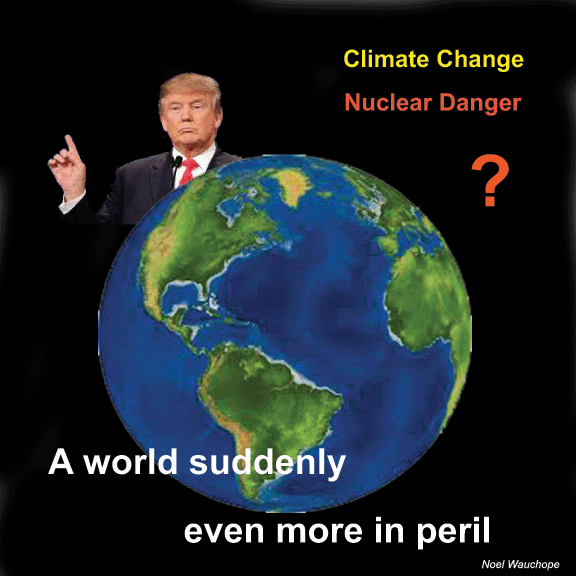
¶ “The wise man Trump should listen to” • My unsolicited advice to our President: Listen to George Shultz, who held cabinet positions under Presidents Nixon and Reagan and has a wealth of knowledge. Speaking of what worries him, he said, “Well, there are two things that can wipe us out. One is nuclear weapons and the other is climate change.” [CNN]
Science and Technology:
¶ The records highlighted in the “State of the Climate in 2016” report from the NOAA…
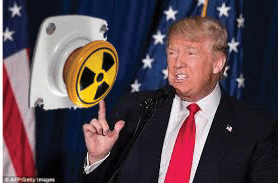
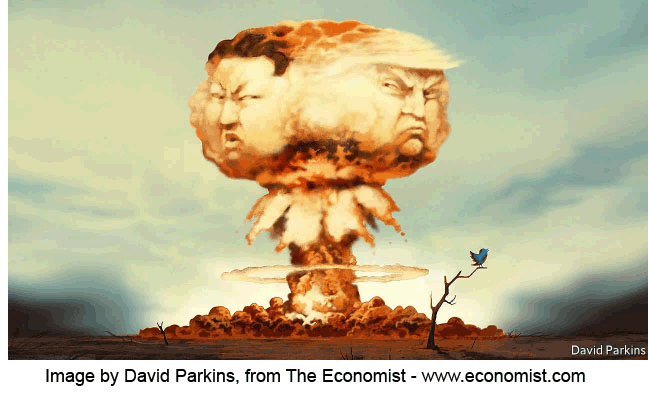
Trump has taken us to the brink of nuclear war. Can he be stopped?In previous standoffs, Trump’s predecessors knew when to hold back. Now there is no such certainty, Irish Times, Jonathan Freedland, 1o Aug 17, his was the moment many Americans, along with the rest of the world, feared. This – precisely this – was what alarmed us most about the prospect of Donald Trump becoming president of the US. Not that he would hire useless people or that he would tweet all day or use high office to enrich himself and his family or that he’d be cruel, bigoted and divisive – though those were all concerns. No, the chief anxiety provoked by the notion of Trump in the White House was this: that he was sufficiently reckless, impulsive and stupid to bring the world to the brink of nuclear war.
‘Fire and fury’ wasn’t tough enough – Trump on North Korea
Of course, cooler heads might soon prevail. China might find the diplomatic back-channel that persuades North Korea to step back from the current clash with Washington. The Pyongyang regime might calculate for itself that, despite its latest threat to attack the US airbase in the Pacific island of Guam, further escalation risks its own survival. Or the generals that now flank Trump – John Kelly as chief of staff, Jim Mattis as defence secretary – might succeed in talking their boss down from the ledge.
But make no mistake. Trump’s remarks on Tuesday have pushed the US to the precipice of nuclear confrontation with North Korea. We have to hope that both parties will step back, but be under no illusion that the brink is where we stand. And Trump put us there.
The form of words the president used made the critical difference. Threatening Kim Jong-un with “fire and fury” was bellicose enough. But adding the words “the likes of which this world has never seen before” left no doubt that he was talking about a nuclear strike against North Korea.
It is worth pausing to consider the obvious consequences of such an action. About 75 million people live on the Korean peninsula. There are also 30,000 US servicemen and women stationed there. How many would die if Trump made good on his threat? And that is to reckon without further retaliation and escalation, as Russia or China unleashed their own nuclear arsenals. This is why all previous US presidents have used only the most sober language when speaking of North Korea. They have understood the human stakes. They have sought to reduce tension, not ratchet it up……..
The point is that since the dawn of the atomic age the world’s leaders have understood that these weapons have to be handled with the greatest delicacy. Nuclear standoffs happen, but each side has always understood where the brink lies and were careful not to overstep it. That means, especially, understanding the need not to say anything that the other side might misinterpret as a cue for war.
Both Washington and Moscow understood that throughout the cold war; it’s what stopped the Cuban missile crisis turning into Armageddon. Most analysts believe the regime in Pyongyang, for all its brutality, understands that too: it is not suicidal. But the question hanging over the world today is one that has never had to be asked before: does the US president understand this most essential point, one on which the fate of the world depends?
OVER THE next week or so, the Trump administration must decide whether to approve or suppress a major federal climate change report. Though scientists have signed off on its findings, including that the average U.S. temperature has spiked in the past several decades and that humans have almost certainly played a predominant role, President Trump and Environmental Protection Agency Administrator Scott Pruitt have indicated they simply do not believe the experts.
Even as the federal climate assessment has been under review, the warnings have grown starker.
A paper published last week in Nature Climate Change offered a harrowing view. International negotiators committed in Paris to keeping global temperature rise below 2 degrees Celsius, the point past which experts warn warming could be very dangerous. Analysts from the University of Washington and the University of California at Santa Barbara found that there is only a 5 percent chance the world will achieve that goal.
Instead of predicting how technology or policy might change, the researchers looked at how nations have done until now and inferred from those trends what will happen in the future. As economies expand, they emit more planet-warming carbon dioxide into the air. Fortunately, over time economies also produce more efficiently, using less fuel and therefore emitting less carbon dioxide for every widget assembled or mile driven. By projecting population growth, economic expansion and carbon efficiency into the future, the analysts came up with a rough guide to where the global temperature will be at the end of the century.
They found that there is a 90 percent chance the world will warm between 2 degrees and 4.9 degrees Celsius, with a median of 3.2 degrees. Though this avoids the most alarming scenarios scientists have previously considered, it also excludes the least concerning, finding virtually no chance the Earth will keep warming below the desirable level of 1.5 degrees Celsius.
How does this translate into the real world? Some other new research provides answers. Experts at the Massachusetts Institute of Technology and Loyola Marymount University in Los Angeles found that at 4.5 degrees of temperature rise by 2100, highly populated and impoverished swaths of South Asia would experience heat waves so extreme that human beings would not be able to survive without protection. At 2.25 degrees of warming, heat-wave temperatures in the region would be dangerous but not as deadly. Another new analysis from European Union researchers warned that deaths due to extreme weather across Europe could increase from about 3,000 per year to 152,000 annually if the Earth warmed 3 degrees by century’s end.
Each of these studies comes with caveats. For example, much of the risk would be averted with a strong global commitment to cutting carbon dioxide emissions, particularly if green technology became significantly cheaper, making it easier to decarbonize than in the past. Yet even if the breakthroughs do not come, or do not come fast enough, the latest research suggests it is neither unrealistic nor pointless to aim for the low end of the range of possible climate outcomes, even over 2 degrees, to at least limit the damage to the planet’s habitability. That path, however, requires leaders to admit there is a problem.
Super-heatwaves of 55°C to emerge if global warming continues http://www.enn.com/climate/article/52119 10 Aug 17, Heatwaves amplified by high humidity can reach above 40°C and may occur as often as every two years, leading to serious risks for human health. If global temperatures rise with 4°C, a new super heatwave of 55°C can hit regularly many parts of the world, including Europe.
A recently published study by the Joint Research Centre (JRC) – the European Commission’s science and knowledge service – analyses the interaction between humidity and heat. The novelty of this study is that it looks not only at temperature but also relative humidity to estimate the magnitude and impact of heat waves.
It finds out that the combinations of the two, and the resulting heatwaves, leave ever more people exposed to significant health risks, especially in East Asia and America’s East Coast.
Warm air combined with high humidity can be very dangerous as it prevents the human body from cooling down through sweating, leading to hyperthermia. As a result, if global warming trends continue, many more people are expected to suffer sun strokes, especially in densely populated areas of India, China and the US. Read more at European Commission, Joint Research Centre (JRC)
Experts: US-N.Korea nuclear war unlikely, but risk is rising, https://www.apnews.com/95ffd16e43af4bca815a22f39813a8ac, — Martha Mendoza in San Jose, California, 10 Aug 17 A nuclear war between North Korea and the United States is not imminent, analysts said, but the inflammatory rhetoric on both sides is increasing the risk. They called on all parties to de-escalate.
North Korea’s army said in a statement distributed by state media Wednesday that it was examining a plan to use ballistic missiles to make an “enveloping fire” around Guam, a U.S. territory that is home to Andersen Air Force Base. The statement came a day after President Donald Trump warned North Korea against making more threats, saying, “They will be met with fire and fury like the world has never seen.”
What experts in South Korea, China and the U.S. had to say:
SLIM CHANCE OF ATTACK
A North Korean attack or an American pre-emptive strike is unlikely, said John Delury, an associate professor of East Asian Studies at Yonsei University in Seoul.
He saw North Korea’s statement as a warning to Washington that its missiles could reach targets in the region, rather than one of an actual attack.
“Well, I’m gonna go out on a limb here and say if North Korea was planning some kind of pre-emptive or surprise attack on Guam, we would not be reading about it in North Korean media,” Delury said in an interview at his office. “Now that said, you do need to track their threats. And there are cases where they (have) made a specific threat and carried it out.”
A U.S. strike against North Korea would need the support of South Korea, he said, because the North would likely retaliate against the South and its 600,000 troops.
“It’s not something you can do without robust, full support from the South Korean government people, and there’s absolutely no sign that South Korea will support military options with North Korea,” Delury said.
— Yong Jun Chang in Seoul, South Korea
DEEP CONCERN IN BEIJING
Chinese government-backed scholars said Beijing is deeply concerned about the latest statements from Trump and North Korea. They hold the U.S. partly responsible, saying Trump’s heated rhetoric is fueling the flames.
Trump’s tough talk has contributed to an increase in animosity that is pushing the sides closer to armed conflict, said Cheng Xiaohe of the School of International Studies at Beijing’s Renmin University.
“If not kept well under control, this verbal spat could turn into a military clash,” he said, adding that China should dispatch diplomats to engage in shuttle diplomacy to bring the sides to the negotiating table.
China’s patience with North Korea, its onetime close ally, appears to be running thin: Beijing agreed to recent U.N. sanctions, despite potential losses to Chinese firms doing business with North Korea and fears over destabilizing the Pyongyang regime.
A top Chinese expert on North Korea said Pyongyang seemed to have been heartened by Washington’s failure to take firm measures in response to earlier actions.
“Trump said the U.S. would take tough measures if North Korea fired off missiles, but it did not,” said Zhang Liangui, a professor at the ruling Communist Party’s main training academy. “This might make North Korea think that’s just some verbal threat, so its attitude is getting tougher and tougher.”
The U.S., China and Russia need to come together to force the North to de-escalate, he said. “The big countries should not attack each other, but unite to better cooperate on maintaining the denuclearization of the Korean Peninsula.”
— Christopher Bodeen and Fu Ting in Beijing
NO CAPABILITY YET
U.S. nuclear expert Siegfried Hecker, who has repeatedly visited North Korea’s nuclear facilities, said he doesn’t think North Korea currently has weapons systems for “enveloping fire” around Guam, as it threatened.
“I don’t believe they have the capability to do so yet, and besides, why would they want to commit suicide by attacking a remote target like Guam?” he said. “The real threat is stumbling into an inadvertent nuclear war on the Korean Peninsula by misunderstanding or miscalculation. Inflammatory rhetoric on both sides will make that more likely. It’s time to tone down the rhetoric.”
Hecker said North Korea does not have a sophisticated nuclear weapon like those of the U.S., Russia, Britain, China or France, the major nuclear superpowers.
“The shorter-range missile that can reach South Korea and Japan can accommodate larger nuclear warhead payloads,” he said. “Making the warhead sufficiently small, light and robust to survive an ICBM delivery is extremely challenging and still beyond North Korea’s reach.”
The way to avert a war with North Korea is to have a conversation, and that’s not happening, Hecker said.
“Unfortunately, there seems to be no serious dialogue between Washington and Pyongyang, only threats,” he said.
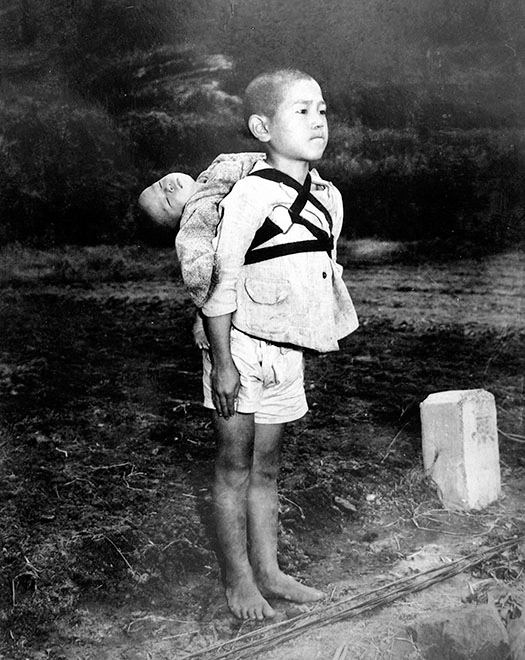
If you’re against war, get this book: The photos will haunt you http://www.asahi.com/ajw/articles/AJ201708100035.html By SONOKO MIYAZAKI/ Staff Writer August 10, 2017 A boy standing at rigid attention with the dead body of his infant brother strapped to his back at a crematorium in Nagasaki is one of searing images of the city’s destruction after the U.S. atomic bombing in 1945.
In a book published Aug. 9, Kimiko Sakai, the widow of Joe O’Donnell, the photographer who snapped the image, tells the story of her husband’s life work through photographs he shot in Japan in the immediate aftermath of the war.
Aug. 9 marked the 72nd anniversary of the bombing as well as the 10th anniversary of O’Donnell’s death at the age of 85.
The 192-page book, titled “Kamisama no Finder: Moto-Beijugun Cameraman no Isan” (God’s finder: the legacy of a former war photographer), was published by the Tokyo-based Word of Life Press Ministries.
After Japan’s surrender, O’Donnell, who was attached to the U.S. Marine Corps, traveled to Hiroshima, Nagasaki and other Japanese cities to document the wartime devastation. He stayed in Japan from September 1945 to March 1946.
He took 300 or so photographs for his private use.
He believed it was wrong to drop the atomic bombs after witnessing the sufferings of the victims.
But O’Donnell didn’t exhibit these pictures for decades because of prevailing U.S. sentiment that the atomic bombings of Hiroshima and Nagasaki hastened the end of World War and saved many American lives.
O’Donnell later decided to exhibit the photographs in the hope they would help advance the anti-war movement.
The catalyst for this was when he gazed on a sculpture evoking Jesus on the cross and engulfed by flames at a church in Kentucky in 1989. The life-size work, titled “Once,” was created for the repose of the tens of thousands of people killed in that atomic bombings, with photos of victims pasted all over the body. O’Donnell was stunned.
After that, O’Donnell until his death held exhibitions of his photos in the United States and Japan to convey the horrors of nuclear war.
The image of the boy at the crematorium stayed with him. O’Donnell recalled that the boy stared motionless as bodies were being burned and he awaited his turn. He also noticed that the boy’s lips were caked with blood because he was biting them so hard, although no blood spilled.
Sakai agreed to a proposal to publish the book after she was contacted by the publisher two years or so ago. Sakai, who lives in Tennessee, said she accepted out of respect for her husband’s commitment to the anti-war cause.
“My husband photographed his subjects as fellow human beings, not as an occupier,” she said in a recent interview with The Asahi Shimbun.
Asked if she had a message for those working to rid the world of nuclear arsenals, she said, “Just ‘not to forget,’ which is important.”
The destruction of Hiroshima and Nagasaki was a war crime worse than any that Japanese generals were executed for in Tokyo and Manila. If Harry Truman was not a war criminal, then no one ever was.
The most spectacular episode of Harry Truman’s presidency will never be forgotten but will be forever linked to his name: the atomic bombings of Hiroshima on August 6, 1945, and of Nagasaki three days later. Probably around two hundred thousand persons were killed in the attacks and through radiation poisoning; the vast majority were civilians, including several thousand Korean workers. Twelve US Navy fliers incarcerated in a Hiroshima jail were also among the dead.1
Great controversy has always surrounded the bombings. …….
the rationale for the atomic bombings has come to rest on a single colossal fabrication, which has gained surprising currency — that they were necessary in order to save a half-million or more American lives. These, supposedly, are the lives that would have been lost in the planned invasion of Kyushu in December, then in the all-out invasion of Honshu the next year, if that had been needed. But the worst-case scenario for a full-scale invasion of the Japanese home islands was forty-six thousand American lives lost.7 The ridiculously inflated figure of a half-million for the potential death toll — nearly twice the total of US dead in all theaters in the Second World War — is now routinely repeated in high-school and college textbooks and bandied about by ignorant commentators. Unsurprisingly the prize for sheer fatuousness on this score goes to President George H.W. Bush, who claimed in 1991 that dropping the bomb “spared millions of American lives.”8
“The rationale for the atomic bombings has come to rest on a single colossal fabrication — that they were necessary in order to save a half-million or more American lives.”
Still, Truman’s multiple deceptions and self-deceptions are understandable, considering the horror he unleashed. It is equally understandable that the US occupation authorities censored reports from the shattered cities and did not permit films and photographs of the thousands of corpses and the frightfully mutilated survivors to reach the public.9 Otherwise, Americans — and the rest of the world — might have drawn disturbing comparisons to scenes then coming to light from the Nazi concentration camps.
The bombings were condemned as barbaric and unnecessary by high American military officers, including Eisenhower and MacArthur.10 The view of Admiral William D. Leahy, Truman’s own chief of staff, was typical:
the use of this barbarous weapon at Hiroshima and Nagasaki was of no material assistance in our war against Japan. … My own feeling was that in being the first to use it, we had adopted an ethical standard common to the barbarians of the Dark Ages. I was not taught to make wars in that fashion, and wars cannot be won by destroying women and children.11
The political elite implicated in the atomic bombings feared a backlash that would aid and abet the rebirth of horrid prewar “isolationism.” Apologias were rushed into print, lest public disgust at the sickening war crime result in erosion of enthusiasm for the globalist project.12 No need to worry. A sea change had taken place in the attitudes of the American people. Then and ever after, all surveys have shown that the great majority supported Truman, believing that the bombs were required to end the war and save hundreds of thousands of American lives, or, more likely, not really caring one way or the other.
Those who may still be troubled by such a grisly exercise in cost-benefit analysis — innocent Japanese lives balanced against the lives of Allied servicemen — might reflect on the judgment of the Catholic philosopher G.E.M. Anscombe, who insisted on the supremacy of moral rules.13 When, in June 1956, Truman was awarded an honorary degree by her university, Oxford, Anscombe protested.14 Truman was a war criminal, she contended, for what is the difference between the US government massacring civilians from the air, as at Hiroshima and Nagasaki, and the Nazis wiping out the inhabitants of some Czech or Polish village?……
While the mass media parroted the government line in praising the atomic incinerations, prominent conservatives denounced them as unspeakable war crimes. Felix Morley, constitutional scholar and one of the founders of Human Events, drew attention to the horror of Hiroshima, including the “thousands of children trapped in the thirty-three schools that were destroyed.” He called on his compatriots to atone for what had been done in their name, and proposed that groups of Americans be sent to Hiroshima, as Germans were sent to witness what had been done in the Nazi camps.
The Paulist priest, Father James Gillis, editor of The Catholic World and another stalwart of the Old Right, castigated the bombings as “the most powerful blow ever delivered against Christian civilization and the moral law.” David Lawrence, conservative owner of US News and World Report, continued to denounce them for years.21 The distinguished conservative philosopher Richard Weaver was revolted by
the spectacle of young boys fresh out of Kansas and Texas turning nonmilitary Dresden into a holocaust … pulverizing ancient shrines like Monte Cassino and Nuremberg, and bringing atomic annihilation to Hiroshima and Nagasaki.
Weaver considered such atrocities as deeply “inimical to the foundations on which civilization is built.”22
Today, self-styled conservatives slander as “anti-American” anyone who is in the least troubled by Truman’s massacre of so many tens of thousands of Japanese innocents from the air. This shows as well as anything the difference between today’s “conservatives” and those who once deserved the name.
Leo Szilard was the world-renowned physicist who drafted the original letter to Roosevelt that Einstein signed, instigating the Manhattan Project. In 1960, shortly before his death, Szilard stated another obvious truth:
If the Germans had dropped atomic bombs on cities instead of us, we would have defined the dropping of atomic bombs on cities as a war crime, and we would have sentenced the Germans who were guilty of this crime to death at Nuremberg and hanged them.23
The destruction of Hiroshima and Nagasaki was a war crime worse than any that Japanese generals were executed for in Tokyo and Manila. If Harry Truman was not a war criminal, then no one ever was. https://mises.org/blog/harry-truman-and-atomic-bomb
Poland speaks out harshly against Belarusian nuclear plant,Poland has lent its voice to a growing chorus of countries that won’t buy power from the Belarusian Nuclear Power Plant that Moscow is building in Ostrovets because it considers the project to be unsafe, RIA Novosti reported, Bellona, August 9, 2017 by Charles Digges, Poland has lent its voice to a growing chorus of countries that won’t buy power from the Belarusian Nuclear Power Plant that Moscow is building in Ostrovets because it considers the project to be unsafe, RIA Novosti reported.
Warsaw joins Lithuania in its dour appraisal of the project despite recent assurances from the International Atomic Energy Agency that the plant meets safety norms.
Saying Warsaw “has a different opinion” than the IAEA, Polish Foreign Minister Witold Waszczykowski told reporters “We won’t change our position on buying energy from this atomic station.”
“I think that at its foundation lies unsafe technology, and a lack of safety led to Chernobyl,” he said, adding “We are against this nuclear station and don’t plan to cooperate and buy its energy.”
Waszczykowski’s remarks Tuesday were the latest of the stinging rebukes from Eastern Bloc nations against the Belarusian nuclear plant, which have been running on high volume in recent months.
The VVER-1200 nuclear plant, built on a whopping export credit from Russian state nuclear corporation Rosatom, is expected to come online in 2020.
In April, Vilnius passed a law against buying energy from what its parliament termed “unsafe nuclear power plants in third countries,” and forbidding utilities from transferring energy from such plants through the country’s territory.
The legislation’s clear target, however, is the Belarusian plant, which is going up a mere 40 kilometers from the Lithuanian capital, from which its rising cooling towers are visible on a clear day.
Since May, Lithuania has mounted a campaign among its diplomats throughout Europe to heap criticism on the plant to anyone willing to listen.
Tomas Tomilinas, a Lithuanian parliamentarian recently told Bellona that his country’s opposition to the plant was nothing less than a question of national security.
“Here there cannot be any compromises in questions of guaranteeing the safety of our country and its capital Vilnius,” Tomilinas told Bellona. “We absolutely disagree with the choice of site for the plant and are unsatisfied with answers from the Belarusian side on a whole host of safety issues and incidents that have already occurred during construction.”
By AUDREY McAVOY, 11 Aug 17, HONOLULU (AP) — The small U.S. territory of Guam has become a focal point after North Korea’s army threatened to use ballistic missiles to create an “enveloping fire” around the island. The exclamation came after President Donald Trump warned Pyongyang of “fire and fury like the world has never seen.” Here’s a look at the U.S. military’s role on the island, which became a U.S. territory in 1898.
WHAT INSTALLATIONS ARE ON GUAM AND HOW SIGNIFICANT ARE THEY? There are two major bases on Guam: Andersen Air Force Base in the north and Naval Base Guam in the south. They are both managed under Joint Base Marianas. The tourist district of Tumon, home to many of Guam’s hotels and resorts, is in between.
The naval base dates to 1898, when the U.S. took over Guam from Spain after the Spanish-American War. The air base was built in 1944, when the U.S. was preparing to send bombers to Japan during World War II.
Today, Naval Base Guam is the home port for four nuclear-powered fast attack submarines and two submarine tenders.
Andersen Air Force Base hosts a Navy helicopter squadron and Air Force bombers that rotate to Guam from the U.S. mainland. It has two 2-mile (3-kilometer) long runways and large fuel and munitions storage facilities.
Altogether, 7,000 U.S. military personnel are stationed on Guam. Most are sailors and airmen. The military plans to move thousands of U.S. Marines to Guam from Okinawa in southern Japan.
Guam’s total population is 160,000.
___
WHAT ROLES DO THE BASES PLAY IN THE REGION
Guam is strategically located a short flight from the Korean peninsula and other potential flashpoints in East Asia. Seoul is 2,000 miles (3,200 kilometers) to the northwest, Tokyo is 1,500 miles (2,400 kilometers) north and Taipei is 1,700 miles (2,700 kilometers) west.
Because Guam is a U.S. territory, the U.S. military may launch forces from there without worrying about upsetting a host nation that may object to U.S. actions.
The naval base is an important outpost for U.S. fast-attack submarines that are a key means for gathering intelligence in the region, including the Korean peninsula and the South China Sea where China has been building military bases on man-made islands.
___
HOW HAS THE U.S. USED GUAM TO ADDRESS THE THREAT FROM NORTH KOREA?
The U.S. military began rotating bombers — the B-2 stealth bomber as well as the B-1 and B-52 — to Andersen in 2004. It did so to compensate for U.S. forces diverted from other bases in the Asia-Pacific region to fight in the Middle East. The rotations also came as North Korea increasingly upped the ante in the standoff over its development of nuclear weapons.
In 2013, the Army sent a missile defense system to Guam called Terminal High Altitude Area Defense or THAAD.
It’s designed to destroy ballistic missiles during their final phase of flight. A THAAD battery includes a truck-mounted launcher, tracking radar, interceptor missiles and an integrated fire control system.
___
WHAT’S THE HISTORY OF THE U.S. MILITARY ON GUAM?
The U.S. took control of Guam in 1898, when Spanish authorities surrendered to the U.S. Navy. President William McKinley ordered Guam to be ruled by the U.S. Navy. The Navy used the island as a coaling base and communications station until Japan seized the island on Dec. 10, 1941. The U.S. took back control of Guam on July 21, 1944.
During the Vietnam War, the Air Force sent 155 B-52 bombers to Andersen to hit targets in Southeast Asia. Guam was also a refueling and transfer spot for military personnel heading to Southeast Asia. Many refugees fleeing Vietnam were evacuated through Guam.
Little Boy itself was three metres long, about 70 centimetres in diameter and weighed nearly 4,500 kilograms. Its destruction extended for miles.
In fact, the biggest nuclear bomb ever detonated was the Tsar Bomba, a hydrogen bomb exploded by the Russians in 1961.
It produced a 50-megaton blast and a mushroom cloud nearly 40 kilometres high, making it about 3,300 times more powerful than Little Boy.
An atomic bomb relies on nuclear fission — the splitting of an atom’s nucleus to create different elements — a process which produces extraordinary energy.
Whereas an H-bomb, or thermonuclear bomb, uses the energy from nuclear fission to fuel a secondary process of nuclear fusion, where the nuclei of smaller atoms fuse together to create even heavier elements, and thereby release even more energy.
By its nature then, a thermonuclear bomb produces an exponentially higher force than an atomic bomb of the same size or weight.
And given that today’s weapons are so much more precise than those unleashed in the 1950s and 60s, it follows that modern day nuclear bombs are now smaller, but more powerful.
This process of miniaturisation has continued ever since. By the early 1960s the US was well on the way to developing the Davy Crockett — the first nuclear rocket and small enough to use on a battlefield. Today, the US is believed to have hundreds of these so-called “tactical nukes” that in theory could be deployed from nuclear submarines.
They could include missiles and artillery shells. And their small size means they can be deployed at shorter range, but still with extraordinary power.
By contrast, North Korea’s recent missile tests have involved intercontinental ballistic missiles — that by definition cover a trajectory of thousands of kilometres and reach into space before re-entering the atmosphere. The heat and energy required for re-entry means size and weight are crucial.
As such the US, Japan and South Korea have been deeply sceptical until now that North Korea could possibly have the capability of fitting a nuclear warhead on a ballistic missile. If indeed Pyongyang has developed a miniaturised bomb, that would be a game changer.
Because it means North Korea has mastered the technology to build a Hydrogen bomb that is exponentially more powerful than an atomic bomb and could feasibly fit onto the end of an intercontinental ballistic missile.
It would mean the perceived threat from North Korea’s nuclear program is far more serious than thought.
And specifically, its threats to attack the US mainland — and potentially its allies, including Australia — can no longer be taken as just sabre rattling.
‘Unusual’ Greenland wildfires linked to peat, BBC News, By Matt McGrathEnvironment correspondent, 9 August 2017
New images have been released of wildfires that continue to burn close to the Greenland ice sheet, on the country’s west coast.Fires are rare on an island where 80% of the land is covered by ice up to 3km thick in places.
However, satellites have observed smoke and flames north-east of a town called Sisimiut since 31 July.
Experts believe at least two fires are burning in peat that may have dried out as temperatures have risen.
A song of fire and ice? Researchers say that across Greenland there is now less surface water than in the past, which could be making vegetation more susceptible to fire. The latest satellite images show a number of plumes. Police have warned hikers and tourists to stay away from the region because of the dangers posed by smoke. There are also concerns that the fire will damage grazing for reindeer.
Scientists believe that instead of shrubs or mosses, the likely source is fire in the peaty soil, which can only burn when dry.
“Usually when a wildfire is smouldering like that it’s because there’s a lot of ground-level fuel, carbon organic matter; that’s why I assume that it’s peat,” wildfire expert Prof Jessica McCarty from Miami University, US, told BBC News.
“The fire line is not moving, the fire is not progressing like we’d see in a forest fire, so that means it’s burning whatever fuel is on the ground.”
Prof McCarthy believes that melting permafrost is likely to have contributed to this outbreak. She referred to studies carried out in the region that showed degraded permafrost around the town of Sisimiut.
Locals say that what they call “soil fires” have happened before, especially in the last 20-30 years. Researchers have been busily examining the satellite record to look for evidence of previous outbreaks.
“The only record I found is the MODIS active fire record. It’s a satellite that measures the temperature of the surface and can locate hotspots from fire,” said Dr Stef Lhermitte from Delft University in the Netherlands.
“I think that fires have been there before but what’s different is that this fire is big, in Greenlandic terms; that is unusual. It’s the biggest one we have in the satellite record.”
Dr Lhermitte’s analysis suggest that the satellite has detected more fires in 2017 alone in Greenland than in the 15 years it has been operating. A previous large outbreak was seen in 2015…….http://www.bbc.com/news/science-environment-40877099
Nuclear Engineering International 10th Aug 2017, One of the conclusions of my most recent article on China was that many ofthe negative factors which have affected nuclear programmes elsewhere in
the world are now also crucial there.
The last year has confirmed that this was a reasonable judgement. Despite five new reactors starting up in 2016,
to bring the number in operation to 36, with combined generating capacity
of 32.6GWe, it is clear that the programme has continued to slow sharply.
The most obvious sign is the lack of approvals for new construction.
Although there are 21 units under construction, representing 23.1GWe, there
have now been no new approvals for 18 months. Other signs of trouble are
the uncertainties about the type of reactor to be utilised in the future,
the position of the power market in China, the structure of the industry
with its large state owned enterprises (SOEs), the degree of support from
top state planners and public opposition to nuclear plans.
There are a few possible explanations for the slowdown in approvals. Delays in imported
Generation III reactor designs (the Westinghouse AP1000 and Areva EPR) have
no doubt concerned regulators. Problems with the AP1000 projects at Sanmen
and Haiyang are more serious, as this reactor was destined for most of
China’s future reactor sites. Now hot testing is complete the first
Sanmen unit may go into operation before the end of 2017, but this will not
bring forward a flood of new approvals.
The Chinese have suffered a severe dent in their confidence about the AP1000, not helped by Westinghouse’s
bankruptcy. The authorities will want to see clear evidence of successful
operation before authorising more units. If they do, the first will be at
the existing two sites, but there are several others that have been ready
to go for several years now. http://www.neimagazine.com/opinion/opinionnuclear-in-china-why-the-slowdown-5896525/
The Newest Risk to Nuclear Power May Be the Biggest Yet (Hint: It’s Hacking), Madison.com newsfeedback@fool.com (Maxx Chatsko) Aug 9, 2017
Nuclear energy has faced no shortage of obstacles over the past several years, although the biggest threat to date has been economics…..But economics may no longer be the biggest threat. A series of recently uncovered cyberattacks hint that hacking may be a worrisome new risk for existing nuclear reactors.
A serious threat?
In late June E&E News was the first to report that an American nuclear facility had been hacked into, prompting the FBI and Department of Homeland Security to issue back-to-back cybersecurity warnings to grid operators. The site, initially identified only as “nuclear 17”, was later confirmed to be the Wolf Creek facility in Kansas.
It’s owned by a consortium that includes Westar Energy(NYSE: WR). Although it hasn’t commented on the hack directly to shareholders, the company began including “cyber terrorism” as a potential risk in SEC filings beginning on July 9. That may soon become the norm for utilities and power generators, especially those exposed to nuclear energy, which generates 19% of American electricity.
How real is the risk? The New York Timesobtained an urgent joint report issued by the Department of Homeland Security and the FBI that resulted in an “urgent amber warning”, which is the second-highest possible.
Grid hacking is already commonplace in the Ukraine, which security experts suspect Russia is using as a sandbox to test hacking tools for industrial infrastructure. Indeed, the techniques used to hack into Wolf Creek are eerily similar to a Russian hacking group called “Energetic Bear”.
Wolf Creek was hardly a one time incident in the United States. Michael Yates of Vanity Fairrecently interviewed current and former officials at the U.S. Department of Energy, which devotes half of its annual budget to nuclear waste management and nuclear security for the entire planet. One interviewee, John MacWilliams, the first Chief Risk Officer for the DOE, spoke to the vulnerability of the national grid to hacking:…….
What does it mean for investors?
The new reality of cyber warfare presents a significant new risk to nuclear power plant operators such as Exelon and Westar Energy, and investors should expect new risk factors to begin appearing in SEC filings. It also presents another argument in favor of distributed, clean energy systems — and I’m saying that as a nuclear bull. After all, a hacked solar panel or wind turbine sounds significantly less terrifying than a hacked nuclear plant.
New Generation Nuclear Reactors Unlikely to Deliver on Design, EcoWatch, By Paul Brown, 9 Aug 17
New generation nuclear reactors, promised for the last 18 years by the U.S. Office of Nuclear Energy (NE) as a way to provide cheap and plentiful supplies of electricity, are unlikely to be fulfilled any time in the next 30 years.
That is the conclusion of university researchers who have used the Freedom of Information Act to obtain the program’s budget history to find out what designs the government has spent $2 billion of public money on supporting.
Researchers from the University of California San Diego and Carnegie Mellon University described the research program as “incoherent” and said the government was “unlikely” to deliver on its mission to develop and demonstrate an advanced nuclear reactor by mid-century.
The study, published in the journal Environmental Research Letters, said much of the money that was supposed to be spent on civilian reactors was spent instead on supporting infrastructure, where the main focus was defense programs and not commercial opportunities……..
Overall, the technology’s prospects appear grim, with implications that go beyond energy.
“Without a sense of urgency among NE and its political leaders,” Abdulla warned, “the likelihood of advanced reactors playing a substantial role in the transition to a low-carbon U.S. energy portfolio is exceedingly low…..
These reported failings in the U.S. research program come at a difficult time for the industry when across the world the current “new” generation of large nuclear reactors is proving difficult to build on time and on budget, and some projects are being abandoned mid-way through construction…….
Most of the money now being spent on research into new generations of nuclear power stations is being provided by nuclear weapon states. Most countries that have never had nuclear weapons but have invested in nuclear power stations are now phasing them out and putting their development money into cheaper renewables. https://www.ecowatch.com/new-generation-nuclear-2471347067.html
Unheeded warnings, repeated mistakes put workers’ health at risk at Idaho nuclear lab, Idaho Statesman, BY PATRICK MALONE AND PETER CARY, The Center for Public Integrity AUGUST 10, 2017
Ted Lewis knew the plutonium plates at the government lab where he worked could leak potentially lethal radioactive dust.
He had seen it occur in the 1970s, when he was helping load some of those plates into a nuclear reactor at the lab near Idaho Falls. A steel jacket enclosing one of the plates somehow cracked, spilling plutonium oxide particles into the air. But Lewis and his colleagues were lucky — they were wearing respirators and given cleansing showers, so their lives weren’t endangered.
Three decades later, Lewis, an electrical engineer who had become chairman of the lab’s safety committee, had a bad feeling this could happen again, with a worse outcome. And he turned out to be right.
He tried to head it off. In 2009, Lewis wrote a pointed warning memo — he called it a white paper — and gave it to the official in charge of all nuclear operations at the Idaho National Laboratory, which is run by a consortium of private companies and universities under contract to the Energy Department.
The memo said the chance of encountering a plutonium plate that disintegrated, as Lewis had previously witnessed, was “greater than facility and senior management realizes,” according to a copy. Although Lewis said that a workplace manual published by the contractor — Battelle Energy Alliance LLC (BEA) — called the risk of an accidental spill of such radioactive dust “negligible,” he wanted his superiors to expect it and prepare for it.
He said in a sworn court deposition in January 2016 that he shared his concerns with at least 19 others at the laboratory, which holds one of the world’s largest stockpiles of plutonium, the explosive at the heart of modern nuclear weapons. But they didn’t respond, he said, and some of the precautions he urged — checking the plates more carefully before they were unwrapped and repackaged for shipment and setting up a decontamination shower — were ignored.
Then, at 11:04 a.m. on Tuesday, Nov. 8, 2011, Lewis’ fears came to life in a cavernous room at the lab where workers were readying some plates the size of Hershey’s chocolate bars for shipment to other federal sites and to researchers. The workers had a lead shield between themselves and the plates, but the table where they sorted the plates wasn’t sealed, and none of them had respirators on.
When a nuclear material handler named Ralph Stanton noticed that one plate’s container had a label warning that the plate’s corner was “swollen,” he asked a shift supervisor for guidance. The supervisor phoned one of the lab officials whom Ted Lewis had briefed on his worries, but after finishing the call the official told the workers to continue, according to an internal Department of Energyreport in January 2012.
Sure enough, as the plate’s wrapping was pulled away, black powder leaked out, and Stanton, along with 15 of his colleagues in the facility, inhaled the plutonium dust, according to the report. Three of them wound up suing BEA, saying that they had been sickened due to the company’s negligence. BEA publicly disputed that the workers were harmed, but it also reached private settlements with each of the litigants that included nondisclosure provisions.
The contamination incident was extensively covered by two newspapers published in Boise, including the Idaho Statesman. But the Center for Public Integrity’s investigation shows it was preceded by two other serious instances of radioactive contamination at the lab as well as by Lewis’ careful warnings, and that it was also followed by two additional, avoidable radioactive contaminations there……..
Idaho National Laboratory is not unique. The government has been similarly generous to many of the other private contractors that operate key nuclear weapons-related facilities. Part of the problem, according to auditors at the Government Accountability Office, which reports to Congress, is that the Energy Department has too little staff, and poorly-trained contract managers, making it more susceptible to fraud and waste than most agencies.
The contractors largely police themselves, according to the GAO and inspector general reports. Penalties do not cause enough pain to act as deterrents, safety experts say. And — as might be expected — the contractors typicallyprioritize the mission-related responsibilities that bear directly and most strongly on their profits, according to current and former workers and accident investigation reports.
Plenty of warning that workers were at risk
Lewis’ “white paper” was not the only sign that BEA’s effort to prevent radiation contamination of its Idaho workforce were lagging………
Numerous problems contribute to the mass inhalation incident
Then came the radiation contamination of 16 workers on Nov. 8, 2011, which occurred in a white, mound-shaped building that was once home to a now-dismantled nuclear reactor and still has a massive vault resembling a walk-in freezer. It’s there that the government stores several metric tons of surplus plutonium, which the Department of Homeland Security and the NNSA use to help develop and refine radiation detection devices deployed by Washington at ports and border crossings around the globe.
Multiple physical shortcomings and managerial lapses combined to endanger the workers that day, according to the Energy Department’s report: The building had old and failing equipment, and no showers. Records of the plutonium plates’ individual histories — including previous damage — had been lost, and Lewis’ warnings that some were liable to turning to powder were ignored. Managers “did not recognize the significance of this information,” the report said.
Worse, the nearest air monitor was 15 feet from where the plates were being unwrapped. A vent supposed to draw dangerous fumes from the work area was partially blocked. And some of those doing the work “had no training on the hazards associated with Pu [plutonium],” BEA’s report said.
According to the lawsuits filed against BEA, the company at the time felt compelled to complete the work speedily. In interviews with the Center, Stanton said he was told it was a “bonus job,” meaning that meeting deadlines would help the company and its managers earn their profits. “DOE gives these guys a bonus. When the milestone is in play, safety is completely gone,” he said. “We were playing Russian roulette.”
Braase, a health physicist technician responsible for checking jobsite radiation and worker exposures, said in his own legal complaint that the work was accelerated so it could be completed before he went on a medical leave, allowing less time than usual for a careful review. BEA’sreport on the accident, issued Sept. 17, 2012, said one of the factors contributing to the accident was that the company’s “focus is on getting the work done (the end justifies the means).”…
Health physicists consulted by the Center noted that the unusual circumstances complicate estimates of the potential consequences. If you inhale plutonium particles, they sit in the lung or get into the bloodstream and continue to radiate for a lifetime or until they are all are excreted. As a result, labs generally predict exposures and assign limits for this type of exposure over a 50-year period. Annual radiation limits for workers, in contrast, are pegged to short-term exposures from sources outside the body — like from an X-ray or series of X-rays……..
For this incident, and for the earlier radiation exposures that year of the three workers in the hot fuel facility, the DOE’s enforcement officer initially proposed fining BEA $615,000. But Boulden reduced the fine to $412,500 for what he said were “corrective actions taken.”
Separately, BEA’s profit was cut by $500,000 on Jan. 31, 2012, in a letter from Richard B. Provencher, the DOE’s fee awarding official, to Grossenbacher that noted “unacceptable events continue to occur” at the lab. But on Nov. 22, 2013, Provencher, who determines BEA’s annual profit, gave back the entire $500,000 that had been withheld, with the stipulation that BEA spend $100,000 of it on efforts to improve operations and safety.
In total, in 2011, BEA earned $17.1 million in profits, the year of the accident, or 92 percent of what was available. In 2012, it earned $16.2 million, but the next year it got the $500,000 back.
New contamination incidents
The plutonium contamination of 16 BEA workers was followed by two other significant radiation exposures, with the first occurring in August 2014, when workers in the Fuel Manufacturing Facility, a low structure next to the building where the plutonium exposures occurred, were fabricating radioactive americium in a glove box.
Outside the body, small bits of americium pose almost no threat to human health. But in higher internal doses, its radiation breaks down cells, alters genes and attacks bones and organs, increasing its victims’ chances of contracting life-threatening maladies, according tothe Centers for Disease Control and Prevention…….
At the end of 2014, BEA was awarded $18.1 million in pure profit, after $350,000 was deducted for the two safety incidents. That meant the company got 97 percent of the maximum profit allowed under its contract. It also got its contract extended to 2019 without competition. A joint newsrelease from BEA and the Energy Department announcing the extension credited the decision to the company’s “consistently strong annual performance and success in managing INL.”













 nuclear-news
