Nagasaki Mayor Tomihisa Taue said the fear of another bomb attack is not in the distant future and urged nuclear states to abandon their weapons. He criticized Japan’s national government, being under the U.S. nuclear umbrella, for not contributing to the U.N. nuclear arms ban treaty.
Taue demanded that the Japanese government join the recent treaty adopted by 122 U.N. member nations in an effort to achieve a world without nuclear weapons.
The declaration was made Wednesday during Nagasaki’s annual memorial ceremony, known as its Peace Declaration.
Taue called Japan’s stance “incomprehensible” while addressing the crowd. “[The Japanese government’s] stance of not even participating in the diplomatic negotiations for the Nuclear Prohibition Treaty is quite incomprehensible to those of us living in the cities that suffered atomic bombings,” Taue said at the city’s Peace Park, the Japanese newspaper the Mainichi reported.
“As the only country in the world to have suffered wartime atomic bombings, I urge the Japanese government to reconsider the policy of relying on the nuclear umbrella and join the Nuclear Prohibition Treaty at the earliest possible opportunity,” he added.
“[The Japanese government’s] stance of not even participating in the diplomatic negotiations for the Nuclear Prohibition Treaty is quite incomprehensible to those of us living in the cities that suffered atomic bombings,” Taue said at the city’s Peace Park, the Japanese newspaper the Mainichi reported.
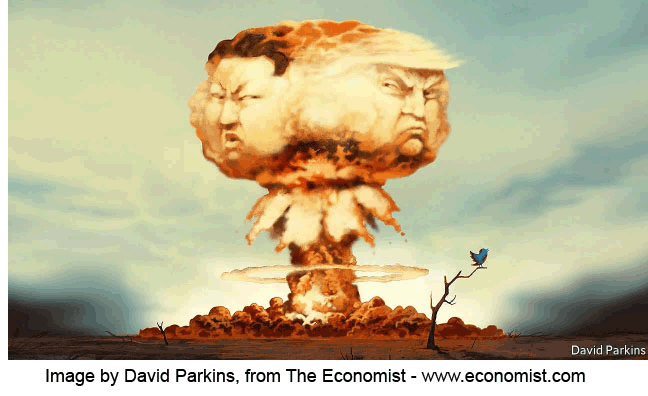
North Korea considers missile strike on Guam after Trump’s ‘fire and fury’ warning, Maureen N. Maratita and Philip Wen, GUAM/DANDONG, China (Reuters) 8 Aug 17,- North Korea said on Wednesday it is considering plans for a missile strike on the U.S. Pacific territory of Guam, just hours after President Donald Trump told the North that any threat to the United States would be met with “fire and fury”.
The sharp increase in tensions rattled financial markets and prompted warnings from U.S. officials and analysts not to engage in rhetorical slanging matches with North Korea.
Pyongyang said it was “carefully examining” a plan to strike Guam, which is home to about 163,000 people and a U.S. military base that includes a submarine squadron, an airbase and a Coast Guard group.
A Korean People’s Army spokesman said in a statement carried by state-run KCNA news agency the plan would be put into practice at any moment GUAM/DANDONG, China (Reuters) – North Korea said on Wednesday it is considering plans for a missile strike on the U.S. Pacific territory of Guam, just hours after President Donald Trump told the North that any threat to the United States would be met with “fire and fury”.
The sharp increase in tensions rattled financial markets and prompted warnings from U.S. officials and analysts not to engage in rhetorical slanging matches with North Korea.
Pyongyang said it was “carefully examining” a plan to strike Guam, which is home to about 163,000 people and a U.S. military base that includes a submarine squadron, an airbase and a Coast Guard group.
A Korean People’s Army spokesman said in a statement carried by state-run KCNA news agency the plan would be put into practice at any moment ….. GUAM/DANDONG, China (Reuters) – North Korea said on Wednesday it is considering plans for a missile strike on the U.S. Pacific territory of Guam, just hours after President Donald Trump told the North that any threat to the United States would be met with “fire and fury”.
The sharp increase in tensions rattled financial markets and prompted warnings from U.S. officials and analysts not to engage in rhetorical slanging matches with North Korea.
Pyongyang said it was “carefully examining” a plan to strike Guam, which is home to about 163,000 people and a U.S. military base that includes a submarine squadron, an airbase and a Coast Guard group.
Donald Trump has threatened to hit North Korea with ‘fire and fury like the world has never seen’ if it escalates its nuclear threat against the United States.
His strong words came after the revelation that North Korea has successfully miniaturised a nuclear warhead, removing the last major obstacle to Kim Jong-un’s regime launching a nuclear attack on the United States or Australia.
It was met by a furious response from the president. “(They) best not make any more threats,” he said. “They will be met with fire and fury like the world has never seen.”
The frightening new assessment by US intelligence is a game-changer for the west, catapulting the rogue regime into the status of a genuine nuclear weapons state.
“The IC [intelligence community] assesses North Korea has produced nuclear weapons for ballistic missile delivery, to include delivery by ICBM-class missiles,” says a confidential US intelligence assessment by the Defence Intelligence Agency reported by the Washington Post.
A separate US intelligence assessment also estimates that North Korea now has as many as 60 nuclear weapons, up the three times the number of previous estimates.
The conclusions are startling because they shows North Korea had developed all aspects of its nuclear and missile capability much faster than previously thought.
The regime successfully tested its first long range ICBM last month, bringing some of continental US and parts of Northern Australia into its missile range.
But the west was still sceptical that North Korea had advanced its technology to be able to miniaturise its nuclear weapons to place them on the ICBM and deliver them to a distant target.
The alarming new assessments come as North Korea threatened ‘thousands-fold revenge’ against the US over its role in obtained UN Security Council agreement for sweeping new sanctions against North Korea.
Donald Trump’s national security adviser HR McMaster said at the weekend that a North Korea with nuclear-tipped ICBMs would be ‘intolerable from the president’s perspective.”
A PUBLIC sector department has told employees to cease using the term ‘climate change’ and opt for other more benign words instead. Benedict Brook@BenedictBrook, news.com.au , 8 Aug 17 GOVERNMENT employees in the US have been given a dictionary of accepted words to use — and “climate change” isn’t one of them.
In a directive reminiscent of George Orwell’s dystopian novel Nineteen Eighty-Four, where people were only allowed to communicate in an ever diminishing language called “newspeak”, employees of the US Department of Agriculture (USDA) have been told to ditch the word “climate change”.
They should use “weather extreme” instead.
The clampdown comes as President Donald Trump further distances the US from global moves to limit global warming. Last week, the US formally announced its withdrawal from the Paris Agreement on climate change.
In a series of emails received by the Guardian, the director of the USDA’s soil health department, Bianca Moebius-Clune, listed terms that should be avoided and the alternatives to be used instead.
As well as giving climate change the flick, staff were told to avoid the term “climate change adaptation” and instead opt for “resilience to weather extremes”.
When talking about the cause of climate change, sorry “weather extremes”, saying people should “reduce greenhouse gases” is a big no-no. Rather, staff should talk in favour of “build soil organic matter, increase nutrient use efficiency”.
The email was dated 16 February but has only just come to light.
However, far from being a politically motivated reaction against the science of climate change, the instructions to staff may instead be a way for the Government department to continue its work without ruffling feathers in a White House averse to discussing global warming.
In the missive, Ms Moebius-Clune said that, “we won’t change the modelling, just how we talk about it — there are a lot of benefits to putting carbon back in the soil, climate mitigation is just one of them”.
The Guardian report added that public relations staff from the USDA had advised departments should “tamp down on discretionary messaging right now”.
The USDA denied it was limited discussion of climate change.
In a statement, the department said, “this guidance, similar to procedures issued by previous administrations, was misinterpreted by some to cover data and scientific publications.
Al Gore: We’re working around Donald Trump on climate change, DW, 8 Aug 17 The former vice president turned environmental activist says that the US will stick to the Paris Agreement despite Donald Trump’s opposition. He also accused the current president of censoring scientific information.
The 69-year-old environmental activist was in Berlin to preview “An Inconvenient Sequel,” a follow-up to his Oscar-winning 2006 film “An Inconvenient Truth” about global warming. Citing the axiom from physics that “for every action there is an equal counter-reaction,” Gore said that Trump’s election had galvanized and energized environmentalists in the US.
“The good news is that we are working around [Trump],” Gore said. “The US is going to meet its commitments under the Paris Agreement, regardless of what Trump says or does or tweets. He has isolated himself.”
Gore added that the majority of Republican voters in the US think that the country should have stayed in the Paris agreement. In perhaps the most unlikely scene in the film, Gore visits the Republican mayor of a town in the most conservative part of Texas, which had just completely gone over to using renewable energy sources. And that’s not the only example of Americans acting locally.
“In his speech on June 1, President Trump said that he was elected to represent Pittsburgh and not Paris,” Gore related with a smile. “And the next day the mayor of Pittsburgh said ‘Well, we’re still in the Paris Agreement.'”……
The former vice president took the current US president to task for suppressing scientific evidence and accused him of blocking a report, drawn up by scientists every four years, which concluded the earth is already feeling the effects of human-caused climate change. Excerpts from a draft of the report, which was leaked to the New York Times newspaper, were published on Monday.
A CONTROVERSIAL draft report on climate change that contradicts claims made by Donald Trump’s administration on global warming has been leaked. A DAMNING report on climate change that contradicts claims made by Donald Trump’s administration on global warming has been leaked, as scientists fear the President may suppress it.
“Americans are feeling the effects of climate change right now,” the report said according to The New York Times, which acquired a draft copy of the report by scientists from 13 federal agencies.
The report says extreme heatwaves have become more common and extreme cold waves have less common since the 1980s. It says emissions of greenhouse gases will affect the degree to which global temperatures continue to rise — a claim President Trump and some members of his cabinet have disputed. One scientist cited anonymously by the Times says he and other researchers are worried that the Trump administration, which must approve the report’s release, will suppress it.
The report “directly contradicts claims by President Trump and members of his cabinet who say that the human contribution to climate change is uncertain and that the ability to predict the effects is limited,” the Times said.
“How much more the climate will change depends on future emissions and the sensitivity of the climate system to those emissions,” a draft of the report states.
The report is part of the National Climate Assessment, which is carried out every four years, The New York Times reports. The National Academy of Sciences has signed off on the draft and is awaiting permission from the Trump administration for it to be publicly released.
The report also found that we would still experience at least 0.30 degrees Celsius of warming over this century compared with today, even if we put a stop to greenhouse gas emissions.
A small increase in global temperatures can lead to prolonged heatwaves, storms and the breakdown of coral reefs. The report found that surface, air and ground temperatures in Alaska and the Arctic are warming twice as fast as the global average.
“It is very likely that the accelerated rate of Arctic warming will have a significant consequence for the United States due to accelerating land and sea ice melting that is driving changes in the ocean including sea level rise threatening our coastal communities,” the report states.
The United States just announced Friday it would still take part in international climate change negotiations in order to protect its interests, despite its planned withdrawal from the Paris accord on global warming. Two months after President Trump announced the United States would abandon the 2015 global pact, his administration confirmed it had informed the United Nations of its “intent to withdraw from the Paris Agreement” — a process that will take at least until 2020.
The United States is the world’s second biggest producer of greenhouse gases after China and its withdrawal was a seen as a body blow to the Paris agreement.
The accord commits signatories to efforts to reduce greenhouse gas emissions that cause global warming, which is blamed for melting ice caps and glaciers, rising sea levels and more violent weather events.
They vowed steps to keep the worldwide rise in temperatures “well below” two degrees Celsius from pre-industrial times and to “pursue efforts” to hold the increase under 1.5 degrees Celsius
The Joint Comprehensive Plan of Action (JCPOA) is at risk of failure, potentially turning Iran into the next North Korea. Reports suggest that both the Trump administration and hardliners in Iran are ready to walk away from the agreement. Both sides accuse the other of violations, and the Trump administration is apparently intent on finding a reason not to recertify the agreement, due in a little under 90 days. And yet, the JCPOA remains the best way to ensure that Iran does not acquire nuclear weapons, at least in the next decade. In light of this, European leadership should urgently pursue three policy options—including the opening of a European financial channel with Iran—to counter the opposition to the agreement by the Trump administration and Iranian hardliners.
The Trump administration and Iran are risking Europe’s strategic interests. The European states had pursued a peaceful but verifiable agreement on the Iran nuclear issue since the early 2000s and were key to achieving the nuclear agreement with Iran. The European Union and its member states were among the key actors in negotiating the JCPOA and are now centrally involved in ensuring that Iran adheres to (and doesn’t cheat on) the agreement. This European involvement includes chairing the Joint Commission, the mechanism accepted by all parties and endorsed by the United Nations Security Council as responsible for ensuring that the agreement is fully implemented by all sides.
To date, it has also been the Europeans who have adhered most closely to the letter of the agreement. European countries have lifted sanctions as required by the JCPOA and have engaged in civil nuclear cooperation with Iran on issues like nuclear security. European businesses have also begun to re-engage with Iran, including through one particularly large contract between the French oil company Total and the National Iranian Oil Company to develop a phase of the South Pars oil field. At the same time, European States have taken a firm line when Iran has pushed the bounds of the JCPOA, including its technical violation of the heavy water cap and proposals to import large quantities of uranium from Kazakhstan.
For its part, however, Iran has largely adhered to both the letter and the spirit of the JCPOA. Iran has destroyed the core of the Arak reactor and dismantled vast numbers of centrifuges. And its technical violations have been relatively minor to date. Worryingly, there are signs that Iran has also engaged in some higher risk activities, such as a previously underreported case involving the import of carbon fibre for its missile program, a dual‑use material subject to export controls under the Nuclear Suppliers Group guidelines. But to be clear, this case was not considered a violation of the JCPOA by the United States, as the agreement covers only the import of dual-use goods for “Iran’s nuclear programme [as] set out in this JCPOA or other non-nuclear civilian end-use.” Counterintuitively, this language means that imports of nuclear-related dual-use items for a missile-related end use are not considered “civil” and are therefore a violation not of the JCPOA but of UNSCR2231, which prohibits development of missiles capable of carrying nuclear weapons. In this case, Iran is evidently pushing the bounds of what is allowed under the JCPOA.
Despite the Trump administration’s rhetoric, the United States has also largely lived up to its commitments under the JCPOA. In particular, the United States lifted—and doesn’t appear to be planning to reverse—its own nuclear-related sanctions. (Washington has taken additional action in relation to Iran’s ballistic missile program, including through the designation of additional entities to be sanctioned.)
Amid this general adherence to the JCPOA, however, President Trump’s harsh anti-Iran rhetoric and the opposition of Iranian hardliners and Iran’s Islamic Revolutionary Guard Corps risk undermining the nuclear agreement—an agreement that has undoubtedly has set back Iran’s nuclear weapons potential by many years and is in Europe’s strategic interests.
There’s much more that Europe could do.The Iran nuclear agreement belongs as much to Europe as it does to the other countries involved. European states demonstrated that they were willing to take an economic hit from sanctions to bring the agreement about. They have also invested heavily on the diplomatic front to both achieve and maintain the JCPOA. There is now no question that the European states wish to see full, continued implementation of the JCPOA and would only change this view if Iran committed an egregious violation. For these reasons, the European states have embarked upon a diplomatic and public campaign to persuade the United States that it must not withdraw from the agreement.
To sustain the JCPOA, however, the Europeans must urgently undertake three additional actions to demonstrate to both the United States and Iran that Europe will implement the JCPOA for as long as Iran is in compliance.
First, the Europeans should again explore the possibility of creating a safe financial channel for transactions with Iran. This move would have the dual benefit of encouraging trade with Iran, which has hitherto been slow to pick up, while also making clear to hardliners in the United States that it could not, on its own, undermine the JPCOA by leveraging the international financial system. Second, Europe should be prepared to adopt further sanctions on Iran for any violations of Security Council resolution 2231. This should include both missile launches and violations of the procurement restrictions mentioned above. These two actions would make clear that Europe is committed to implementing the JCPOA regardless of the actions of the United States and, at the same time, that the European countries are not willing to accept egregious action by Iran.
The European Union should embark on a third action. Presently the JCPOA is the best mechanism to ensure that Iran’s nuclear program stays peaceful, but the value of the agreement’s restrictions will reduce over time. By the mid-2020s, Iran will again be scaling up its enrichment effort. Therefore, the EU should begin to search for a longer-term solution both to the Iran nuclear issue and to broader regional tensions. This might best be pursued in the short term through the holding of bilateral dialogues and through civil society discourse on relevant security issues, including the nuclear issue and broader regional security issues.
Europe’s interest and President Trump’s interest align. Although President Trump might feel he can do without the Obama-era JCPOA, in reality the agreement is the best mechanism for both the Europeans and the United States to ensure the peaceful nature of Iran’s nuclear program—at least for the next decade. It is also in the interest of Iran and its people. As such, it is appropriate for the Europeans to use its position and influence to ensure the sustainability for the JCPOA for as long as the IAEA confirms Iran’s compliance.
The Trump administration might resist the idea of a safe European financial channel with Iran or European leadership in relation to broader regional issues. It should nonetheless be willing to accept these measures, given that the result would be to ensure the continued peaceful nature of Iran’s nuclear program. The alternative would be for the United States to unilaterally weaken is position vis-à-vis Iran and diminish its control over the global financial system, which would be counter to broader US security interests.
President Trump must ultimately decide within 90 days on whether to recertify Iran in compliance or to jeopardize the security interests of both the United States and its closest allies.
Under guidance from the agency’s director of soil health, Bianca Moebius-Clune, a list of phrases to be avoided includes “climate change” and “climate change adaptation”, to be replaced by “weather extremes” and “resilience to weather extremes”.
Also blacklisted is the scary locution “reduce greenhouse gases” – and here, the agency’s linguists have done an even better job of camouflage: the new and approved term is “increase nutrient use efficiency”.
The effectiveness of this approach – based on the well-known principle that what you can’t say won’t hurt you – has previously been tested at the state level, making use of the “policy laboratories” provided by America’s federalist system.
In 2012, for instance, the North Carolina general assembly voted to prevent communities from planning for sea level rise. Early analysis suggests this legislation has been ineffective: Hurricane Matthew, in 2016, for instance drove storm surge from the Atlantic ocean to historic levels along the Cape Fear river. Total damage from the storm was estimated at $4.8bn.
It is true that the next year “unprecedented” coral bleaching blamed on rising temperatures destroyed vast swaths of the state’s reefs: from Key Biscayne to Fort Lauderdale, a survey found that “about two-thirds were dead or reduced to less than half of their live tissue”. Still, it’s possible that they simply need to increase their nutrient use efficiency.
At the federal level, the new policy has yet to show clear-cut success either. As the say-no-evil policy has rolled out in the early months of the Trump presidency, it coincided with the onset of a truly dramatic “flash drought” across much of the nation’s wheat belt.
As the Farm Journal website pointed out earlier last week: “Crops in the Dakotas and Montana are baking on an anvil of severe drought and extreme heat, as bone-dry conditions force growers and ranchers to make difficult decisions regarding cattle, corn and wheat.”
In typically negative journalistic fashion, the Farm Journal reported that “abandoned acres, fields with zero emergence, stunted crops, anemic yields, wheat rolled into hay, and early herd culls comprise a tapestry of disaster for many producers”.
Which is why it’s good news for the new strategy that the USDA has filled its vacant position of chief scientist with someone who knows the power of words.
In fact, Sam Clovis, the new chief scientist, is not actually a scientist of the kind that does science, or has degrees in science, but instead formerly served in the demanding task of rightwing radio host (where he pointed out that followers of former president Obama were “Maoists”). He has actually used the words “climate change” in the past, but only to dismiss it as “junk science”.
Under his guidance the new policy should soon yield results, which is timely since recent research (carried out, it must be said, by scientist scientists at MIT) showed that “climate change could deplete some US water basins and dramatically reduce crop yields in some areas by 2050”. But probably not if we don’t talk about it. Bill McKibben is the founder of the climate campaign 350.org.
Not all glaciers in Antarctica have been affected by climate change https://www.eurekalert.org/pub_releases/2017-08/gsoa-nag080817.phpGEOLOGICAL SOCIETY OF AMERICA Boulder, Colo., USA: A new study by scientists at Portland State University and the National Snow and Ice Data Center (NSIDC) at the University of Colorado Boulder has found that the effects of climate change, which are apparent in other parts of the Antarctic continent, are not yet observed for glaciers in the western Ross Sea coast.
Published online ahead of print for the journal Geology, the study found that the pattern of glacier advance and retreat has not changed along the western Ross Sea coast, in contrast to the rapidly shrinking glaciers on the Antarctic Peninsula.
The western Ross Sea is a key region of Antarctica, home to a complex and diverse ocean ecosystem, and the location of several Antarctic research stations including the U.S. McMurdo Station, the largest on the continent.
The research team compiled historic maps and a variety of satellite images (such as https://eoimages.gsfc.nasa.gov/images/imagerecords/2000/2066/seawifs_south_pole_ross_lrg.jpg) spanning the last half-century to examine glacier activity along more than 700 kilometers of coastline. The NASA-U.S. Geological Survey (USGS) Landsat series satellites were particularly useful, including the newest Landsat 8 instrument, launched in 2013.
The scientists examined 34 large glaciers for details of ice flow, extent, and calving events (formation of icebergs). Although each glacier showed advances and retreats, there was no overall pattern over time or with latitude.
The results suggest that changes in the drivers of glacier response to climate — air temperature, snowfall, and ocean temperatures — have been minimal over the past half century in this region.
The study was part of a National Science Foundation and U.S. Geological Survey study and was motivated by previous work documenting significant glacier retreat and ice shelf collapse along the coastline of the Antarctic Peninsula. The region’s ongoing changes were highlighted recently with the cracking and separation of a large iceberg from the Larsen C Ice Shelf.
Earlier studies had documented little change in the western Ross coastline prior to 1995, and the new study both confirmed the earlier work and extended the analysis to the present time.
This work underscores the complexity of Antarctic climate change and glacier response.
SC Attorney General sues feds for $100 million over plutonium left behind, BY JOHN MONK jmonk@thestate.com, AUGUST 08, 2017 COLUMBIA, SC
The South Carolina Attorney General’s Office announced Tuesday it has filed a lawsuit against the federal government seeking to recover an eye-catching $100 million it says the U.S. Department of Energy owes the state for failing to make good on a promise to remove one ton of plutonium from the Savannah River Site this year.
“A case of such magnitude has never been filed by South Carolina against the federal government,” a press release from the attorney general’s office said.
The press release said that Congress mandated that the U.S. Department of Energy would pay South Carolina $1 million per day, beginning Jan. 1, 2016, for every day the department failed to remove from the state one metric ton of weapons-grade defense plutonium. The requirement is in place during the first 100 days of each year from 2016 through 2021.
“The Department of Energy has failed to process or remove the plutonium or pay the state the $100 million owed for 2016 or 2017. This lawsuit seeks the recovery of the $100 million owed for 2017,” the press release said……http://www.thestate.com/news/local/article166008462.html
Friends of the Earth/Sierra Club will soon file a request that the hearing it garnered in response to a complaint filed on June 22 (Docket 2017-207-E) to be merged with SCE&G’s abandonment docket. The PSC issued an order on August 2 that positions on docket consolidation be filed by FOE/Sierra Club and SCE&G within 21 days.
SCE&G ratepayers already pay 18% of their monthly bill, averaging $27 per household, to pay for the failed nuclear project. Customers have been hit with nine rate hikes since 2009 to pay for the project in advance. Under SCE&G’s abandonment plan, that percentage of the bill would be increased, to pay for $2.2 billion in abandonment costs. SCE&G has presented a pay-back period of 60 years, meaning that additional billions of dollars would be collected by SCE&G, while no costs would be assumed by SCE&G and its shareholders.
Reflective of growing concern on the political level about the failed reactor project, leaders in the South Carolina Senate on August 4 requested a special legislative session to discuss SCE&G’s failed project. The attorney general of South Carolina followed by also submitting a letter to the legislature in support of such a legislative session and requested that any additional rate hikes to pay for abandonment be delayed while an investigation is proceeding.
COLUMBIA, S.C. – In an effort to protect ratepayers and advocate for alternative energy, Friends of the Earth and the Sierra Club today filed a formal intervention against a proposal from South Carolina Electric and Gas (SCE&G) to abandon its troubled nuclear construction project and charge ratepayers $2.2 billion over the next 60 years to pay for the failed project.
The plan, filed on August 1 by SCE&G with South Carolina Public Service Commission (PSC), abandoned the problem-plagued V.C. Summer reactor construction project. (See Docket 2017-244-E.) The project was abruptly halted on July 31 after continuous formal opposition by Friends of the Earth and the Sierra Club since 2008.
“Due to growing pressure from the public and legislators, the PSC will not be able to simply rubber stamp passing the cost onto SCE&G’s ratepayers,” said Tom Clements, senior adviser with Friends of the Earth. “We will fight this unjust plan and make sure that the company and its shareholders are put on the financial hook for the bad decisions made by SCE&G since 2008. It is simply unacceptable that SCE&G customers, who will not get any benefit after paying into the project since its inception, will now be stiffed with all of the costs while SCE&G walks away unscathed.”
The Friends of the Earth/Sierra Club intervention petition, filed by well-known South Carolina environmental lawyer Bob Guild, requests that the PSC review the imprudence of decisions related to the project, that reparations be made to SCE&G customers and that “available least cost efficiency and renewable energy alternatives,” as advocated by the groups now be pursued.
The hearing earlier granted to Friends of the Earth/Sierra Club on the project will likely now be consolidated with the abandonment docket, giving the organizations the right to review past cost overrun decisions, chronic schedule delays and repayment to customers for money wasted by SCE&G.
The abandonment petition filed by SCE&G included a suggested November date for a hearing on the matter, but in an unprecedented move late on the evening of Friday, August 4, the PSC’s chief clerk rejected the hearing dates. As pressure grows on how the PSC failed to properly monitor the project, no new dates have been set for the abandonment hearing.
The next step in the process will be for the PSC to approve the Friends of the Earth/Sierra Club intervention, which will then enable discovery to be filed for internal SCE&G documents. In particular, the groups want to learn what SCE&G knew about the bankruptcy of the reactor design company Westinghouse, filed on March 29, and if the PSC was informed by the company about what it knew.
Friends of the Earth is the U.S. voice of the world’s largest grassroots environmental network, with member groups in 77 countries. Since 1969, Friends of the Earth has fought to create a more healthy, just world.
Plutonium detected in air near public Highway 240 at Hanford, BY ANNETTE CARY, acary@tricityherald.com, AUGUST 08, 2017 Radioactive plutonium and americium have been found in air samples collected at the Rattlesnake Barricade just off public Highway 240, where workers enter the secure area of the Hanford nuclear reservation, according to the state Department of Health.
Air samples were collected by the Department of Health on June 8, the day that workers at the Plutonium Finishing Plant were ordered to take cover indoors because of an airborne release of radioactive particles during demolition of the highly contaminated facility.
Analysis results for the air samples were received Monday, Department of Health officials said at a Hanford Advisory Board committee meeting Tuesday in Richland.
Nuclear-concerned Norway wants to give iodine tablets to citizens, The Local, 8 Aug 17Aging nuclear power plants across Europe as well as increasing tensions between Russia and the West also concern Norwegian authorities, writes NRK.
The Dmitry Donskoi sailed through Danish territorial waters in July as part of a joint exercise between the Russian and Chinese navies.The presence of nuclear submarines along the coast of Norway means an increased risk of accidents, according to Norwegian authorities.
Maritime visits such as those from the 172-metre-long Russian sub Dmitry Donskoi, the world’s largest nuclear submarine currently sailing off Norway’s coast, are no longer a rare event, according to the Norwegian Radiation Protection Authority (Statens strålevern, NRPA).
The Russian vessel can carry up to 200 nuclear warheads and is powered by two nuclear reactors.
“We have seen an increasing number of nuclear submarines off Norway’s coast – both visiting allies and Russian submarines patrolling off the coast all the way to Great Britain,” NRPA section manager Astrid Liland told NRK.
Increased numbers of nuclear submarines along the coast of Norway increase the risk of radioactive accidents, say authorities, who have now decided to assess the viability of distributing iodine tablets to parts of the population.
“An accident of this kind with a nuclear-powered submarine could actually occur anywhere along our coast,” Liland said to NRK. A study group has been assigned to analyse how iodine tablets, sometimes used as a preventative measure against thyroid cancer in children and young adults after nuclear accidents, can be made available to that group, as well as to women who breastfeed.
For the tablet to have any effect, it must be taken within hours of any exposure to radioactive iodine.
43 crates containing a total of three million iodine tablets are already being stored at a depot in Oslo as one of Norway’s nuclear contingency precautions.
These tablets could be distributed to municipalities in the relevant areas.
Nuclear submarines are not the only reason for the Norwegian authorities’ increased concern over radioactive accidents.
Aging nuclear power plants across Europe as well as increasing tensions between Russia and the West also concern Norwegian authorities, writes NRK.
Bloomberg 4th Aug 2017, Some eighty days into Emmanuel Macron’s new job, Europe’s biggest
renewable energy companies are still waiting for the French president to
make good on campaign pledges to boost green power.
To meet French goals of doubling onshore wind and tripling solar solar power by 2023, Macron’s
government still needs to show it can support investments by helping
developers cut through the country’s bureaucratic red tape.
Companies including Italy’sEnel SpA, Germany’s EON SE and Innogy SE remain
reluctant to develop renewables in Europe’s third-biggest economy. “We
regularly check our existing markets and potential new markets on new
project opportunities,” Innogy’s spokeswoman Viola Baumann said in an
email response to questions from Bloomberg. “There’s no new development
and that also applies to France.” https://www.bloomberg.com/news/articles/2017-08-04/green-power-still-tied-up-with-red-tape-in-macron-s-france






 Friends of the Earth/Sierra Club will soon file a request that the hearing it garnered in response to a complaint filed on June 22 (




 nuclear-news