Strange Summer Nor’Easter Drops 3 Inches of Rain in 45 Minutes Over Parts of D.C. Area

Climate change related hydrological events. Rain bombs. These are somewhat uncomfortable subjects. But it’s a basic fact that if you warm the Earth, you also crank up rates of evaporation and precipitation. And since we’ve warmed the Earth by about 1.2 C above preindustrial levels by burning fossil fuels and dumping so much carbon into the atmosphere, we’ve loaded the climate dice for producing both more extreme rainfall and more extreme drought events.
In the mid-Atlantic today, a strange summer Nor’easter is dropping multiple inches of rain over parts of Maryland, Virginia and Delaware in very short time periods. In an area just northwest of Silver Spring, M.D., an amazing 3.19 inches of rain fell in just 45 minutes
View original post 533 more words
July 28 Energy News

World:
¶ Enormous quantities of toxic mercury are now accumulating in the Arctic tundra as a result of industrial activity and emissions in the temperate parts of the globe, according to a study from UMass Lowell. With the Arctic tundra warming, mercury that is accumulating there will increasingly make its way into the Arctic Ocean. [CleanTechnica]
 Researcher in the Tundra
¶ Royal Dutch Shell is bracing for a peak in oil demand. Shell boss Ben Van Beurden said the oil major had changed its company mindset to a “lower forever” oil price environment and is focusing on being “fit for the forties,” in reference to the faltering oil price, which has struggled to remain above the $50 a barrel mark. [Telegraph.co.uk]
¶ A report from the Rocky Mountain Institute has concluded that a collection of factors have created a “groundbreaking” opportunity for decarbonizing the global mining industry by…
View original post 765 more words
Fossil Fuel Use is Rising Like There is NO Tomorrow–July 27, 2017

GR: Climate scientist Paul Beckwith is a reliable source for climate-change information. I’ve included the text of Dr. Beckwith’s introduction to his latest video. There’s not much I want to add. I will say that I watched the video twice and did some fact checking and have to say that unfortunately, Beckwith’s report is accurate. I don’t know how many times we have to discover that things are worse than we thought, but here we are again. [My transcription is a lightly edited version of Beckwith’s introduction.]
 Image by Syracuse University iSchool.
Paul Beckwith– “If you think that 25+ years of global climate change policy meetings (IPCCs & COPs), and today’s much discussed growth in clean energy and efficiency are reducing global fossil fuel usage and thus greenhouse gas emissions then you are mistaken. The truth, illustrated by cold hard data, is brutal in its stark revelation of the lack…
View original post 48 more words
Russia provides $70 billions to countries in its nuclear marketing drive

 Russia’s $70 Billion ‘Secret’ Spending Lets Money Do the Talking, Bloomberg By
While discussions about aiding cash-strapped allies frequently spill into the open, the Finance Ministry’s debt chief Konstantin Vyshkovsky says information about individual loans isn’t public and a budget addendum on state financial and export credit is classified as “secret.” But, speaking in an interview at his office a short walk from the Kremlin, Vyshkovsky said Russia has committed about $70 billion in total to such loans, a figure that hasn’t been disclosed before. …..
Russia doesn’t make much effort to keep the spending under wraps, using it to grease political ties and pave the way for projects from China to Hungary for its nuclear energy agency, Rosatom. Some loans also go bad, keeping the subject in the public eye. Most recently, crisis-stricken Venezuela failedto make payments on its debt, opening a 53.9 billion ruble ($900 million) hole in Russia’s expected government revenue this year…….
The vast majority of money made available by the government covers export finance, with the borrower getting Russian products and services and a domestic company receiving the funds. Nuclear projects account for 90 percent of the $70 billion total in state loans, followed by the defense industry and civil aviation, according to Vyshkovsky…….
Unlike most nations that offer guarantees in the form of export insurance for loans made out by commercial banks, what makes Russia’s approach unique is that it provides the funding directly from the budget.
As the example of Hungary’s “deal of the century” shows, money talks. A member of the European Union, it scrapped bids for the expansion of its nuclear plant in 2014 and handed the contract to Rosatom after Russia offered to pre-finance much of the project in the form of a 30-year, 10 billion-euro ($11.7 billion) loan that covered 80 percent of the total cost. At the time, the government, still paying higher borrowing costs because of its junk sovereign credit status, said it had secured a loan at “below-market” rates.
While Rosatom has had less luck in countries like Bulgaria, it’s also involved in building a nuclear plant in Turkey valued at some $20 billion. When it comes to such costly projects, few rivals can match the financial muscle of Russia, which is additionally drawn to offer government backing because politics come into play.
“These are major, long-term loans,” said Vladimir Salnikov, deputy director of the Center for Macroeconomic Analysis and Short-Term Forecasting in Moscow. “The presence of not just economic but also political considerations naturally translates into the state’s increased role in giving such projects financial support.” https://www.bloomberg.com/news/articles/2017-07-25/russia-s-70-billion-secret-spending-lets-money-do-the-talking
Nuclear danger as Trump government guts science, removes Department of Energy’s skilled personnel
The department trains every international atomic-energy inspector; if nuclear power plants around the world are not producing weapons-grade material on the sly by reprocessing spent fuel rods and recovering plutonium, it’s because of these people
Since Perry was confirmed, his role has been ceremonial and bizarre. He pops up in distant lands and tweets in praise of this or that D.O.E. program while his masters inside the White House create budgets to eliminate those very programs.
Trump’s budget … cuts funding to the national labs in a way that implies the laying off of 6,000 of their people. It eliminates all research on climate change. It halves the funding for work to secure the electrical grid from attack or natural disaster
 WHY THE SCARIEST NUCLEAR THREAT MAY BE COMING FROM INSIDE THE WHITE HOUSE Donald Trump’s secretary of energy, Rick Perry, once campaigned to abolish the $30 billion agency that he now runs, which oversees everything from our nuclear arsenal to the electrical grid. The department’s budget is now on the chopping block. But does anyone in the White House really understand what the Department of Energy actually does? And what a horrible risk it would be to ignore its extraordinary, life-or-death responsibilities? BY MICHAEL LEWIS SEPTEMBER 2017 “………..Two weeks after the election the Obama people inside the D.O.E. read in the newspapers that Trump had created a small “Landing Team.” According to several D.O.E. employees, this was led by, and mostly consisted of, a man named Thomas Pyle, president of the American Energy Alliance, which, upon inspection, proved to be a Washington, D.C., propaganda machine funded with millions of dollars from ExxonMobil and Koch Industries. Pyle himself had served as a Koch Industries lobbyist and ran a side business writing editorials attacking the D.O.E.’s attempts to reduce the dependence of the American economy on carbon……….
…..There was a reason Obama had appointed nuclear physicists to run the place: it, like the problems it grappled with, was technical and complicated……..
Pyle, according to D.O.E. officials, eventually sent over a list of 74 questions he wanted answers to. His list addressed some of the subjects covered in the briefing materials, but also a few not:
Can you provide a list of Department employees or contractors who attended any of the Conference of the Parties (under the United Nations Framework Convention on Climate Change) in the last five years?”
That, in a nutshell, was the spirit of the Trump enterprise. “It reminded me of McCarthyism,” says Sherwood-Randall……..
The one concrete action the Trump administration took before Inauguration Day was to clear the D.O.E. building of anyone appointed by Obama…….
Since Perry was confirmed, his role has been ceremonial and bizarre. He pops up in distant lands and tweets in praise of this or that D.O.E. program while his masters inside the White House create budgets to eliminate those very programs. His sporadic public communications have had in them something of the shell-shocked grandmother trying to preside over a pleasant family Thanksgiving dinner while pretending that her blind-drunk husband isn’t standing naked on the dining-room table waving the carving knife over his head.
Meanwhile, inside the D.O.E. building, people claiming to be from the Trump administration appear willy-nilly, unannounced, and unintroduced to the career people. “There’s a mysterious kind of chain from the Trump loyalists who have shown up inside D.O.E. to the White House,” says a career civil servant. “That’s how decisions, like the budget, seem to get made. Not by Perry.”…….
Because of that lack of communication, nothing is being done. All policy questions remain unanswered.”……..
Another permanent employee, in another wing of the D.O.E., says, “The biggest change is the grinding to a halt of any proactive work. There’s very little work happening. There’s a lot of confusion about what our mission was going to be. For a majority of the workforce it’s been demoralizing.”
Over and over again, I was asked by people who worked inside the D.O.E. not to use their names, or identify them in any way, for fear of reprisal…..
…….The D.O.E. ran the 17 national labs—Brookhaven, the Fermi National Accelerator Lab, Oak Ridge, the Princeton Plasma Physics Lab, and so on. “The office of science in D.O.E. is not the office of science for D.O.E.,” said MacWilliams. “It’s the office of science for all science in America. I realized pretty quickly that it was the place where you could work on the two biggest risks to human existence, nuclear weapons and climate change.”…….
Indeed, if you are seeking to preserve a certain worldview, it actually helps to gut science. Trump’s budget, like the social forces behind it, is powered by a perverse desire—to remain ignorant. Trump didn’t invent this desire. He is just its ultimate expression. http://www.vanityfair.com/news/2017/07/department-of-energy-risks-michael-lewis
USA Labor Department tactic: delay compensation as long as possible – nuclear workers die
Longtime critics of the program’s administration point to numerous examples not only of claimants dying after years of waiting for their compensation but of spouses who refiled for survivorship claims dying while waiting for their compensation awards.
 Labor Department Whistleblower: Agency Officials Intentionally Denied or Delayed Pay-Outs to Nuclear Workers in Hopes They Would Die Government attorney who raised red flags said Perez, other Obama officials ignored his complaints about hostility toward nuclear-worker claims, Washington Free Beacon
A senior attorney at the Labor Department is accusing agency officials of writing and manipulating regulations to intentionally delay and deny congressionally mandated compensation to nuclear-weapons workers who suffered from sicknesses—and in some cases died—as a result of their work building the nation’s Cold War nuclear arsenal.
The attorney, Stephen Silbiger, says Labor Department leadership under former Labor Secretary Tom Perez ignored years of his complaints about the “open hostility” he said some officials exhibited toward claimants, many of whom are too poor and sick to fight the agency’s denials and red tape in federal court.
When Congress passed the law creating the compensation program in 2000, a bipartisan group of lawmakers promised these nuclear workers a claimant-friendly path to compensating them or their families for illnesses related to the country’s nuclear build-up and their exposure to toxins at bombing-making facilities.
Under the law, the Energy Employees Occupational Illness Compensation Program Act (EEOICPA), qualified workers or their survivors who were diagnosed with certain types of cancer or other diseases from exposure to toxic substances at covered facilities are entitled to between tens of thousands and hundreds of thousands of dollars in compensation to help pay medical bills and loss of wages due to their illnesses, with a cap of $400,000.
However, Silbiger and other critics say government officials often purposely thwarted workers’ attempts to seek the compensation by writing regulations that made qualification much more stringent than Congress intended, failing to disclose all the application rules, changing eligibility rules midstream, and delaying compensation for years until the sick workers died.
“There’s explicit hostility toward claimants, and this has become a game for bureaucrats to see how clever they can be in manipulating the statute and the regs to deny benefits to indigent claimants,” Silbiger told the Washington Free Beacon in his first public complaint about the program’s administrators.
Silbiger says the problems with the compensation program parallel some of those at the heart of decades of Veterans Affairs Department corruption and abuse.
“The problem in the VA is that nobody would confront these people [poorly administrating the VA medical service]—it’s very similar,” he said. “Nobody really cares about the program—these people have no real constituency. They’re rural, they’re elderly, they have no political clout, so they’re ignored.”
Silbiger, an attorney in the Labor Department’s Solicitor’s Office, which is charged with meeting the agency’s legal service demands, says that President Donald Trump and Labor Secretary Alexander Acosta now have a chance to fix the problems.
Two Labor Department spokesman did not respond to repeated emails seeking answers to a list of Free Beacon questions about the program, including whether there is a current claimant backlog, exactly how many claimants have received compensation versus how many have filed for it, and why top officials never took action in response to Silbiger’s complaints.
The Democratic National Committee, which Perez now chairs, also did not respond to a request for comment after acknowledging receipt of the questions……….
Longtime critics of the program’s administration point to numerous examples not only of claimants dying after years of waiting for their compensation but of spouses who refiled for survivorship claims dying while waiting for their compensation awards.
Some of Silbiger’s complaints echo recent allegations from the Alliance of Nuclear Workers Advocacy Groups (ANWAG), although the two parties said they do not know each other and have not conferred on the topic or anything else.
In a letter to the Labor Department Inspector General Scott Dahl dated July 12, ANWAG called for an immediate and full investigation into the administrators’ handling of the claims “to determine if unethical or illegal regulatory procedures occurred which may have resulted in unjustified denial of claims.”………
ANWAG, however, remains deeply concerned about other recent eligibility rules changes, they say make it more difficult to qualify for compensation. In its July 12 letter to the Labor Department’s inspector general, ANWAG argued that that changes to the rules EEOIC program administrators made earlier this year are illegal because they were never formally adopted through the rulemaking process and were used to deny claims months and even years before officially proposed.
“We do not take this step lightly,” ANWAG stated in its letter, noting that it represents more than 100 advocates across the country helping sick nuclear workers and their survivors receive compensation Congress promised them.
“We believe government employees responsible for implementing EEOICPA have abused their power, ignored the laws of the land [and] failed to comply with executive orders requiring that agencies operate in a transparent manner,” ANWAG wrote, noting that the Labor Department received nearly 500 comments during the rulemaking promise with many commenters voicing their objection to the proposed changes, including those dealing with changes to eligibility for wage-loss compensation.
The new rules require that a worker must identify the “trigger month” in which he first became disabled and that the worker must be employed during that “trigger month” to receive any wage-loss compensation.
ANWAG argued that the new rule did not take into account that the symptoms of the illness could have begun long before a worker left their position and long before reaching a definitive doctor diagnosis of their illness.
“Since DOL regulations accepts [sic] that a worker was injured the last day he or she worked at a facility, it seems logical that DOL would only need to review the medical records they relied upon to accept a disease and compare those records (such as date of diagnosis or documentation of symptoms consistent with the disease before a formal diagnosis was rendered) to the Social Security Administration’s quarterly wages to determine when the worker first lost wages due to [a] covered disease,” the organization wrote.
To make matters worse, the Labor Department revised the rule for wage-loss claims to reflect this more stringent standard in July 2015, four months before they issued proposed rules to do so, the group said. It cited a case in which EEOICP administrators used the same language about the new “trigger month” requirement.
ANWAG also cited a case of the EEOICP officials using this “unauthorized wording” to deny a wage-loss claim seven years ago, in February 12, 2009.
The group also referred to the Lucero decision to back up their argument that the Labor Department is narrowly and illegally interpreting the law Congress passed to compensate nuclear workers for their illnesses in a timely and even-handed way.
“It is ANWAG’s position that DEEOIC has, at least in the changes made for wage-loss claims, overstepped their authority by restricting the ability to claim loss of wages to a very narrow time period,” Barrie wrote.
“Congress understood that many workers suffered from occupational disease which went often not correctly diagnosed for months after the symptoms appeared,” she argued.
“The statute clearly lays out the manner for which DEEOIC is to figure out amount of wage loss. It does not give DEEOIC the authority to limit wage loss to only workers who were employed during the same month they were diagnosed with a covered condition.” http://freebeacon.com/issues/labor-department-whistleblower-agency-officials-intentionally-denied-or-delayed-pay-outs-to-nuclear-workers-in-hopes-they-would-die/
USA government in confusion over funding of MOX nuclear facility
 Trump administration opposes House measure funding MOX nuclear facility http://www.janes.com/article/72606/trump-administration-opposes-house-measure-funding-mox-nuclear-facility,Daniel Wasserbly – IHS Jane’s Defence Weekly, 26 July 2017
Key Points
- The White House ‘strongly opposes’ a House effort to continue funding the MOX plutonium disposition programme
- House and Senate appropriators are at odds over funding the controversial facility
The White House is backing a US Department of Energy (DoE) request, once again, for Congress to terminate a multi-billion-dollar project aimed at disposing weapon-grade plutonium, the Mixed Oxide Fuel Fabrication Facility (MFFF).
MFFF has suffered significant cost and schedule issues but is strongly supported by South Carolina’s congressional delegation and there are few easy options to replace the facility. It has survived repeated White House and DoE efforts during the Obama administration to curtail or terminate the programme, and last year even survived Russia’s suspension of the arms control agreement that underpins the project.
The Trump administration, in its fiscal year 2018 (FY 2018) budget request for the DoE, asked for USD270 million “to terminate the Mixed Oxide [MOX] Fuel Fabrication Facility with an orderly and safe closure of the facility”. It also asked for USD9 million in FY 2018 to pursue a ‘dilute and dispose’ method as an alternative for plutonium disposition. The Obama administration asked for, but did not receive, the same thing last year.
So far, during a tumultuous FY 2018 budget process, Senate appropriators appear to back the White House’s request to end MOX but House appropriators want the programme to continue.
In a 24 July ‘statement of administration policy’, the White House said it “strongly objects to continued construction of the Mixed Oxide [MOX] Fuel Fabrication Facility” as directed in the House appropriations bill. That legislation is still being finalised and must be reconciled with the Senate version before being enacted by the president. The White House did not indicate that it would consider a veto.
If Trump were to order a pre-emptive nuclear strike on China, U.S. Pacific Fleet commander would launch it
US admiral stands ready to obey a Trump nuclear strike order CANBERRA, Australia (AP) 28 July 17 — The U.S. Pacific Fleet commander said Thursday he would launch a nuclear strike against China next week if President Donald Trump ordered it, and warned against the military ever shifting its allegiance from its commander in chief.
Adm. Scott Swift was responding to a hypothetical question at an Australian National University security conference following a major joint U.S.- Australian military exercise off the Australian coast. The drills were monitored by a Chinese intelligence-gathering ship off northeast Australia.
Asked by an academic in the audience whether he would make a nuclear attack on China next week if Trump ordered it, Swift replied: “The answer would be: Yes.”
“Every member of the U.S. military has sworn an oath to defend the constitution of the United States against all enemies foreign and domestic and to obey the officers and the president of the United States as commander and chief appointed over us,” Swift said.
He added: “This is core to the American democracy and any time you have a military that is moving away from a focus and an allegiance to civilian control, then we really have a significant problem.”
Pacific Fleet spokesman Capt. Charlie Brown later said Swift’s answer reaffirmed the principle of civilian control over the military.
“The admiral was not addressing the premise of the question, he was addressing the principle of civilian authority of the military,” Brown said. “The premise of the question was ridiculous.”
The biennial Talisman Saber exercise involved 36 warships including the aircraft carrier USS Ronald Reagan, 220 aircraft and 33,000 military personnel……. https://apnews.com/e7a5db2a77b94ce78f6ef13b6562b8e2/US-admiral-stands-ready-to-obey-a-Trump-nuclear-strike-order
NASA monitors Arctic sea ice loss
Sea levels, which were more or less constant for the past 2,000 years, have climbed at a rate of roughly 1.7mm a year in the past century; in the past 25 years, that rate has doubled to 3.4mm a year, already enough to create adverse effects in coastal areas. A conservative estimate holds that waters will rise roughly 0.9 metres (3ft) by the year 2100, which will place hundreds of millions of people in jeopardy.
even as we passed through this landscape, even as the lasers and radars took their deep gulps of data from the ice, I could hear expressions of anxiety from the data hunters. “At the same time that we’re getting better at gathering this data, we seem to be losing the ability to communicate its importance to the public,” one engineer told me four hours into a flight, during a transit between glaciers

Where global warming gets real: inside Nasa’s mission to the north pole For 10 years, Nasa has been flying over the ice caps to chart their retreat. This data is an invaluable record of climate change. But does anyone care? By Avi Steinberg, Guardian, 27 July 17
From the window of a Nasa aircraft flying over the Arctic, looking down on the ice sheet that covers most of Greenland, it’s easy to see why it is so hard to describe climate change. The scale of polar ice, so dramatic and so clear from a plane flying at 450 metres (1,500ft) – high enough to appreciate the scope of the ice and low enough to sense its mass – is nearly impossible to fathom when you aren’t sitting at that particular vantage point.
But it’s different when you are there, cruising over the ice for hours, with Nasa’s monitors all over the cabin streaming data output, documenting in real time – dramatising, in a sense – the depth of the ice beneath. You get it, because you can see it all there in front of you, in three dimensions…..
The crew of Nasa’s Operation IceBridge have seen this ice from every imaginable angle. IceBridge is an aerial survey of the polar regions that has been underway for nearly a decade – the most ambitious of its kind to date. It has yielded a growing dataset that helps researchers document, among other things, how much, and at what rate, ice is disappearing from the poles, contributing to global sea-level rises, and to a variety of other phenomena related to climate change.
Alternating seasonally between the north and south poles, Operation Icebridge mounts months-long campaigns in which it operates eight- to 12-hour daily flights, as often as weather permits…….
On each flight, I witnessed a remarkable tableau. Even as Arctic glaciers were losing mass right below the speeding plane, and even as raw data gleaned directly from those glaciers was pouring in on their monitors, the Nasa engineers sat next to their fact-recording instruments, sighing and wondering aloud if Americans had lost the eyes to see what they were seeing, to see the facts. What they told me revealed something about what it means to be a US federally funded climate researcher in 2017 – and what they didn’t, or couldn’t, tell me revealed even more……
Each of the 63 flight plans for this season in the Arctic was the result of months of meticulous planning. A team of polar scientists from across the US sets the research priorities, in collaboration with flight crews, who make sure the routes are feasible; the mission is managed from Nasa’s Goddard Space Flight Center in Maryland……
Sea levels, which were more or less constant for the past 2,000 years, have climbed at a rate of roughly 1.7mm a year in the past century; in the past 25 years, that rate has doubled to 3.4mm a year, already enough to create adverse effects in coastal areas. A conservative estimate holds that waters will rise roughly 0.9 metres (3ft) by the year 2100, which will place hundreds of millions of people in jeopardy.
Given the scale of sea- and ice-related questions, the vantage point that is needed is from the air and from space, and is best served through large, continuous, state-supported investments: hence Nasa. There is a lot we don’t know and a lot that the ice itself, which is a frozen archive of past climate changes, can tell us. But we need the eyes to see it……
polar snow and ice, precisely because it is white, with a quality known as high albedo, deflects solar energy back into space and helps keep earth’s climate cool; the loss of all this white material means more heat is absorbed and the earth warms faster. In a variety of other ways, including moderating weather patterns, the ice helps makes life on earth more livable. The extreme conditions of the poles, so useful for instilling fear in 19th-century readers, actually make the world more habitable……
even as we passed through this landscape, even as the lasers and radars took their deep gulps of data from the ice, I could hear expressions of anxiety from the data hunters. “At the same time that we’re getting better at gathering this data, we seem to be losing the ability to communicate its importance to the public,” one engineer told me four hours into a flight, during a transit between glaciers…….https://www.theguardian.com/environment/2017/jul/27/watching-ice-melt-inside-nasas-mission-to-the-north-pole
Hanford nuclear waste site – a national disaster they don’t want to talk about.
“Nobody in the world has waste like ours,” says one of my guides as we enter the site. No one has so much strontium 90, for instance, which behaves a lot like calcium and lodges inside the bones of any living creatures it penetrates, basically forever. Along with chromium and tritium and carbon tetrachloride and iodine 129 and the other waste products of a plutonium factory it is already present in Hanford’s groundwater. There are other nuclear-waste sites in the United States, but two-thirds of all the waste is here. Beneath Hanford a massive underground glacier of radioactive sludge is moving slowly, but relentlessly, toward the Columbia River.
The place is now an eerie deconstruction site, with ghost towns on top of ghost towns. Much of the old plutonium plant still stands: the husks of the original nine reactors, built in the 1940s, still line the Columbia River, like grain elevators. Their doors have been welded shut, and they have been left to decay—for another century.
Only one stakeholder in the place wanted to know what was going on beneath its soil: the tribes.
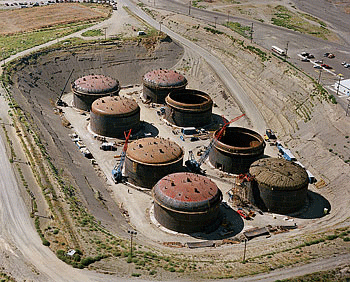
 WHY THE SCARIEST NUCLEAR THREAT MAY BE COMING FROM INSIDE THE WHITE HOUSE, Vanity Fair, BY MICHAEL LEWIS, September 2017 “………By the early 1940s the United States government understood that for democracy to survive it needed to beat Hitler to the atom bomb, and that the race had two paths—one required enriched uranium, the other plutonium. In early 1943, the United States Army was evicting everyone from an area in Eastern Washington nearly half the size of Rhode Island and setting out to create plutonium in order to build a nuclear bomb. The site of Hanford was chosen for its proximity to the Columbia River, which could supply the cooling water while its dams provided the electricity needed to make plutonium. Hanford was also chosen for its remoteness: the army was worried about both enemy attacks and an accidental nuclear explosion. Hanford was, finally, chosen for its poverty. It was convenient that what would become the world’s largest public-works project arose in a place from which people had to be paid so little to leave.
More or less overnight Hanford went from the business of making plutonium to the even more lucrative business of cleaning it up. In its last years of production the plutonium plant employed around 9,000 people. It still employs 9,000 people and pays them even more than it used to. “It’s a good thing that we live in a country that cares enough to take the time it will take, and spend the money it will spend, to clean up the legacy of the Cold War,” said MacWilliams. “In Russia they just drop concrete on the stuff and move on.”
The Department of Energy wires 10 percent of its annual budget, or $3 billion a year, into this tiny place and intends to do so until the radioactive mess is cleaned up. And even though what is now called the Tri-Cities area is well populated and amazingly prosperous—yachts on the river, $300 bottles of wine in the bistros—the absolute worst thing that could happen to it is probably not a nuclear accident. The worst thing that could happen is that the federal government loses interest in it and slashes the D.O.E.’s budget—as President Trump has proposed to do. And yet Trump won the county in which Hanford resides by 25 points. Continue reading
Lawsuit aims to stop construction of the problem-plagued Uranium Processing Facility (UPF)

 Public Interest Organizations File Lawsuit Against New Nuclear Bomb Plant http://www.ladailypost.com/content/public-interest-organizations-file-lawsuit-against-new-nuclear-bomb-plant, by Carol A. Clark July 26, 2017, OREPA News: WASHINGTON, D.C. ― The Oak Ridge Environmental Peace Alliance (OREPA), Nuclear Watch New Mexico, and the Natural Resources Defense Council filed a federal lawsuit July 20, to stop construction of the problem-plagued Uranium Processing Facility (UPF) until a legally required environmental review is completed.
American new sanctions against Iran – designed to kill off the nuclear agreement
New US sanctions aim to kill Iran nuclear deal – expert https://en.trend.az/iran/nuclearp/2781079.html26 July 2017 Baku, Azerbaijan, By Farhad Daneshvar – Trend:
The US decision to impose fresh sanctions on Iran is a violation of a nuclear deal reached in 2015 between Tehran and the six major powers including the United States, a Norway-based Iranian financial analyst told Trend.
Elaborating on the recent decision by US House of Representatives to slap new sanctions on Iran, Mehrdad Seyed Asgari said that the new sanctions provide the US with a chance to covertly kill or avert the nuclear accord.
In this particular case aborting the deal means that the US will refuse to properly implement the articles of the Joint Comprehensive Plan of Action (JCPOA aka nuclear deal) aimed at placing the administration of President Hassan Rouhani under tremendous pressure.
Sanctions have been imposed on Iran with an aim to divide the country’s economic system in two parts of “white and black”, he mentioned.
Since the American lawmakers believe that sanctions work as a powerful tool, they appear to continue increasing pressure on Iran through introducing new sanctions.
The recent bill passed by the US House of Representatives on introducing new sanctions on Iran is very likely to become a law, he concluded.
The lawmakers voted overwhelmingly on Tuesday to slap new sanctions on Iran, Russia and North Korea.
The legislation in order to become a law still needs to be signed by President Donald Trump
Climate change is not friendly to water hungry nuclear power stations
 Ars Technica 26th July 2017,Unless you work at a coal, gas, or nuclear plant, you may not think about
water when you think about electricity (certainly at a household level;
they don’t mix). But water plays an important part in cooling many power
plants, and many power plants also depend on a nearby water source to
create steam that drives turbines.
So the availability of water for power production is a serious consideration. Not enough water? That power plant
could have to shut down. If the water isn’t chilly enough to cool the
plant? Same problem.
In a paper published in Nature Energy this week, a
group of researchers from the Netherlands estimated how water availability
would affect coal, gas, and nuclear plants in the European Union out to
2030. The researchers took into account a changing climate that will likely
make water reserves scarcer and warmer,
but they also accounted for
progressive renewable energy policies in EU member countries, which are
already prompting some thermoelectric plants to retire in favor of wind and
solar (which need negligible amounts of water to operate). https://arstechnica.co.uk/science/2017/07/a-potential-climate-change-consequence-not-enough-cool-water-for-power-plants/
Dopey U.S. energy secretary Rick Perry fooled by Russian comedians
U.S. energy secretary duped into fake interview with Russian comedians, Timothy Gardner WASHINGTON (Reuters), 26 July 17 – U.S. Energy Secretary Rick Perry optimistically discussed expanding American coal exports to Ukraine and other energy matters during a lengthy phone call this month with a Russian prankster who Perry thought was Ukraine’s prime minister.Perry actually was talking with comedians known in Russia for targeting celebrities and politicians with audacious stunts, Energy Department spokeswoman Shaylyn Hynes said in a written statement.
Pranksters Vladimir Krasnov and Alexei Stolyarov are sometimes called the “Jerky Boys of Russia,” after an American duo who put out recordings of their prank phone calls in the 1990s. They have made faux calls to British singer Elton John, who thought he was speaking to Russian President Vladimir Putin, and others……https://www.reuters.com/article/us-usa-energysecretary-idUSKBN1AB06G
Thomas Perez, chairman of the Democratic National Committee, callously disregarded nuclear workers’ health
1 This Month

of the week – Shut Down Drone Warfare!


Tell the Ukrainian Government to Drop Prosecution of Peace Activist Yurii Sheliazhenko

Petition to revoke the licensing of the Near Surface Nuclear Disposal Facility (NSDF) at Chalk River. https://www.ourcommons.ca/petitions/en/Petition/Details?Petition=e-7247
To see nuclear-related stories in greater depth and intensity – go to https://nuclearinformation.wordpress.com
-
Archives
- April 2026 (57)
- March 2026 (251)
- February 2026 (268)
- January 2026 (308)
- December 2025 (358)
- November 2025 (359)
- October 2025 (376)
- September 2025 (257)
- August 2025 (319)
- July 2025 (230)
- June 2025 (348)
- May 2025 (261)
-
Categories
- 1
- 1 NUCLEAR ISSUES
- business and costs
- climate change
- culture and arts
- ENERGY
- environment
- health
- history
- indigenous issues
- Legal
- marketing of nuclear
- media
- opposition to nuclear
- PERSONAL STORIES
- politics
- politics international
- Religion and ethics
- safety
- secrets,lies and civil liberties
- spinbuster
- technology
- Uranium
- wastes
- weapons and war
- Women
- 2 WORLD
- ACTION
- AFRICA
- Atrocities
- AUSTRALIA
- Christina's notes
- Christina's themes
- culture and arts
- Events
- Fuk 2022
- Fuk 2023
- Fukushima 2017
- Fukushima 2018
- fukushima 2019
- Fukushima 2020
- Fukushima 2021
- general
- global warming
- Humour (God we need it)
- Nuclear
- RARE EARTHS
- Reference
- resources – print
- Resources -audiovicual
- Weekly Newsletter
- World
- World Nuclear
- YouTube
-
RSS
Entries RSS
Comments RSS
 nuclear-news